Blog Robotics
Gemini Robotics ER 2 Arrives on Google Cloud for Factories
On this page· 7 sections
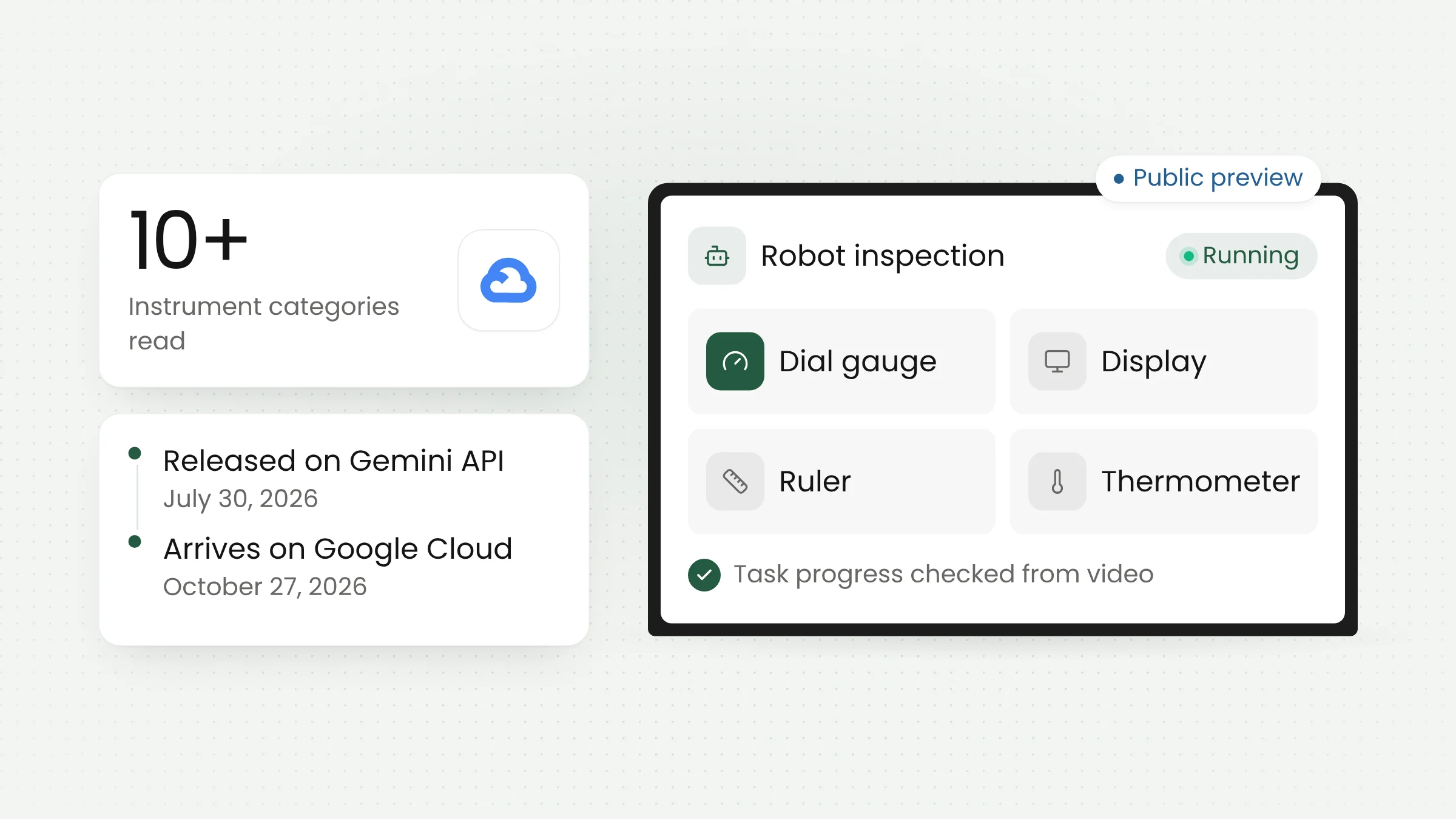
Google Cloud opened Gemini Robotics ER 2 to enterprise customers in public preview on October 27, 2026. The model acts as a robot’s high-level “brain”: it sees through cameras, plans the work, reads more than 10 types of instruments, and checks whether a task is done. For factories, reading gauges on older machines is the most immediate use.
From the Gemini API to Google Cloud
Gemini Robotics ER 2 (ER stands for embodied reasoning) was first introduced by Google DeepMind on July 30, 2026. At the time, according to Google DeepMind, the model was available in Google AI Studio and in private preview on Gemini Enterprise Agent Platform. The same announcement introduced Gemini Robotics 2, a model that turns vision and language into motor control, and On-Device 2, a version that runs directly on robot hardware.
Three months later, the Google Cloud blog announced ER 2 in public preview on the Gemini platform through Model Garden, under the model ID gemini-robotics-er-2-preview. Public preview means anyone with an account can try the service, but it has not reached general availability with full service commitments.
The division of labor matters. ER 2 does not drive a robot’s motors directly. eWeek describes it as a vision-language model that handles reasoning and planning, while separate action models or robotics APIs carry out the physical work. Each robot’s sensors, actuators, and controllers still set the limits of what it can do.
The Gemini API documentation says ER 2 builds on Gemini 3.5 Flash. It accepts text, images, video, and audio, and returns text, such as the coordinates of an object in JSON format.
How ER 2 works inside a robot
Google presents ER 2 as one intelligence layer for many robot bodies, from stationary arms and wheeled rovers to quadrupeds and humanoids. In a single workflow, the model plays four roles.
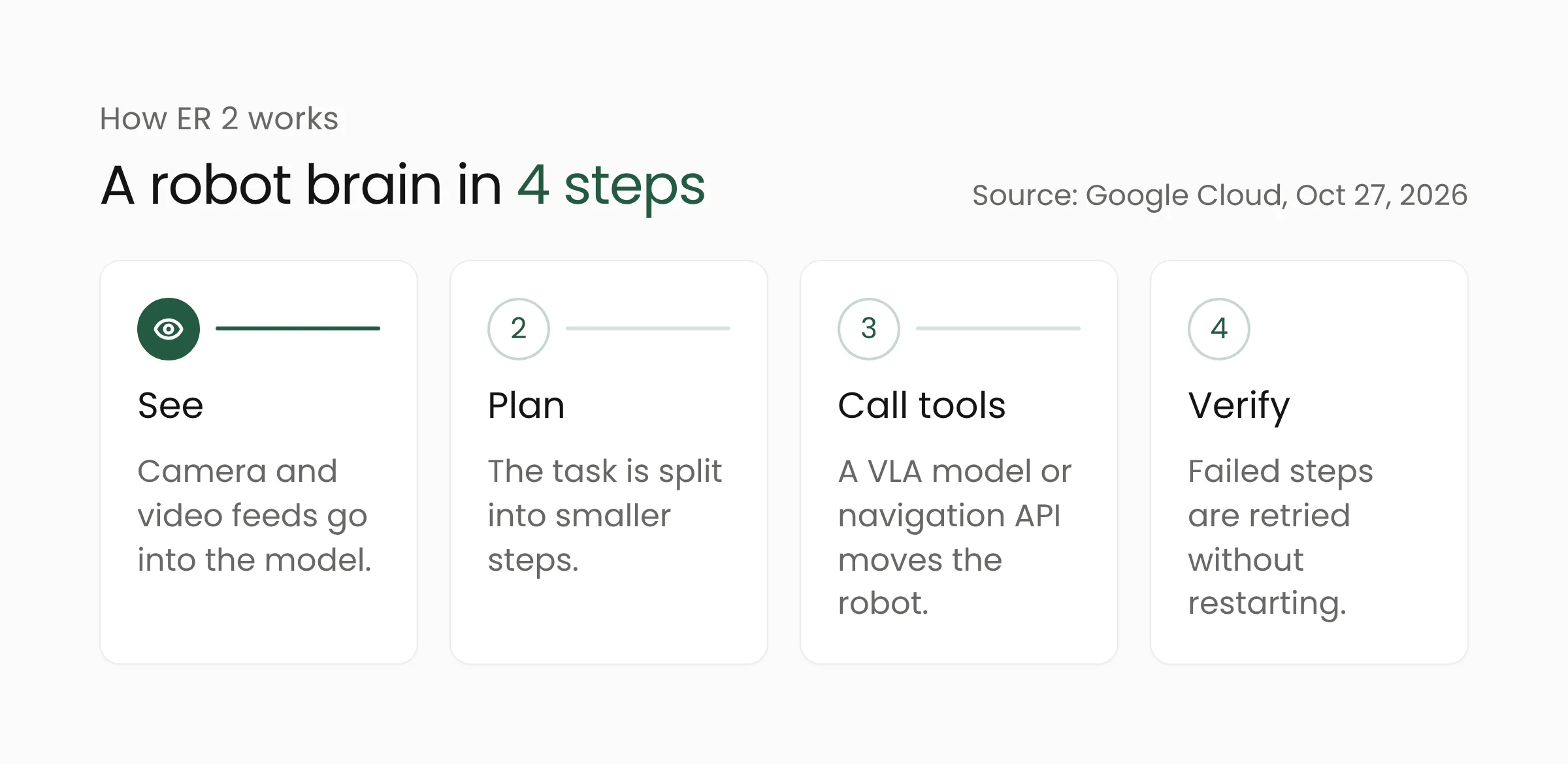
First, it observes the environment through images and video. Second, it breaks an instruction into smaller steps. Third, it calls tools that developers register, such as a VLA (vision-language-action) model that converts sight and instructions into movement, a navigation API, or custom functions. Fourth, it checks the outcome of each step.
Google also says operators can redirect robots without technical language. On a production floor, a shift supervisor could give an instruction in plain words and let ER 2 translate it into a sequence of tool calls. Robots of different types can share an understanding of the workspace, divide labor, and hand tasks to one another.
Reading gauges on legacy machines
The capability closest to factory needs is instrument reading. According to Google Cloud, ER 2 reads more than 10 categories of instruments, including circular dials, sight glasses, digital displays, linear scales, rulers, and liquid thermometers.
This matters because many plant machines have no digital sensors or APIs. Pressure, temperature, and fluid levels are often still written down by staff walking the floor with a clipboard. Early users show where this could go. Singapore’s A*STAR Institute of Materials Research and Engineering uses ER 2 so its lab robots can read the touchscreen of a legacy microwave reactor that has no API.
Boston Dynamics applies a similar capability to its Spot inspection robot. Marco da Silva, vice president and general manager of Spot at Boston Dynamics, said in the Google Cloud post, “Video changes what an inspection can be.” With video analysis, a robot can assess a machine across an entire inspection round and catch changes that a single snapshot would miss.
Checking task progress from video
ER 2 can score task progress in three forms: a yes-or-no status, discrete categories, or a continuous score. When a step fails, the robot can retry that step without restarting the whole workflow.
Google also claims ER 2 can find key moments in video, such as the right time to stop pouring a liquid, with 91.3% accuracy and a mean gap of 0.96 seconds from the actual moment. These figures come from Google’s own testing and have not been independently verified.
Safety claims and their limits
Google DeepMind calls ER 2 its safest robotics model to date on safety constraint following and human proximity benchmarks. To measure this, DeepMind introduced ASIMOV-Agentic, a benchmark that tests whether the model refuses unsafe commands, judges whether a task is feasible, and asks a human for help when uncertain.
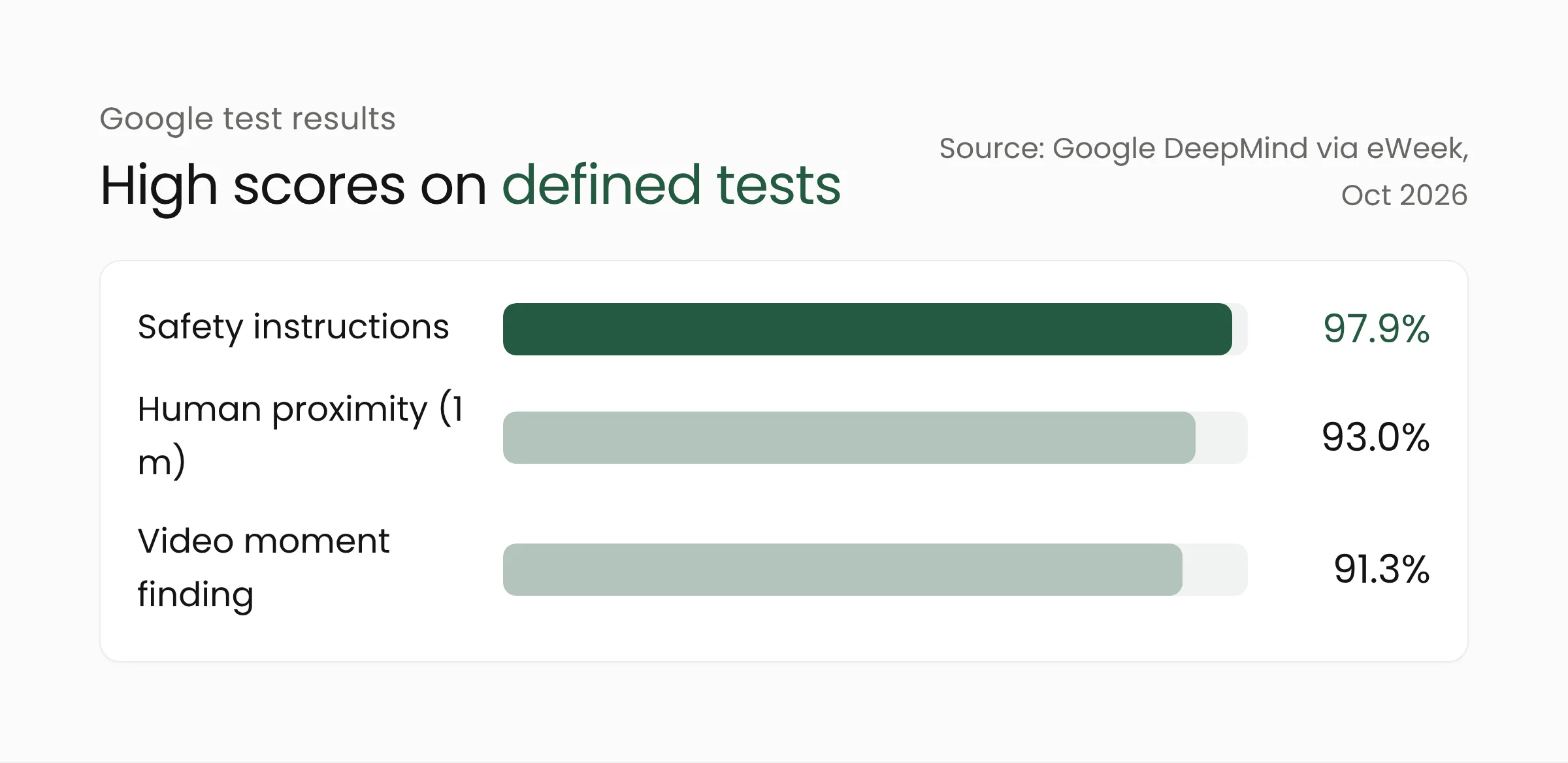
eWeek reported scores of 97.9% on the Safety Instruction Following benchmark and 93.0% on the Human Proximity benchmark at a one-meter threshold. The publication noted that these numbers measure performance on defined test tasks and do not describe overall workplace safety.
Google’s own safety report says physical protections, including emergency stops, barriers, and speed or force limits, remain essential. The Gemini API documentation makes the same point: users are responsible for keeping the area around a robot safe, because physical robots can cause damage. It also warns that the models can occasionally hallucinate, especially when prompts are ambiguous.
On cost, eWeek reported promotional pricing through December 31, 2026, of US$1 per million input tokens and US$5 per million output tokens. From January 1, 2027, those rates rise to US$2 and US$10. Tokens are the units of text or data a model counts as it works.
What this means for factories
Many plants in Indonesia still run older machines whose gauges are read and logged by hand. ER 2 is not a finished product, but its availability on Google Cloud lets teams start trials earlier. The points below can help production and IT teams plan. For context on robot investment in the sector, see our analysis of US scrutiny of industrial robot imports.
Start with reading tasks
The most sensible first task is an inspection round: reading pressure gauges, thermometers, and fluid levels, then logging the results. The robot does not need to touch any machine. A camera on a wheeled robot, or even a fixed camera at key points, is enough to test reading accuracy before the robot is given physical work.
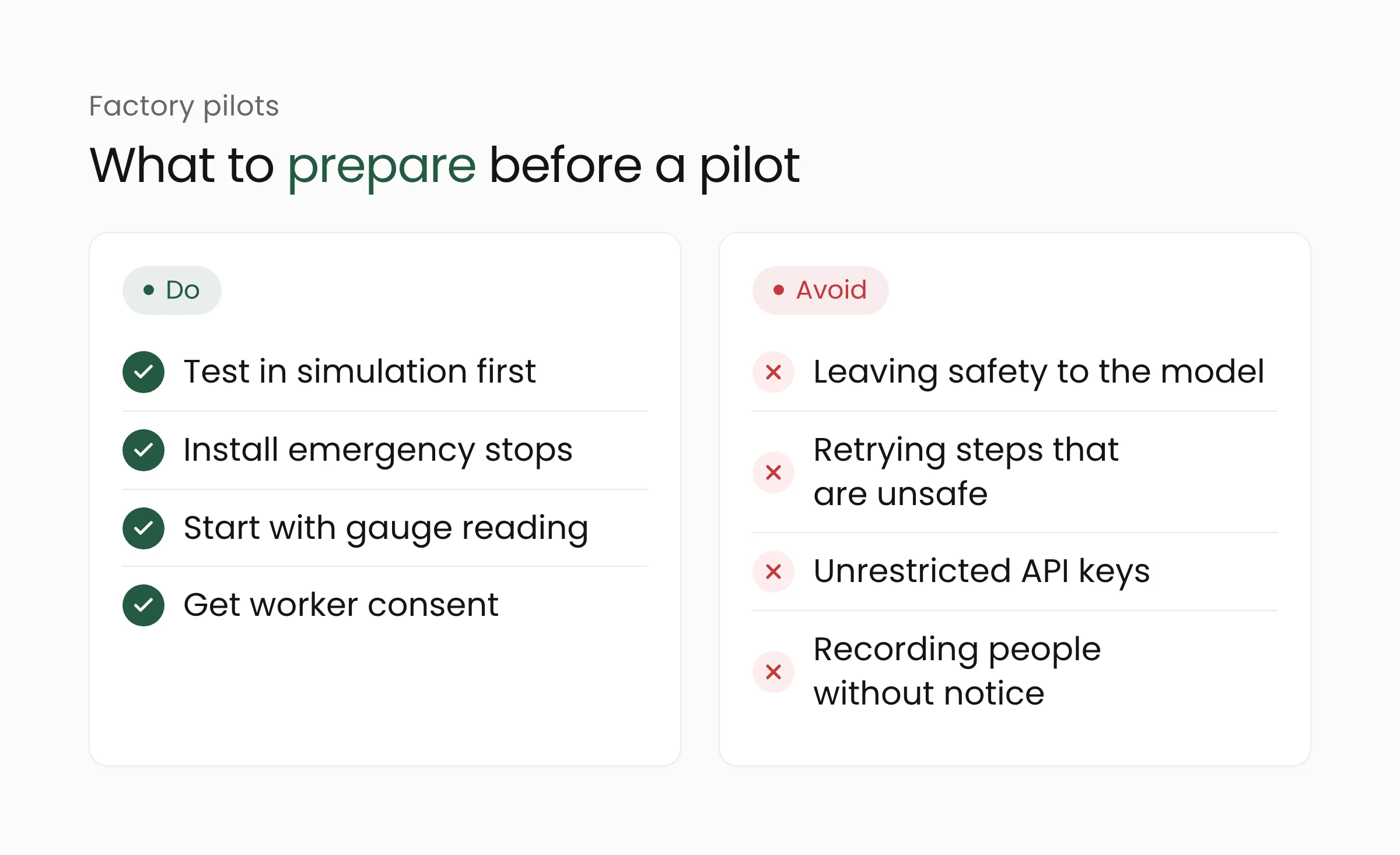
Test in simulation first
Google offers simulation through MuJoCo-Warp and NVIDIA Isaac Sim. Rare scenarios, such as a fogged-up gauge or poor lighting on a night shift, can be tested without stopping a production line.
Plan the data flow and integration
Readings are only useful once they reach the systems a team already uses. Google Cloud offers BigQuery to collect fleet telemetry and Google Distributed Cloud to run latency-sensitive workloads, such as mapping and path planning, close to the site. Connect the results to an existing maintenance dashboard or SCADA system. This kind of integration is part of our industrial automation solutions and IoT services.
Protect worker safety and privacy
Safety is still designed physically, with emergency stops, barriers, and speed limits. Retrying a failed step only makes sense when the retry is safe. On data, the Gemini API documentation says identifiable people should not be recorded unless they have been notified and have consented, and it recommends face blurring. That aligns with Indonesia’s Personal Data Protection Law (Undang-Undang Pelindungan Data Pribadi). The Gemini API also rejects requests from unrestricted API keys, so access controls need to be set up from the start.
Measure results with your own numbers
Google’s benchmark scores do not automatically carry over to your plant. Set success measures before the pilot, such as the share of readings that match staff records and the time saved per inspection round. If your team needs support designing the model setup and its evaluation, our artificial intelligence services can help.
Frequently asked questions
Can Gemini Robotics ER 2 be used in Indonesia?
Google Cloud did not mention country restrictions in its announcement. The service is still in public preview, so regional availability, quotas, and pricing may change before general availability. Check the Google Cloud console and the official pricing page before budgeting.
Can ER 2 move a robot on its own?
Not directly. ER 2 handles reasoning and planning, then calls action models such as Gemini Robotics 2, navigation APIs, or developer-defined functions to carry out movement.
Can older robots use ER 2?
Google says ER 2 works across many robot types, from arms to humanoids, as long as the robot has cameras and an interface that can be called as a tool. Its physical abilities are still set by the robot’s sensors, actuators, and controllers.
Closing thoughts
Gemini Robotics ER 2’s arrival on Google Cloud shows AI-driven robotics being offered as an enterprise service. For factories, the realistic first step is a small, measurable pilot that starts with reading gauges. If you are weighing a trial like this, the Merakit team can help design the integration, evaluation, and safeguards.
Sources
- Gemini Robotics Embodied Reasoning 2 is now available on Google Cloud, Google Cloud Blog, October 27, 2026
- Gemini Robotics 2 brings whole body intelligence to robots, Google DeepMind, July 30, 2026
- Google Brings Gemini Robotics ER 2 to Cloud Public Preview, eWeek, October 28, 2026
- Gemini Robotics ER, Gemini API documentation, accessed November 2, 2026