Blog Genomics AI
AlphaGenome 2 Predicts DNA Variant Effects by Cell Type
On this page· 7 sections
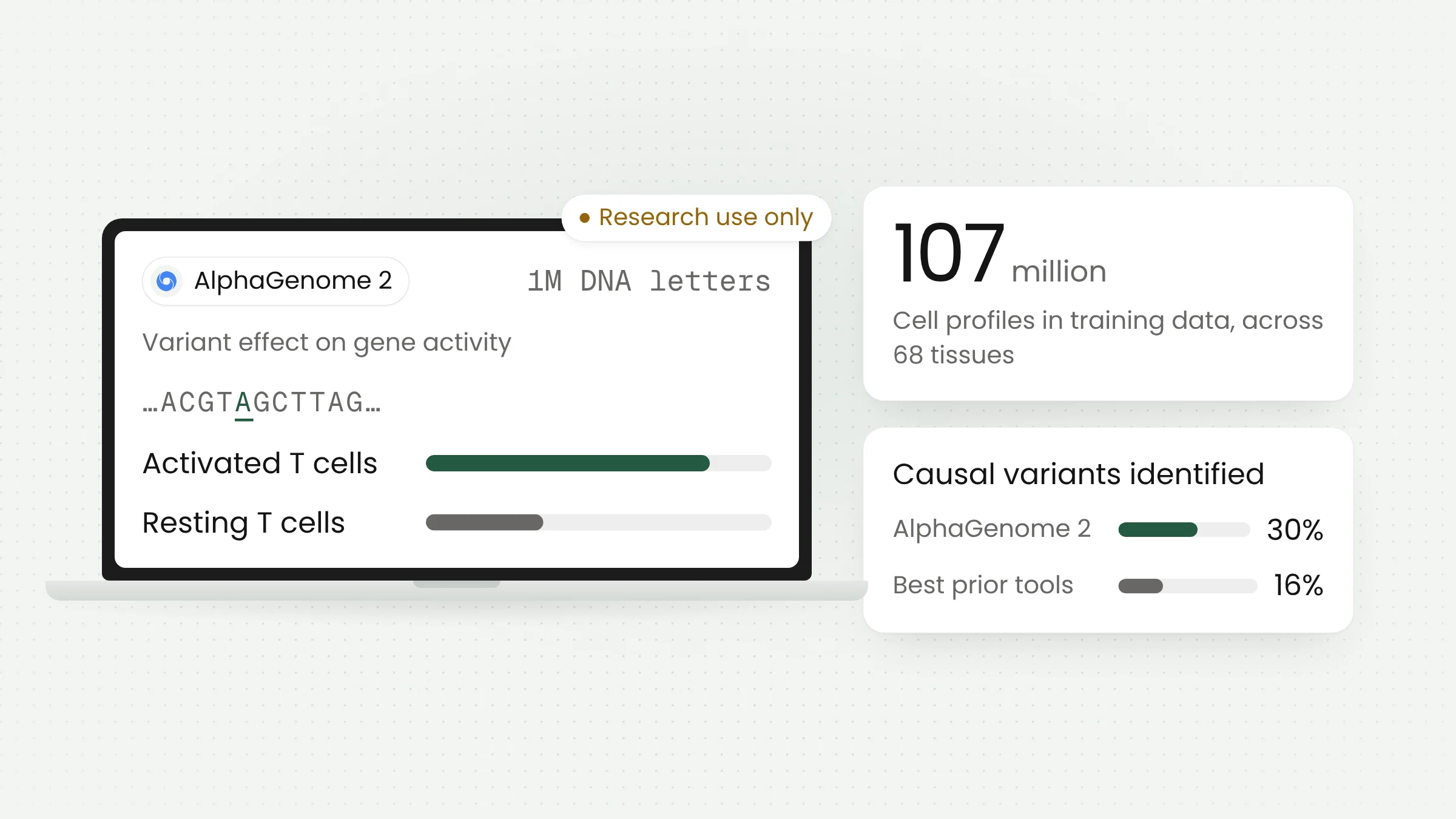
Google DeepMind released AlphaGenome 2 on November 11, 2026. The genomics AI model predicts how small changes in DNA, known as variants, affect gene activity in a specific cell type, such as an immune cell or a cell in the gut. It is free for non-commercial research and is not cleared for diagnosing patients.
What Google DeepMind released
Nearly every cell in the body carries the same DNA. What differs is how each cell reads it: an immune cell switches on different genes from a brain cell or a liver cell. As a result, one variant can have a large effect in one cell type and almost none in another. AlphaGenome 2 is built to predict those differences.
According to DeepMind’s announcement, the model takes two inputs. The first is a DNA sequence of up to one million letters. The second is a biological condition: a tissue, a cell type or a particular cell state. From these, it predicts gene expression, chromatin accessibility (how open a stretch of DNA is to being read), histone modifications and DNA methylation. Methylation is a new readout that DeepMind says researchers had frequently requested.
How it differs from the first version
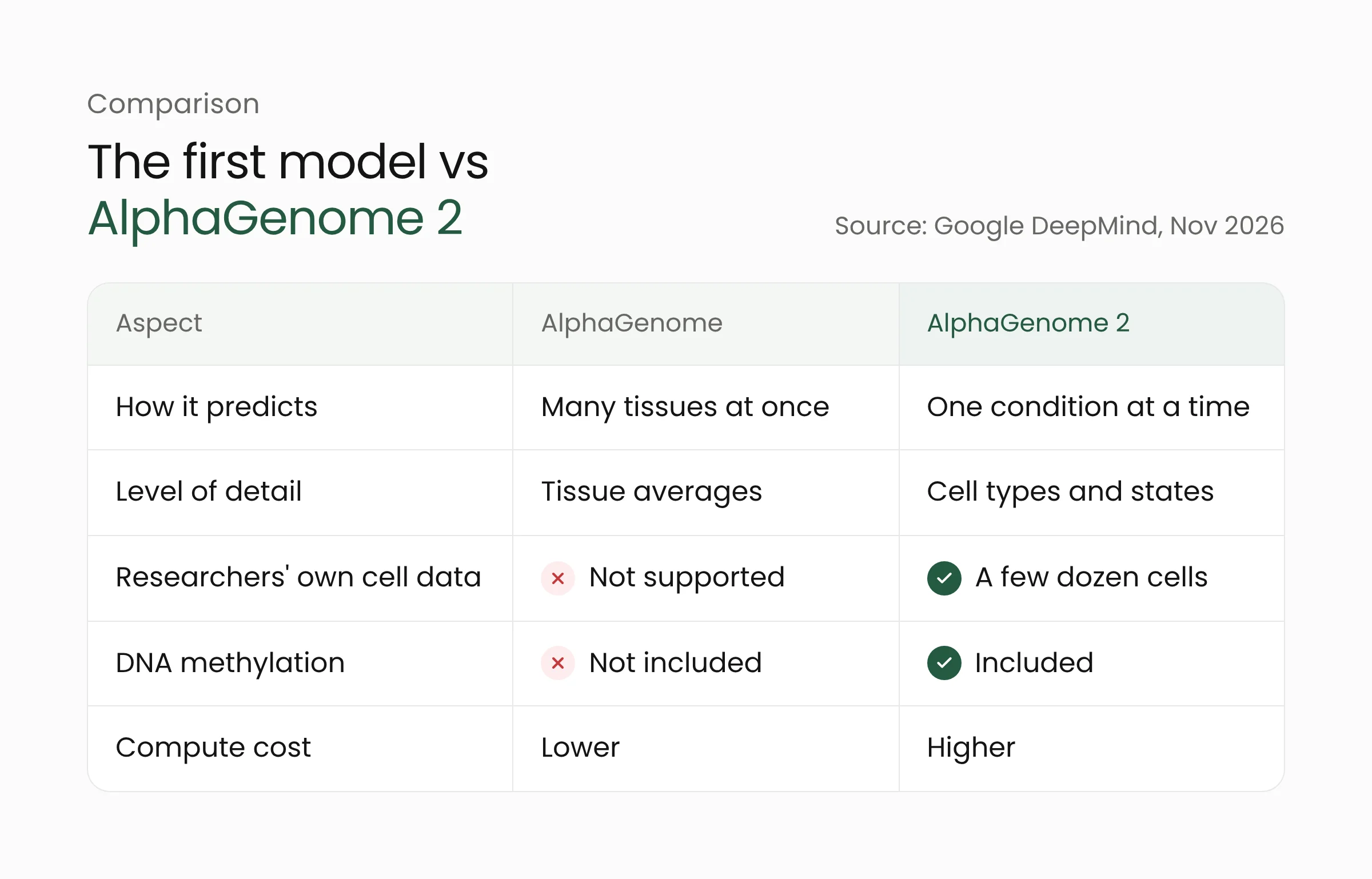
The first AlphaGenome, which DeepMind introduced in June 2025, predicted many tissues in parallel and produced tissue-level averages. The second version was redesigned as a conditional model that handles one condition per prediction. That design lets it learn how the same DNA is read differently by different cell types.
Another new feature is a cell encoder. Researchers can build a condition from their own single-cell data, meaning gene activity measured cell by cell. DeepMind says data from a few dozen cells is enough and the model does not need retraining. In DeepMind’s tests, the results matched or beat models trained directly on those datasets.
The model was trained on more than 107 million cell profiles across 68 tissues, using human and mouse data. Sarah Teichmann, a co-founder of the Human Cell Atlas consortium and a professor at the University of Cambridge, highlighted that ability in a statement published by DeepMind: “What makes AlphaGenome 2 exciting is how it adapts directly to new single-cell data without retraining.”
Benchmark results and disease examples
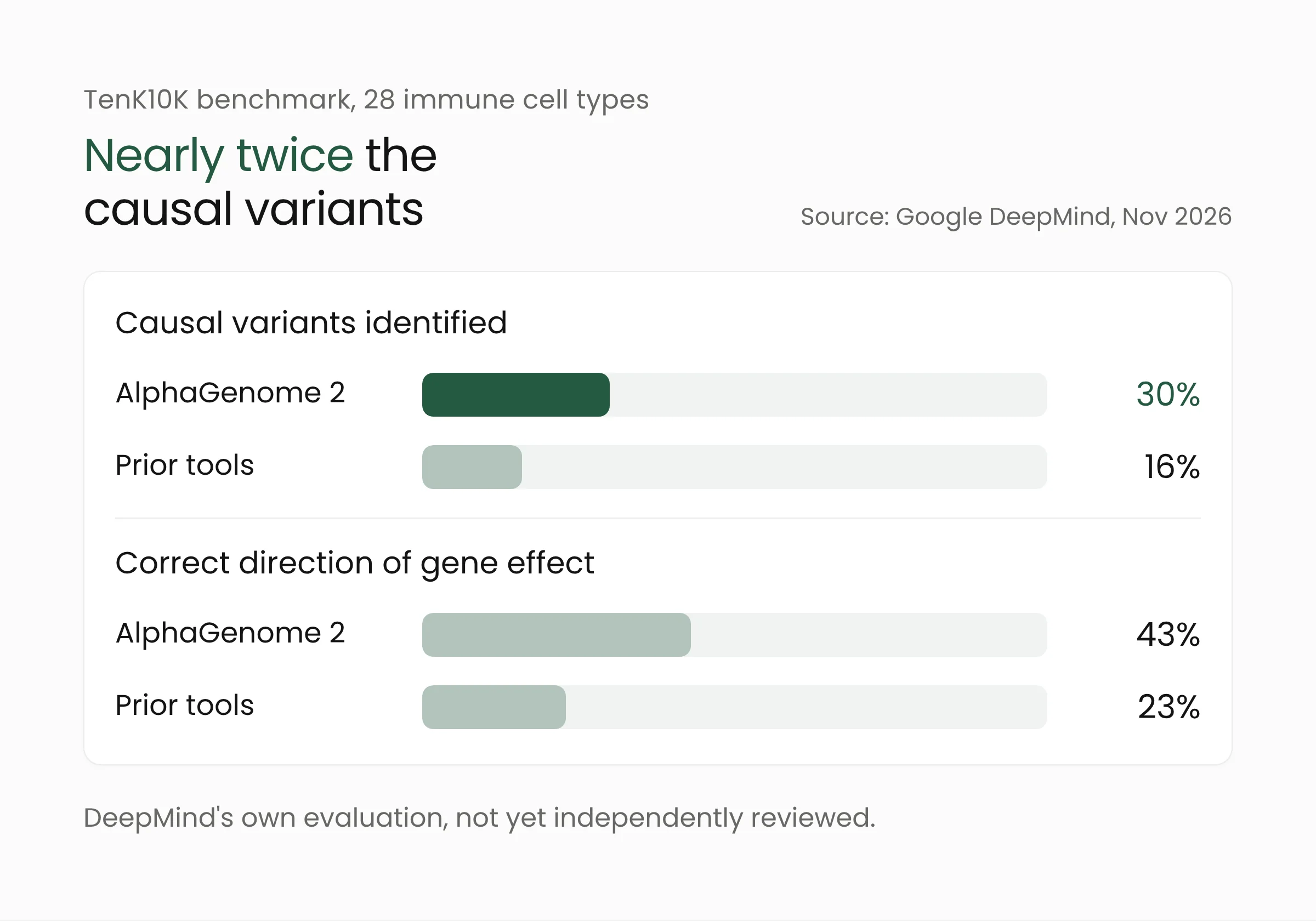
DeepMind tested the model on TenK10K, a single-cell map covering 28 primary immune cell types. According to Interesting Engineering, AlphaGenome 2 identified 30% of causal variants, compared with 16% for the original AlphaGenome fine-tuned on single-cell data and other specialized tools. When predicting the direction of an effect, meaning whether a variant raises or lowers gene activity, it was right 43% of the time versus 23%.
These figures come from DeepMind’s own evaluation. At the time of writing, no independent group had reproduced them.
Inflammatory bowel disease and COVID-19
DeepMind gave two disease examples. The first involves inflammatory bowel disease. The model reproduced a published finding about a variant in a regulatory region far from the ETS2 gene. That variant makes ETS2 overactive in gut macrophages, a type of immune cell. AlphaGenome 2 singled out the causal variant and predicted that its effect was concentrated in those cells.
The second example used single-cell data from people who received an mRNA COVID-19 vaccine. The model separated T cells activated by the vaccine from resting T cells. It also showed that a variant linked to severe COVID-19 disrupts gene activity more strongly in activated T cells. According to MLQ.ai, the model had not seen this study’s data during training.
DeepMind also published precomputed predictions for trait-associated variants across hundreds of cell and tissue conditions, covering traits from height to type 2 diabetes. Separately, it is working with the Wellcome Sanger Institute to profile more cell types and states.
Limits DeepMind acknowledges
DeepMind says AlphaGenome 2 is for research use only and has not been validated or approved for clinical or diagnostic purposes. The official GitHub documentation states that predictions must not be used for clinical decision-making or relied on as medical advice. Computational predictions still need to be confirmed in the lab.
The model is also more expensive to run. MLQ.ai, citing The Verge, reported that AlphaGenome 2 predictions cost more compute than those of the first version. For that reason DeepMind did not build a genome-wide atlas with the new model, and the original version remains available.
Genomics research in Indonesia
In Indonesia, the Ministry of Health runs the Biomedical and Genome Science Initiative (BGSi), a precision medicine program that aims to match treatment to each patient’s genetic profile. TVRI News reported in February 2026 that the program had recruited more than 20,000 participants, produced about 16,000 whole genome sequences and involved 10 hospitals as hub centers.
detikHealth reported the health minister’s target of 100,000 samples in 2026 and 400,000 samples by 2030. The initial focus is stroke, heart disease and breast cancer.
The more genomes a country sequences, the more variants it has to interpret. Most variants are harmless, so researchers need to narrow down which ones deserve lab testing. Models such as AlphaGenome 2 are designed to support that filtering at the level of cell types.
There is one practical difference from some other genomics models. Hugging Face earlier released Carbon-X, an open model for DNA questions whose weights can be downloaded and run on local servers. AlphaGenome 2 is accessed through an API and Google Cloud, so the sequences or variants being analyzed are sent to Google’s service. DeepMind’s announcement does not mention plans to release AlphaGenome 2 weights.
That matters because Indonesia’s Personal Data Protection Law, Undang-Undang Nomor 27 Tahun 2022 tentang Pelindungan Data Pribadi (Law No. 27 of 2022), classifies genetic data as specific personal data, alongside health and biometric data.
What this means for hospitals and research institutions
For teaching hospitals, genomics labs and medical schools, AlphaGenome 2 is a research tool worth testing. Four things should be settled before a pilot starts.
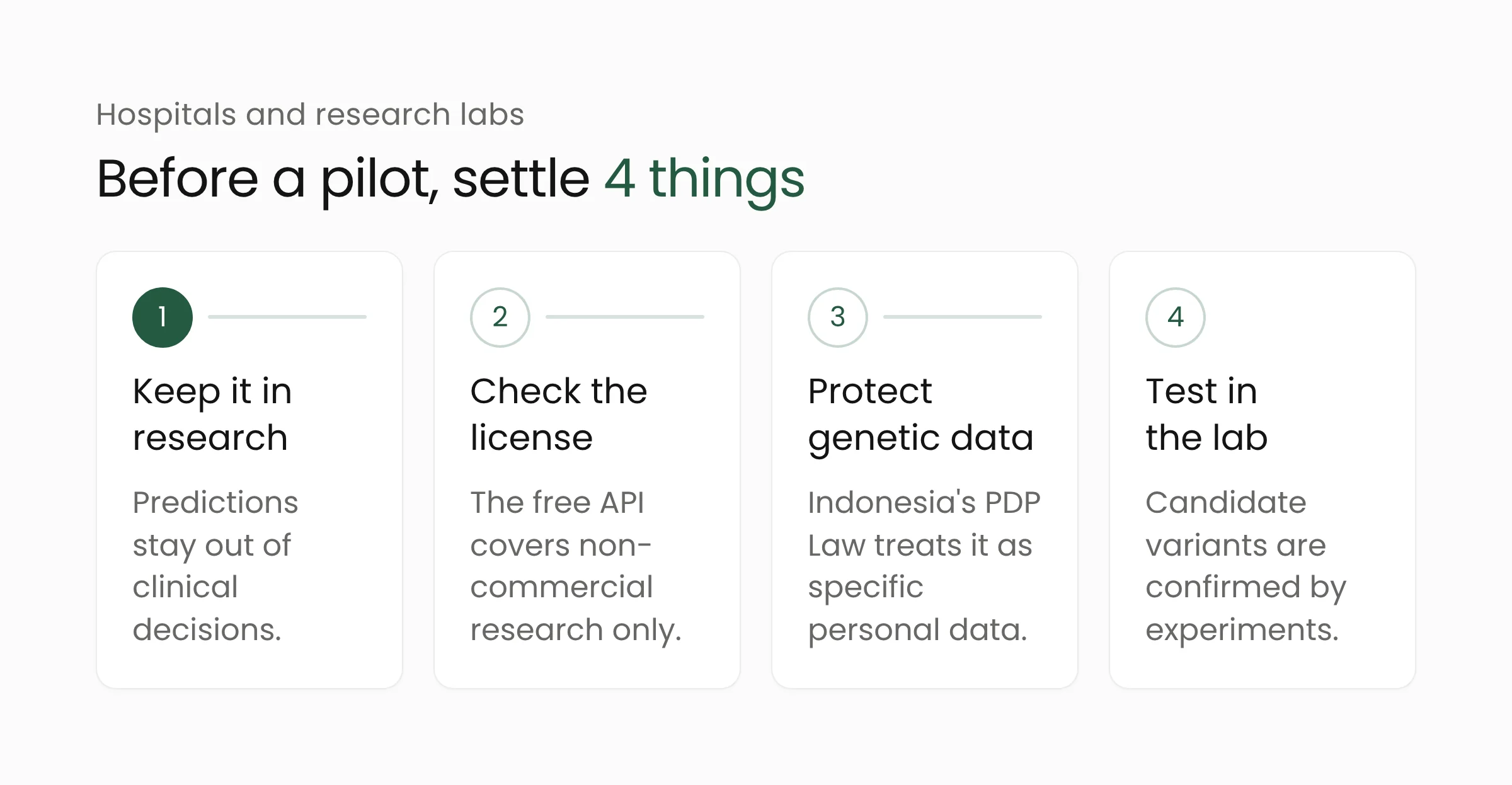
- Keep it in research. Use the predictions to shortlist candidate variants for studies. Results should stay out of medical records and treatment decisions.
- Check the license. The free API is for non-commercial use only, and its outputs may not be used for commercial work or to train other machine learning models. Labs that serve paying clients should check whether their work counts as commercial, since commercial access is offered separately through Google Cloud.
- Protect genetic data. Before sending sequences or variants from patient samples to an overseas service, confirm participant consent, separate the data from identities and follow the cross-border transfer rules in the PDP Law. Early pilots can start with public datasets.
- Test in the lab. Candidate variants from the model should be confirmed experimentally and compared with local patient data before results are published.
On the technical side, teams need a documented data flow: where each sample came from, which variants were sent to the API and who accessed the results. That record makes ethics reviews and compliance checks easier. Merakit’s digital health solutions and data analytics services teams can help design that flow, including de-identification and access logs.
Frequently asked questions
Can AlphaGenome 2 be used to diagnose patients?
No. DeepMind says the model is for research only and has not been validated or approved for clinical or diagnostic use. Its official documentation also rules out using predictions for clinical decisions.
How much does AlphaGenome 2 cost?
For non-commercial research, AlphaGenome 2 is free through the AlphaGenome API. For commercial use, DeepMind offers a private preview through Google Cloud. DeepMind’s announcement does not state commercial pricing.
Can researchers use their own cell data?
Yes. Through the cell encoder, researchers can upload their own single-cell RNA-seq data to create new conditions, such as a disease state or cells after drug treatment. DeepMind says a few dozen cells are enough and no retraining is needed.
Conclusion
AlphaGenome 2 points to where genomics AI is heading: reading the effect of DNA variants down to individual cell types and states. Its value as a research aid is clear, while its benchmark results still await independent review and it has not reached patient care. If your institution is preparing genomics research and needs a secure data pipeline, Merakit Indonesia is ready to talk.
Sources
- AlphaGenome 2: Deciphering how cells read DNA to better understand disease, Google DeepMind, November 11, 2026
- AlphaGenome, Google DeepMind, accessed November 16, 2026
- google-deepmind/alphagenome, GitHub, accessed November 16, 2026
- AlphaGenome 2: DeepMind’s DNA model finds nearly 2x more causal variants in cells, Interesting Engineering, November 11, 2026
- Google DeepMind releases AlphaGenome 2 to predict how DNA changes affect specific cell types and disease, MLQ.ai, November 11, 2026
- Kemenkes Percepat Kedokteran Presisi, 16 Ribu Data Genom Jadi Basis Efisiensi Biaya Kesehatan, TVRI News, February 13, 2026
- Ramai BGSi Disebut Jual Data Genomik Warga +62, Menkes Ungkap Faktanya, detikHealth, February 12, 2026
- Law No. 27 of 2022 on Personal Data Protection, Pasal.id, accessed November 16, 2026