Blog Cybersecurity
CVE-2026-90436 Exploited, Update Confluence to 9.2.28 Now
On this page· 7 sections
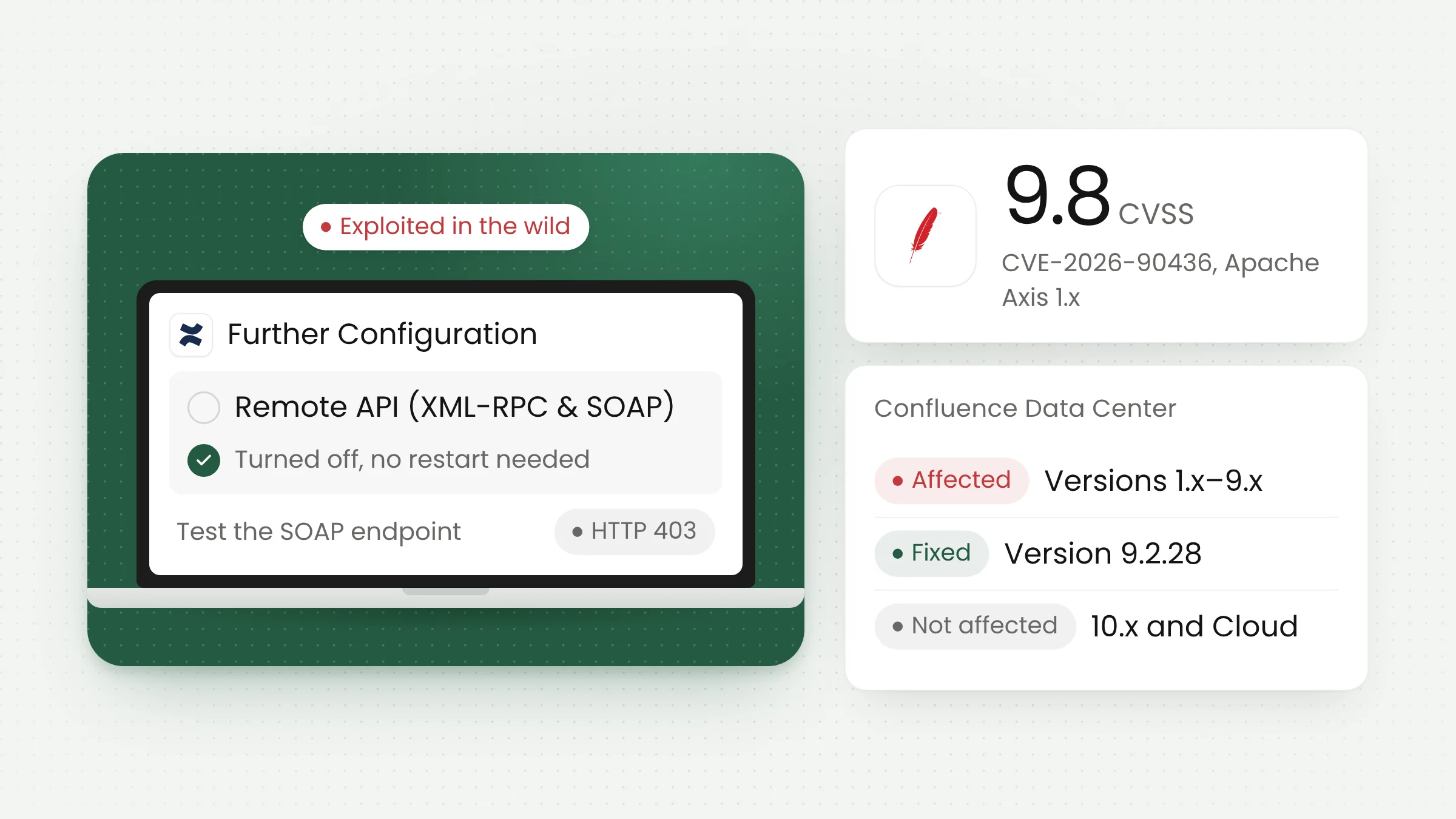
Attackers are exploiting CVE-2026-90436, a flaw in the Apache Axis 1.x library, to break into Atlassian Confluence Data Center. Rapid7 detected the activity on November 13, 2026. Confluence servers running versions 1.x through 9.x with Remote API enabled should move to 9.2.28 or a 10.x release, or switch the feature off until they can.
How Apache Axis mishandles SOAP messages
Apache Axis is a Java library for building SOAP web services. SOAP is an XML-based format that older enterprise applications still use to exchange data. The 1.x line stopped being developed long ago, yet it remains embedded in commercial products and in-house software.
According to the Apache advisory posted to oss-security on November 6, 2026, the bug sits in how Axis 1.x handles incoming SOAP fault messages. When a fault names a Java class, Axis loads that class and creates an object from it before checking that it is a legitimate fault type. Loading the class alone runs its initialization code. With a suitable class on the application’s classpath, an attacker can run commands on the server without logging in.
Apache also notes that the fault is parsed before each service’s own handler chain runs. As a result, authentication handlers configured on a SOAP service do not stop the attack. The issue was found by José Apari-Pantigozo of OKIOK.
Because Axis 1.x has reached end of life, Apache does not plan to ship a fixed 1.x release. The options are to move to a supported SOAP engine such as Apache Axis2/Java, or to rebuild Axis 1.x with a patch from the Apache code repository.
Two severity scores
Every party rates the flaw as critical, but the numbers differ because they use different versions of the scoring system. According to Rapid7, CISA assigned a CVSS 3.1 score of 9.8. Atlassian’s own advisory gives a CVSS 4.0 score of 9.3 and a critical rating.
Exploitation status as of November 17
Roughly a week passed between disclosure and the first detected attack. Rapid7 says its detection team saw exploitation of Confluence Data Center in a customer environment on November 13, 2026, and it published a warning on November 16. The company also released a list of IP addresses seen in the attacks, noting that their absence from logs does not prove a server is clean.
“Rapid7 recommends remediating exposed systems on an emergency basis outside of normal patching cycles,” the company wrote. It advises starting with internet-facing instances that have the vulnerable APIs enabled, then moving on to internal deployments.
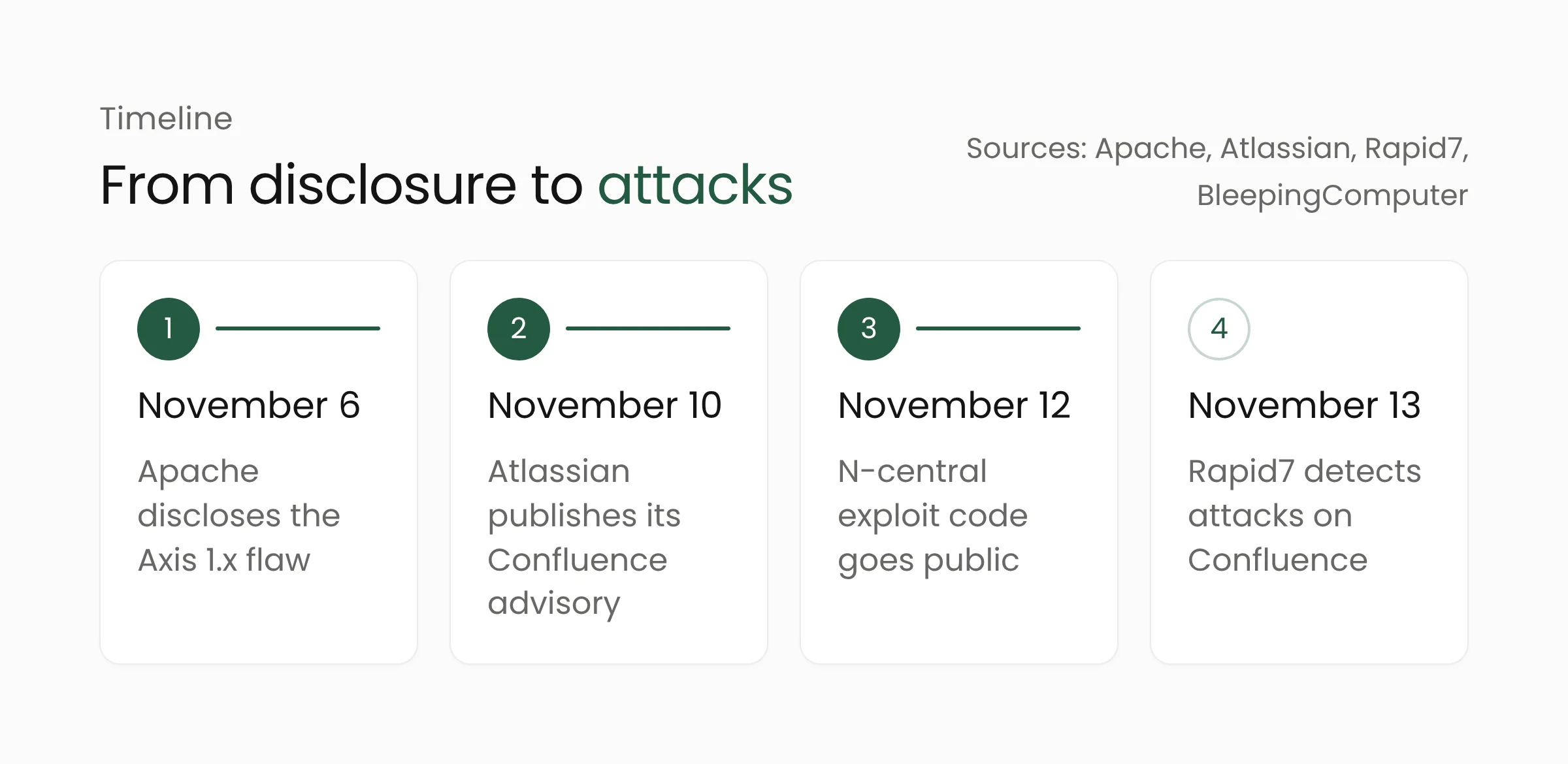
Atlassian’s advisory date shifts by a day depending on the time zone. It is stamped November 9, 2026, at 10:00 p.m. Pacific time, which was already November 10 in Asia. The advisory itself does not mention exploitation. It says Atlassian cannot confirm whether a given instance has been affected and asks local security teams to check.
At the time of writing, CVE-2026-90436 was not listed in CISA’s Known Exploited Vulnerabilities (KEV) catalog, last updated on November 13, 2026. That may change, and the missing entry does not weaken the evidence of attacks reported by Rapid7.
Attacks on N-able N-central
The same flaw is also being used against N-central, the remote monitoring and management software from N-able that many managed IT service providers rely on. According to BleepingComputer, researcher Sean Bales released exploit code called 4EverAble2Shell on November 12. The chain pairs the Axis flaw with a separate N-central privilege escalation weakness to gain root access.
Huntback, as cited by BleepingComputer, counted at least 21 compromised production N-central servers running the XMRig cryptocurrency miner. N-able told customers who run N-central on their own servers to confirm that the Legacy API is disabled, which is the default setting. According to Rapid7, the 2026.4 HF3 release will remove Legacy API access permanently.
Affected Confluence versions and the fix
Atlassian’s advisory lists Confluence Data Center 1.x through 9.x as affected when the “Remote API (XML-RPC & SOAP)” feature is enabled. Confluence relies on Apache Axis to serve those XML-RPC and SOAP APIs.
The listed fixed version is 9.2.28. Atlassian recommends upgrading to the latest release or a fixed LTS release, and it states that binary patches are no longer released. Confluence 10.x and later are not affected because the Remote API was removed in version 10.0. Atlassian Cloud sites are also outside the scope and need no action.
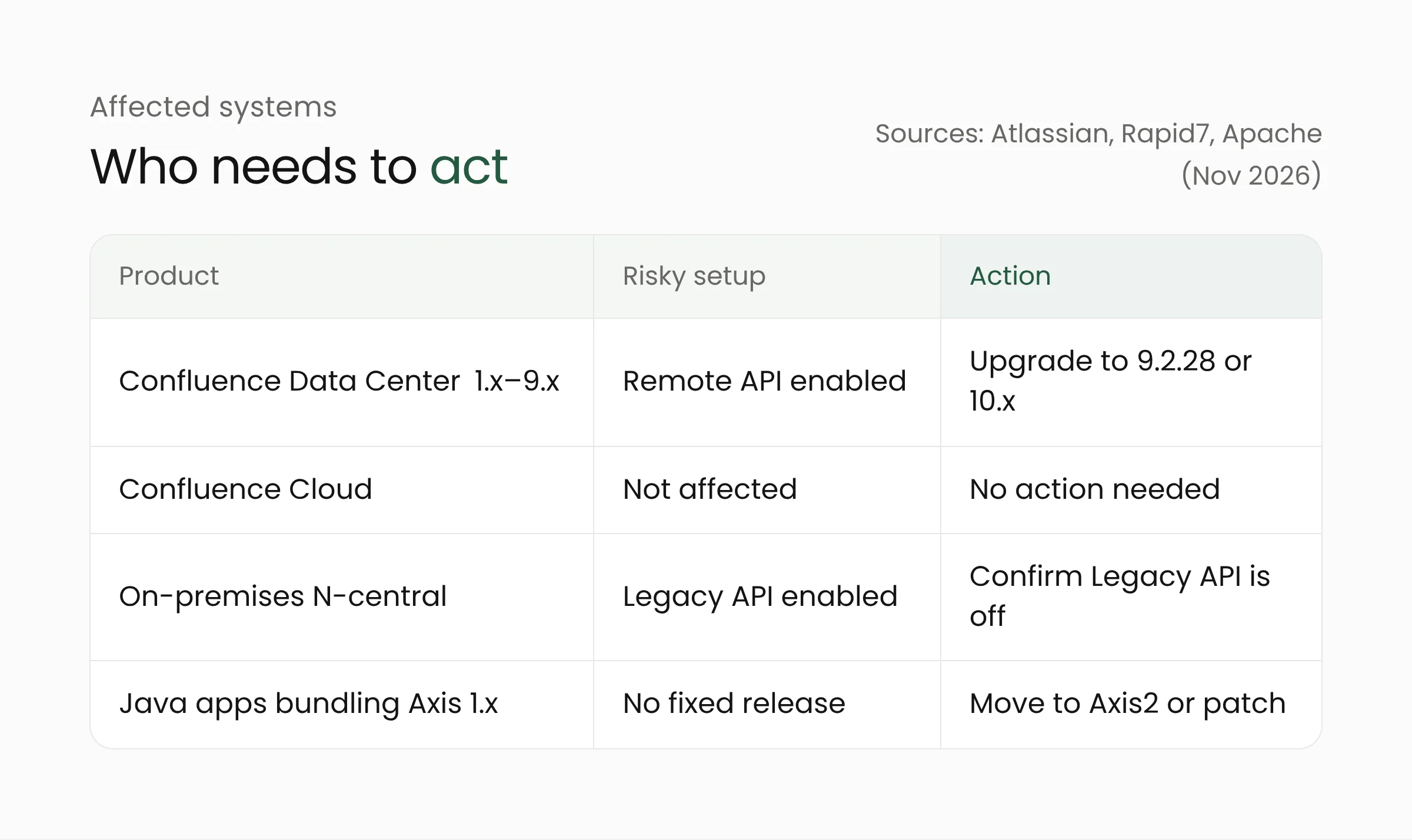
Since Confluence 3.0, the Remote API has been off by default for new installations, so not every server is exposed. Older servers that have been upgraded many times, or that turned the feature on for scripts and integrations, remain at risk.
How to check your server
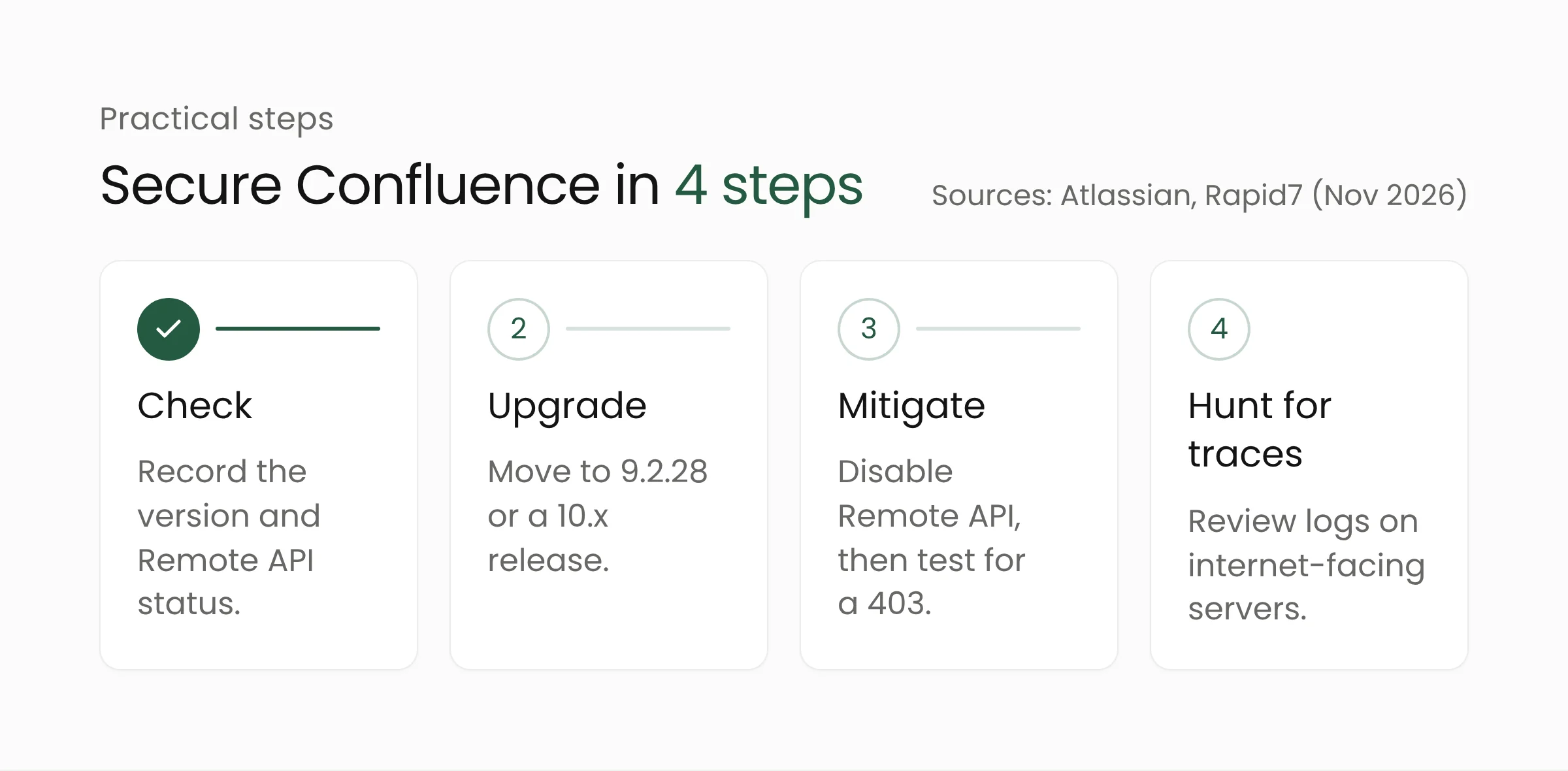
Log in as an administrator, open the gear menu, then choose General Configuration and Further Configuration. The same page is available directly at <base_url>/admin/viewspacesconfig.action. If the “Remote API (XML-RPC & SOAP)” box is ticked and the server runs a version below 9.2.28, it is exposed.
What this means for your IT team
Confluence Data Center is often self-hosted as a company wiki, a project documentation space at a university, or a service knowledge base at a government agency. Servers like these tend to run for years because they are treated as support tools. This flaw shows that an internet-facing support tool can still be the way into a network.
Upgrade internet-facing servers first
List every Confluence Data Center server and its version, including test servers and old instances that see little use. Start with servers reachable from the internet, then move to internal ones. Organizations still on 7.x or 8.x should begin planning the version jump now, since it usually requires compatibility testing for add-ons.
Switch off Remote API if you cannot upgrade yet
Atlassian’s temporary mitigation is to clear the “Remote API (XML-RPC & SOAP)” box on the Further Configuration page and save. No restart is required. Then browse to <base_url>/plugins/servlet/soap-axis1/confluenceservice-v2. If the mitigation works, the server returns “HTTP Status 403 - Forbidden”.
Atlassian warns that disabling the Remote API may stop scripts, automations, and third-party add-ons that depend on it. Record which integrations break and prepare replacements, such as the Confluence REST API.
Audit your own Java applications
The Axis 1.x risk does not end with Confluence. Legacy Java applications that expose or call SOAP services, such as system integrations built more than a decade ago, may still bundle the library. Review project dependencies, for example the pom.xml file or the WEB-INF/lib folder, for Apache Axis 1.x. If you find it, plan a move to Axis2 or another supported SOAP engine. Teams already modernizing older systems can fold this into a roadmap with a web application development partner.
The pattern resembles the outdated PHP servers at government agencies that Indonesia’s Ministry of Communication and Digital Affairs flagged earlier. Unsupported components keep running quietly until a flaw is announced and there is no official update to install.
Look for signs of compromise
Atlassian and Rapid7 both advise checking exposed servers for evidence of attack. That means reviewing access logs for the SOAP endpoint, matching IP addresses against the list Rapid7 published, and looking for unknown processes or accounts. For N-central, BleepingComputer lists researcher indicators that include requests to /dms/services/ServerUI and an unexpected systemd service named xvd.service. Any server showing these signs should be treated as compromised.
Frequently asked questions
Do Confluence Cloud customers need to do anything?
No. Atlassian says the flaw has no impact on Atlassian Cloud sites and no action is required. The organizations that need to act are those running Confluence Data Center on their own infrastructure.
Is a server with Remote API turned off safe?
According to Atlassian, the vulnerable condition only applies when the Remote API is enabled. A server with the feature off does not meet that condition, but upgrading to 9.2.28 or a 10.x release is still recommended. The setting can be switched back on by accident, for example when a new integration is requested.
Why is Apache not releasing a fixed Axis 1.x version?
Axis 1.x is end of life, so Apache marked this CVE as “unsupported when assigned”. Apache provides a patch in its code repository for anyone who wants to rebuild the library, but the recommended path is moving to a supported SOAP engine such as Axis2/Java.
Conclusion
CVE-2026-90436 shows how one old library can expose many products at once. For Confluence Data Center administrators, the fastest response is to check the Remote API today, upgrade to 9.2.28 or 10.x, and look for traces of attack on any server that was exposed. If your team needs support with inventorying legacy applications and reviewing servers, Merakit’s cybersecurity services can help.
Sources
- Rapid7: Rapid7 Detected Exploitation of CVE-2026-90436 against Atlassian Confluence Data Center, N-able N-central also Exploited, November 16, 2026
- Atlassian: CVE-2026-90436 - Remote Code Execution in Confluence Data Center, November 9, 2026 (Pacific time)
- Apache Axis via oss-security: CVE-2026-90436: Apache Axis 1.x (EOL): unauthenticated remote class instantiation via SOAP fault exceptionName, November 6, 2026
- BleepingComputer: New N-able “4EverAble2Shell” zero-day exploited hours after PoC released, November 12, 2026
- Cyber Daily: Hackers targeting critical vulnerability impacting Atlassian & N-able products, November 17, 2026
- CISA: Known Exploited Vulnerabilities Catalog, checked November 17, 2026 (catalog release November 13, 2026)