Blog AI Agents
Zocdoc Opens Doctor Booking to AI Agents, With Strict Rules
On this page· 7 sections
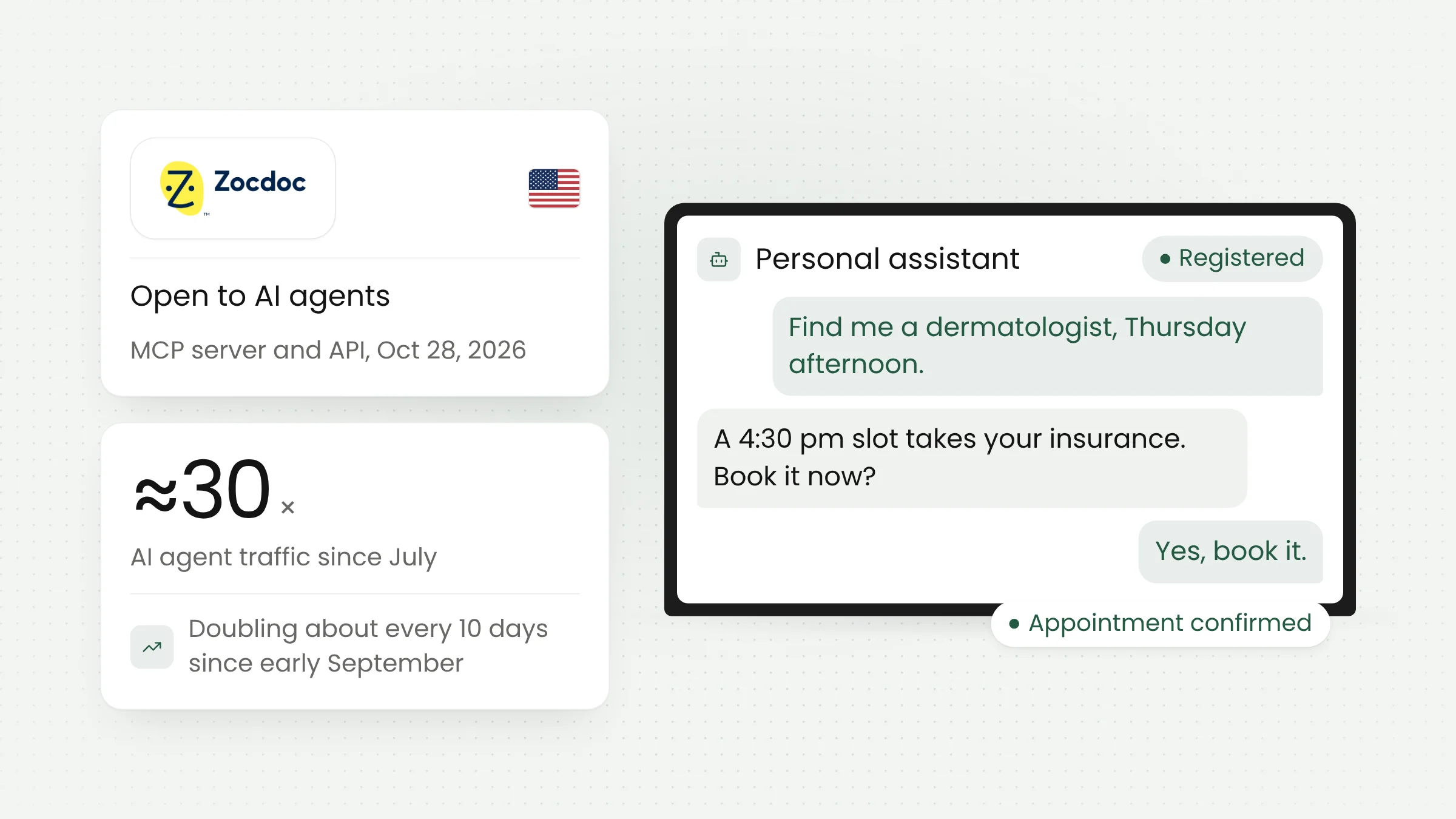
Zocdoc, the US doctor-booking platform, began letting registered AI agents find doctors, verify insurance, and book appointments for patients on October 28, 2026. Agents must identify themselves as AI, obtain explicit patient consent, and protect patient data. The first named partner is Instinct, a personal AI assistant.
What Zocdoc announced on October 28
According to Zocdoc’s press release, AI agents can now use the company’s infrastructure to find vetted providers, confirm that a patient’s insurance is accepted, and book confirmed appointments that land directly on a provider’s calendar. An AI agent, in this sense, is software that carries out tasks for its user, such as a phone assistant asked to “find me a dermatologist for Thursday afternoon.”
Zocdoc says its network covers more than 200,000 verified providers, more than 10,000 insurance plans, and more than 175 scheduling integrations. At the time of the announcement, about 250,000 appointments were open for booking within the next 24 hours.
The launch partner is Instinct, a personal AI agent that people reach by text message or phone call. Instinct joins Zocdoc’s Care Access Network, which the release says already includes Google Gemini, Amazon Health AI, Yelp, Healthgrades, and Blue Shield of California. Healthcare Dive notes the network launched in September to embed Zocdoc’s scheduling technology in third-party apps, insurer websites, and AI tools.
The move runs against the current. Zocdoc founder and CEO Oliver Kharraz said in the release: “Most of the internet is treating AI agents like intruders.” Many websites block bots outright. Zocdoc chose instead to offer an official route, so agents do not have to guess from information scattered across the web.
How an AI agent books a doctor’s appointment
The Zocdoc for Agents page lists four ways in. The main one is an MCP server. MCP, the Model Context Protocol, is an open standard that lets AI models use outside services as “tools,” such as a provider search tool or a booking tool. The others are a REST API for custom integrations, an llms.txt file with machine-readable guidance, and deep links that hand patients a pre-filled Zocdoc search. Post-booking notifications through webhooks are listed as coming soon.
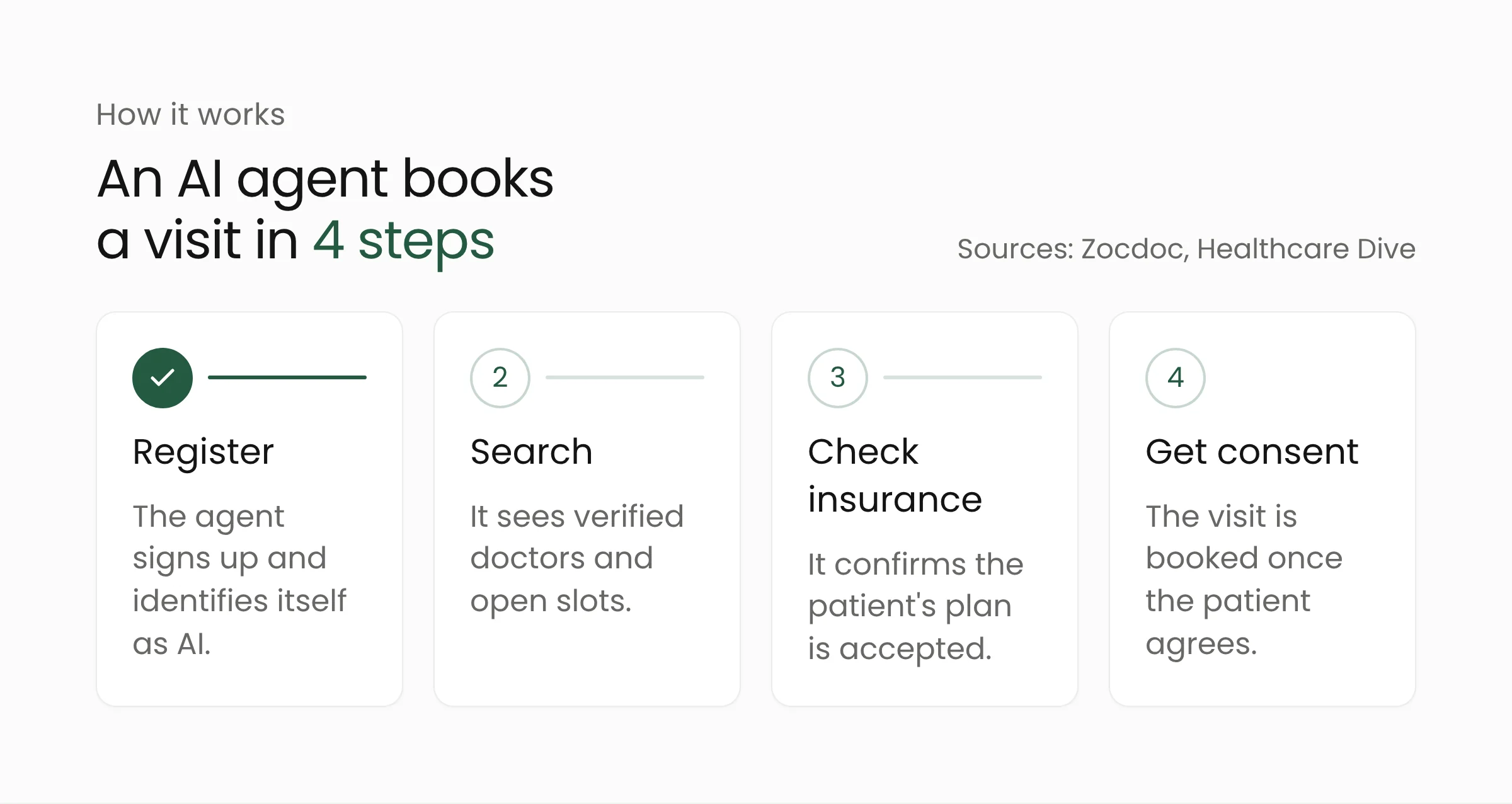
The process is straightforward. The organization behind an agent fills out a partner form, names a human point of contact, and receives credentials for the MCP server or the API. Once approved, Healthcare Dive reports, an agent can search the provider directory, check open slots, verify insurance, and book an appointment. It still has to check back with the patient before making a final decision.
Zocdoc’s main selling point is data accuracy. Provider listings and availability come from direct integrations with electronic health record and practice scheduling systems. Healthcare Dive says this approach is more accurate than agents scraping the open web, where information may already be out of date.
The rules agents must follow
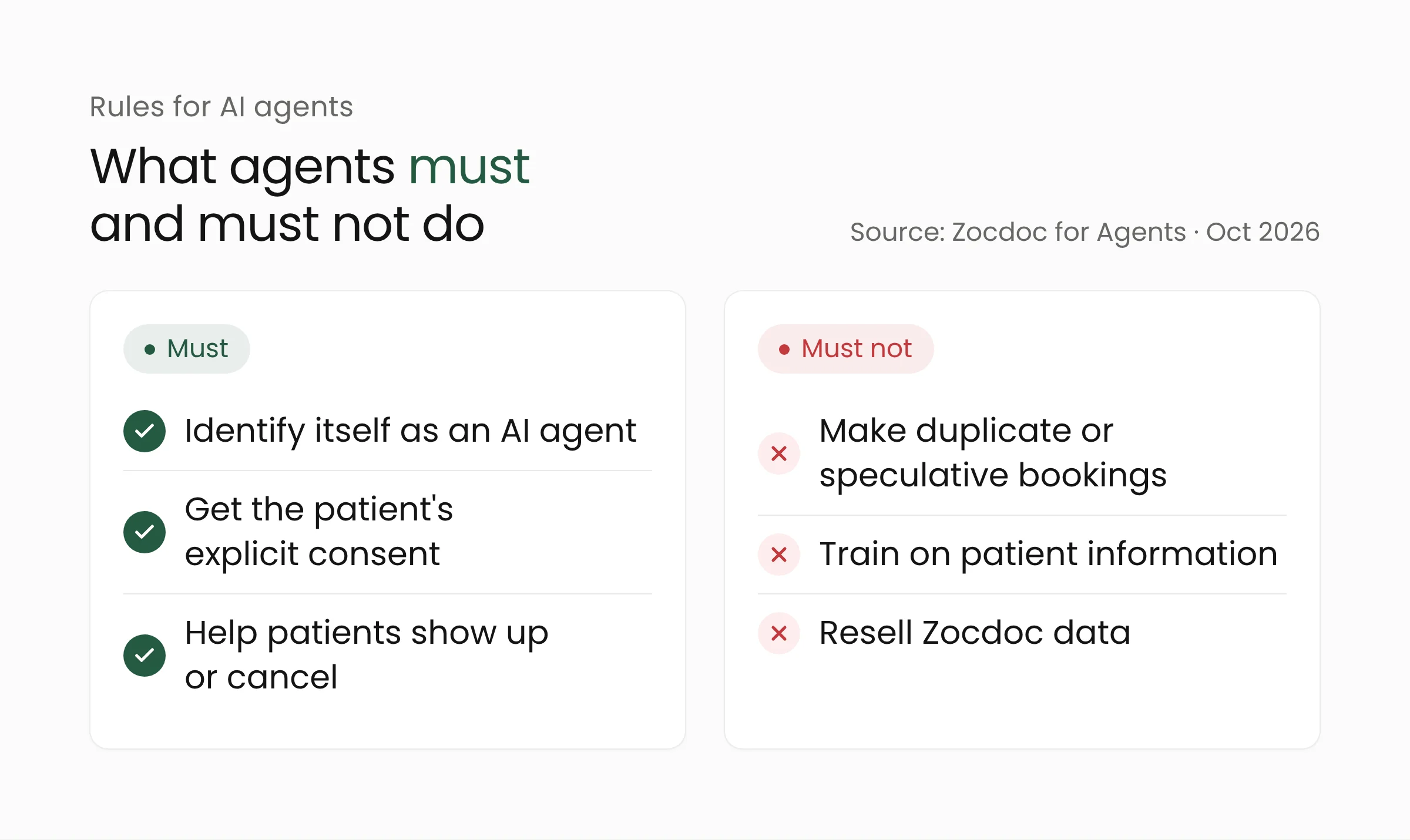
Zocdoc spells out what it expects. Agents must identify themselves as AI agents, name their organization, and state that they act on behalf of the patient. They must ask for the patient’s explicit consent before booking, changing, or canceling anything.
The prohibitions are equally clear. Agents may not make duplicate or speculative bookings, may not use patient information to train models or resell it, and may not copy or resell Zocdoc’s provider, review, insurance, or availability data. Results must be presented honestly, including labels on paid placements. Agents that waste provider time, misuse data, or create fraudulent bookings may face lower limits or lose access.
In return, Zocdoc promises not to block registered agents, to show them the same providers and open slots that patients see, and to announce rate limits and term changes in advance in machine-readable form. Registered agents get higher rate limits, and eligible partners can earn revenue from their integrations.
One gap remains. Healthcare Dive reports that Zocdoc did not specify how it will make sure agents actually respect the data-use restrictions. The written rules exist, but the enforcement mechanism has not been explained publicly.
Growth claims that deserve a careful read
Zocdoc says AI agent traffic on its platform has grown nearly 30-fold since July 2026 and has doubled roughly every 10 days since early September. Those figures come from the company itself. TokenPost notes that Zocdoc has not disclosed how many agent visits turned into bookings or revenue, so the business impact cannot yet be judged.
The health sector is split. According to Healthcare Dive, some health tech companies welcome AI agents while others warn about privacy and governance risks. Other industries face the same choice. In retail, Walmart built a dedicated gateway for shopping agents with spending limits, as we covered in our piece on Walmart Agent Gateway. In banking, several large US banks went the other way and restricted AI agents from customer accounts.
The pattern is consistent across sectors. Organizations that hold important data and transactions have to decide whether AI agents are treated as intruders or as a new service channel governed by clear terms.
What this means for hospitals and clinics
Zocdoc operates in the United States, yet the issue applies in Indonesia too. Many patients already book queue numbers online. According to InfoPublik, members of Indonesia’s national health insurance (JKN) can take a queue number through the Mobile JKN app before visiting a facility, cutting average waiting time from about 6 hours to around 2.5 hours. Over time, those queue requests may also come from AI assistants acting for patients.
Hospitals and clinics can start preparing with a few steps.
Clean up schedule and provider data. An AI agent is only useful if clinic hours, departments, and accepted insurers are always current. Data that is out of sync between the hospital information system and the website will produce wrong bookings, whether a person or a machine makes them.
Offer an official route instead of letting agents guess. The lesson from Zocdoc is to provide a registered, measurable entry point. A booking API with client identity, rate limits, and activity logs is far easier to oversee than bots filling out web forms. A web development team can help design such an API.
Record patient consent. Under Indonesia’s Undang-Undang Nomor 27 Tahun 2022 tentang Pelindungan Data Pribadi (Personal Data Protection Law), health data and information count as specific personal data (Article 4(2)), and explicit, valid consent is one lawful basis for processing (Article 20(2)). Systems should record who gave consent, when, and for what purpose, including when the request arrives through an agent.
Set data-use rules. Like Zocdoc, a hospital can prohibit schedule and patient data from being used for model training or resale, and prepare a way to cut off agents that break the rules.
Pilot with a small workflow. Start with one department or one service, such as routine follow-up visits, and measure cancellations and no-shows. This gradual approach fits digital healthcare solutions that put patient data security at the start of the design.
Frequently asked questions
Can an AI agent book a doctor’s appointment without the patient knowing?
Under Zocdoc’s rules, no. Agents must obtain the patient’s explicit consent before booking, changing, or canceling an appointment. Agents that break the rules can be limited or lose access.
Which AI agents are already connected to Zocdoc?
Instinct is the first partner, announced on October 28, 2026. Zocdoc’s release also lists Google Gemini and Amazon Health AI as part of its Care Access Network. Other agents can apply through the Zocdoc for Agents page.
Is this service available in Indonesia?
Zocdoc serves patients and providers in the United States and has not announced plans for Indonesia. For healthcare facilities here, the news is best read as a model for governing AI agents that may one day help manage patient queues.
Conclusion
Zocdoc’s decision shows that AI agents can be given an official place in healthcare when identity, patient consent, and data-use limits are in place. Hospitals and clinics in Indonesia can use this moment to tidy up schedule data and prepare a safe booking channel. If you are weighing those steps, the Merakit team is ready to talk.
Sources
- Zocdoc via PR Newswire: As Others Put Up Walls, Zocdoc Opens Its Doors and Welcomes AI Agents to Reliably Connect Patients to Care (October 28, 2026)
- Healthcare Dive: Zocdoc invites AI agents to book appointments on behalf of patients (October 28, 2026)
- Zocdoc for Agents (accessed November 1, 2026)
- Digital Health News: Zocdoc Opens Healthcare Infrastructure to AI Agents, Announces Instinct Partnership (October 2026)
- TokenPost: Zocdoc CEO Sees AI Agents as a Test of Booking Infrastructure’s Value (October 28, 2026)
- InfoPublik: Mobile JKN, Solusi Praktis Akses Layanan Kesehatan dari Genggaman (June 6, 2025)
- Undang-Undang Nomor 27 Tahun 2022 tentang Pelindungan Data Pribadi