Blog Digital Health
Indonesia's Health App Inclusivity Guidelines Explained
On this page· 7 sections
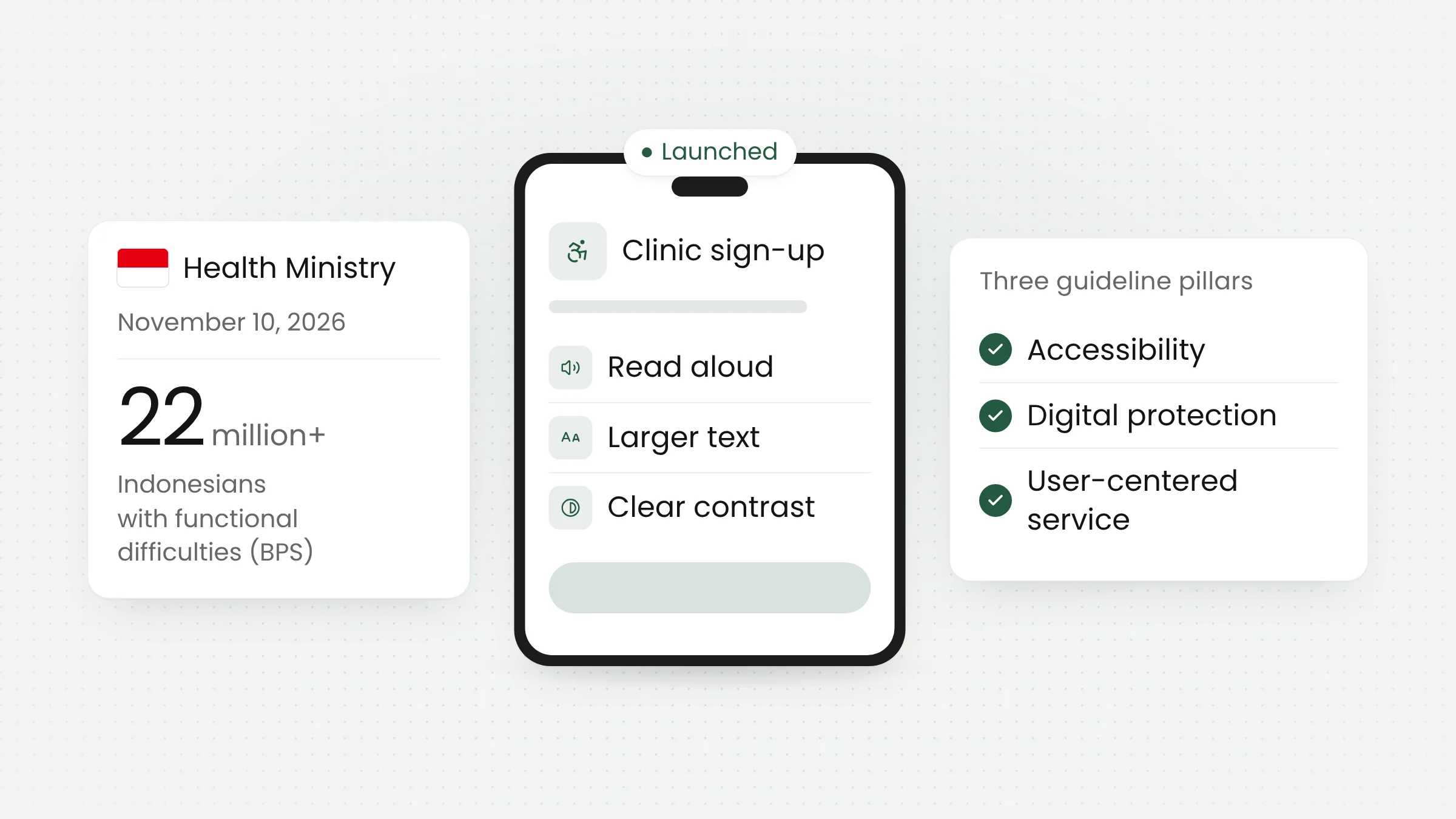
Indonesia’s Ministry of Health (Kemenkes) launched inclusivity guidelines for digital health technology on November 10, 2026. The document sets out how health apps, from hospital registration to telemedicine, should serve people with disabilities, older adults and users with varying digital skills. It draws on the WHO-ITU telehealth standard and WCAG 2.2.
What was launched at the Sandbox Kesehatan Summit
The guidelines, formally titled Pedoman dan Instrumen Inklusivitas bagi Teknologi Digital Kesehatan (Guidelines and Instruments for Inclusivity in Digital Health Technology), were presented at the Sandbox Kesehatan Summit 2026 in Jakarta. According to ANTARA, the launch is part of the three-year Health Sandbox, a national program that tests health technologies, mentors innovators, gathers evidence and drafts policy recommendations.
Imran Pambudi, the ministry’s Director of Health Services for Vulnerable Groups, introduced the document. He said technology progress has to come with easier access. “Inovasi juga harus mampu menjawab kebutuhan pengguna yang sangat beragam, termasuk kelompok rentan,” Imran said, as quoted by ANTARA. The line translates roughly as “innovation must also meet the needs of very diverse users, including vulnerable groups.”
The same event covered wider oversight of digital health. Medcom.id reported that the ministry is tightening supervision of services ranging from telemedicine to artificial intelligence, supported by the British Embassy in Jakarta through a three-year partnership called Tangguh Plus Health.
Merakit has previously explained how the Health Sandbox works as a testing route for medical AI. The inclusivity guidelines add a new yardstick to that route: how easily people with different needs can use a service.
Who stands to benefit
The ministry built its case on the number of users who are often left out of design decisions. Citing the World Health Organization, about 16% of the world’s population, or more than 1.3 billion people, live with a disability. In Indonesia, data from Statistics Indonesia (BPS) show more than 22 million people aged over five have some degree of functional difficulty.
That figure excludes older adults. ANTARA reported that older people are projected to make up nearly 20% of Indonesia’s population by 2045. For them, small text, cramped buttons or long forms can be enough to abandon an app halfway through.
The guidelines also address users with uneven digital literacy, who need simple language and predictable navigation. Another group is people sharing sensitive health data, who need strong data protection and clear privacy settings.
Representatives of people with disabilities, women, children, older adults, people living with HIV and mental health service users took part in drafting. Regulators, academics and technology experts also contributed.
The international standards behind it
The guidelines combine several international standards and adapt them to Indonesian conditions. In an opinion piece for KBK News, Imran listed the references and their roles.
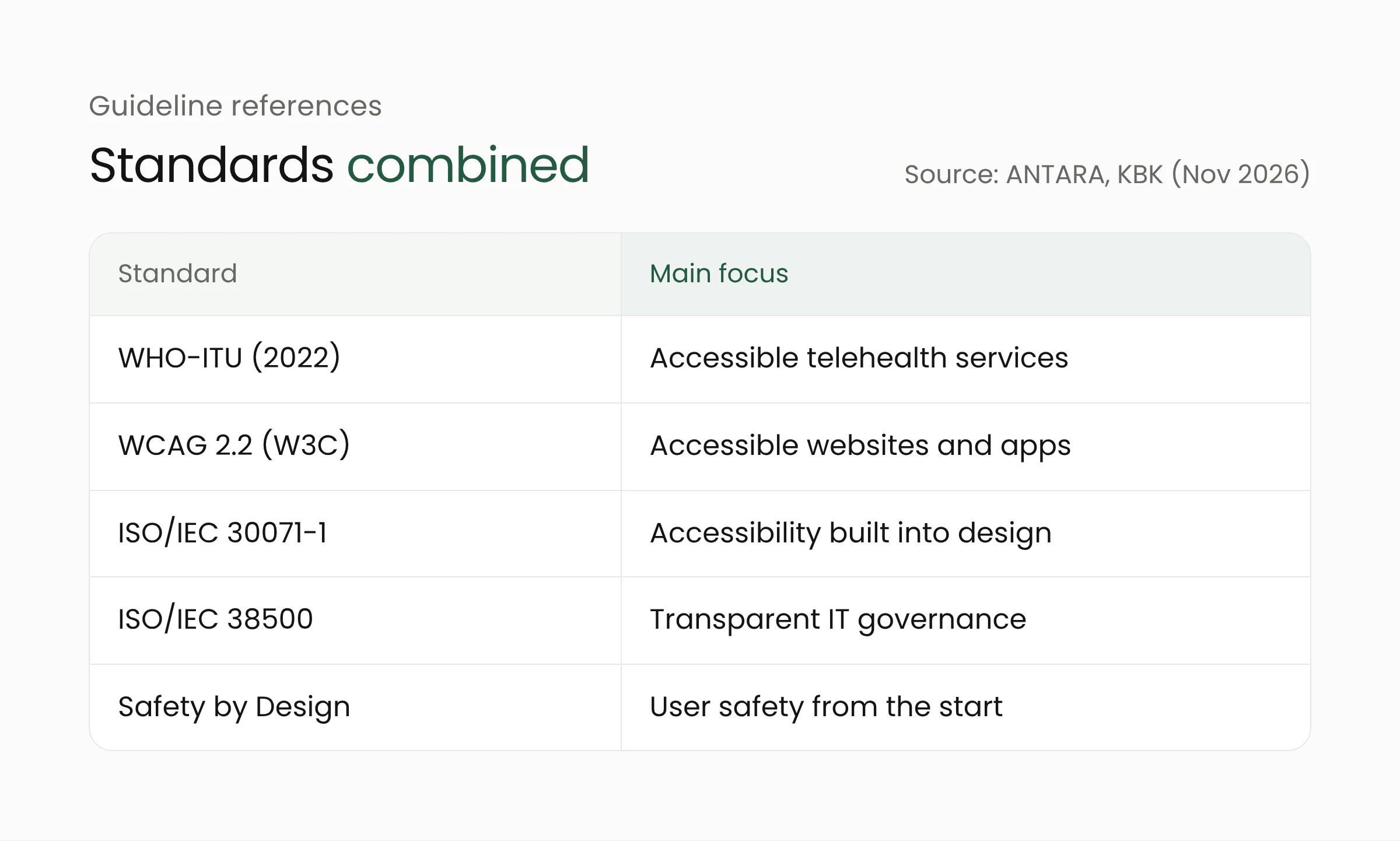
The first is the WHO-ITU global standard for accessibility of telehealth services, published in 2022. It sets technical requirements for telehealth platforms, such as compatibility with screen readers for people with vision impairment and remote sign language interpretation for deaf users.
The second is the Web Content Accessibility Guidelines (WCAG) 2.2 from the World Wide Web Consortium (W3C), the accessibility benchmark most widely used by web and app developers. The guidelines also cite ISO/IEC 38500 on responsible and transparent IT governance, and ISO/IEC 30071-1 on building accessibility into design and development from the outset.
Beyond those standards, the document adopts Safety by Design principles and a human-centered design approach. All of these feed into three pillars: accessibility, digital protection and security, and user-centered service.
The three pillars in everyday apps
The ministry offered examples that are easy to picture. A hospital registration app with automatic text-to-speech, adjustable font sizes and adequate color contrast is easier for blind users and older adults. A consultation feature written in plain language with intuitive navigation helps people with different levels of digital literacy.
For the security pillar, the guidelines point to digital mental health platforms. Security features, clear consent flows and user-safe design can reduce the risk of misuse and data leaks, particularly for teenagers and vulnerable groups.
WCAG 2.2 supplies the technical detail. It requires normal text to have a contrast ratio of at least 4.5:1 and text that can be resized up to 200% without losing content or function. The 2.2 version also adds nine new success criteria. According to the W3C overview, these include touch targets of at least 24 by 24 CSS pixels, logins that do not depend on memorizing or solving puzzles unless a helper is available, and not asking users to re-enter information they already provided in the same process.
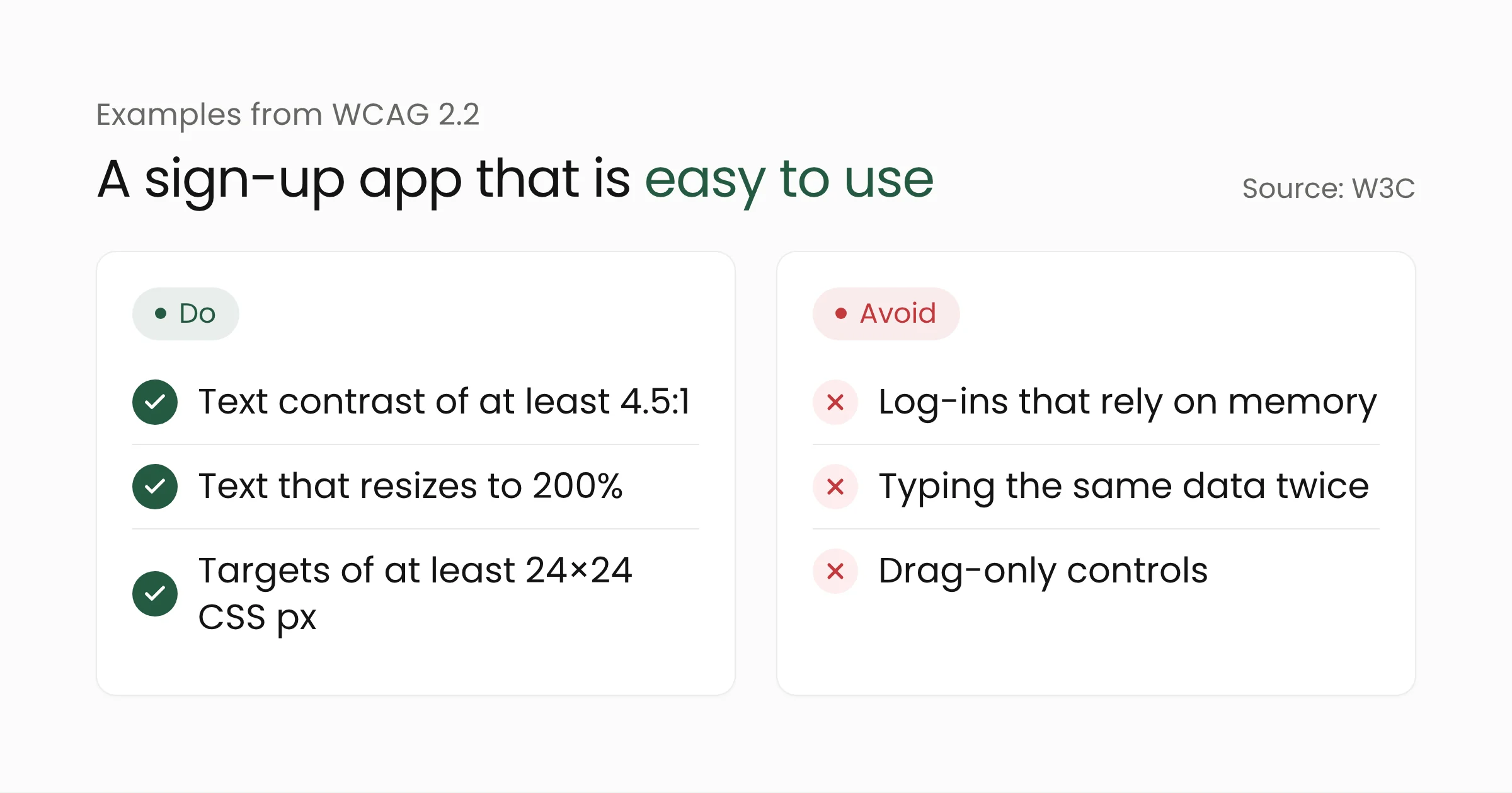
These criteria map directly onto flows patients use every day. A clinic registration form that asks for a national ID number twice, a login code that must be retyped from a text message with pasting disabled, or appointment buttons packed too closely together are common barriers.
What this means for hospitals and app developers
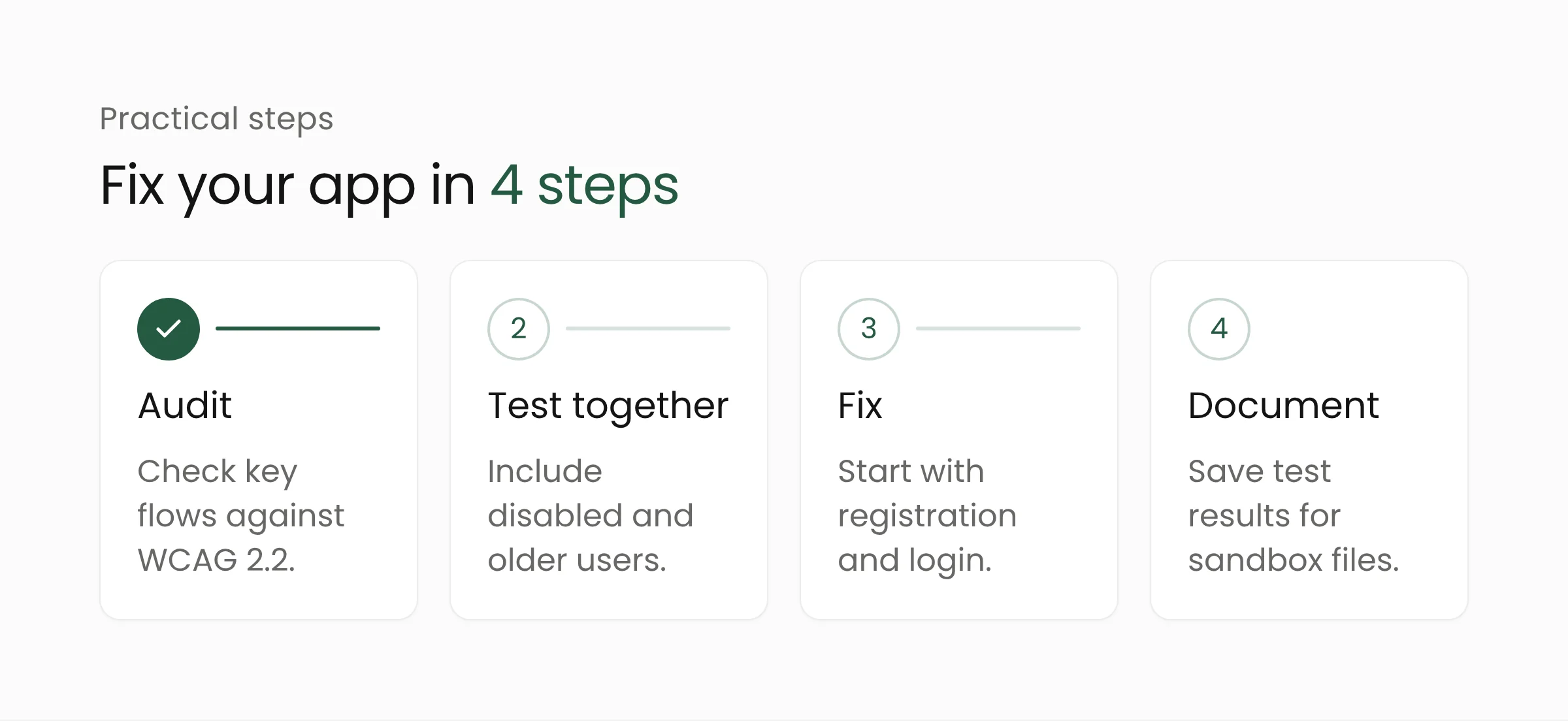
Available reports do not yet say whether the guidelines are mandatory, how the instrument is scored, or when the full text will be published. Imran said app developers, digital health startups, hospitals and operators of health electronic systems can use the document to assess and improve their services. Teams can start with these steps now.
- Audit the core flows. Begin with patient registration, login, doctor schedules and test results. Check contrast, font sizes, button labels and screen reader support against WCAG 2.2.
- Test with real users. The guidelines were drafted with vulnerable groups, and app testing should follow the same approach. Invite blind users, deaf users and older adults to try the app, and note where they get stuck.
- Fix in stages. Prioritize problems that block essential tasks, such as a patient who cannot finish registering. Fixes such as contrast and text size usually do not require rebuilding the app.
- Keep test evidence. According to a Health Ministry press release, registration for the next Health Sandbox period is scheduled to open at the end of 2026. Audit and user testing results can support an application if you plan to apply.
Data protection belongs on the list as well. Apps that store medical histories, lab results or counseling notes should explain what data they collect, why, and how users can withdraw consent. That explanation should be written in plain language so every user can follow it.
Hospitals that rely on vendor apps can use the guidelines as a checklist during procurement or contract renewal. Ask for accessibility test results and a remediation plan. Merakit’s healthcare solutions and mobile app development teams can help with accessibility audits and fixes to patient-facing app flows.
Frequently asked questions
Are the inclusivity guidelines mandatory?
Reports so far do not state their legal status. The guidelines were launched as part of the Health Sandbox and described as a practical tool for assessing and improving services. Watch the ministry’s official channels for the full text and implementation rules.
How does WCAG 2.2 differ from the WHO-ITU standard?
WCAG 2.2 applies to websites and apps in general, from color contrast to login steps. The WHO-ITU standard focuses on telehealth services, including needs such as remote sign language interpretation during video consultations. The ministry’s guidelines draw on both.
Do existing apps need to be rebuilt?
Usually not. Many accessibility fixes involve adjusting layouts and flows, such as contrast, text size, screen reader labels and shorter forms. An audit helps separate quick fixes from changes that need longer planning.
Conclusion
The Health Ministry’s inclusivity guidelines give health apps a clear benchmark: they should work for patients with the widest range of needs. Hospitals and developers that start auditing now will be better prepared when implementation rules are announced. If you would like a review of a patient app or a health service website, the Merakit team is ready to talk.
Sources
- ANTARA: Kemenkes launches inclusivity guidelines for digital health technology (November 10, 2026)
- KBK News: Inclusivity, an important foundation for Indonesia’s digital health future (November 11, 2026)
- Medcom.id: Kemenkes tightens digital health regulation through the sandbox (November 10, 2026)
- Ministry of Health: Kemenkes encourages health technology innovation that improves access and quality (October 27, 2026)
- WHO: WHO-ITU global standard for accessibility of telehealth services (2022)
- W3C: Web Content Accessibility Guidelines (WCAG) 2.2
- W3C: What’s New in WCAG 2.2