Blog Digital Health
Heidi Scribe at Bali Hospital: AI Notes and Data Conditions
On this page· 7 sections
Bali International Hospital (BIH), located in the Sanur special economic zone, has signed a memorandum of understanding with Australian health technology company Heidi to assess Heidi Scribe. The AI clinical documentation tool drafts notes from the conversation between doctor and patient. Any rollout depends on an evaluation and a limited pilot.
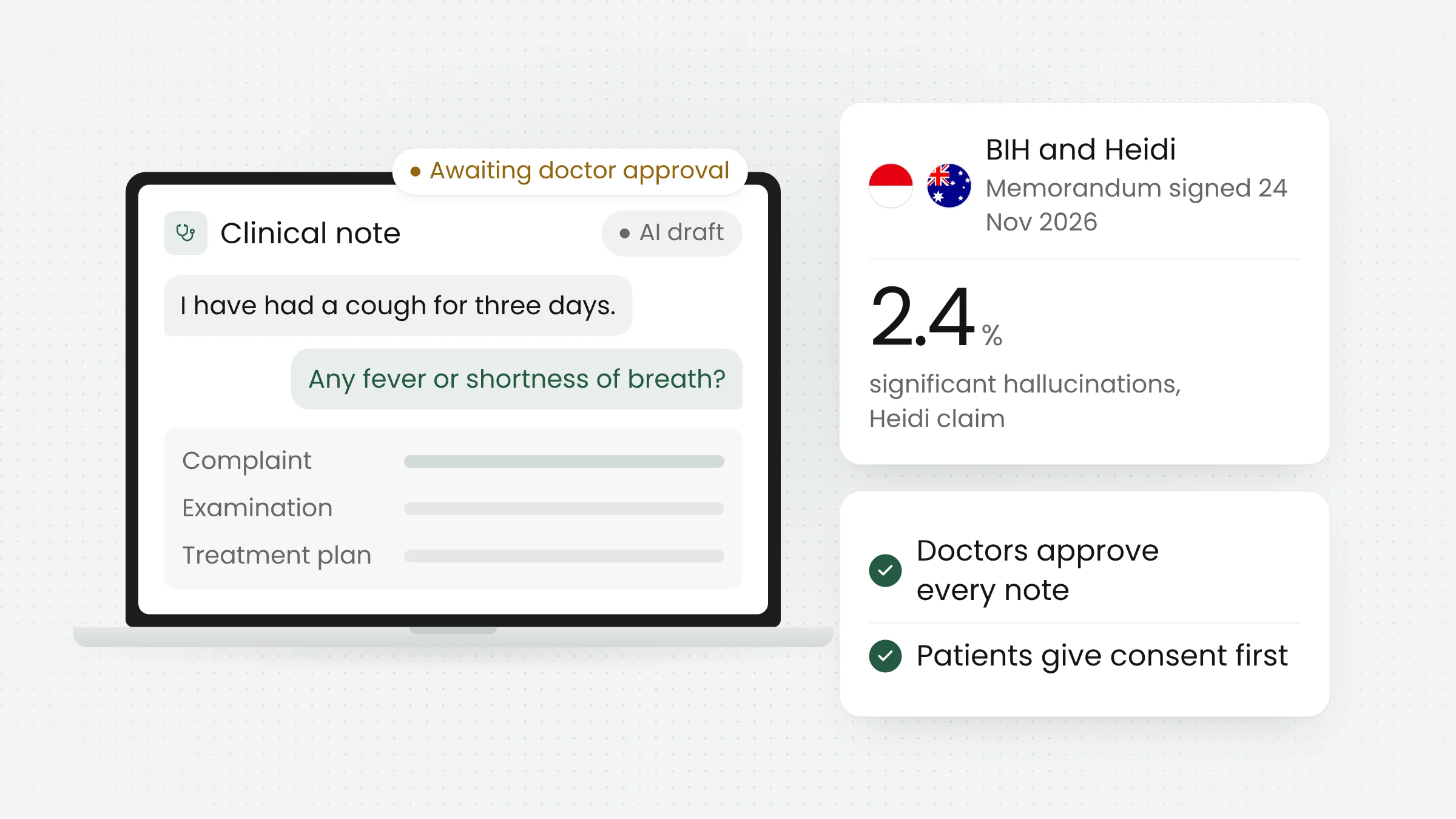
For other hospitals in Indonesia, the conditions announced alongside the deal are the useful part. Doctors approve every note, patients are asked for consent before a consultation, and any use of patient data waits for a separate agreement. Heidi also shared accuracy figures for its product, which should be read as company claims.
What the BIH and Heidi memorandum covers
Bali Express reported that the memorandum was signed on 24 November 2026 between Heidi and BIH, which is operated by PT Pertamedika Bali Hospital. ANTARA covered it from Denpasar on Thursday, 26 November 2026, with additional comments from Heidi.
The product under assessment is Heidi Scribe. According to IT Brief Asia, it is designed to support consultation transcription, the preparation of clinical notes and other medical documentation.
The work is staged. The two sides first assess whether the technology meets the hospital’s clinical, operational and regulatory requirements. They then plan a limited pilot in selected clinical units, followed by an assessment of integration with the hospital management information system and electronic medical records (EMR). User training and support are part of the scope.
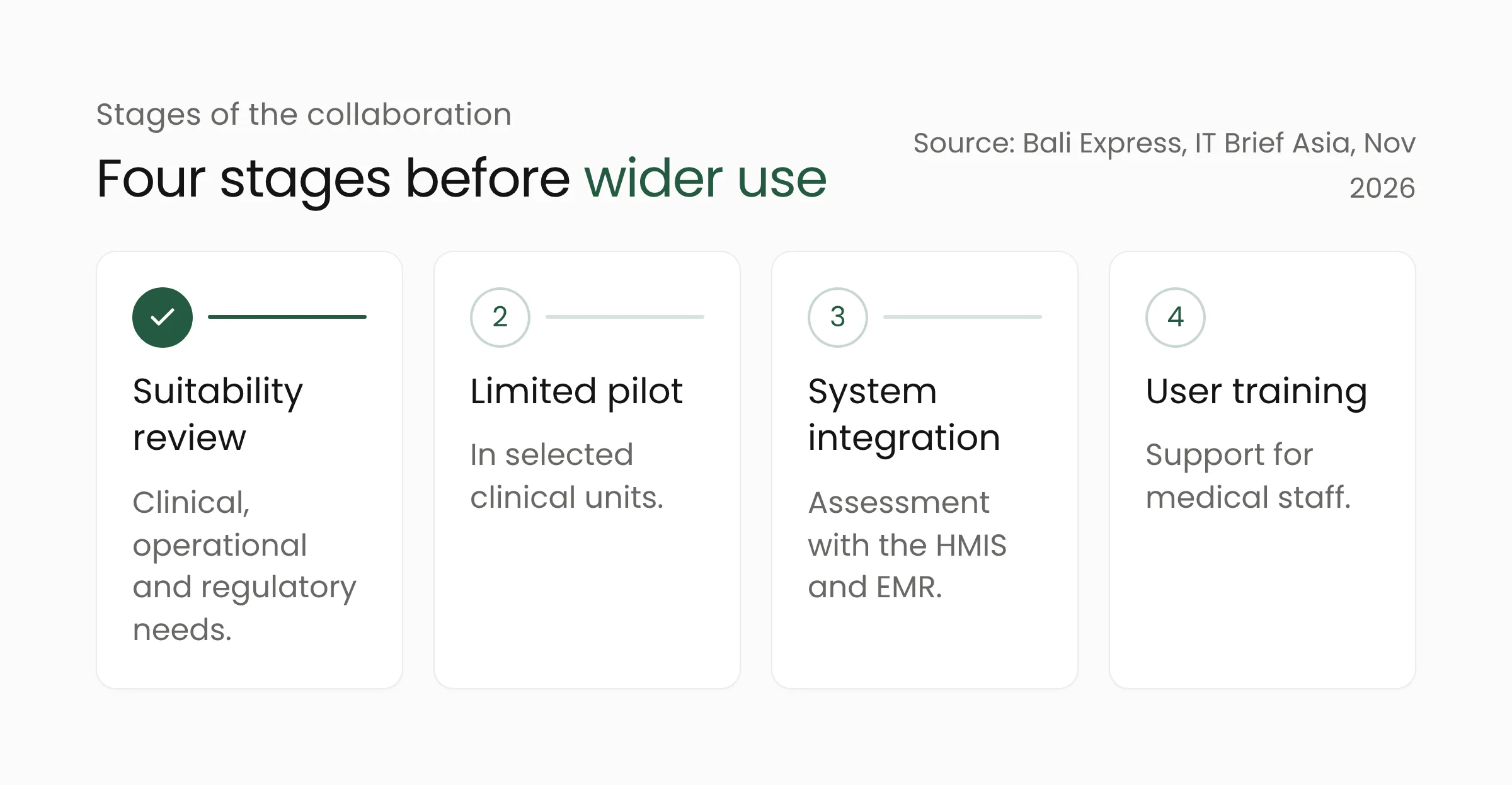
Bali Express stressed that the memorandum does not mean AI is now fully in use at BIH. IT Brief Asia wrote that broader implementation would be considered only after the platform’s fit with clinical workflows has been evaluated. Financial terms, the clinical units involved and the pilot schedule have not been announced.
How AI clinical documentation works
Tools such as Heidi Scribe are often called AI scribes. During a consultation the tool records the conversation, converts it to text, and drafts a clinical note in the format the doctor uses. The doctor then checks the draft before it is saved.
The task being reduced is typing. Doctors usually record complaints, examination findings, the diagnosis and the treatment plan while talking to the patient, or complete the record after clinic hours. Thomas Kelly, Heidi’s chief executive and co-founder, said in a statement carried by IT Brief Asia: “We see great potential in using AI to support healthcare professionals by reducing the administrative burden associated with clinical documentation.”
Doctors approve every note
BIH chief executive Dr Noel Yeo said Heidi is designed as a documentation support tool and is not intended to make clinical decisions. All documentation the system produces will be reviewed, corrected where necessary and approved by the responsible medical professional before it becomes part of a patient’s record.
This condition settles who is accountable for the content of the medical record. An AI draft becomes an official note only after the clinician treating the patient approves it.
The accuracy figures Heidi has shared
Language models can write things that were never said in the consultation. This error is known as a hallucination. The opposite error is an omission, where an important fact that was said does not make it into the note.
Keppell Smith, Heidi’s general manager for Asia, gave ANTARA figures for both. Heidi’s note-generation model is said to have a clinically significant hallucination rate of 2.4%, compared with 5.0% for another frontier AI model that was not named. Heidi also said its model captures 77.7% of key clinical facts, with a significant omission rate of 9.7%. According to Smith, the output is monitored by an AI-based clinical evaluator before a doctor approves the note.
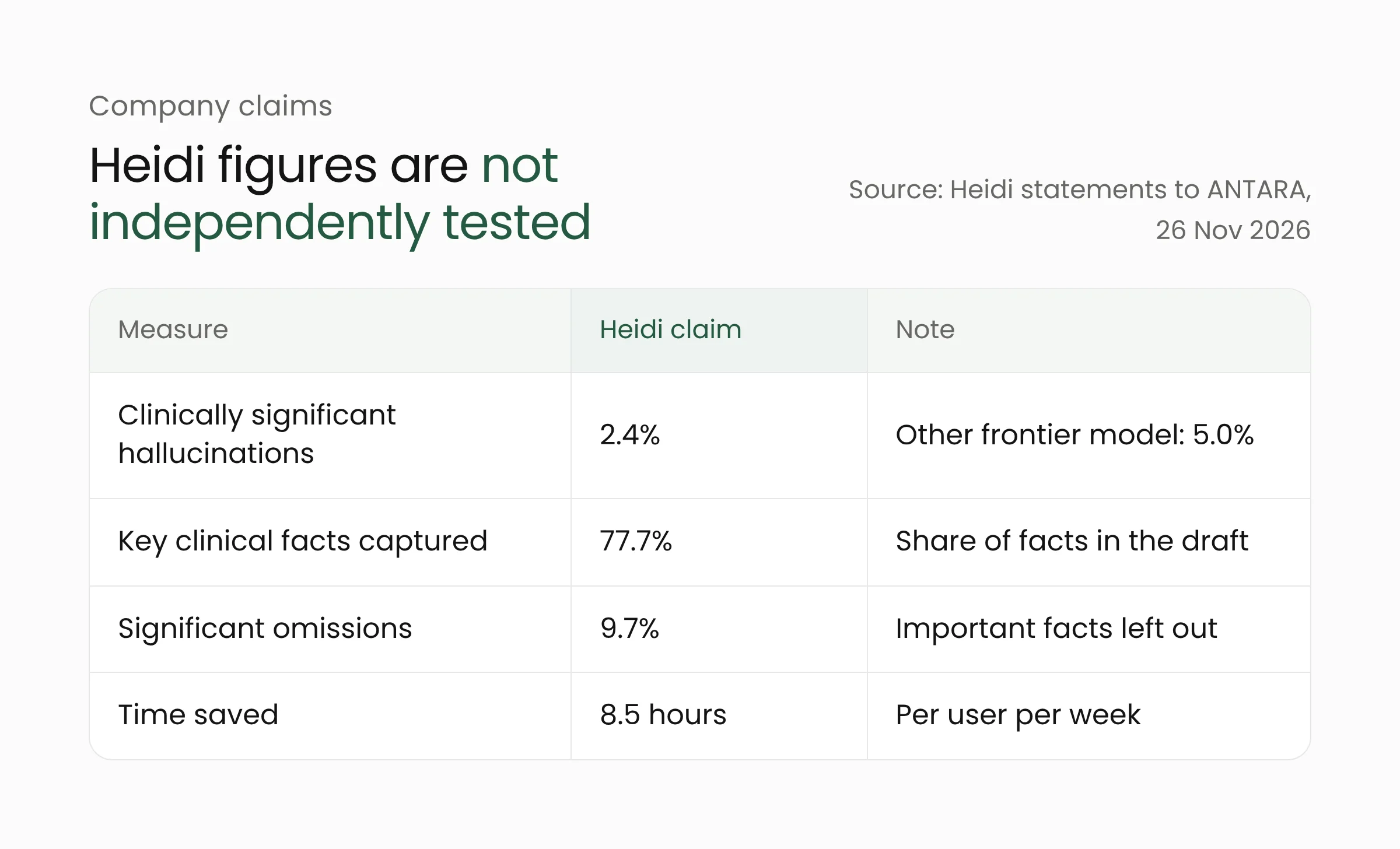
All of these figures come from Heidi. The reports do not mention independent testing, the number of consultations assessed or the languages used in the evaluation. The 77.7% figure also means that, by Heidi’s own measure, some key clinical facts do not reach the draft. Review by the doctor therefore remains the main safeguard.
On time saved, Heidi said its service has supported 72.2 million clinical working hours worldwide, with an average saving of 8.5 hours per user per week. The company cited 59 minutes of clinical capacity freed per day in Australia, a 51 to 86% cut in documentation time in the United Kingdom, and 13 minutes saved per visit in Canada. Smith acknowledged that savings vary by specialty and organisation. Heidi runs a pilot with each partner against benchmarks agreed at the start.
Heidi’s expansion in Asia
BIH is one of several Asian hospitals Heidi has approached this month. Korea Biomedical Review reported on 13 November 2026 that Samsung Medical Center in Seoul signed a similar memorandum. There, Heidi plans a proof of concept using an on-premise version installed within the hospital’s own infrastructure, and the two sides intend to develop Korean clinical documentation standards based on HL7 FHIR, the international standard for exchanging health data.
The same publication wrote that Heidi was founded in Melbourne in 2019. The company says its technology supports more than 3 million patient consultations a week across 190 countries and 110 languages.
Patient data rules for recorded consultations
A conversation between doctor and patient contains complaints, medical history and current medication. Indonesia’s personal data protection law, Undang-Undang Nomor 27 Tahun 2022 tentang Pelindungan Data Pribadi, classifies health data and information as specific personal data (Article 4, paragraph 2).
The BIH and Heidi memorandum contains three safeguards that relate to this. According to IT Brief Asia, the document provides a framework for assessing technology integration, data protection, medical confidentiality and cybersecurity. Any implementation involving patient data will be subject to definitive agreements and applicable regulations. Patients must also receive prior notice and give consent before Heidi Scribe is used in a consultation.
The reports do not yet explain where recordings are processed and stored, how long they are kept, or what happens when a patient declines to be recorded. Samsung Medical Center’s plan to run the system on its own infrastructure shows that data location is something a hospital can negotiate with the vendor.
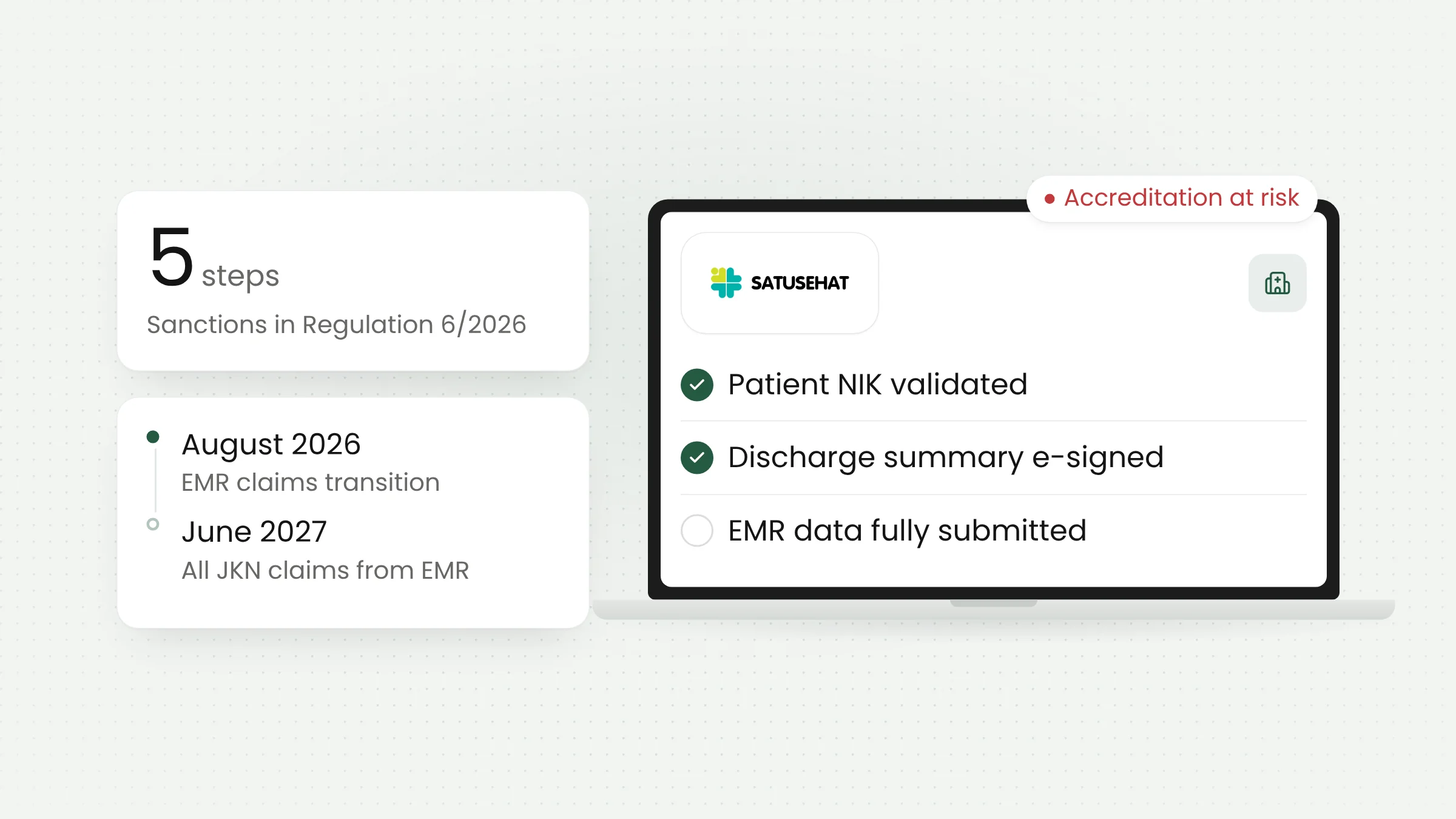
EMR integration matters for Indonesian hospitals as well. A note produced by an AI scribe ends up in a medical record that must connect to SATUSEHAT, the health ministry’s national health data platform. We explained that obligation in our article on the five stages of SATUSEHAT EMR sanctions. For new health applications and devices, the ministry offers a controlled testing route through its Health Sandbox.
What this means for hospitals and clinics
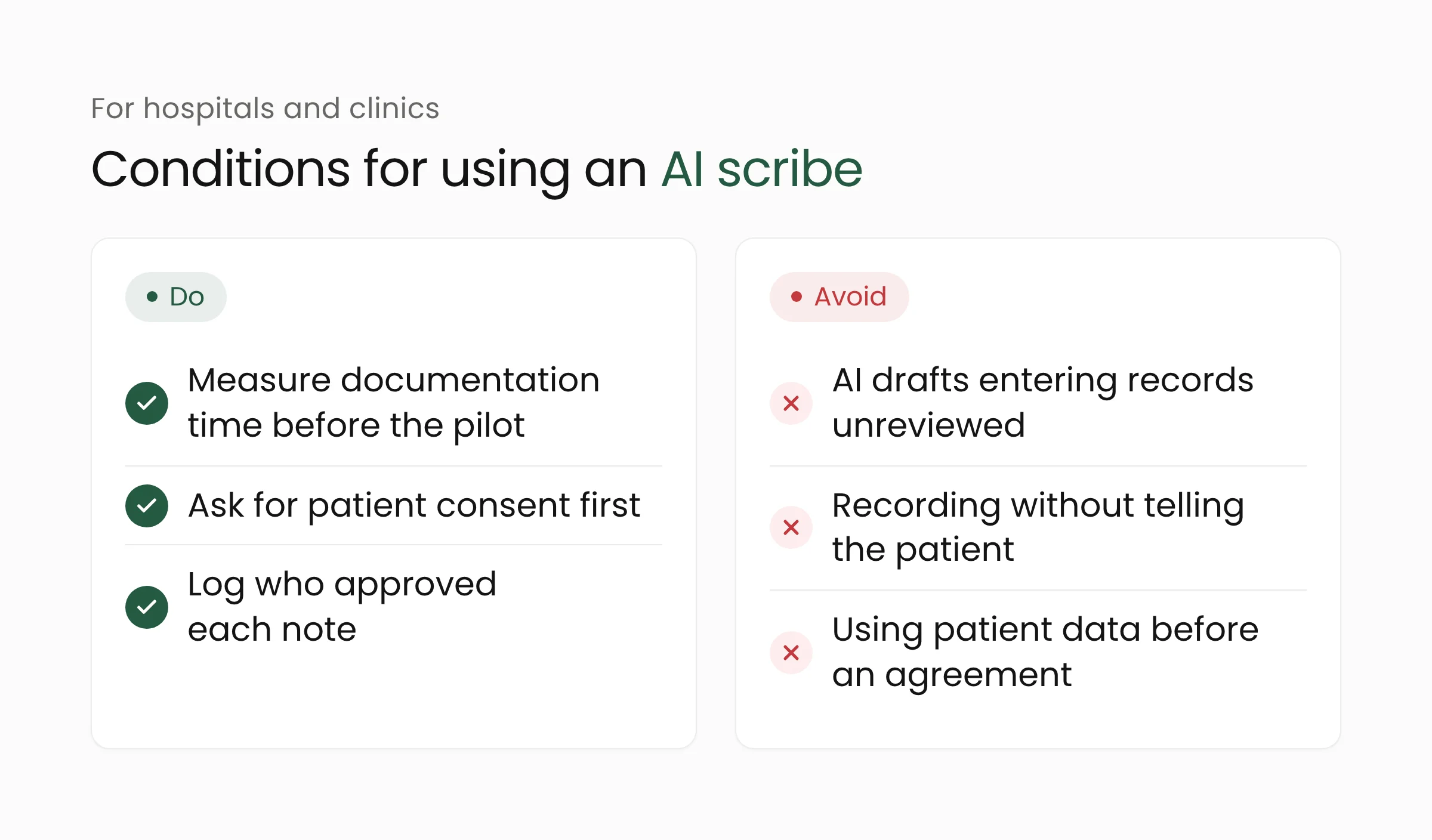
Hospitals and clinics weighing a similar tool can use the structure of the BIH collaboration as a checklist.
Set success measures before the pilot. Measure documentation time per visit before the tool is introduced, then compare afterwards. Count how often doctors correct the draft and what kinds of errors they find. Savings reported in other countries may not hold for an outpatient clinic with long queues and short consultations.
Test with the language patients speak. Consultations in Indonesia often mix regional languages, lay terms and medical abbreviations. Ask the vendor to show results on Indonesian-language recordings from the specialties that will use the tool.
Prepare the patient consent flow. Decide how patients are informed, where consent is recorded, and what happens when a patient declines. A consultation must still be able to proceed without recording.
Make sure doctor approval is logged. The system should store who approved a note, when, and what was changed from the AI draft. This trail is needed for quality audits and medical disputes.
Ask where the data travels. Request a written explanation of where audio and transcripts are processed, how long they are retained, who can access them, and whether the data is used to train models. The answers feed into the data processing agreement.
Plan integration from the start. A note that has to be copied by hand into the hospital information system loses much of its value. EMR integration, including mapping to the format SATUSEHAT requires, is usually the largest piece of work in a health information system project. Hospitals that want to build or test a similar workflow with a model of their own choosing can bring in an AI development team to design the evaluation and the audit trail.
Frequently asked questions
Is Heidi Scribe already being used with patients at BIH?
Nothing in the reports says it is in clinical use. The memorandum is a basis for assessment, and a limited pilot is planned in selected clinical units. No schedule has been announced.
Does this AI diagnose illness?
No. According to BIH, Heidi Scribe is a documentation support tool and is not intended to make clinical decisions. Diagnosis and treatment remain with the doctor, who also approves the content of the note.
Can a patient refuse to have a consultation recorded?
The collaboration requires prior notice and patient consent before Heidi Scribe is used. The procedure for patients who decline has not been described in the reports.
Closing
The Heidi Scribe assessment at BIH follows a sequence worth copying: review, limited pilot, integration, then training, with the doctor as final approver and patient consent as a condition. The pilot in Sanur will show how much the tool helps in daily practice. If your hospital or clinic is weighing AI for documentation, EMR integration or model evaluation, the Merakit team is ready to talk.
Sources
- BIH adopsi AI untuk dokumentasi klinis, ANTARA Bali, 26 November 2026
- BIH Gandeng Heidi, Jajaki Penggunaan AI untuk Dokumentasi Medis, Dokter Tetap Pegang Kendali, Bali Express, 24 November 2026
- Bali hospital and Heidi explore AI clinical documentation, IT Brief Asia, 25 November 2026
- Samsung Medical Center signs MOU with Australian healthcare AI firm Heidi to test clinical documentation technology, Korea Biomedical Review, 13 November 2026
- Undang-Undang Nomor 27 Tahun 2022 tentang Pelindungan Data Pribadi, JDIH BPK