Blog Artificial Intelligence
Microsoft MAI-DxO: What the Science Diagnosis Study Shows
On this page· 7 sections
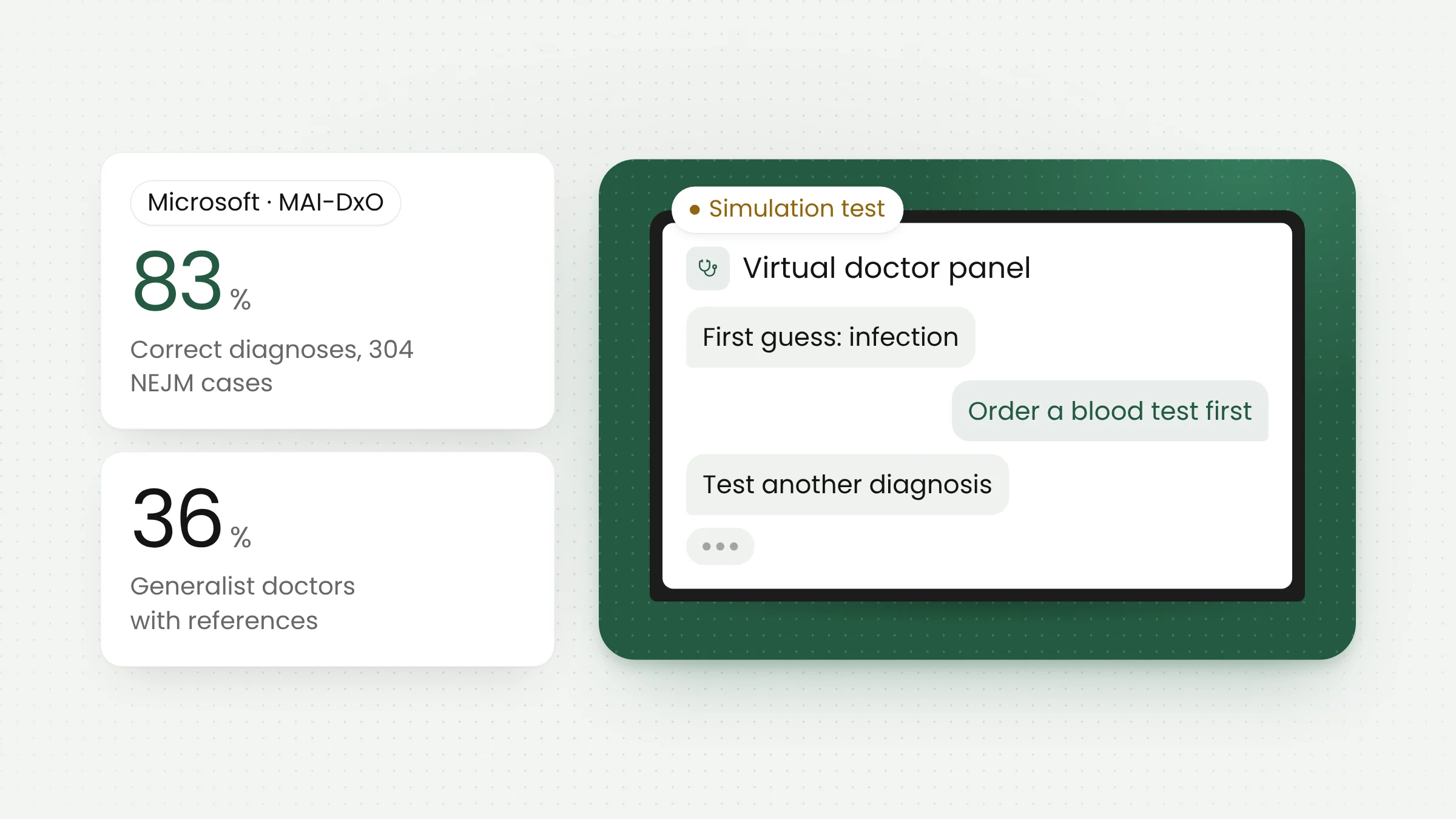
Microsoft published the results of MAI-DxO, its AI system for medical diagnosis, in the journal Science on October 22, 2026. On 304 difficult case records from the New England Journal of Medicine (NEJM), MAI-DxO reached the correct diagnosis 83% of the time. Generalist doctors using reference material reached 36%. The test was a simulation built on archived cases.
What Microsoft announced
The paper, titled “Sequential diagnosis with language models,” appears in volume 394 of Science. All fifteen authors work at Microsoft, among them Microsoft AI chief executive Mustafa Suleyman and vice president of health Dominic King. An earlier version circulated on arXiv as a preprint in June 2025, before any peer review.
That preprint reported 80% accuracy for MAI-DxO running on OpenAI’s o3 model, against an average of 20% for physicians. The Science version uses revised methods and newer models, so the figures differ. According to Microsoft AI’s announcement, the gains held up and improved when the evaluation was repeated with later models, including GPT-5.5.
Microsoft frames the study as part of a goal it calls “medical superintelligence.” Speaking to TechCrunch, Dominic King said, “This technology is ready for real-world evaluations.” That statement is best read alongside the limits the authors themselves acknowledge.
How MAI-DxO works through a case
Most earlier tests of medical AI used multiple-choice questions: the model received all patient information at once and picked an answer. This study is closer to how doctors actually work. Microsoft built a benchmark called the Sequential Diagnosis Benchmark (SDBench) from 304 NEJM clinicopathological conference cases, which are chosen precisely because they are hard to diagnose.
Each case opens with a short summary. The system under test has to ask about the patient’s history, request physical examination findings, or order laboratory and imaging tests one at a time. A “gatekeeper” agent supplies information on request, and a “judge” agent scores the final diagnosis on a scale of one to five, with four or five counted as correct. Every test ordered carries a price taken from a US hospital’s list of charges, so accuracy and cost are scored together.
MAI-DxO acts as an orchestrator. Microsoft describes it as a panel of virtual physicians that debates over several rounds. One proposes likely diagnoses, another chooses the next question or test, and another challenges the working diagnosis. The panel also weighs whether each test is worth its cost.
The orchestrator works with different underlying models. Microsoft tested it with models from OpenAI, Google, Anthropic, Meta, and DeepSeek, and the best results came from GPT-5 and GPT-5.5.
Results on hard cases and emergency cases
On the 304 NEJM cases, MAI-DxO with GPT-5 reached 83.2% accuracy. Generalist physicians and general internists working alone scored 36.1% when allowed reference material and 22.3% without it. Microsoft also reported a cost-conscious configuration that reached 81% at less than half the cost of comparable systems.
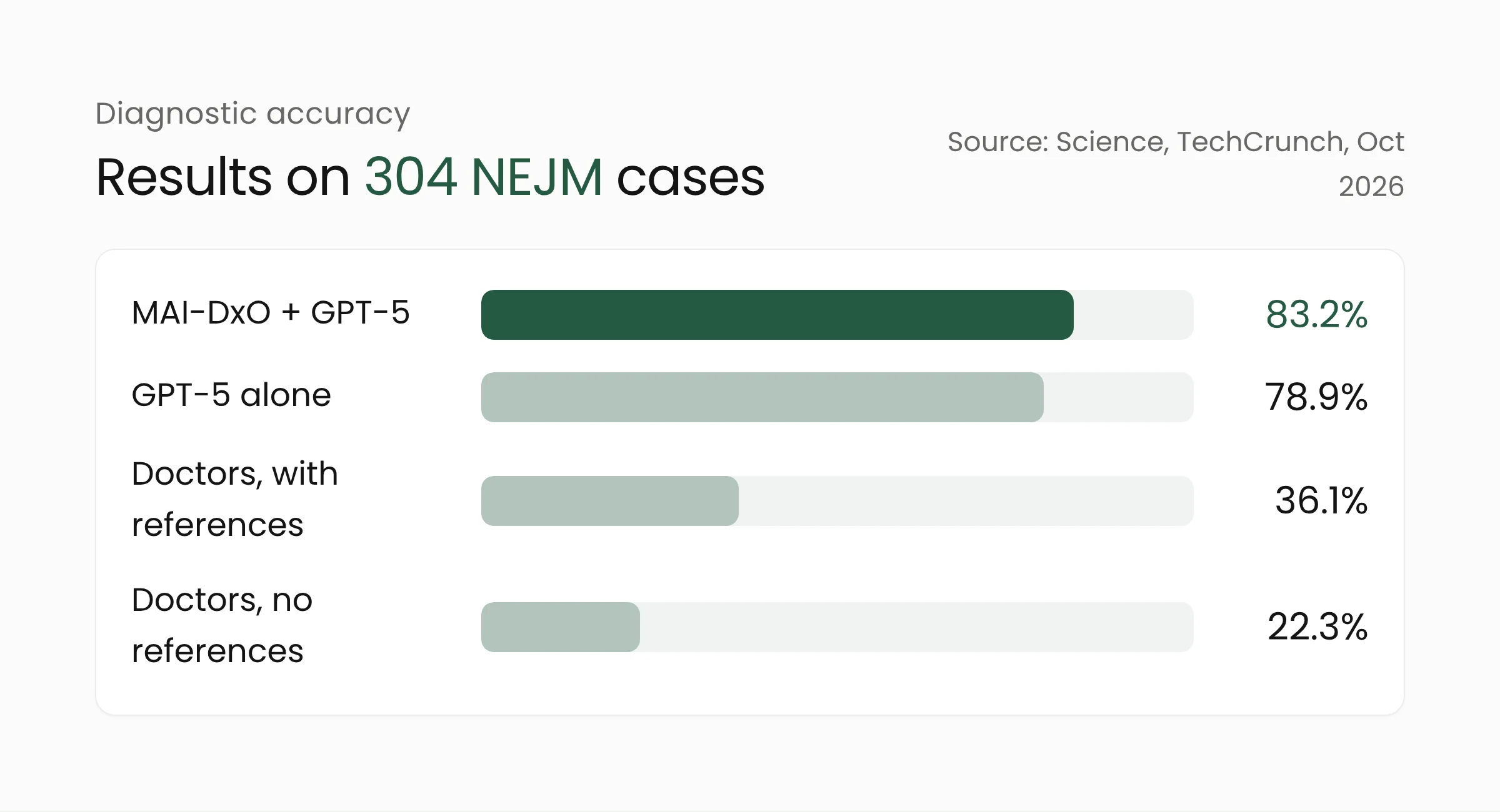
These figures deserve a careful reading. According to TechCrunch, GPT-5 used directly with a short basic prompt already reached 78.9%. The MAI-DxO orchestration added about four points of accuracy and cut test spending by about $3,000 per case. The biggest jumps came with weaker models: Gemini 2.5 Flash rose from 46.4% to nearly 69%. Most of the advantage over doctors therefore comes from the underlying model, with the orchestrator adding accuracy and efficiency on top.
Microsoft also tested more routine emergency department cases drawn from the MIMIC-IV-ED database. There, MAI-DxO scored 80% against 47% for physicians. TechCrunch noted that on these emergency cases the orchestration added little accuracy to GPT-5 or GPT-5.5, because the base models already performed well.
Study limits and next steps
Limits the authors acknowledge
The authors list several limits that matter to anyone quoting the 83% figure.
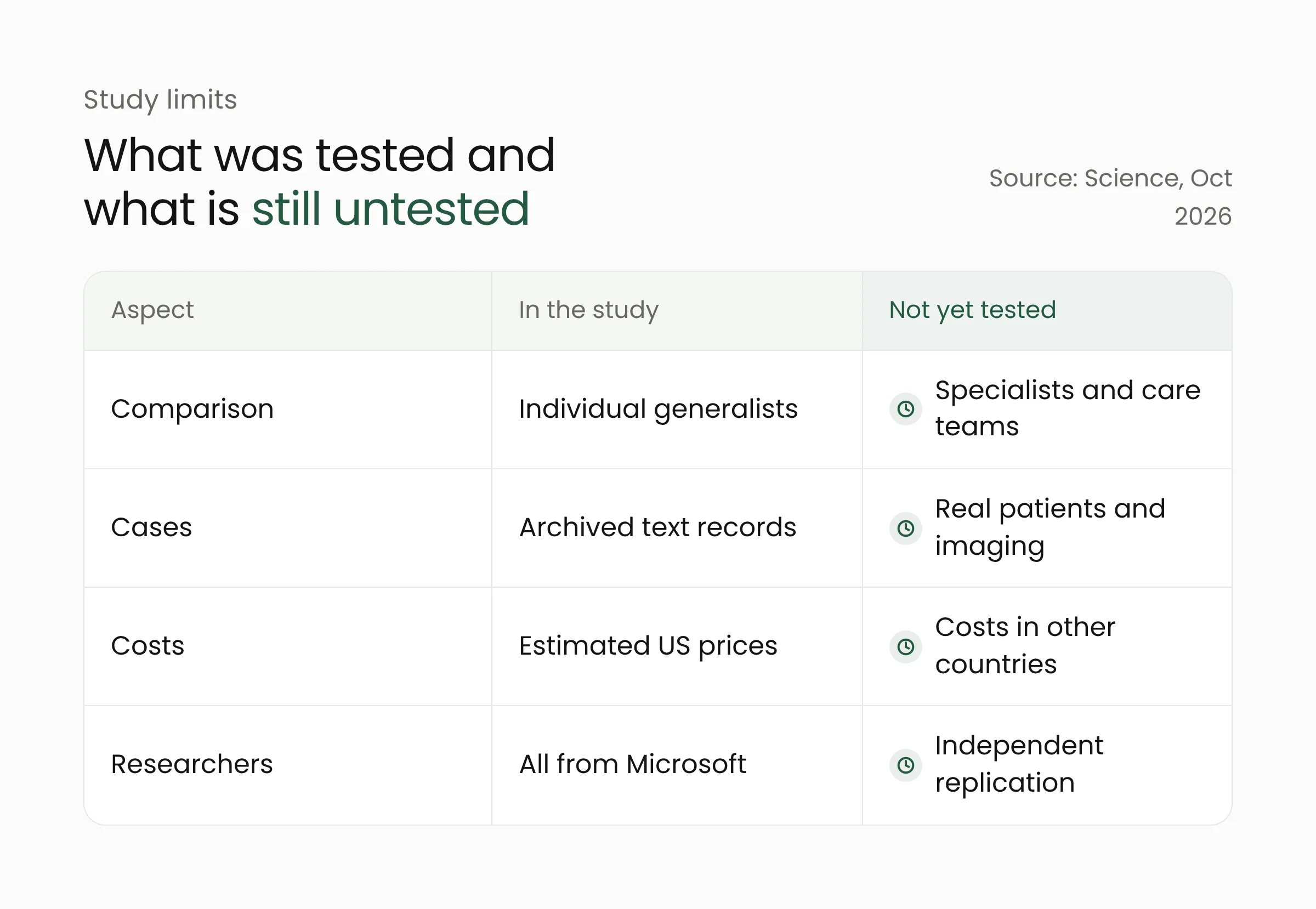
First, the comparison group was generalist doctors working alone. NEJM cases are usually handled by specialists or multidisciplinary teams, and the authors expect the gap to narrow against such teams. Second, every case was an archived text record. The simulation left out vague histories, incomplete records, rapport with patients, long-term follow-up, and imaging data such as X-rays and pathology slides.
Third, NEJM cases tend to overrepresent rare and difficult conditions, and the study did not measure false alarms in patients who turn out to be healthy. Fourth, costs were estimated from US prices and do not reflect real costs elsewhere. Finally, all authors are Microsoft employees who hold company equity, and the results have not been replicated by independent researchers.
Microsoft released part of the SDBench code on GitHub, including the gatekeeper, the judge, and the cost estimator. The NEJM case data still requires a license from NEJM Group, while the MIMIC data requires credentialed access through PhysioNet. Other researchers can use these tools to test the claims again.
Testing with real patients
Microsoft will run a prospective study with Beth Israel Deaconess Medical Center in Boston. Patients will continue to receive standard care, while those who consent will also interact directly with MAI-DxO. The system’s recommendations will then be compared with physicians’ independent assessments. No start date or participant numbers have been announced, and MAI-DxO is not on sale as a product.
Competition in this area is intense. TechCrunch noted that Google published a study of its AMIE system with Beth Israel in The Lancet this month, and OpenAI has made similar claims. Microsoft is also working with Mayo Clinic on a healthcare AI model planned for release in 2027.
What this means for hospitals
In Indonesia, general practitioners at community health centers (puskesmas), clinics, and regional hospital emergency rooms are often the first to see unusual symptoms. A reliable clinical decision support tool could help them decide when more tests are needed and when a patient should be referred. The study results alone, however, are not enough to justify buying or deploying such a tool.
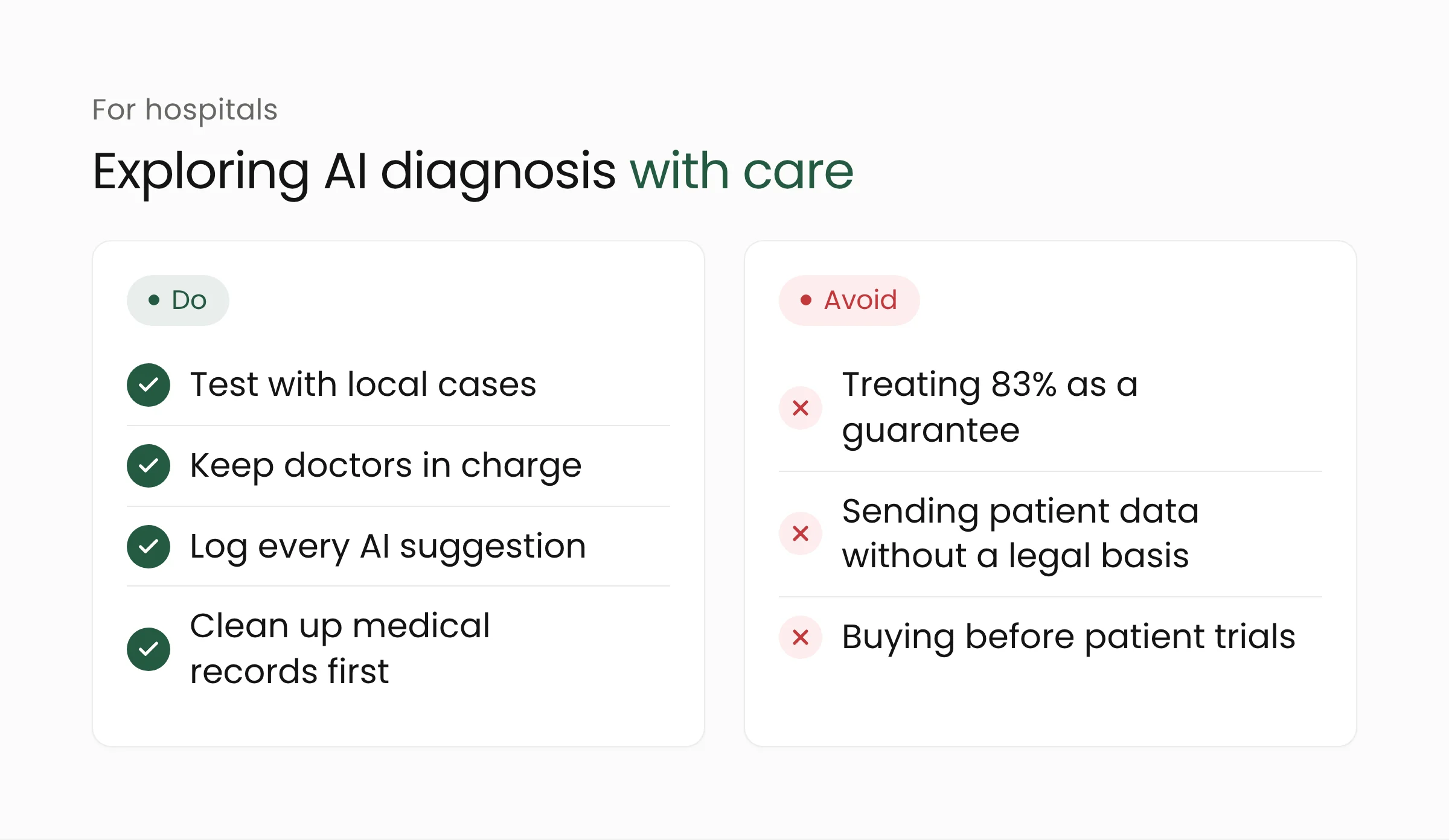
Some considerations for hospital management and medical informatics teams:
- Test with local cases. Tropical diseases, referral patterns, and test availability in Indonesia differ from NEJM cases. Assemble anonymized cases from your own hospital before judging any tool.
- Keep doctors in charge. Treat AI as a second opinion whose answers are recorded, reviewed, and open to rejection by the physician.
- Get the data in order first. Systems like this depend on complete histories, lab results, and clinical notes. Electronic medical records connected to SATUSEHAT matter more than the choice of model.
- Check the legal basis for data processing. Indonesia’s personal data protection law, Undang-Undang Nomor 27 Tahun 2022 tentang Pelindungan Data Pribadi, classifies health data as specific personal data. Sending patient data to an overseas AI service needs legal review and clear consent.
- Measure costs in your own context. The study’s test savings use US prices. Recalculate them with your hospital’s own tariffs and payment arrangements.
Teams that want to start can pick one narrow workflow, such as case summaries for referral meetings, and measure the outcome openly. Merakit helps hospitals prepare data and workflows like these through its digital healthcare solutions and artificial intelligence services.
Frequently asked questions
Can hospitals use MAI-DxO yet?
No. Microsoft has not announced a commercial release date. The next step is a prospective study with patients at Beth Israel Deaconess Medical Center, and its start date has not been announced either.
Is this AI better than doctors?
In a simulation with hard cases, MAI-DxO was more accurate than generalist doctors working alone. The study did not compare it with specialists or medical teams, and it has not yet tested the effect on patient safety.
Why do the numbers differ from last year’s reports?
The June 2025 preprint used the o3 model and reported 80% against 20%. The Science version uses revised methods and GPT-5, giving 83.2% against 36.1% for doctors with reference material.
Conclusion
MAI-DxO shows that AI can work through difficult cases step by step while keeping track of test costs. Evidence from real patients will only come from the follow-up study. In the meantime, hospitals can prepare clean clinical data and clear rules for AI use. If your team would like to discuss where to begin, Merakit is ready to help.
Sources
- Science, Sequential diagnosis with language models, October 22, 2026
- Microsoft AI, Building Medical Superintelligence, October 22, 2026
- TechCrunch, Microsoft’s Mustafa Suleyman says its AI outperforms doctors on hard cases, October 22, 2026
- Unite.AI, Microsoft Diagnostic AI Outperforms Generalist Physicians in Science Study, October 2026
- Microsoft, SDBench (benchmark code and data)
- arXiv, Sequential Diagnosis with Language Models (preprint), June 2025