Blog Blockchain
China's National Blockchain Network: Lessons for Agencies
On this page· 7 sections
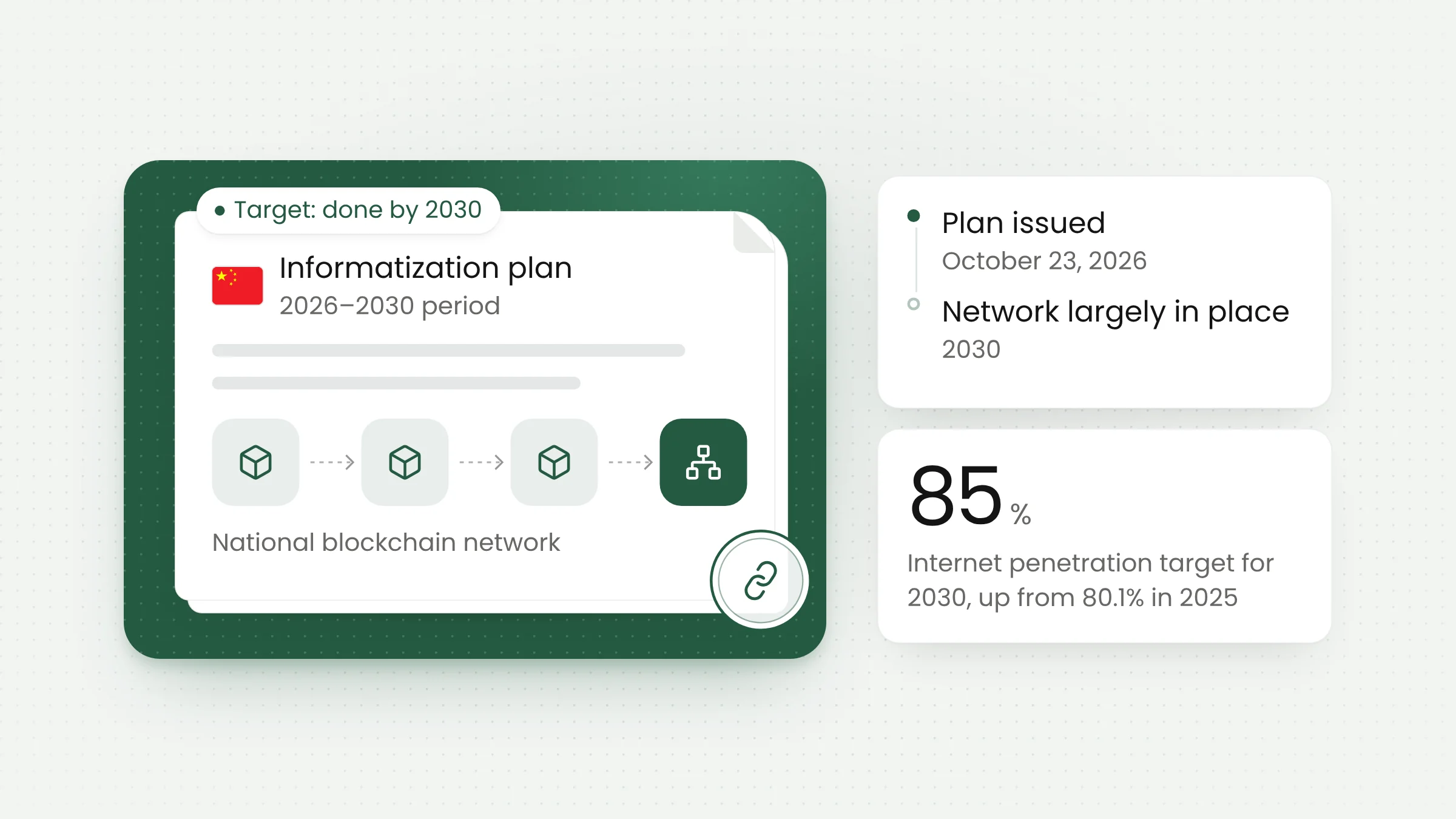
China plans to have its national blockchain network largely built by 2030. The target appears in a 2026–2030 national informatization plan that the Central Cyberspace Affairs Commission issued on October 23, 2026. The plan treats blockchain as state infrastructure for data exchange, trade, and government services.
What the 2026–2030 informatization plan says
The official document is the National Informatization Plan for the 15th Five-Year Plan period (国家信息化”十五五”规划). According to the announcement on the Cyberspace Administration’s website, it sets the direction for China’s digital development over the next five years. The issuing body is a central commission that coordinates cybersecurity and digital development policy.
The plan is organized around a formula of “building three systems, raising five levels, and strengthening two supports.” Its contents are split into 10 task areas and 7 special project columns, covering information infrastructure, breakthroughs in cyber technology, and the development of a smart society.
For 2030, the plan lists several infrastructure targets at once:
- a three-dimensional network spanning land, sea, air, and space should basically take shape;
- the next-generation communications network should be fully built;
- commercial 6G service should launch “at an appropriate time,” with no year given;
- the national blockchain network should be basically complete;
- development of an intelligent internet should accelerate.
State news agency Xinhua, as carried by ANTARA, also reported several figures. China’s internet penetration rate is expected to reach 85 percent by 2030, up from 80.1 percent in 2025. The number of 5G base stations per 10,000 people is projected to rise from 34 to 50. The Ministry of Industry and Information Technology expects revenue from the country’s information and communications industry to reach 4.1 trillion yuan by 2030.
Blockchain also sits on the list of priority industries. The plan calls for internationally competitive technology products in integrated circuits, artificial intelligence, and blockchain.
The national blockchain network project
A blockchain records data in a chain of blocks that is copied across many computers, known as nodes. Each new record is linked to the previous one, so quiet edits are easy to detect. Because the copies are spread out, no single party can rewrite the history alone.
China’s plan goes into specifics. According to a summary of the document reported by Wu Blockchain, the government will run a national blockchain network construction project to strengthen the foundation of what it calls the “value internet.” The project has four main layers.
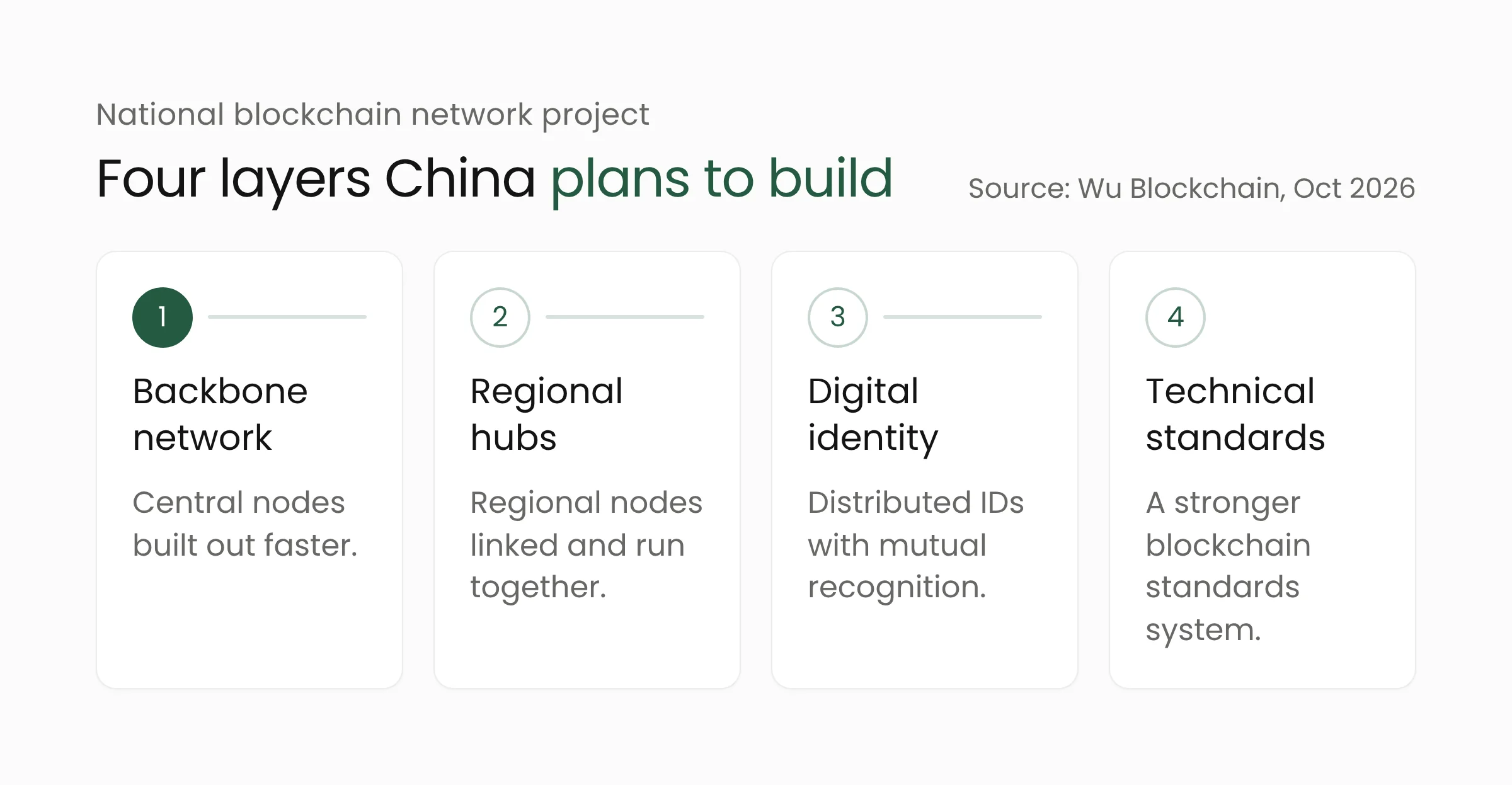
The first layer is a central backbone network, whose construction will be accelerated. The second connects regional hubs so that nodes across provinces operate as one network. The third covers shared basic services, including a distributed digital identity that different systems can mutually recognize. The fourth is a stronger system of blockchain technical standards.
On top of that foundation, the plan promotes blockchain together with privacy-preserving computation for data circulation and trading. Privacy-preserving computation lets several parties process combined data without revealing their raw records to one another. The same plan also calls for the steady development of the digital yuan.
Pilot regions and target sectors
Deployment is aimed at sectors that involve many parties. Wu Blockchain lists digitalization targets in shipping, freight, and trade, followed by expansion into development planning, the low-carbon transition, government services, and taxation.
According to Cointelegraph, the plan also names two regions. The Yangtze River Delta is to deepen the use of blockchain in trade and finance. The Chengdu–Chongqing region in southwestern China is to apply it at scale in manufacturing and agriculture.
The 2030 deadline builds on existing policy. Cointelegraph reports that the national blockchain network project was already included in the national development plan released in March, and that on October 9 the Communist Party’s central leadership and the State Council issued a joint policy calling for its construction. The October 23 plan adds a firm date.
Blockchain without crypto
This part is often misread. China’s plan does not cover cryptocurrency. Crypto-related business remains banned in mainland China, while blockchain as a record-keeping technology is promoted as a national priority, as Cointelegraph notes.
That approach separates two things that are often treated as one. Cryptocurrency is one application of blockchain: digital assets that are traded. The network China is building works more like a shared data highway, where government bodies and companies can record transactions, documents, or identities on common infrastructure under access rules set by the state.
The model has limits. A government-run network is permissioned, so trust still rests with the network operator. The gains it targets are clean audit trails and easier data exchange between institutions; full decentralization of the kind found on public crypto networks is not the goal. Available coverage does not yet describe the network’s architecture, cost, or operators.
What this means for government agencies
Indonesia is organizing data exchange between agencies through its electronic-based government system (SPBE) and the One Data policy. We covered the challenges in our article on Indonesia’s One Data law and agency interoperability. China’s plan offers one architectural option, and several of its lessons apply without copying its scale.
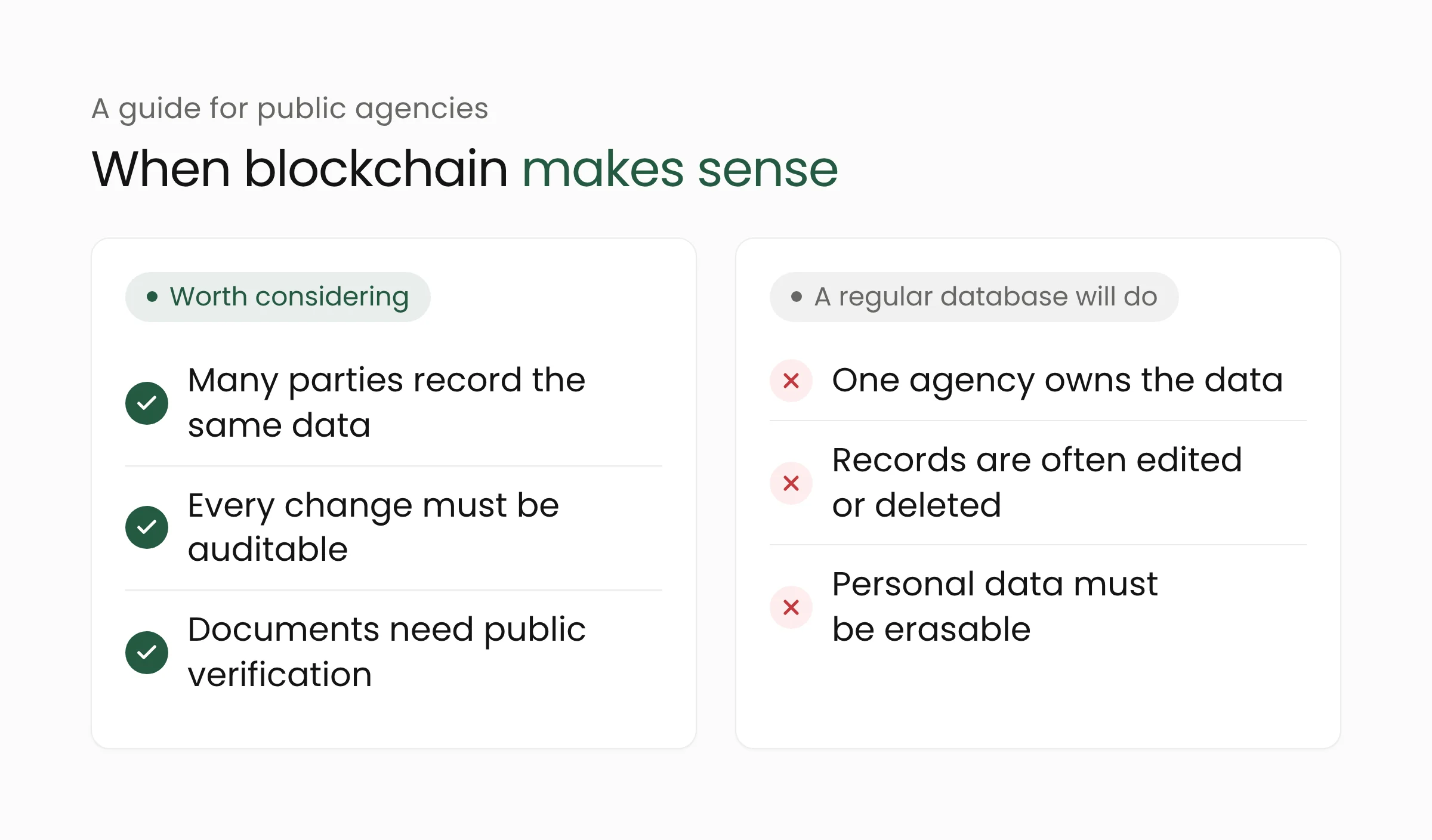
First, start with problems that genuinely involve many parties. Blockchain is most useful when several institutions record the same data and need to check one another, such as permits, training certificates, aid supply chains, or export documents. If a single agency manages the data, an ordinary database with an audit log is often cheaper and easier to maintain.
Second, design identity and standards first. China places distributed digital identity and technical standards in the foundation layer, ahead of applications. For agencies, that means agreeing on data formats, region codes, and identity verification before choosing a record-keeping technology.
Third, do not store complete personal data on the chain. Blockchain records are hard to delete, while Indonesia’s Personal Data Protection Law (Undang-Undang Pelindungan Data Pribadi) gives citizens the right to request deletion. A safer practice is to keep a digital fingerprint (hash) or verification proof on the blockchain and leave the personal data in a system that can be managed under the law.
Fourth, test with a small, measurable project. Pick one service, such as verifying the authenticity of documents issued by a local office, and measure verification time and the number of forgeries caught. Teams designing digital government services should compare the results with a non-blockchain alternative before scaling up.
For developers and service providers, China’s plan also signals where demand is heading. It is moving away from crypto projects toward integrating blockchain with existing systems: permit applications, logistics platforms, and document verification. The ability to connect a ledger to legacy databases and APIs will matter more than the ability to issue tokens.
Frequently asked questions
Does China’s national blockchain network mean China is legalizing crypto?
No. Cointelegraph’s coverage stresses that the plan does not cover cryptocurrency, and crypto business remains banned in mainland China. What is being built is record-keeping infrastructure for data, trade, and government services. The plan does mention the digital yuan, but that is a central bank digital currency controlled by the state.
When will the network be finished?
The official target is for the national blockchain network to be “basically complete” by 2030. The plan does not include a detailed phase-by-phase schedule, and available coverage has not described the network’s architecture or operators.
Should Indonesia build a similar national blockchain network?
Not necessarily. That decision depends on service needs, the maturity of data standards, and maintenance costs. A more realistic path for agencies is to settle data standards and digital identity first, then test blockchain on services that involve many institutions and require strong audit trails.
Closing thoughts
China’s informatization plan puts blockchain alongside 6G and the intelligent internet as state infrastructure, complete with a 2030 deadline and pilot regions. For Indonesia, the most useful lesson is the order of work: standards and identity first, applications second. If your agency or organization is weighing blockchain-based records for cross-institution documents or data, Merakit’s blockchain services team can help assess the fit from the start.
Sources
- 中央网络安全和信息化委员会印发《国家信息化”十五五”规划》, Cyberspace Administration of China, October 23, 2026
- China proposes basic establishment of national blockchain network by 2030, Xinhua, October 23, 2026
- China targetkan jaringan dasar blockchain nasional rampung 2030, ANTARA, October 24, 2026
- China Targets 2030 for Its National Blockchain Network Buildout, Cointelegraph, October 23, 2026
- 中国提出到 2030 年基本建成国家区块链网络, Wu Blockchain, October 23, 2026