Blog Artificial Intelligence
e-Conomy SEA 2026: What 162 Million AI Users Mean for Firms
On this page· 7 sections
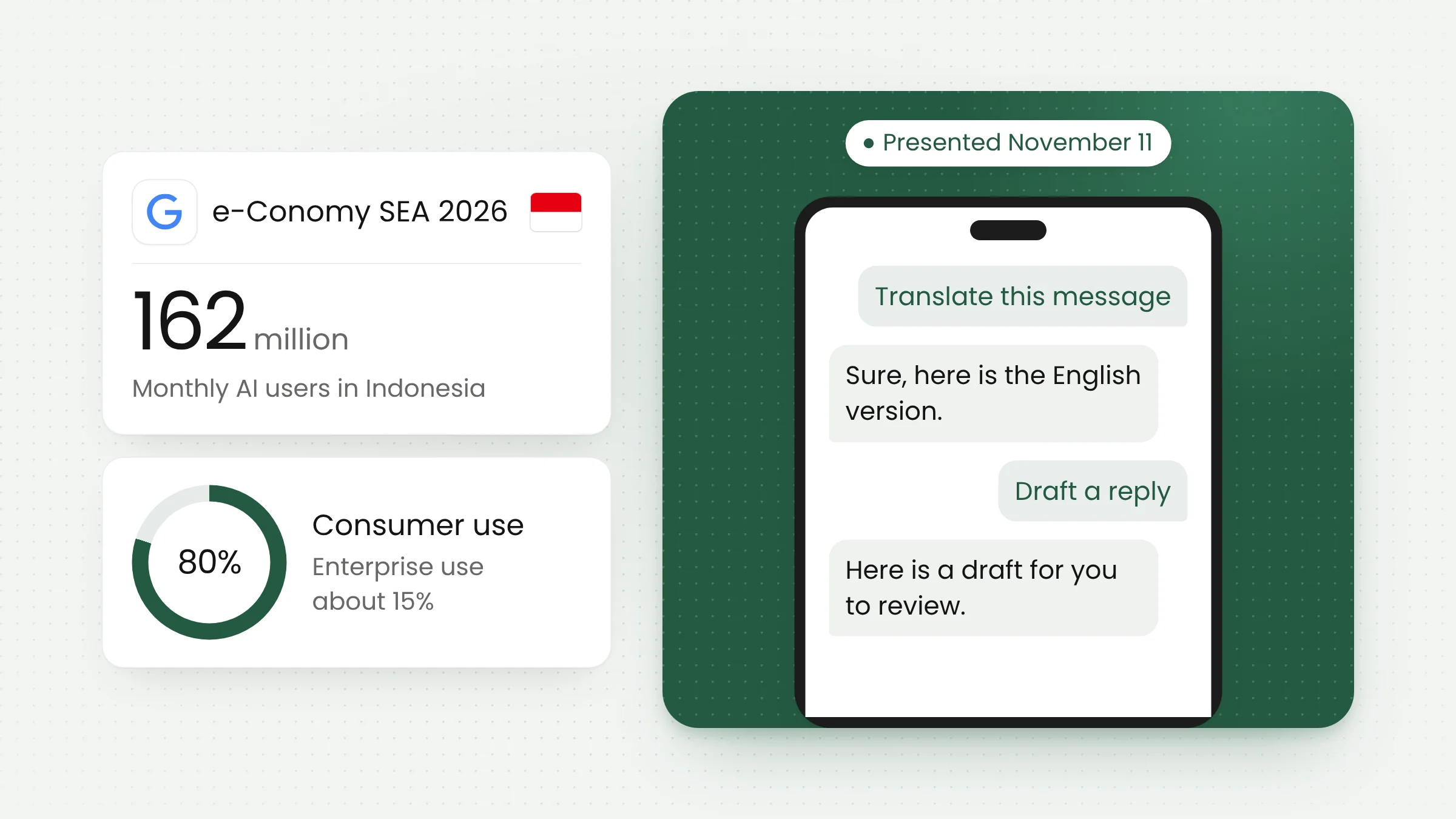
Indonesia has 162 million monthly AI users, the largest base in Southeast Asia, according to the e-Conomy SEA 2026 report that Google presented in Jakarta on Wednesday, November 11, 2026. Yet about 80% of AI use in the country is consumer-driven, while enterprise adoption stands at roughly 15%.
The annual report is produced by Google with Temasek and Bain & Company. This 11th edition, titled “Building the Intelligent Economy,” is the first to measure AI use in tokens alongside the gross transaction values the series usually tracks. Below are the key Indonesian figures, how to read the token metric, the limits of the data, and practical steps for companies and small businesses.
Indonesia’s digital economy in 2026
The regional edition of the report came out on October 21, 2026. According to Google’s official blog, Southeast Asia’s digital economy is expected to reach US$368 billion in gross merchandise value (GMV) in 2026, up 17%, and is projected to pass US$1 trillion by 2035.
Indonesia-specific data was presented in Jakarta by Veronica Utami, Country Director of Google Indonesia. As reported by Antara, Indonesia’s digital economy grew 16% to US$119 billion, or about Rp2.1 quadrillion, despite pressure on the global economy.
E-commerce remained the largest contributor at US$85 billion in GMV, up 16% from 2025. Online media came second at US$12 billion and grew the fastest of the sectors, at 28%. Ride-hailing and food delivery reached US$11 billion, up 10%, and online travel reached US$11 billion, up about 6%.
In digital financial services, digital lending grew fastest at 22% a year. Indonesia also has 17 digital banks, and Veronica said the country leads the region in digital banking. Over the longer term, the report expects growth of about 16% a year to continue, taking Indonesia’s digital economy to US$446 billion to US$550 billion by 2035.
Databoks Katadata noted that video commerce and e-commerce were the main growth drivers this year. The same report lists macroeconomic volatility and financial pressure as short-term challenges.
Tokens as a new measure of AI use
This year’s report introduces tokens as a measure of AI activity. A token is a small chunk of text, often part of a word, that an AI model processes when it reads a prompt and writes a response. The more numerous and complex the tasks given to AI, the more tokens it consumes.
On user numbers, Indonesia stands out. Veronica told Antara that Indonesia has the largest AI user base in the region, with 162 million monthly users. She said Indonesian users submit about 69 billion queries to AI tools each year.
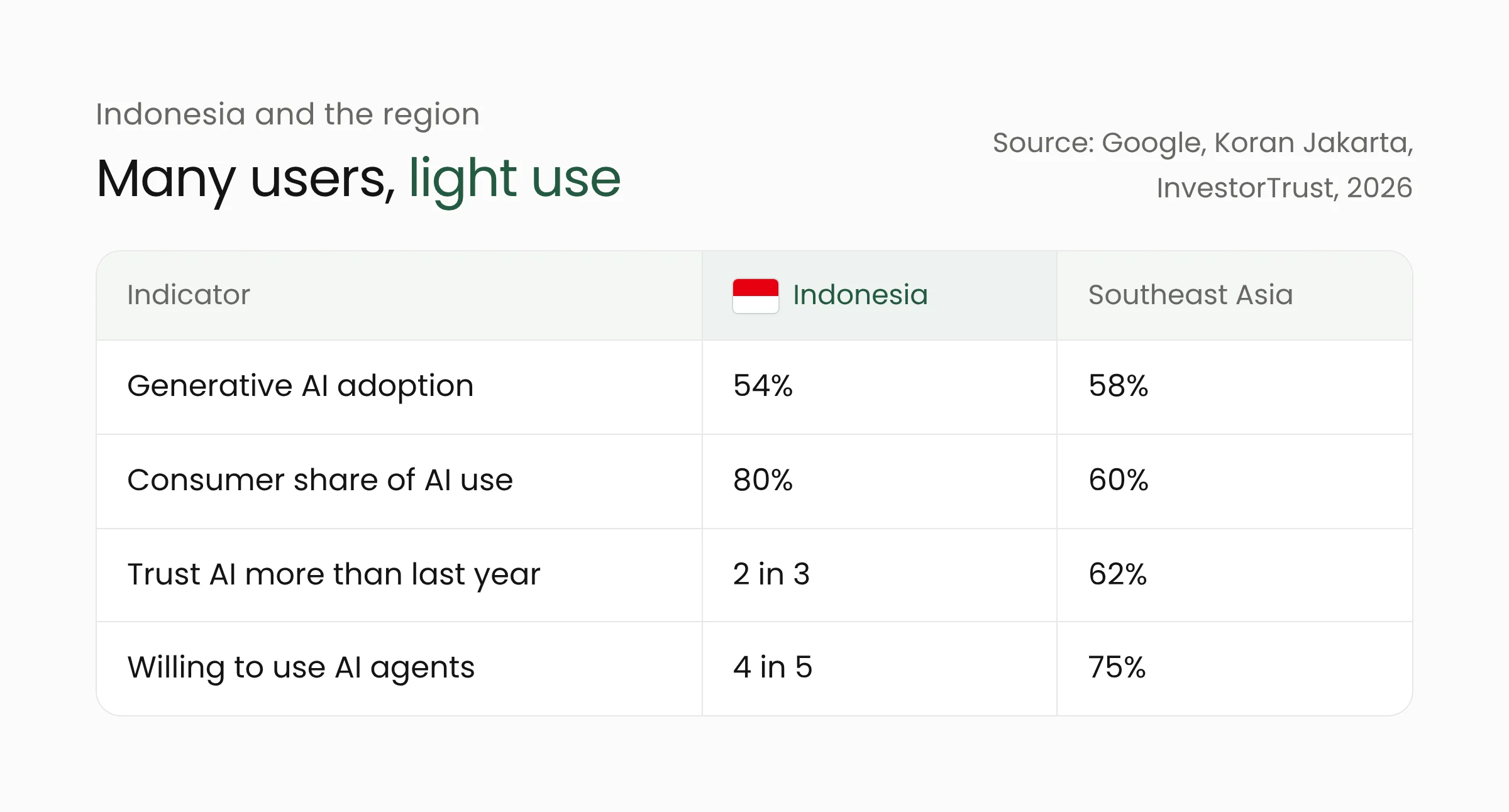
Depth of use is another matter. Token use per person in Southeast Asia, Indonesia included, is only about 10% of the level in the United States. In Indonesia, about 80% of AI workload comes from consumers, for tasks such as translating text or drafting messages. Enterprise adoption, including complex tasks such as writing code, is around 15%.
Across the region, consumers account for about 60% of AI use. In Singapore and Malaysia, enterprise workloads already make up 45% to 60% of usage, according to TNGlobal. Veronica pointed to the habit of accessing AI on mobile phones as one reason for Indonesia’s pattern.
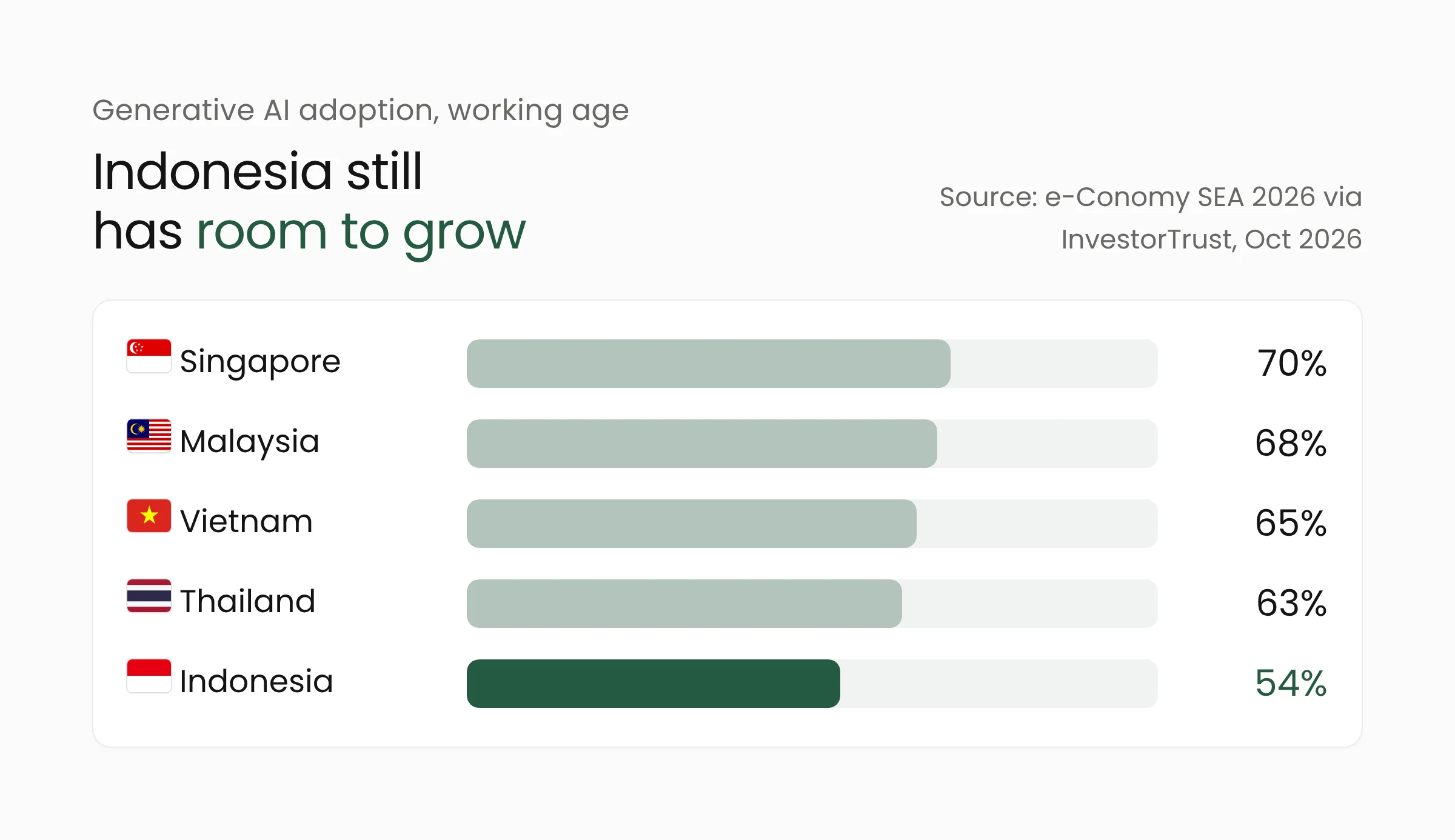
Generative AI adoption tells a similar story. According to InvestorTrust, about 54% of Indonesia’s internet-connected working-age population uses generative AI. That is below Singapore (70%), Malaysia (68%), Vietnam (65%) and Thailand (63%), which leaves plenty of room to grow. Across the region, 243 million people, or 58% of the working-age population, use generative AI.
Most users also pay nothing. InvestorTrust reported that only about 1% to 2% of the population in Southeast Asia’s six largest markets pays for a personal generative AI account.
Trust in AI agents
The report also measures how willing people are to hand tasks to AI agents, meaning AI that can carry out several steps on its own, such as comparing prices and completing a purchase. Across the region, 75% of users would let an AI agent do that, and 62% say they trust AI more than they did a year ago.
In Indonesia, two in three AI users now trust AI more than a year earlier, according to Koran Jakarta. Four in five are willing to delegate digital transactions and purchase decisions to AI agents, provided there are limits and safeguards.
Users are clear about the safeguards they expect. Google’s blog says respondents across the region cited privacy protections (44%), transparency about what AI can do (36%) and the ability to reverse transactions made by an agent (30%).
Reading the report’s numbers with care
A few caveats apply. First, the user counts measure different things. The 162 million figure refers to monthly AI users, while Koran Jakarta reported that about 105 million people, or 54% of the productive-age population, use generative AI. The two numbers describe different groups and do not contradict each other.
Second, tokens are a new metric, so there is no earlier baseline for comparison. Token counts also depend on language, response length and model type, so they do not map directly onto economic value or productivity. The consumer and enterprise shares are best read as a signal of direction.
Third, the projections come with conditions. The report estimates that AI use in the region could grow up to 60-fold by 2030. That depends on affordable agentic AI, roughly tripling data center capacity over five years, energy-efficiency rules and the ASEAN Digital Economy Framework Agreement (DEFA), which is expected in November 2026. Google, one of the report’s authors, also sells AI models and cloud capacity.
What this means for businesses and SMEs
Veronica said the next challenge is to deepen AI use among companies and micro, small and medium enterprises. She urged companies to invest in targeted skills and literacy training so that staff can build products with AI. For business owners, the data offers several practical pointers.
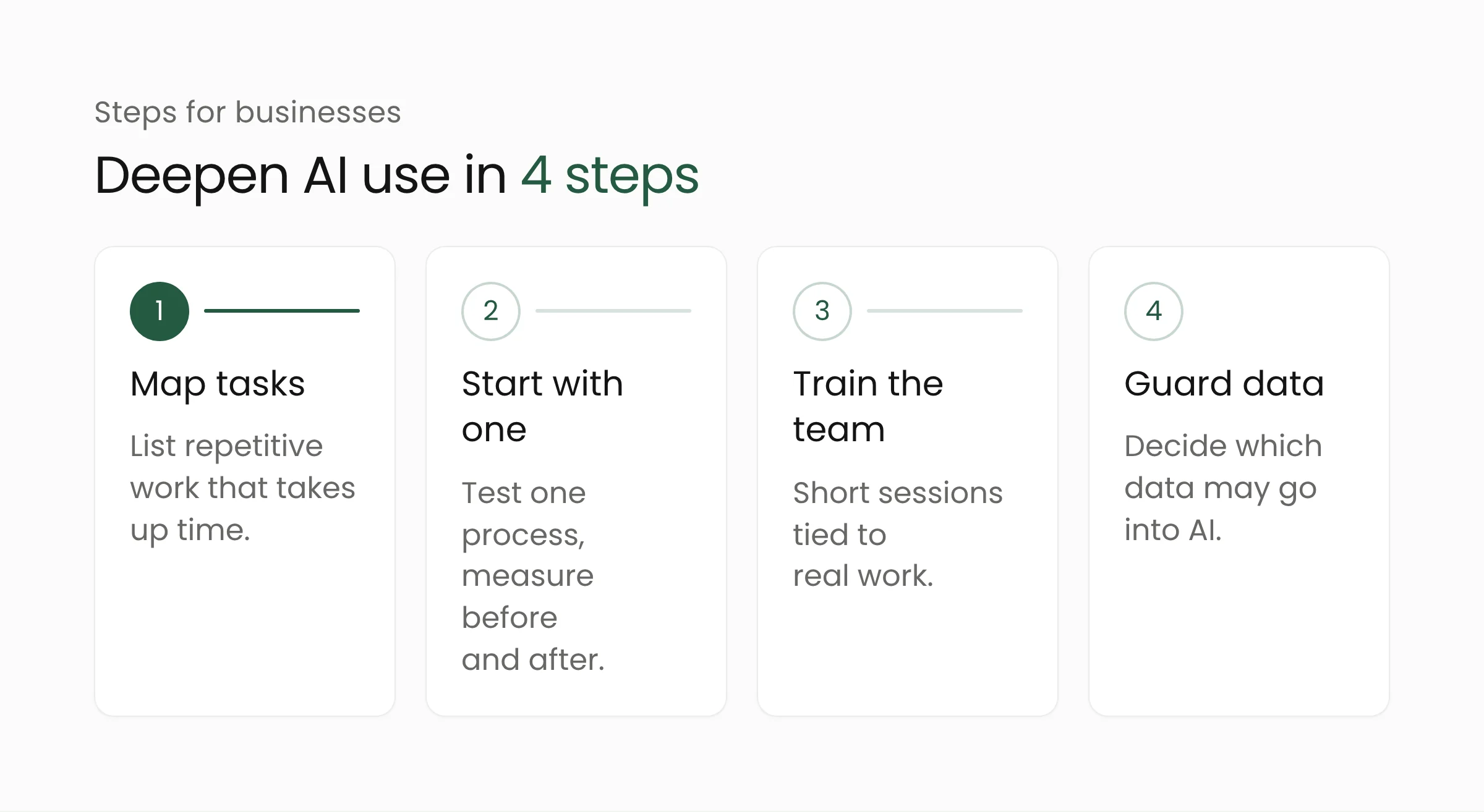
- Map repetitive tasks. List the daily work that eats up time, such as answering customer questions, cleaning sales data or preparing reports. These tasks are the easiest for AI to support.
- Start with one process. Pick a single workflow, measure how long it takes before and after using AI, and then decide whether to expand. This is safer than buying many tools at once.
- Train the team for real work. Short sessions tied directly to daily tasks, such as writing clear instructions or checking AI output, are more useful than general introductions.
- Set data safeguards. Decide which data may and may not be entered into AI services, especially customer data covered by Indonesia’s Undang-Undang Pelindungan Data Pribadi (Personal Data Protection Law).
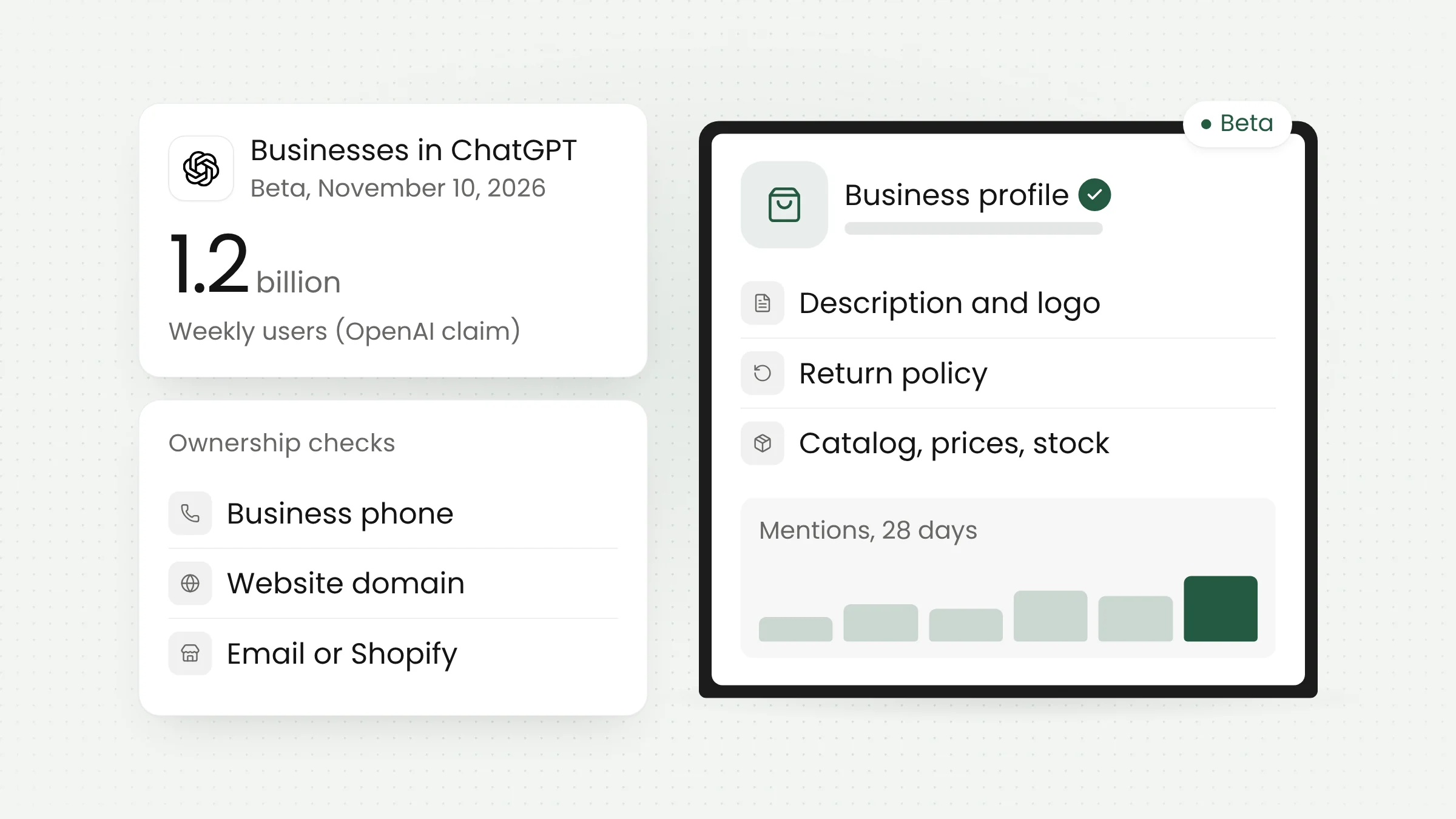
For shops and small businesses selling online, the trust figures for AI agents deserve attention. If buyers start asking AI to compare prices and complete purchases, product details, stock levels and store policies need to be available in a format machines can read. This shift is already visible in features such as Businesses in ChatGPT, which lets stores manage their profiles and catalogs inside ChatGPT. Clean catalog and inventory data, usually kept in a retail management system, is the foundation for being represented correctly by AI services.
For larger companies, the enterprise share in Singapore and Malaysia hints at what comes next. Deeper AI use usually means connecting AI to internal data such as documents, sales systems or customer service knowledge bases. That stage calls for artificial intelligence services planning that covers data integration, security and measurement of results.
Frequently asked questions
What is the e-Conomy SEA report?
e-Conomy SEA is an annual report on Southeast Asia’s digital economy produced by Google, Temasek and Bain & Company. The 2026 edition is the 11th and focuses on AI use, under the title “Building the Intelligent Economy.”
How many AI users does Indonesia have, according to the report?
Google Indonesia says the country has 162 million monthly AI users, the most in Southeast Asia. About 54% of the internet-connected working-age population already uses generative AI.
Why is AI use in Indonesia described as shallow?
About 80% of AI workload in Indonesia still comes from consumer use, such as translation and drafting text. Enterprise use for complex tasks such as coding is around 15%, and token use per person in the region is about 10% of the US level.
Conclusion
The e-Conomy SEA 2026 report shows that Indonesians are already comfortable with AI, while use at work is still lagging. For companies and small businesses, that gap is an opportunity to apply AI to higher-value work, as long as they start from real needs and put data safeguards in place. If your team wants to map which processes AI could support, the Merakit team is ready to talk it through.
Sources
- Southeast Asia’s digital economy to hit $368 billion, Google, October 21, 2026
- Southeast Asia digital economy can reach $368B GMV in 2026, AI usage to surge, TNGlobal, October 21, 2026
- 243 Juta Orang ASEAN Pakai AI, tetapi Mayoritas Masih Gratisan, InvestorTrust, October 27, 2026
- Google: Indonesia punya basis pengguna AI terbesar di Asia Tenggara, Antara, November 11, 2026
- Ekonomi digital RI tumbuh Rp2,1 kuadriliun di 2026 meski ekonomi berat, Antara, November 11, 2026
- Pengguna AI Indonesia Tertinggi di Asia Tenggara, Ekonomi Digital Menuju 119 Miliar Dollar AS, Koran Jakarta, November 11, 2026
- Laporan Google, Temasek, Bain: Ekonomi Digital Indonesia Menguat pada 2026, Databoks Katadata, November 11, 2026