Blog Data Centers
Equinix JK1 Phase 2 Opens: What It Means for Banks
On this page· 7 sections
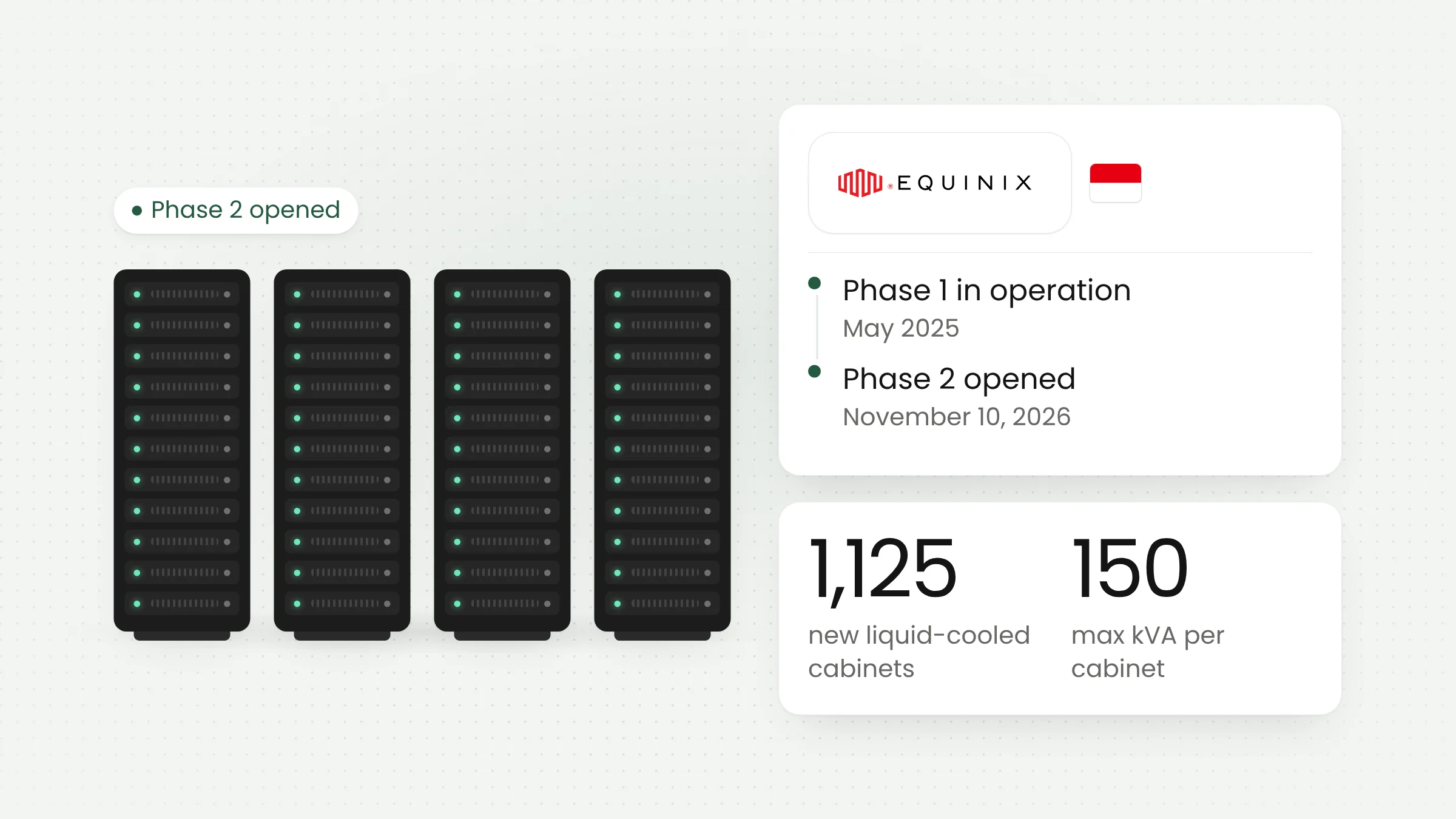
Equinix opened Phase 2 of its JK1 data center in Jakarta on Tuesday, November 10, 2026. The expansion adds about 1,125 liquid-cooled server cabinets aimed at AI workloads and brings total investment in JK1 to US$94 million. The company says JK1’s capacity has tripled since the site first opened.
For organizations that want to run AI models on their own hardware, the news touches several practical questions: where to put power-hungry servers, how to keep them cool, and how to connect them to cloud services. This piece covers what the expansion includes, how liquid cooling works, how to read the site’s energy-efficiency figures, and what banks and other financial institutions should consider.
What JK1 Phase 2 adds
JK1 is Equinix’s first International Business Exchange (IBX) data center in Indonesia. According to ITNews Asia, the eight-story facility in Jakarta’s central business district was built through a joint venture with PT Astra International Tbk, and it began operating in May 2025.
The first phase has two data halls cooled by air. The second phase adds four data halls that use liquid cooling. Katadata put the US$94 million investment at roughly Rp1.7 trillion, while Warta Ekonomi reported about Rp1.69 trillion. Fortune Indonesia said the figure is up from US$74 million at the Phase 1 launch and that JK1 will reach a total of 1,600 cabinets.
Power draw has grown with it. Haris Izmee, president director of Equinix Indonesia, said JK1 now uses about 700 kW, up from roughly 100 kW when it opened last year. He expects most of the data hall space to be filled within six months, citing demand since the start of the year from AI, gas, mining, and banking customers.
Direct links to four cloud providers
Beyond raw capacity, JK1 offers connections to many networks. The site hosts about 70 internet service providers and 60 network providers, and it connects directly to Amazon Web Services, Microsoft Azure, Google Cloud, and Alibaba Cloud. Warta Ekonomi reported that connectivity capacity on the Equinix Internet Exchange at JK1 grew 46% quarter on quarter.
These direct connections are often called cloud on-ramps. Servers that a company places in JK1 can exchange data with cloud services over a private network instead of the public internet. That setup is common in hybrid architectures, where core systems stay on company-owned servers while analytics or AI runs in the cloud.
Jakarta’s place in regional capacity
Nezar Patria, Indonesia’s deputy minister of communication and digital affairs, spoke at the opening. He said Indonesia’s data center capacity is close to 600 MW today and is projected to pass 2 GW by 2029, while Malaysia has reached about 3 GW. He also cited a McKinsey estimate that Asia Pacific could account for about 34% of global data center demand by 2030, as reported by detikInet.
Nezar argued that success should be measured by the value data centers create for local companies and the public, and that Indonesia should be more than a place where infrastructure sits and technology is consumed. Haris added that Equinix is open to expanding to other cities such as Bali and Makassar, depending on customer demand.
Why AI racks need liquid cooling
Servers that train and run AI models pack many graphics processors (GPUs) into a single rack. The denser the computing, the more heat it produces. Reich Stenitho, lead sales engineer at Equinix, said air cooling at JK1 supports up to 30 kVA per cabinet, while liquid cooling supports up to 150 kVA per cabinet.
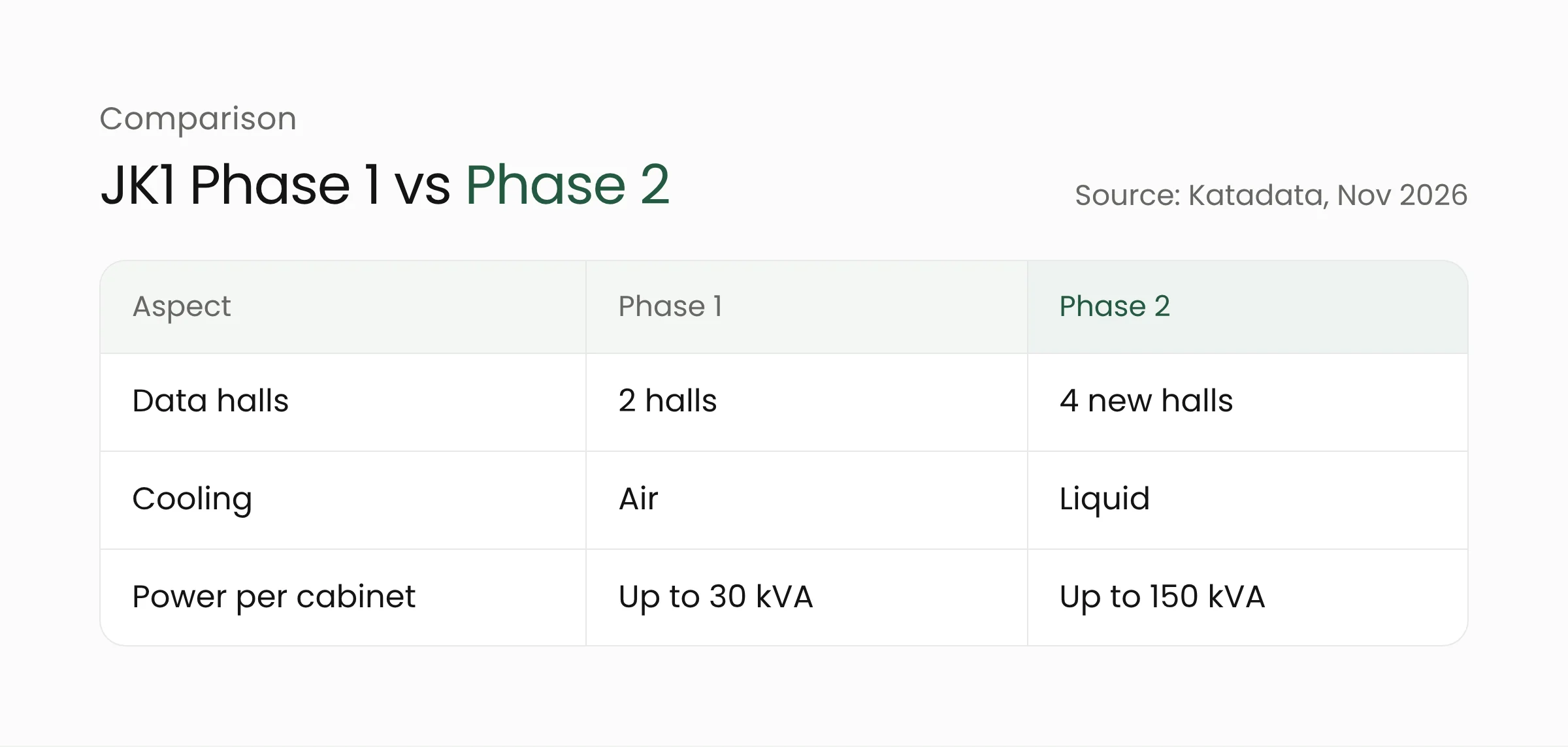
Liquid absorbs and carries heat far more efficiently than air. With liquid cooling, a single cabinet can hold much more powerful servers without overheating the room. For tenants, a workload that would have to be spread across several air-cooled cabinets can fit into one cabinet in Phase 2.
On water, Equinix says all of the water used for cooling at JK1 runs through a closed-loop system. The coolant circulates in sealed pipes and does not evaporate into the open air, which keeps water use low. Fortune Indonesia reported that Equinix keeps its data halls at around 25°C and tracks water usage effectiveness (WUE) across its data centers.
How to read the PUE and green energy claims
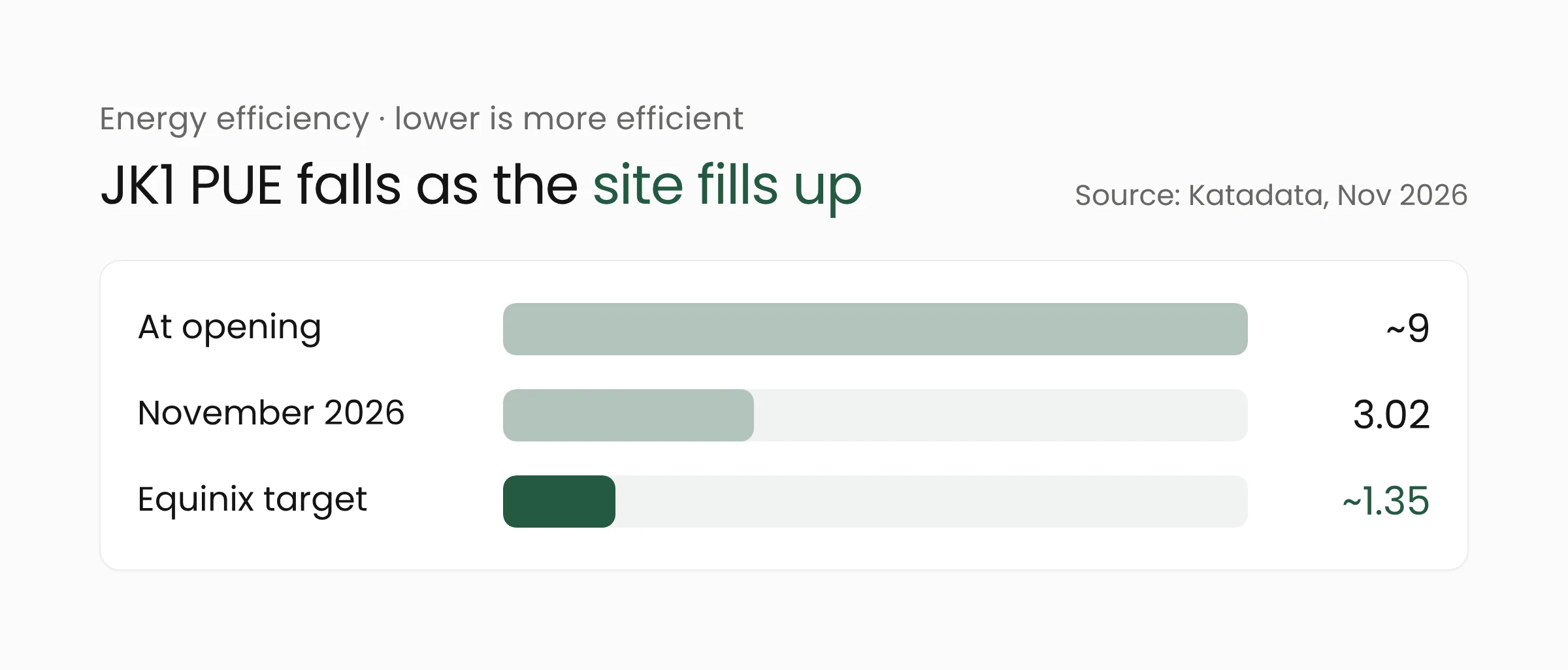
Data center energy efficiency is usually measured with power usage effectiveness (PUE): total facility energy divided by the energy used by IT equipment. A value of 1.0 would mean every watt goes to the servers. The higher the number, the more electricity goes to cooling, lighting, and other support systems.
Haris said JK1’s PUE is currently about 3.02, and Equinix is targeting about 1.35. When the site first opened, the figure was around 9. A high number is expected in a building that is only partly occupied, because cooling and support systems keep running while the server load is still small. As more customers move in, the IT load grows and PUE falls. For comparison, ITNews Asia reported in 2025 that JK1 was designed for an average PUE of 1.41 at full load.
Equinix also claims that all of JK1’s electricity comes from renewable sources through the purchase of renewable energy certificates (RECs). A certificate represents renewable power generated on the grid, so it does not necessarily mean the electricity entering the building comes directly from a solar or wind plant. The claim comes from Equinix and had not been independently verified in the coverage available.
What this means for banks and financial institutions
Banking is one of the sectors named among JK1’s users. Banks and financial institutions hold sensitive customer data and are starting to use AI for fraud detection, credit scoring, and customer service. For IT teams in this sector, the JK1 expansion adds an option, and a few points deserve attention before reserving capacity.
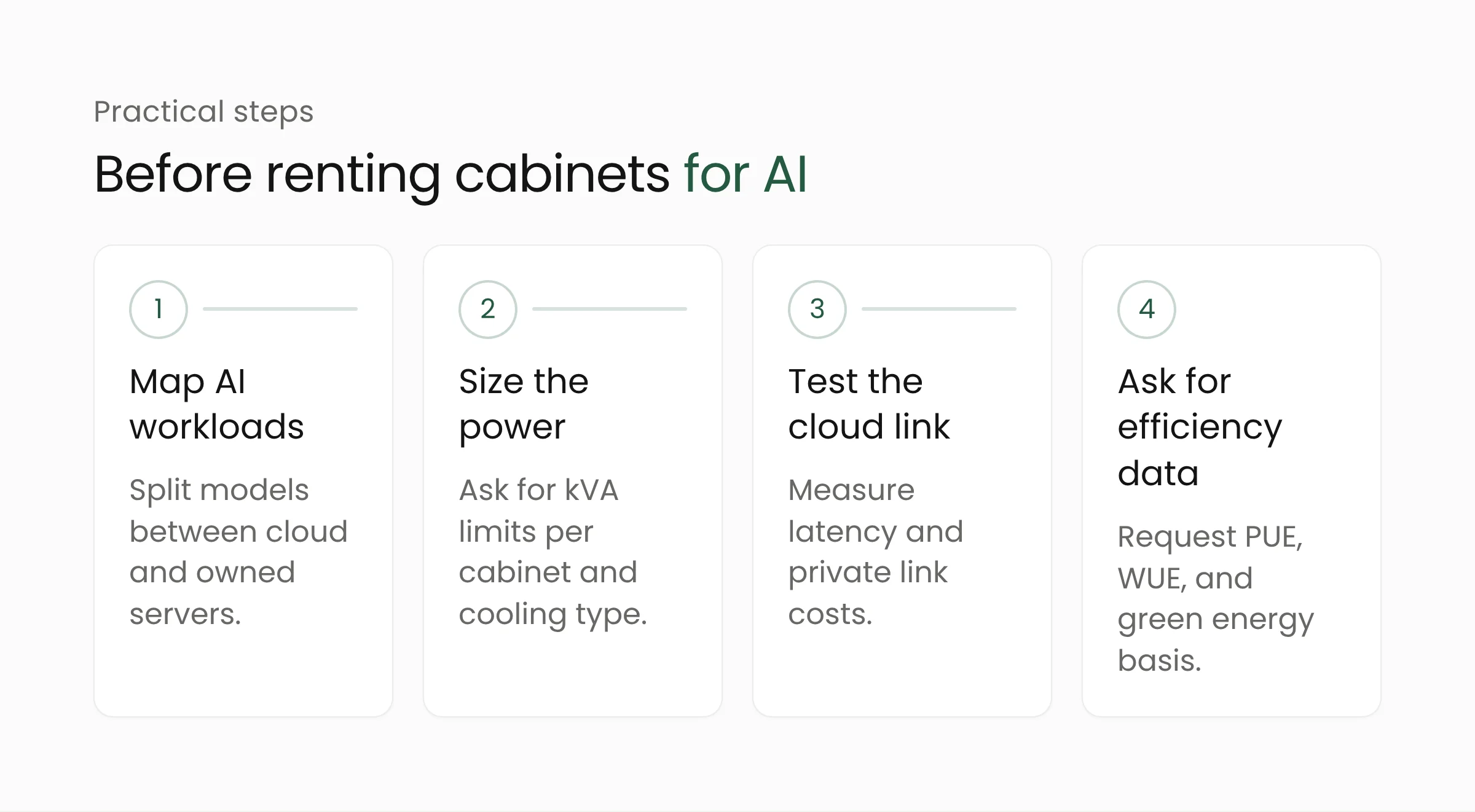
- Map your AI workloads. Separate models that can run comfortably in the public cloud from those that need to stay on your own servers because of the data involved or latency requirements. Only the second group needs high-power cabinets.
- Size power per cabinet. High-power GPU servers can exceed what an air-cooled hall supports. Ask providers for their kVA limit per cabinet, the type of liquid cooling they support, and what it costs.
- Test the link to the cloud. If your architecture is hybrid, confirm that a private connection to your cloud provider is available at the site, then measure latency and data transfer costs. Our cloud computing services team can help design that split.
- Get efficiency data in writing. Request PUE and WUE figures and the basis for any renewable energy claim. This data supports sustainability reporting and helps estimate long-term power costs.
Timing matters as well. If Haris is right that most of the space fills within six months, organizations planning AI projects for 2027 should start talking to providers now. A similar point came up when NTT DATA opened its JKT2A data center in Jakarta: the choice of sites in Jakarta is growing, and each provider offers different power limits per rack. For a broader view of system needs in the sector, see our financial services solutions.
Frequently asked questions
What is Equinix JK1?
JK1 is Equinix’s first IBX data center in Indonesia, located in Jakarta and built with Astra. It began operating in May 2025, and Phase 2 opened on November 10, 2026, adding about 1,125 liquid-cooled cabinets.
Why do AI data centers use liquid cooling?
Dense AI servers generate far more heat than conventional servers. At JK1, air cooling supports up to 30 kVA per cabinet and liquid cooling up to 150 kVA, so one cabinet can hold more powerful hardware.
Does a PUE of 3.02 mean JK1 wastes energy?
The figure reflects a building that is not yet full, since support systems keep running even when the server load is small. Equinix is targeting a PUE of about 1.35 as more customers move in. The final result can only be judged once the halls are occupied.
Conclusion
The JK1 expansion gives organizations in Indonesia another way to run AI on their own hardware while staying connected to public clouds. Capacity is limited and demand is rising, so early planning will shape both cost and readiness. If your team is weighing how to split workloads between owned servers and the cloud, Merakit can help map out the requirements.
Sources
- Equinix Investasi Rp 1,7 Triliun untuk Tambah Kapasitas Data Center di Jakarta, Katadata, November 10, 2026
- Equinix Klaim Pakai Energi Ramah Lingkungan untuk Data Center di Jakarta, Katadata, November 10, 2026
- Equinix Ekspansi Data Center JK1, Tambah Kapasitas 1.125 Kabinet, Fortune Indonesia, November 10, 2026
- Equinix Gelontorkan Investasi Rp1,69 triliun untuk Perluas Pusat Data di Jakarta, Warta Ekonomi, November 10, 2026
- Kapasitas Data Center Indonesia Masih Kalah dari Malaysia, detikInet, November 11, 2026
- Equinix opens its first IBX data centre in Jakarta to meet enterprise demand, ITNews Asia, May 16, 2025