Blog Databases
ExtendDB 1.0 Brings the DynamoDB API to Your Own Servers
On this page· 7 sections
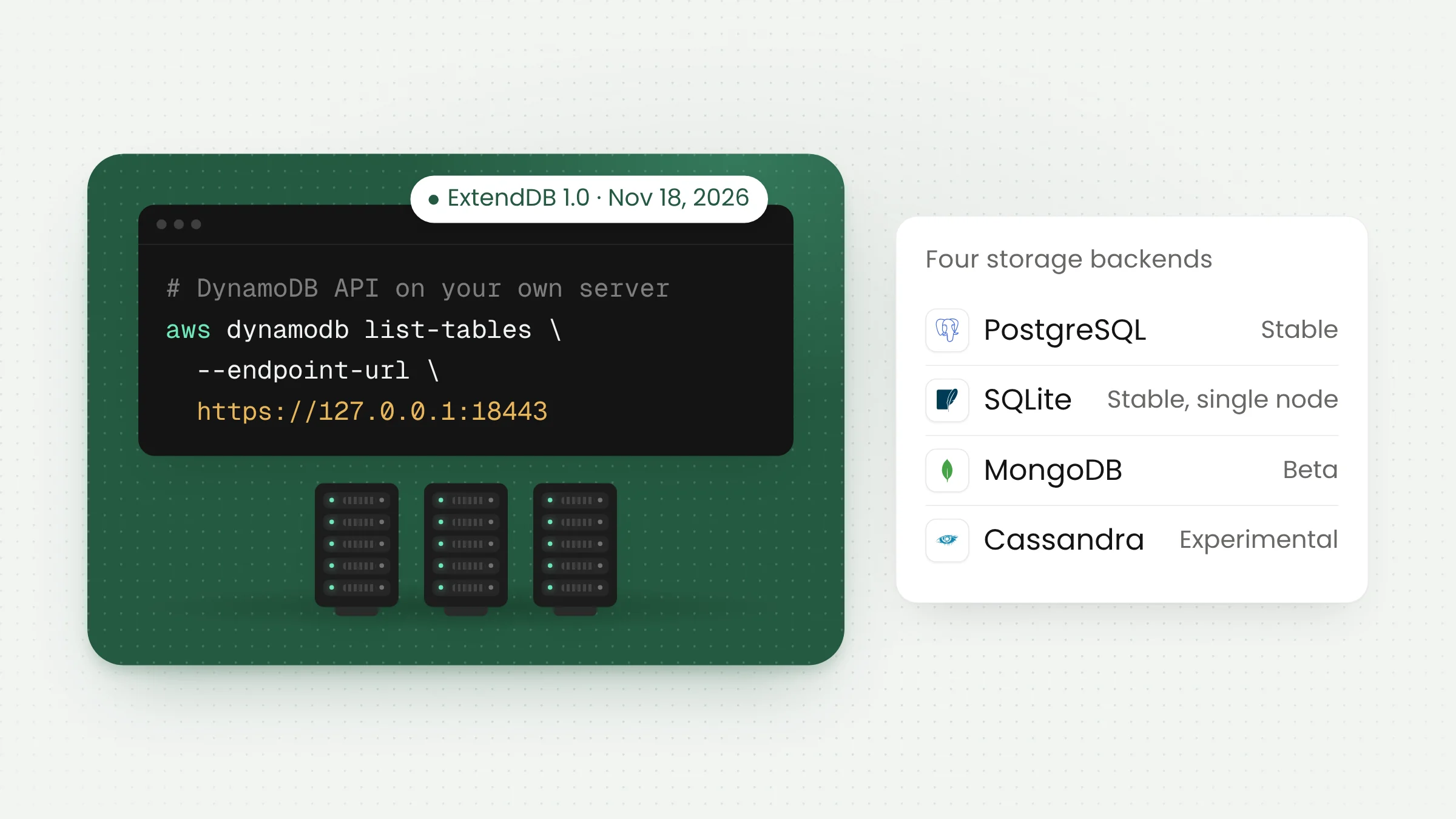
AWS released ExtendDB 1.0 on November 18, 2026. The open source adapter lets applications written for Amazon DynamoDB run on PostgreSQL, SQLite, MongoDB, or Cassandra that a team operates itself. AWS calls 1.0 the first release for production use, and the project documents several limits worth reading first.
ExtendDB 1.0 is the first release for production
DynamoDB is the managed NoSQL database service from AWS. It exists only in the AWS cloud, so an application built on it is hard to move into a company data center without rewriting its data access layer. ExtendDB was built to close that gap.
According to the AWS announcement, ExtendDB runs on a database backend the user chooses. Developers and infrastructure teams can run DynamoDB workloads in on-premises data centers, in private or public clouds, and at the edge without rewriting application code. The project is maintained by AWS, licensed under Apache 2.0, and developed in the open on GitHub.
ExtendDB was first introduced on May 20, 2026, on the AWS Database Blog. At that point it was a v0.1 release for development, testing, and experimentation, with PostgreSQL as the only backend.
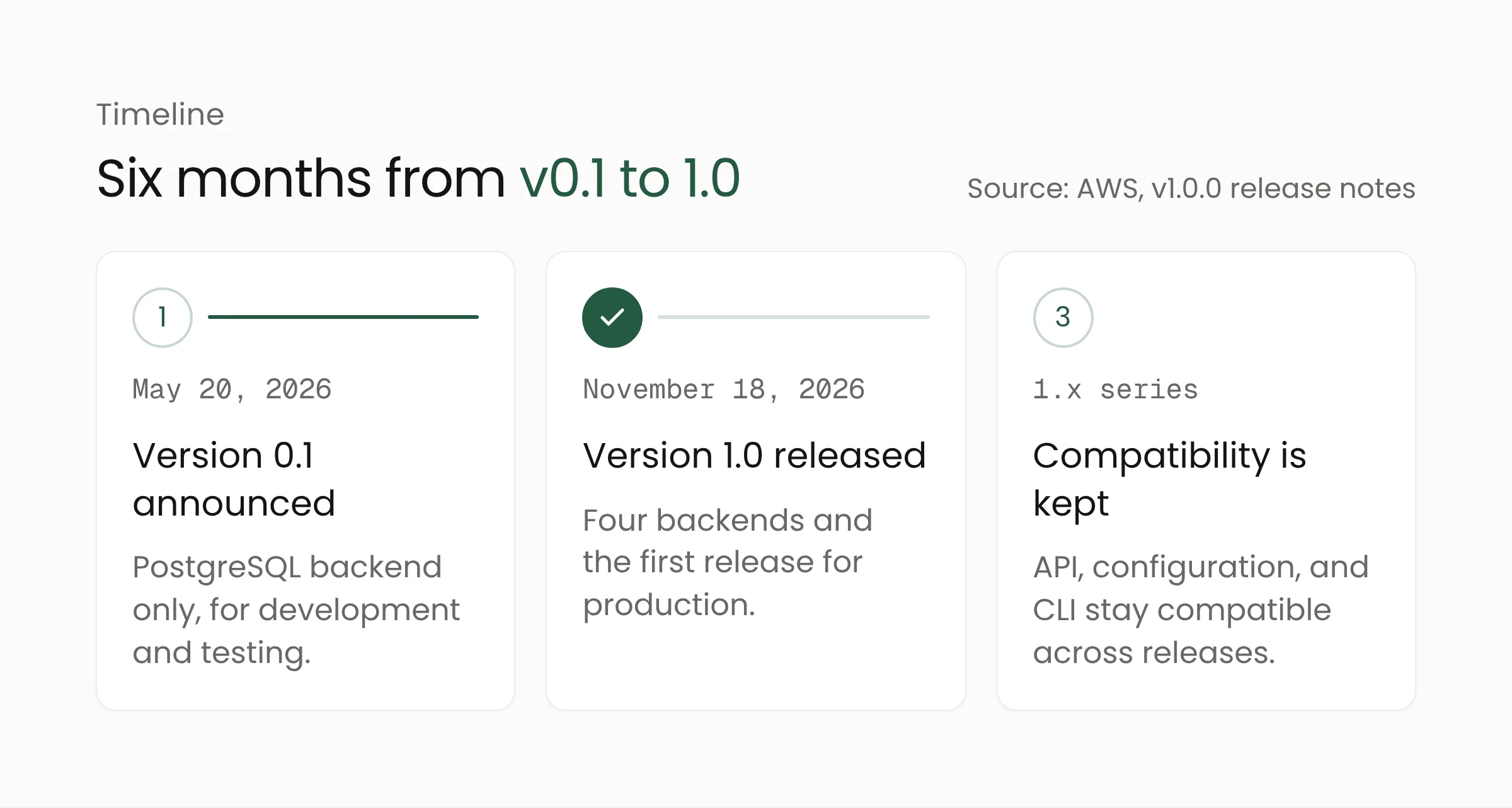
The May post gave an example of the need behind it. A major airline runs most of its applications on AWS with DynamoDB, yet its gate and onboard systems must keep working through network outages. Without a compatible runtime, that team maintains two application stacks with different data access layers.
How the adapter works
ExtendDB is written in Rust and implements the DynamoDB wire protocol. AWS describes it as a translator sitting between an application and its storage backend. The application sends requests in DynamoDB format, ExtendDB translates them, and the database behind it stores the data.
Because the protocol is the same, AWS SDKs, the AWS CLI, and other DynamoDB tools continue to work. The application only needs its endpoint setting pointed at the ExtendDB server. The example in the project README uses https://127.0.0.1:18443 with the command aws dynamodb list-tables.
Each request is signed with SigV4, as it would be for an AWS service, using an access key issued by the ExtendDB server. Connections use TLS with a certificate generated automatically at setup, which can be replaced with one signed by a certificate authority.
Supported operations include table management, item reads and writes, Query, Scan, batch operations, transactions, Streams, Time to Live (TTL), and import and export.
Four backends at different levels of readiness
The 1.0 label does not mean all four backends are equally mature. The README sorts them into three tiers. Stable is for production. Beta is for production within documented limits. Experimental is for evaluation only.
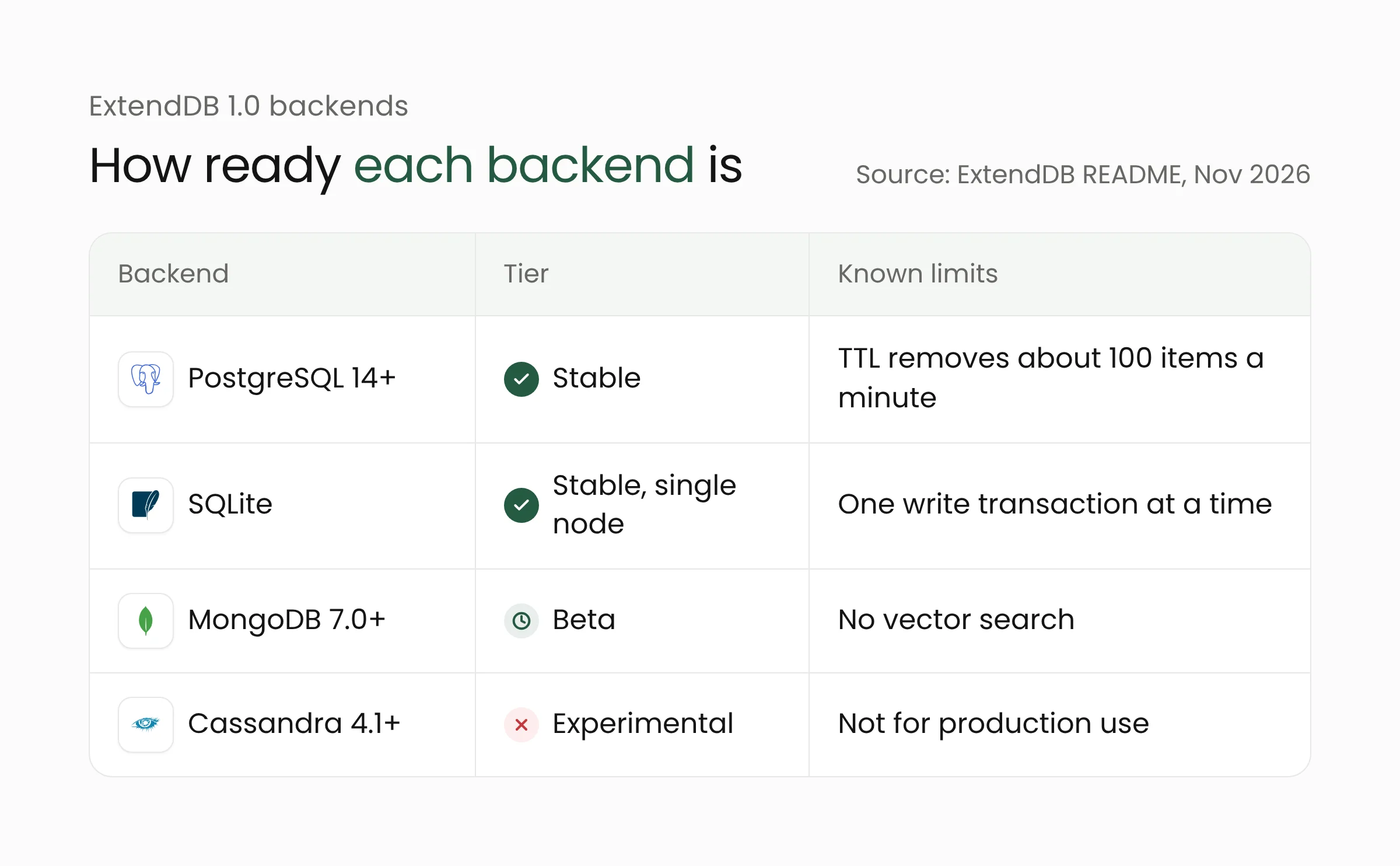
- PostgreSQL is the default backend and is rated Stable. It requires PostgreSQL 14 or later. Vector search needs the pgvector extension.
- SQLite is rated Stable for a single node. The database runs inside the server process and handles one write transaction at a time. There is no production container image for this backend.
- MongoDB is rated Beta and requires MongoDB 7.0 or later running as a replica set. Vector search is unavailable, and numbers in key attributes are limited to 34 significant digits.
- Cassandra is rated Experimental and requires Cassandra 4.1 or later. The README says this backend is not for production use, and the versioning policy does not apply to it.
For local development and continuous integration, AWS provides the extenddb-dev container image and the @extenddb/dev npm package. Both run a DynamoDB-compatible endpoint over SQLite with no external database. This mode uses plain HTTP and seeds an example key that can perform every operation. The v1.0.0 release notes warn against running that image in production.
The same release notes set out a compatibility promise. Throughout the 1.x series, the DynamoDB operations already implemented, configuration keys, and CLI commands stay stable. The 0.1.x releases receive no further fixes. Production images are published for amd64 and arm64 on Docker Hub, ECR Public, and GHCR, and are signed with Sigstore.
How ExtendDB differs from the DynamoDB service
The ExtendDB README opens by stating the project’s boundaries: “It is not Amazon DynamoDB and does not contain any DynamoDB source code.” It is a separate implementation of the same API, and it is not offered as an AWS service.
The first consequence is operational. With DynamoDB, AWS handles replication, recovery, and scaling. With ExtendDB, the user provides the database, and replication, failover, and database backups are handled with that database’s own tools.
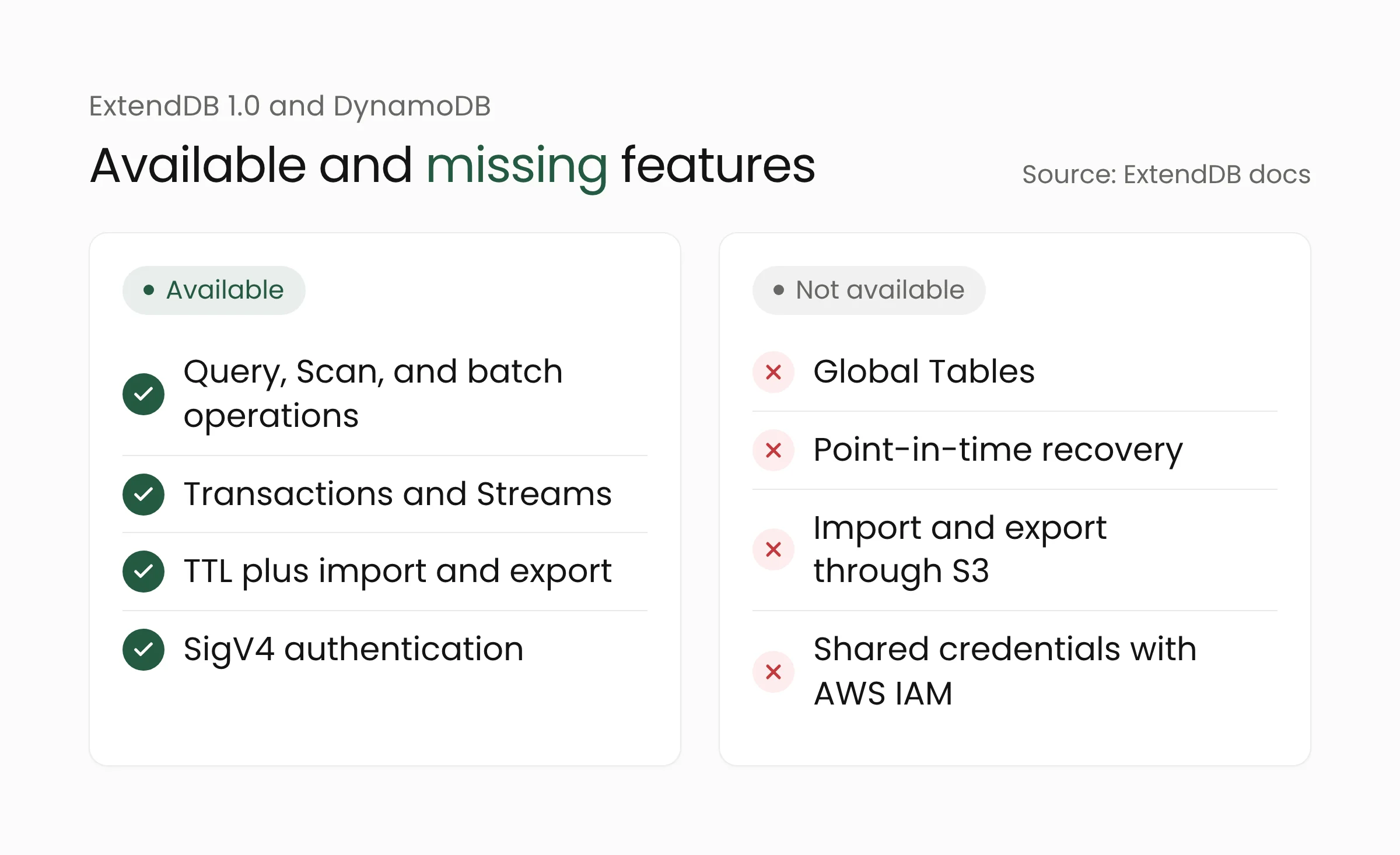
The Differences from DynamoDB document lists more:
- Global Tables are not implemented. Requests for this cross-Region replication feature return an
UnknownOperationExceptionerror. - Point-in-time recovery is not supported. On-demand backups through
CreateBackupandRestoreTableFromBackupare available in its place. - Import and export use local files. In DynamoDB, the source and destination are S3 buckets.
- Credentials are separate from AWS IAM. Users, groups, roles, and policies are created inside ExtendDB. Federated roles through SAML or web identity are not implemented.
- One server per catalog. Running more than one ExtendDB server against the same catalog is not supported in 1.0.
- Transaction behavior can differ. On the PostgreSQL backend, write transactions contending for the same item are queued, so the
TransactionConflicterror that DynamoDB would return is not sent.
On performance, the 1.0 announcement carries no benchmark figures. When version 0.1 came out, InfoQ quoted a Reddit user who reported high latency under heavy write load. That report came from one user on an early version and may not hold for 1.0. The production-readiness claim from AWS has not been tested independently either, so teams still need to test with their own workloads.
What this means for developers and system operators
ExtendDB matters to organizations that already use DynamoDB or are considering it, especially when part of a system has to run outside AWS. Examples include a bank or government agency that keeps certain data in its own data center, a retail chain whose branch point-of-sale systems must keep serving customers when the internet link drops, or a factory with servers on the production floor.
Some steps to consider:
- Start with development and CI. This use carries the least risk. The
@extenddb/devpackage and theextenddb-devimage run tests with no cloud connection and no service charges. Make sure a dev-mode server is reachable only from the machine it runs on. - Choose a backend by its tier. For production, PostgreSQL carries the fullest promise. MongoDB can be used with attention to its documented limits. Cassandra is better left until it moves up a tier.
- Match the features your application uses. Check whether the application depends on Global Tables, point-in-time recovery, imports from S3, or
TransactionConflicthandling. The differences document works as a checklist. - Plan database operations. Backups, replication, monitoring, and upgrades become the team’s responsibility. The ExtendDB
/healthendpoint does not query the database behind it, so database monitoring has to be set up separately. - Manage access keys on their own track. ExtendDB credentials are not linked to AWS IAM. The team needs its own procedure for issuing, rotating, and revoking keys.
- Test performance with real access patterns. Run load tests with data sizes and write patterns close to production before deciding.
For teams designing a new system, the more basic question is whether the DynamoDB data model fits at all. If the whole system will run on company servers and there is no plan to use AWS, working with PostgreSQL directly is usually simpler. ExtendDB is most useful when one codebase has to run in two places, on DynamoDB and outside AWS.
These trade-offs resemble the ones we covered in our article on SaaS and self-hosted software and our look at the private AWS link to Azure. In web application development projects, the database decision is usually made together with the infrastructure design under cloud computing services, because both shape cost and operational load for years.
Frequently asked questions
Can ExtendDB replace DynamoDB?
For some needs, yes. ExtendDB implements the same API, so application code does not have to change. It does not provide the automated management, Global Tables, or point-in-time recovery of the DynamoDB service.
Is ExtendDB free?
The software is licensed under Apache 2.0, so it can be used and modified without license fees. The remaining costs are servers, the database behind it, and the team’s time to operate it. AWS does not offer ExtendDB as a managed service.
How is it different from DynamoDB Local?
DynamoDB Local is a single-process tool from AWS intended for unit testing. ExtendDB targets broader use, including production on your own servers, with SigV4 authentication, an IAM-like permission system, and a choice of backends.
Closing
ExtendDB 1.0 gives DynamoDB users a way to take the same application into their own data center, another cloud, or a site with limited connectivity. Backend readiness varies, some managed-service features are absent, and running the database becomes the user’s job.
Merakit helps organizations design data and application architecture, including the choice between managed services and systems they run themselves. If your team is weighing that decision, our web application development service is a good place to start the conversation.
Sources
- AWS What’s New: AWS announces ExtendDB 1.0 (November 18, 2026)
- ExtendDB on GitHub: v1.0.0 release notes (November 18, 2026)
- ExtendDB on GitHub: project README (accessed November 24, 2026)
- ExtendDB on GitHub: Differences from DynamoDB (accessed November 24, 2026)
- AWS Database Blog: Introducing ExtendDB (May 20, 2026)
- InfoQ: AWS Open Sources ExtendDB to Run DynamoDB on PostgreSQL (June 7, 2026)