Blog Semiconductors
FPT Chip Testing Plant Starts Trials: What It Means
On this page· 7 sections
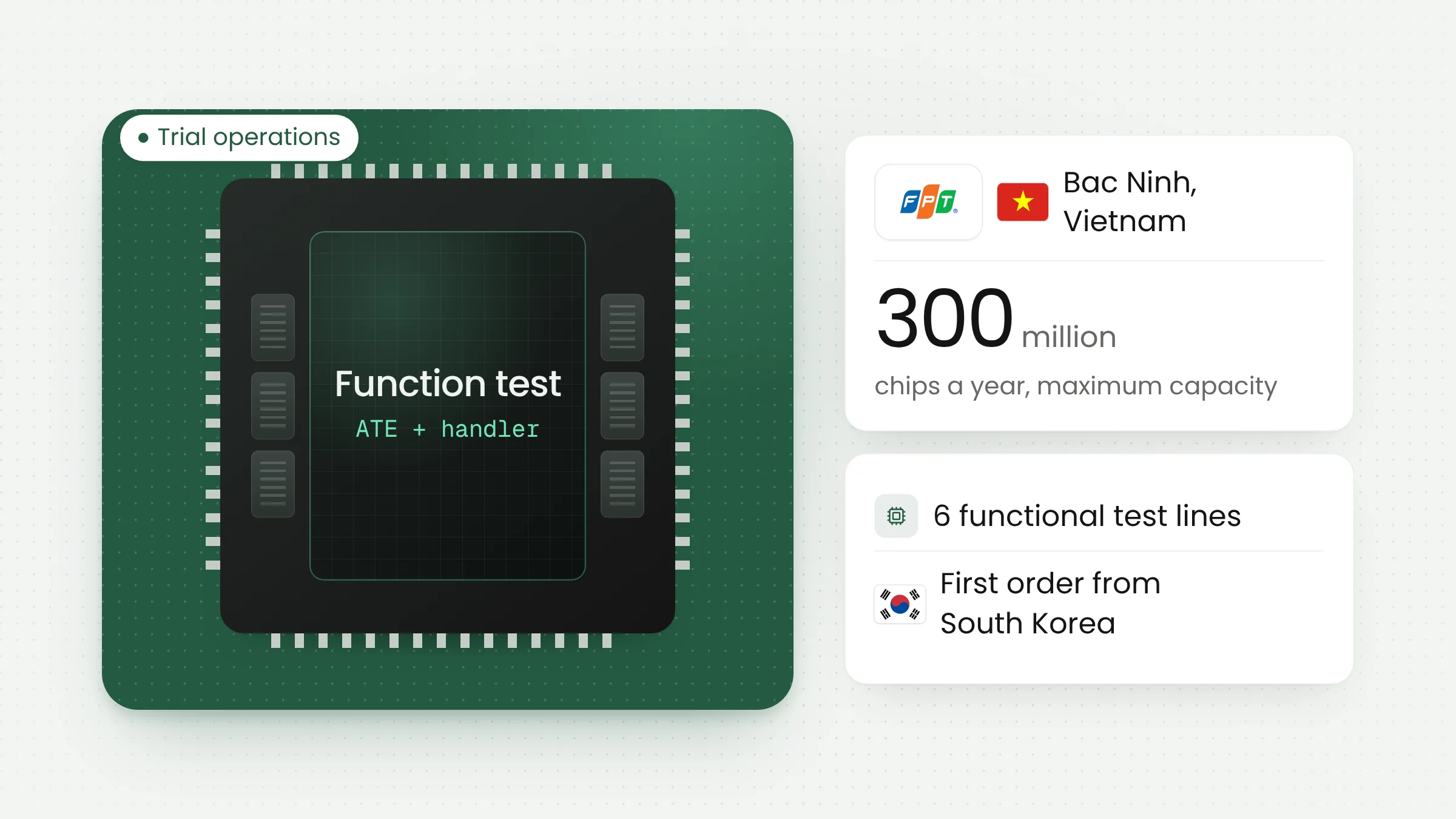
FPT Corporation began trial operations at its chip testing plant in Bac Ninh, northern Vietnam, on November 3, 2026. The facility has six production lines and a maximum design capacity of 300 million chips a year, and it is described as the first chip testing and packaging plant owned by a Vietnamese company.
A 1,600 square meter plant in Bac Ninh
The plant sits in the Yen Phong II-C Industrial Park in Bac Ninh Province and is operated by FPT Analysis Technologies Joint Stock Company. According to FPT’s press release, it covers 1,600 square meters, with six production lines and a maximum design capacity of 300 million chips per year. FPT, a Vietnamese technology group, says it has more than 10 years of experience in the semiconductor industry.
The trial phase is limited to testing. All six lines handle functional testing, which confirms that each chip works as designed, along with quality and reliability testing. Chip packaging is not part of the initial operations; FPT describes it as the next stage of development.
VnEconomy reports that the first commercial order comes from an unnamed South Korean partner, marking the start of FPT’s commercial chip testing business. The company says the service is open to both domestic and international semiconductor firms.
The testing area is a Class 10,000 (ISO Class 7) cleanroom built to the ISO 14644 standard, meaning airborne dust particles are tightly controlled. The plant also uses electrostatic discharge controls and follows the ISO 9001 (quality), ISO 14001 (environment) and ISO 45001 (occupational health and safety) management standards. FPT says its team includes specialists with years of experience at Intel’s plant in Vietnam.
Phase two runs to 2030
When FPT announced the plant on January 28, 2026, it laid out two phases. According to a Bac Ninh News report republished by Gilimex, phase one (2026 to 2027) covers about 1,600 square meters with six functional test lines and a reliability testing area.
Phase two (2028 to 2030) would expand the site to about 6,000 square meters, adding more functional test lines as well as conventional and advanced packaging lines. Capacity is planned to reach billions of units a year. FPT also intends to strengthen testing for high-end chips used in IoT, automotive and edge AI system-on-chip (SoC) applications.
How chip testing works on FPT’s lines
Not every chip that leaves a wafer fab works. Testing makes sure only good parts reach device makers. At FPT’s plant, the work relies on two types of machines. Automated Test Equipment (ATE) sends electrical signals into each chip and checks its function and performance. A handler moves chips into the test position and then sorts them into pass and fail groups.
Each chip type needs its own test program, written by engineers to define the parameters, test conditions and how results are judged. FPT says it is developing an AI-based platform to automate the creation of these programs. The company has not said when the platform will be used on its production lines.
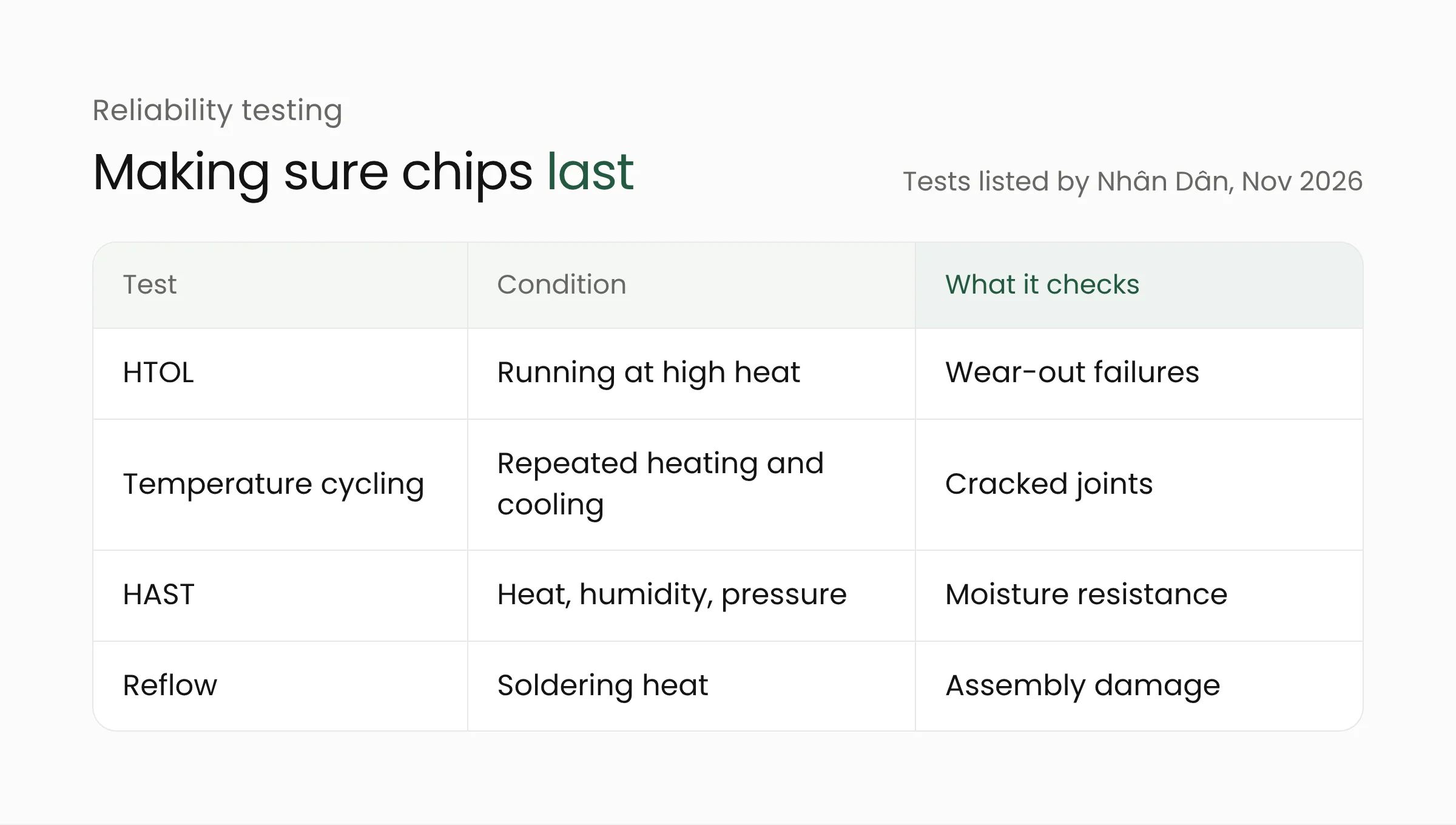
Functional testing shows whether a chip works when it leaves the plant. Reliability testing shows whether it keeps working after long use. According to Nhân Dân, FPT’s reliability lab runs the following tests.
- HTOL (High Temperature Operating Life): chips run at high temperature for long periods to bring forward failures that would normally appear with age.
- LTOL (Low Temperature Operating Life): a similar test at low temperature.
- Temperature cycling: chips are heated and cooled repeatedly to stress their joints and packaging.
- HAST (Highly Accelerated Stress Test): chips are exposed to high temperature and humidity under pressure to check resistance to moisture.
- Reflow: a simulation of the heat chips face when they are soldered onto a circuit board.
FPT aims to have its reliability testing area meet international standards for the competence of testing and calibration laboratories. That matters for overseas customers, who need results from one lab to be comparable with results from another.
Testing as Vietnam’s entry point into chips
Chipmaking is usually split into three broad stages: design, wafer fabrication in a fab, and the packaging and testing work known as the back end. FPT’s plant shows that the testing stage can start in a 1,600 square meter facility and grow step by step.
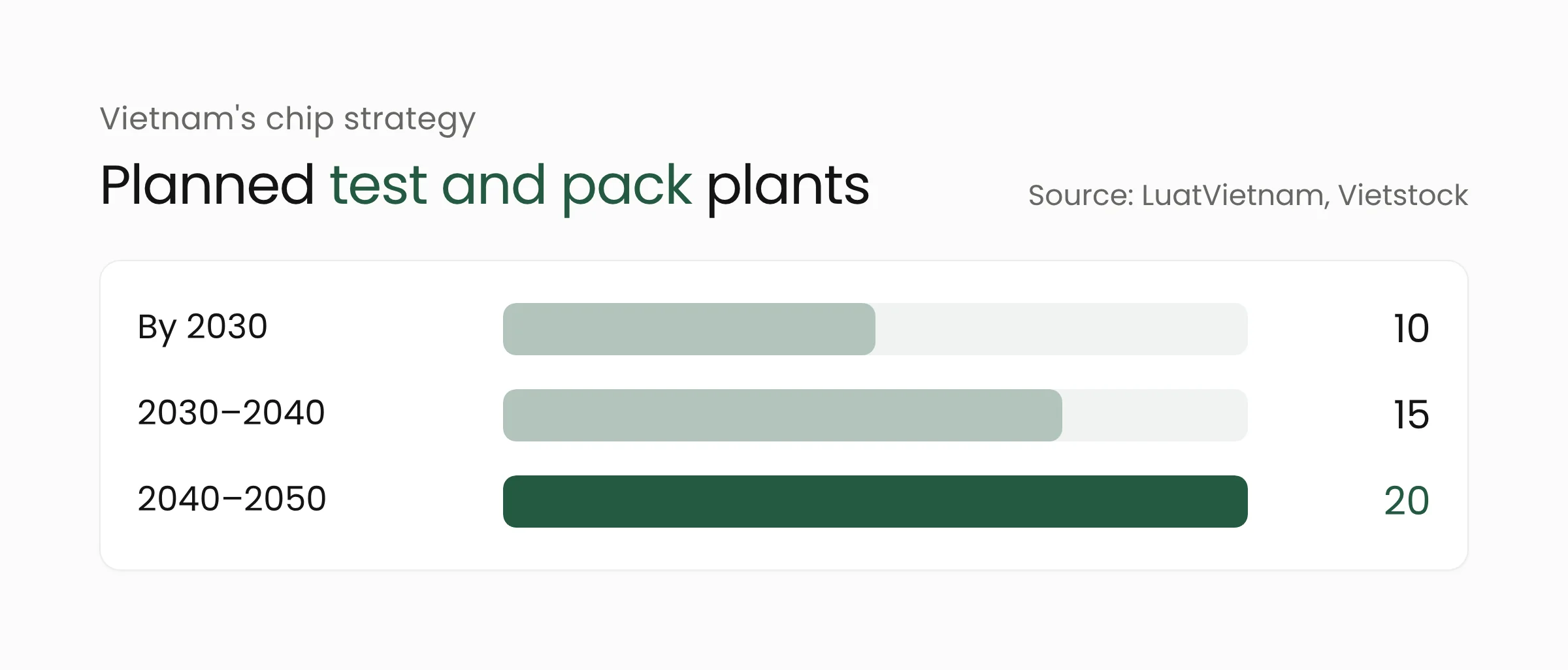
The move fits Vietnam’s national strategy. Prime Minister’s Decision No. 1018/QD-TTg of September 21, 2024 sets out the semiconductor strategy to 2030 with a vision to 2050. According to LuatVietnam, the first phase (2024 to 2030) targets at least 100 chip design companies, one small-scale fab and 10 packaging and testing plants, with semiconductor revenue above US$25 billion a year.
Vietstock reports that the packaging and testing target rises to 15 plants in the 2030 to 2040 phase and 20 in the 2040 to 2050 phase, while the number of fabs is set to grow to two and then three.
Workforce goals sit in a companion semiconductor human resources program, Decision No. 1017/QD-TTg, signed the same day. It targets more than 50,000 semiconductor engineers and graduates by 2030. According to Bac Ninh News, at least 35,000 of them are meant for manufacturing, packaging, testing and related stages. FPT plans a pilot program with FPT Polytechnic from December 2026 that gives students hands-on time on the test lines.
How this relates to Indonesia’s chip plans
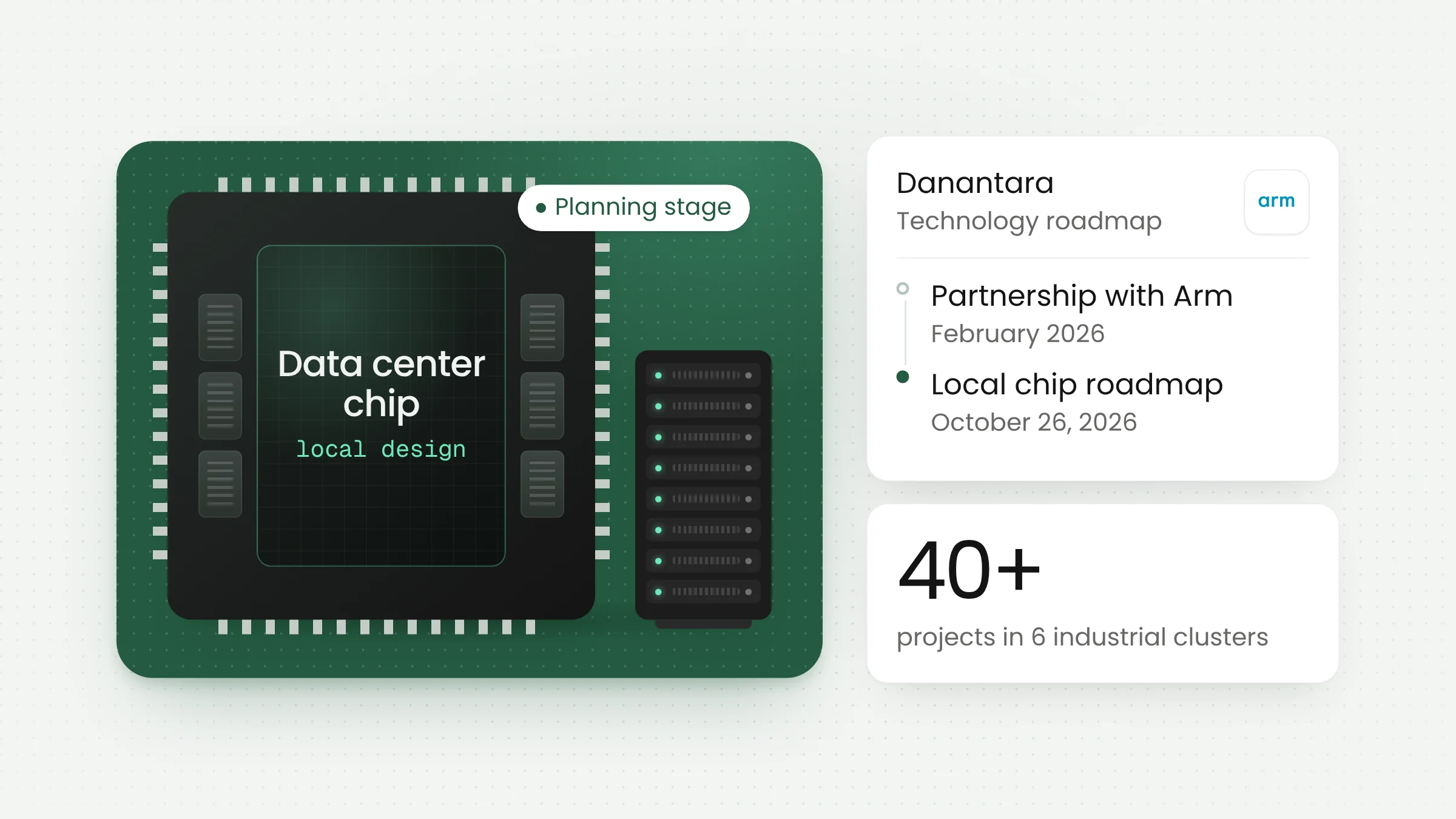
Indonesia is taking a different route. Under a partnership between Danantara and Arm signed in London on February 23, 2026, the government aims to train 15,000 engineers in chip design, backed by initial funding of US$150 million, ANTARA reported. Coordinating Minister for Economic Affairs Airlangga Hartarto listed six national chip designs, including automotive, Internet of Things (IoT), data center and home appliance chips. We covered the plan in Danantara’s push into local chips and data center equipment.
Indonesia is concentrating on design for now, while Vietnam is building capacity in testing. The two stages depend on each other: a chip design still has to be fabricated, packaged and tested before it can go into a device. Available sources do not say where Indonesia’s national chip designs will be tested.
A new testing provider in Southeast Asia adds options for chip design firms in the region. FPT wants to expand testing for IoT and automotive chips, segments that also appear on Indonesia’s list of national designs. The progress of the Bac Ninh plant, including how much of its capacity is used and how many customers it signs, is worth watching for Indonesia’s electronics industry.
What this means for device makers and factories
Most companies in Indonesia do not buy chip testing services directly. They buy modules, sensors and controllers with chips inside. Understanding how chips are tested still helps when assessing suppliers. Heat and humidity at many Indonesian factories, warehouses and field sites make reliability testing relevant for any device installed outside an air-conditioned office.
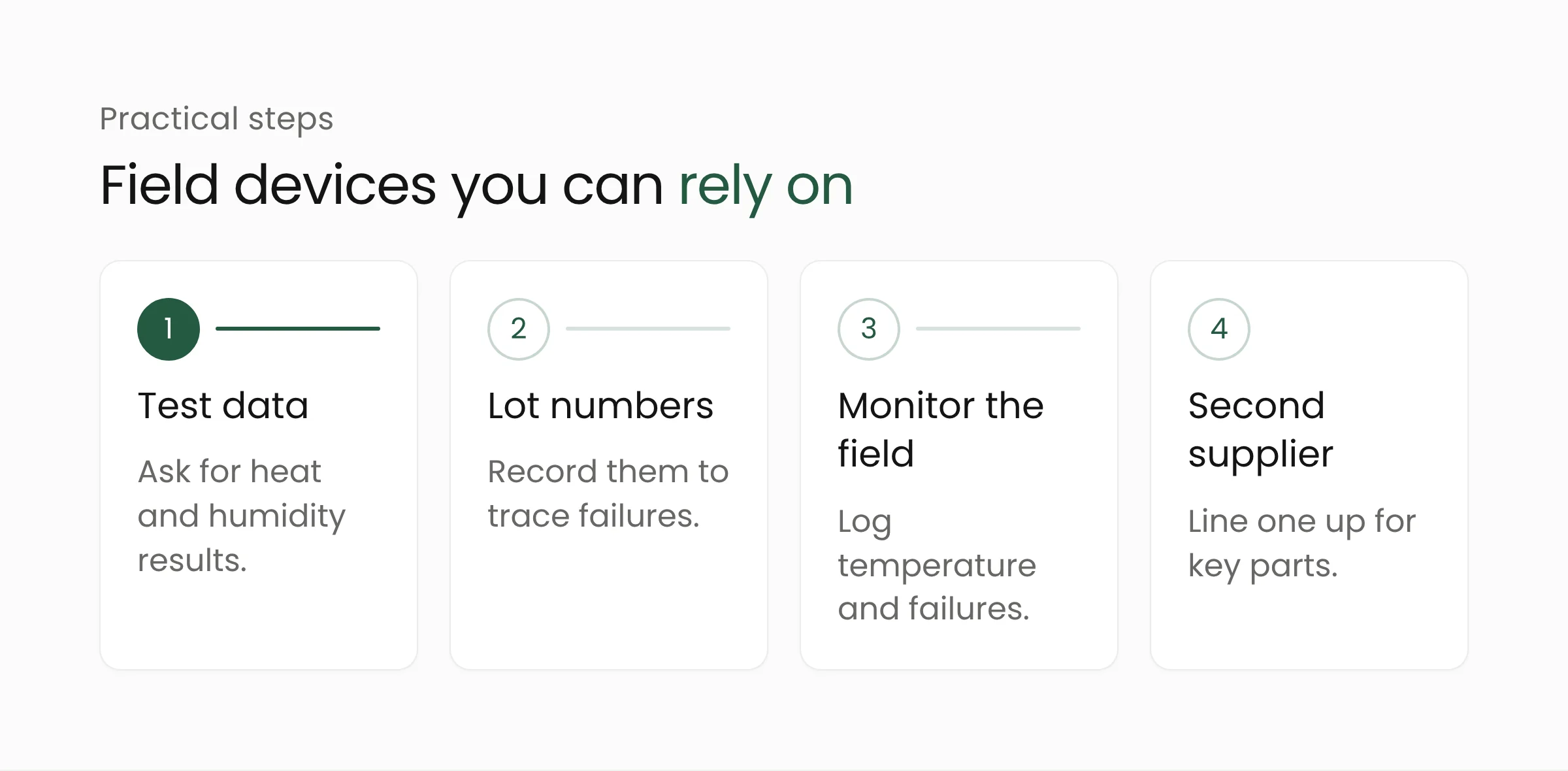
- Ask suppliers for reliability data. For sensors and controllers installed outdoors or in hot production areas, ask for high temperature, temperature cycling and humidity test results. The data helps estimate device lifespan.
- Record component lot numbers. If devices fail at an unusual rate, lot numbers let the supplier trace test results for that batch.
- Monitor conditions in the field. Temperature and humidity readings from panel rooms, along with failure records, show whether field conditions exceed the limits suppliers tested for. An IoT services approach can start with a few critical points.
- Line up a second supplier. A backup supplier for critical components helps keep a plant running when the main supply is disrupted.
For plants preparing industrial automation projects, the reliability of electronic components affects how often a production line stops because of a failed device. Clean failure records also make maintenance planning and spare parts stocking easier.
Frequently asked questions
How is chip testing different from chip manufacturing?
Manufacturing, or fabrication, prints circuits onto silicon wafers in a fab. Testing comes afterward to confirm that chips work as designed and will last. FPT’s Bac Ninh plant handles testing, with packaging planned for a later phase.
What kinds of chips does FPT’s plant test?
FPT has not specified which chips are being tested during the trial phase. The first order comes from an unnamed South Korean partner. When it announced the plant in January 2026, FPT said it planned to strengthen testing for IoT, automotive and edge AI SoC chips.
Does the plant package chips yet?
No. The trial phase focuses on functional and reliability testing. Under the plan announced in January 2026, conventional and advanced packaging lines are part of phase two, from 2028 to 2030.
Conclusion
The trial run at FPT’s Bac Ninh plant shows how Vietnam is building a chip industry from the testing stage, in line with its target of 10 packaging and testing plants by 2030. The next measures are how much capacity is actually used and how many customers follow the first order. If your company is preparing IoT devices or machine monitoring that must hold up in the field, the Merakit team is ready to talk.
Sources
- FPT via PR Newswire: FPT semiconductor chip Testing and Packaging plant officially begins trial operations in Bac Ninh (November 3, 2026)
- VnEconomy: Vietnam’s semiconductor chip testing and packaging plant enters trial operations (November 3, 2026)
- Nhân Dân: Trial operations begin at first Vietnamese-owned semiconductor chip testing and packaging plant (November 3, 2026)
- Gilimex (Bac Ninh News): FPT announces semiconductor testing, packaging plant in Bac Ninh (January 29, 2026)
- LuatVietnam: Premier issues strategy for development of Vietnam’s semiconductor industry (September 24, 2024)
- Vietstock: Strategy issued to develop Việt Nam’s semiconductor industry (September 24, 2024)
- ANTARA: Indonesia targets 15,000 engineers to master chip design technology (February 24, 2026)