Blog Cloud Computing
Google TPUs on Oracle Cloud: AI Chip Choice for Industry
On this page· 7 sections
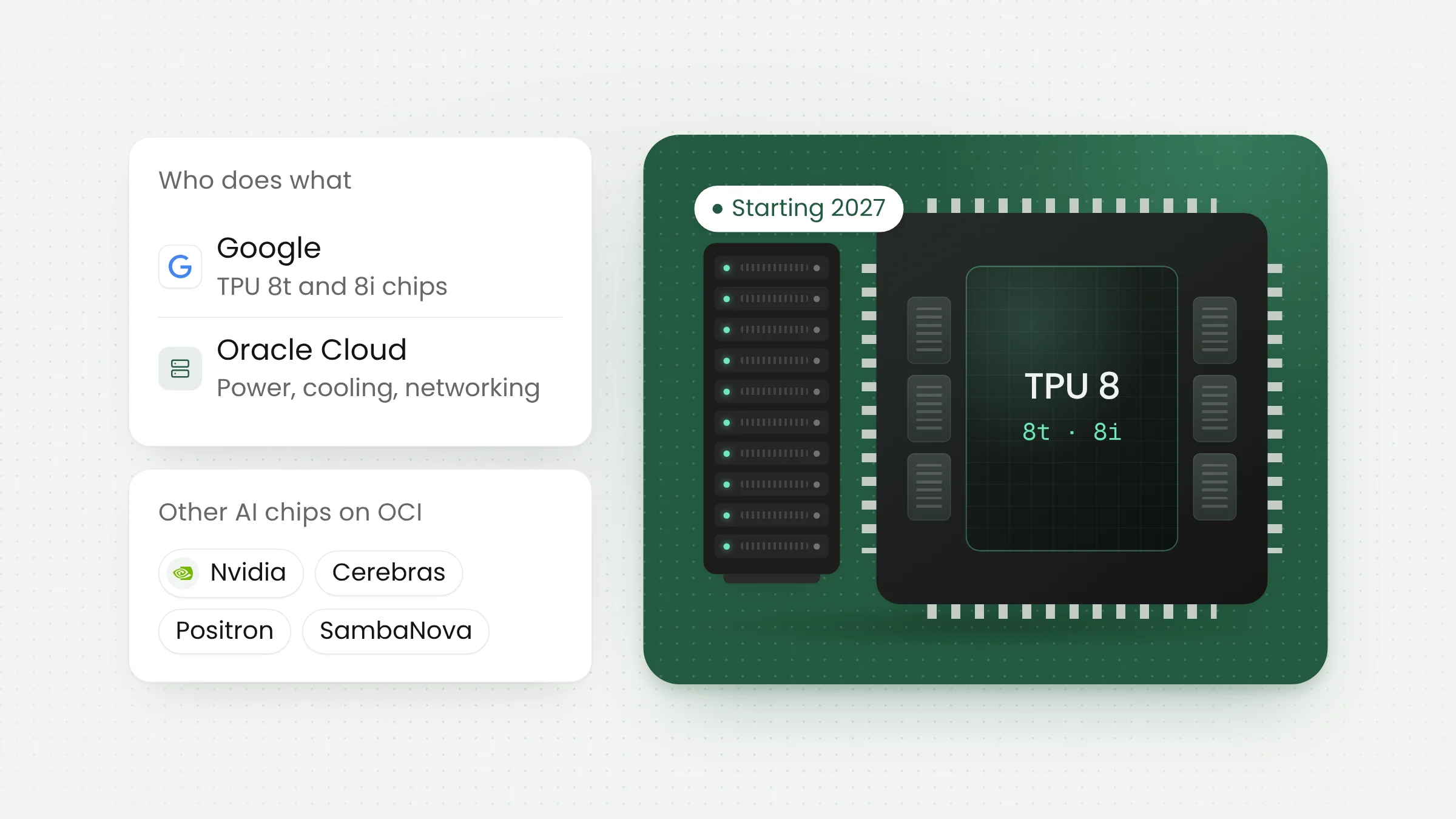
Oracle and Google announced that Google TPUs, the AI chips Google designs in-house, will be available on Oracle Cloud Infrastructure (OCI) starting in 2027. It is the first time a large-scale cloud outside Google Cloud will offer the chips. For companies running AI, the deal widens the choice of hardware for training and serving models.
The Oracle and Google deal at Oracle AI World
The companies made the announcement on October 27, 2026, at Oracle AI World in Las Vegas. According to the joint press release, OCI becomes the first hyperscale cloud platform outside Google to offer TPUs. Hyperscale refers to cloud providers that operate very large data center fleets serving customers in many countries.
The division of labor is straightforward. Google supplies the TPU chips, while Oracle provides the power, cooling, and data center networking needed to run them at scale. TPUs on OCI are scheduled to become available in calendar year 2027, with capacity ramping over several years.
Network World reported that customers will be able to use TPUs for training and inference without running their workloads on Google Cloud. Inference is the stage when a finished model answers requests, such as reading a document or inspecting an image. Pricing, configurations, initial capacity, and the regions where TPUs will be installed have not been disclosed.
Mahesh Thiagarajan, president of Oracle Cloud Infrastructure, said the move gives customers access to several leading AI compute architectures in a single cloud. For Oracle, it strengthens its pitch as an AI infrastructure provider. For Google, chips that were previously rented only through its own cloud can now reach Oracle’s customers.
How TPU 8t and TPU 8i work
A TPU (Tensor Processing Unit) is a chip built specifically for the math behind AI models. GPUs were originally designed for graphics and later adopted for AI, whereas TPUs were designed from the start for the matrix operations at the heart of neural networks. The eighth generation coming to OCI is split into two architectures.
TPU 8t is built for training. Google claims it delivers nearly three times the compute performance per pod of the previous generation and can shorten frontier model development cycles from months to weeks. A pod is a large group of chips connected to work as a single system.
TPU 8i is built for inference. Google designed it for the repetitive work of many specialized AI agents, which are systems that carry out a sequence of tasks on their own, such as checking a file and passing it to a staff member.
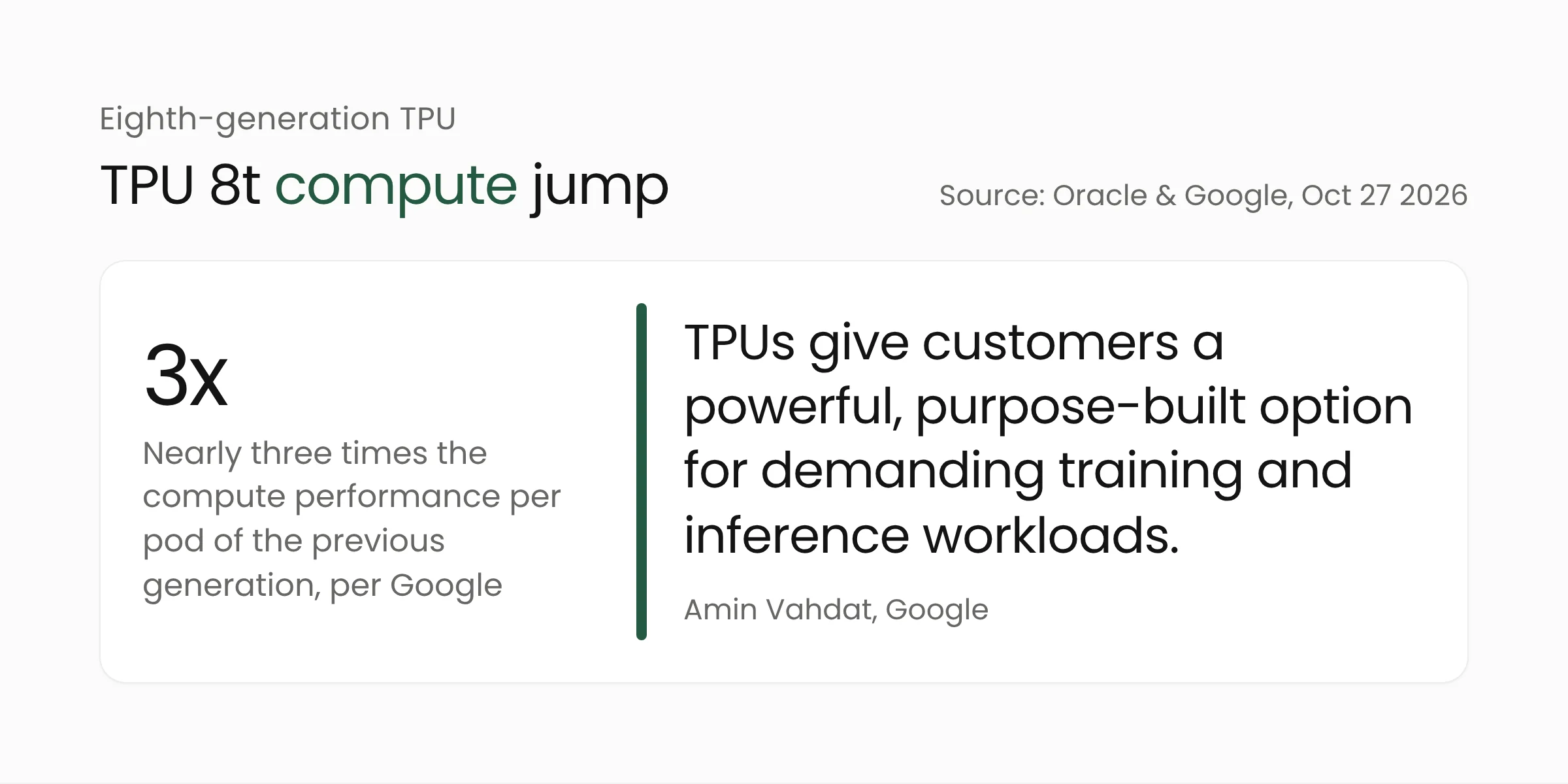
According to the release, TPUs can handle training and post-training of large models, including mixture-of-experts models that split work across specialized parts of the model, as well as production inference for reasoning, agentic, and long-context applications. Amin Vahdat, senior vice president and chief technologist for AI & Infrastructure at Google, said: “TPUs give customers a powerful, purpose-built option for demanding training and inference workloads.”
Data Center Knowledge, citing Google’s blog, added efficiency claims. TPU 8t and TPU 8i each deliver up to twice the performance per watt. TPU 8t offers up to 2.7 times better performance per dollar and TPU 8i up to 80 percent better performance per dollar, compared with the previous generation. These are Google’s figures and have not been independently tested on OCI.
Other AI chips coming to OCI
TPUs were not the only chips Oracle announced at the event. Data Center Knowledge listed the accelerators, chips that speed up AI calculations, that are already on OCI or on the way:
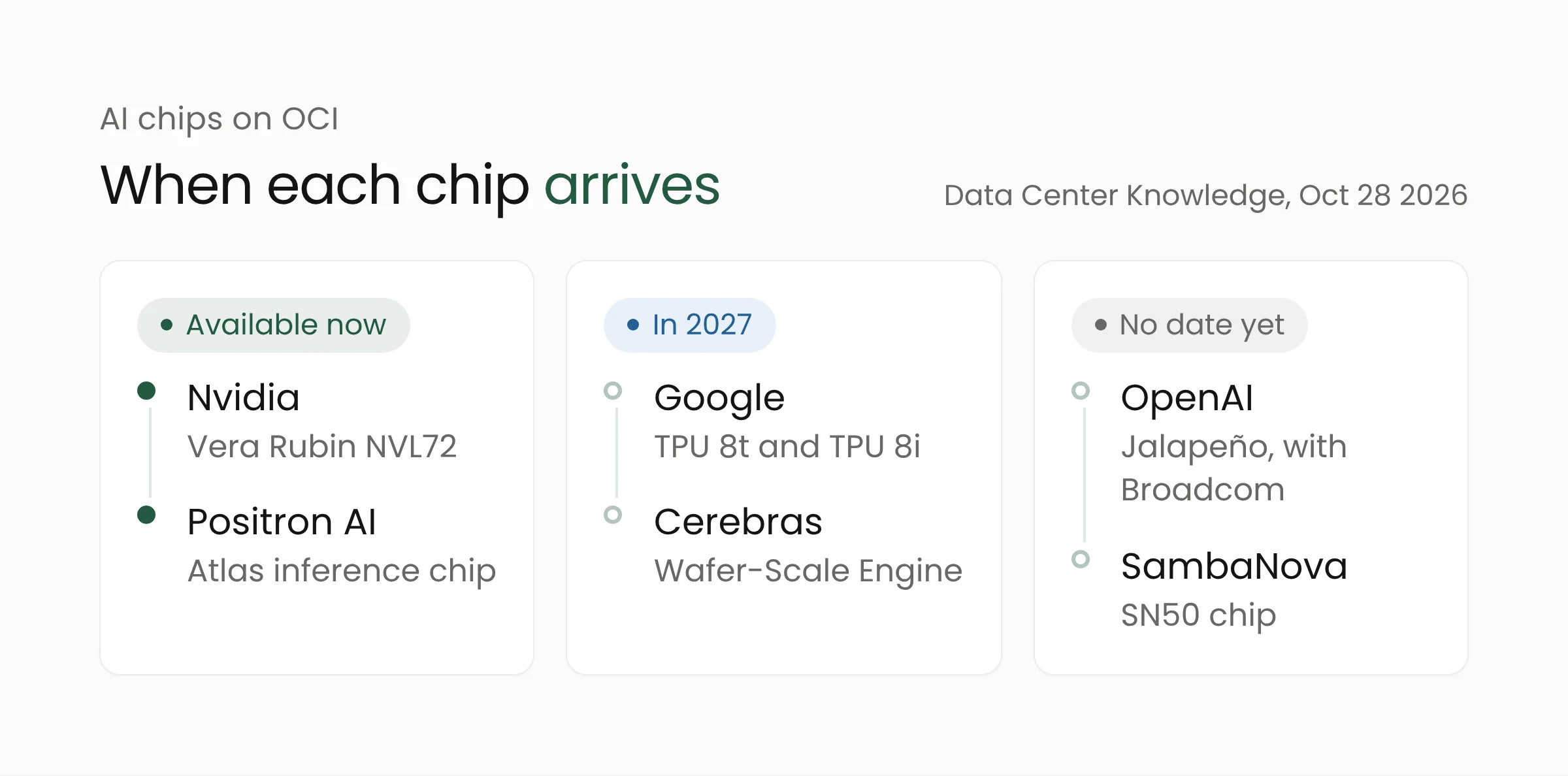
- Nvidia Vera Rubin NVL72 systems and Vera CPUs are generally available. Oracle also plans to expand its Vera Rubin NVL72 based OCI Superclusters to multi-gigawatt scale.
- Positron Atlas, an inference chip from Positron AI, is generally available on OCI now.
- Cerebras will bring its Wafer-Scale Engine for high-speed inference in 2027.
- OpenAI Jalapeño, an inference accelerator developed with Broadcom, will be deployed, though Oracle gave no date. OpenAI and Broadcom had previously expected initial deployment by the end of 2026.
- SambaNova SN50 inference chips will also be deployed, with no availability date given.
Each chipmaker brings its own claims. SambaNova says the SN50 is up to five times faster than competing chips at roughly a third of the total cost of ownership, and averages 20 kW per rack, low enough for existing air-cooled data centers. The Next Platform noted that Cerebras claims up to 30 times the tokens-per-second-per-user speed of GPUs. These are vendor figures that still need to be proven on real workloads.
Power supply is an important backdrop. AI data center buildouts are increasingly limited by electricity, as seen in Amazon’s GPU racks waiting for power. Chips that use less energy per task can help cloud providers serve more customers with the same power budget.
What analysts say
Analysts see the move as Oracle positioning itself as a cloud that offers many types of chips at once. Matt Kimball of Moor Insights & Strategy described it as Oracle trying to be an open silicon cloud with something for everybody. Brendan Burke of Futurum Group noted that OCI has relied primarily on Nvidia GPUs, so Oracle needs to prove the alternative chips are competitive and backed for the long term rather than treated as limited experiments.
Stephanie Walter of HyperFrame Research said alternative chips give enterprises options as GPU costs and infrastructure demands keep rising, especially for inference, which runs every day. She also warned of hidden costs: a cheaper infrastructure price means little if the development and operations work needed to switch chips outweighs the savings. In her view, purpose-built accelerators can perform differently depending on model architecture, workload, and software stack.
The deal also fits a trend visible in cloud providers’ earnings. Alphabet cited sales of TPU systems as a meaningful driver of Google Cloud growth, as covered in our look at Google Cloud and Azure’s latest quarter.
What this means for manufacturers
TPUs on OCI will not arrive until 2027, so nothing needs to change today. Still, manufacturers, processors, and logistics companies that are starting to use AI can prepare to take advantage of a wider choice of chips.
Separate training from inference. Most factories do not train large models from scratch. The more common workload is inference: a defect detection model reading camera feeds on a production line, a model forecasting spare part demand, or an assistant answering technicians’ questions from machine manuals. Inference runs all day, every day, so the cost per request matters more than training speed.
Measure cost per result. Compare the price per thousand images inspected or per thousand questions answered across several chip types. That figure is more useful than an hourly rental rate, because a chip that costs more per hour can be cheaper per result if it is much faster.
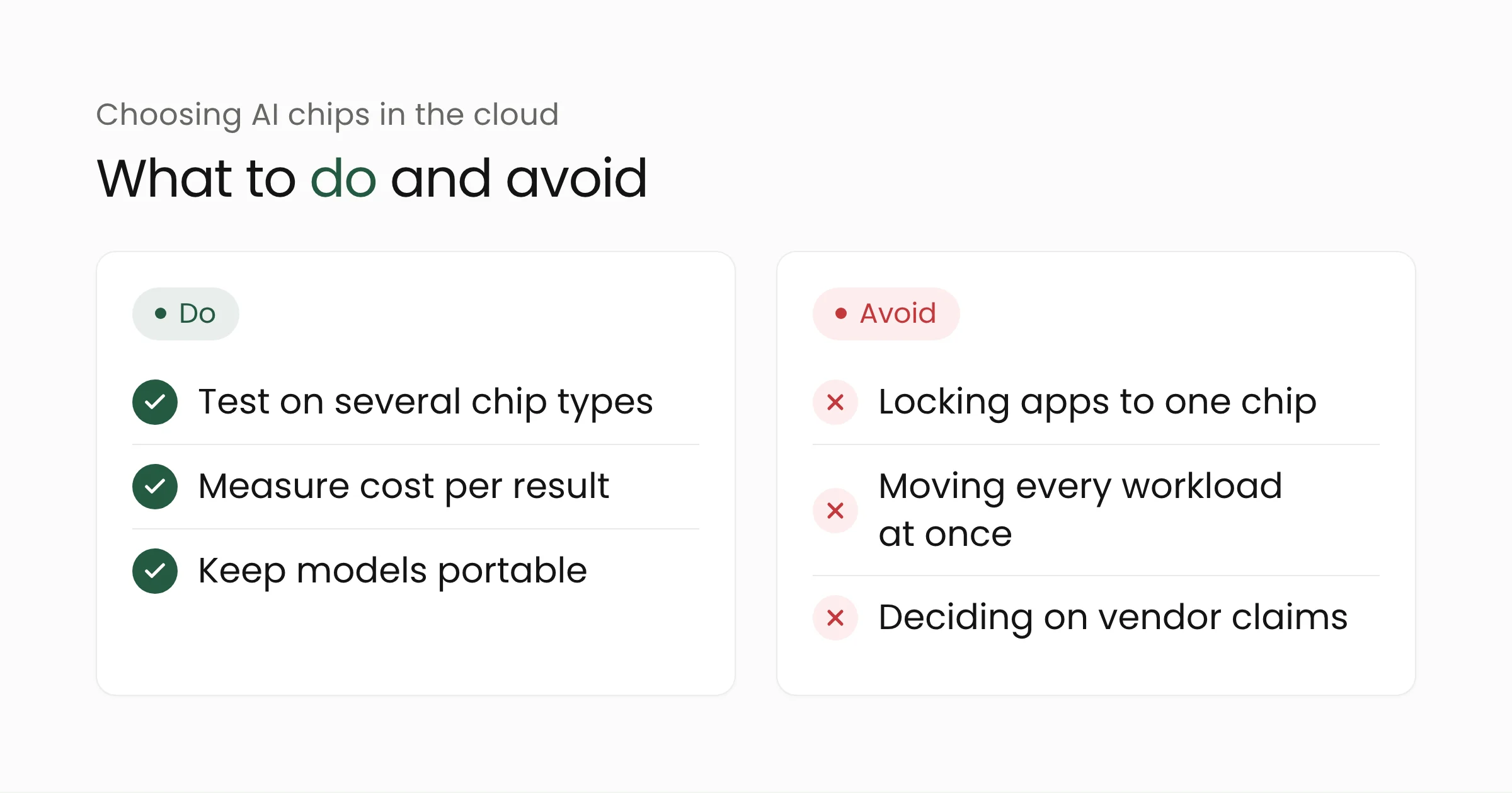
Keep models portable. Use frameworks and model formats supported by many chip types, and separate application logic from the layer that calls the model. That way, teams can test TPUs, GPUs, or other inference chips without rebuilding the application. This kind of design is central to a cloud computing architecture that is not locked to a single vendor.
Ask about location and latency. For systems on the factory floor, distance to the data center affects response time. If TPUs on OCI are only offered in distant regions, inference that needs an instant answer may still be better suited to local devices or servers at the plant. This is a common consideration in industrial automation projects that combine sensors, cameras, and the cloud.
Start with a small trial. When TPUs become available on OCI, run one existing workload on them and compare accuracy, speed, and cost with your current setup. Decisions to switch should rest on your own test data rather than vendor claims.
Frequently asked questions
When will Google TPUs be available on Oracle Cloud?
Oracle and Google say TPUs will be available on OCI in calendar year 2027, with capacity ramping over several years. Exact dates, pricing, and regions have not been announced.
What is the difference between a TPU and a GPU?
GPUs were first built for graphics and are now widely used for AI because they are flexible. TPUs are designed specifically for AI model calculations. How each performs depends on the model and software involved, so the most reliable comparison comes from direct testing.
Do OCI customers need a Google Cloud account to use TPUs?
According to Network World, customers can use TPUs for training and inference without running their workloads on Google Cloud. Details on ordering and billing have not been announced.
Conclusion
Google TPUs coming to Oracle Cloud signal a more open market for AI chips in the cloud. Companies are less tied to a single chip type or provider for running their models. The benefits will go to organizations that keep their applications portable and track cost per result with discipline. If your team is weighing where to run AI models for factory or operational needs, Merakit can help design and test the architecture.
Sources
- Oracle Brings Google TPUs to Oracle Cloud Infrastructure, Google Cloud Press Corner, October 27, 2026
- Oracle adds Google TPUs to OCI to expand enterprise AI compute options, Network World, October 28, 2026
- Oracle Cloud to Offer Google TPUs and New AI Chips, Data Center Knowledge, October 28, 2026
- Oracle is Expanding the Accelerator Options in OCI for Enterprises, The Next Platform, October 27, 2026