Blog Cloud Computing
Google TPU 8tx Shields Data in Use: Lessons for Hospitals
On this page· 8 sections
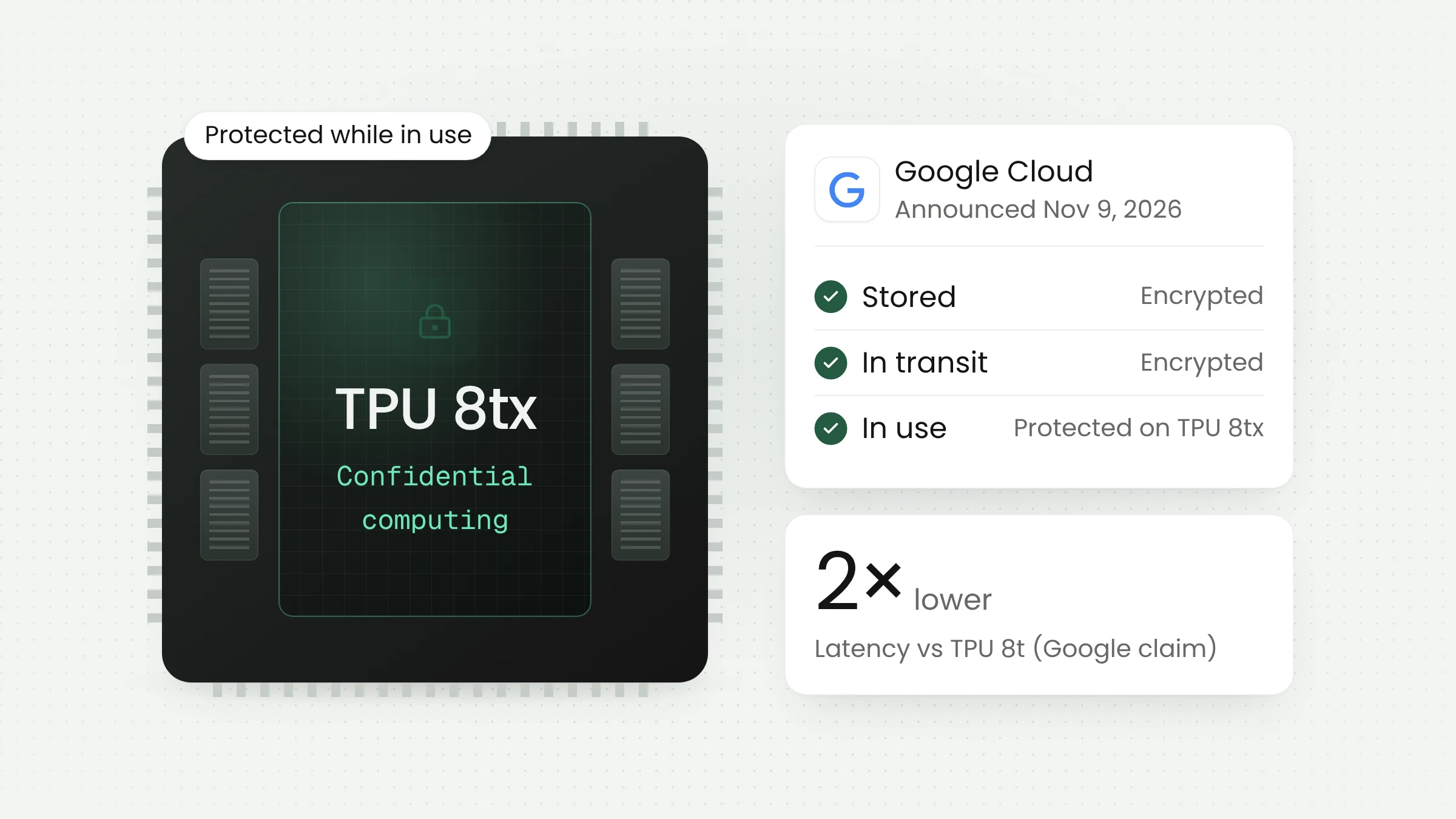
Google unveiled TPU 8tx on November 9, 2026, an AI accelerator system designed to keep sensitive data and model weights protected while they are being processed. The approach, known as confidential computing, is aimed at regulated enterprises and governments, a group that includes organizations handling health and financial records.
Two new systems in the eighth TPU generation
TPUs (Tensor Processing Units) are Google’s custom chips for running AI models. At Google Cloud Next in April 2026, Google introduced two eighth-generation variants: TPU 8t for training and TPU 8i for inference, the stage where a finished model answers user requests. Both were covered in our earlier piece on Google TPUs coming to Oracle Cloud.
In a Google Cloud blog post by Amin Vahdat, Google’s Senior Vice President and Chief Technologist for AI and Infrastructure, the company added two more systems. TPU 8tx is optimized for secure, confidential inference and also handles small-scale training. TPU 8i Max targets very long context windows and the highest compute density per rack. Google said this is the first time it has introduced four TPU systems in a single year.
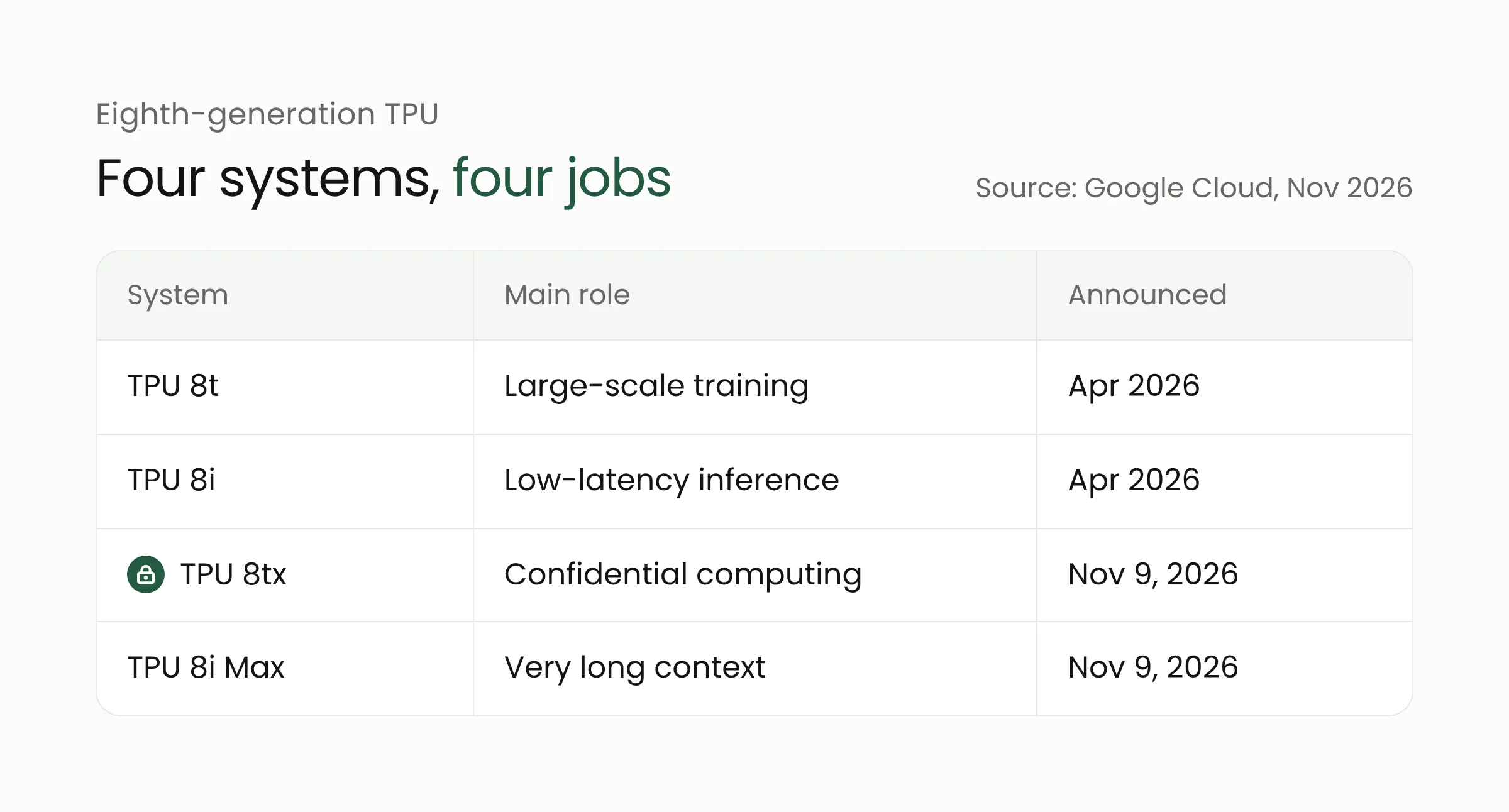
The customer base is growing, although the figures vary by source. Google’s post cites nearly 100 customers, ranging from frontier labs and trading firms to retailers and universities. TechTarget, citing the company, put the number at more than 100 customers and partners. TechTarget also reported that TPU 8t and TPU 8i, announced in April, are still due to go online by the end of 2026.
How confidential computing works on TPU 8tx
Data is usually protected in two states. It is encrypted when stored on disk and encrypted again when it travels across a network. When a computer processes that data, however, it has to be decrypted in memory. Confidential computing is designed to protect data during that third stage.
The Confidential Computing Consortium, an industry group under the Linux Foundation, defines confidential computing as protecting data in use by performing computation in a hardware-based, attested Trusted Execution Environment (TEE). The definition is quoted in Microsoft Learn documentation. A TEE works like a sealed room inside the processor. When the system is configured correctly, other applications, server administrators, and even the cloud operator cannot see what happens inside.
According to Google, TPU 8tx uses the same silicon as TPU 8t and is paired with fifth-generation AMD EPYC host processors. ServeTheHome describes them as custom AMD EPYC “Turin” hosts. Google says this design builds security directly into the hardware layer, so sensitive data and model weights stay protected and isolated while in active use. Model weights are the numbers produced by training, effectively the model’s learned knowledge, and their owners usually guard them closely.
Google’s speed claims
Extra protection usually slows a system down. Google claims TPU 8tx delivers up to 2x lower latency than TPU 8t with a near-zero performance penalty. Latency is the delay between a request and its answer. Google attributes the speed to the Boardfly network it originally built for TPU 8i. ServeTheHome explains that the Boardfly topology has a maximum of seven hops between chips, compared with sixteen in the torus design used for training.
Google also says a single TPU 8tx system can fine-tune models on private data, distill large models into smaller ones, and train agents through reinforcement learning without moving sensitive data between clusters. Patrick Moorhead, founder and chief analyst at Moor Insights & Strategy, described the use case to TechTarget: “A bank or government agency can fine-tune, distill and run reinforcement learning on the same confidential system that serves the model.”
TPU 8i Max for long context
The second system, TPU 8i Max, combines two TPU 8i chips in a single package. Google says it offers double the compute, double the on-chip SRAM, and double the HBM bandwidth of TPU 8i. According to ServeTheHome, the system carries 384 GB of HBM, about a third more than TPU 8i, with 17.2 TB/s of bandwidth and 768 MB of SRAM.
That much memory matters for AI agents that read many documents at once, such as an application’s entire codebase or thousands of pages of reports. Google also released TPU Sync as open-source software that moves a model’s working memory between chips, servers, and storage. Google claims it cuts certain transfer times and time to first token by more than 90 percent.
Limits worth noting
All of the performance figures above come from Google and compare the new systems with Google’s own hardware. Decrypt noted that Google did not compare them with Nvidia’s latest products, and no independent tests have been published. Google also has not announced pricing, availability dates, or the cloud regions that will offer TPU 8tx and TPU 8i Max.
Decrypt added an important caveat. Confidential computing cannot stop a poorly designed AI agent from mishandling data it is allowed to access. Hardware protection keeps data away from outsiders during processing, but access rules inside the application remain the system owner’s responsibility. Google’s post also does not detail TPU 8tx’s attestation process, encryption key management, or compliance certifications.
Google did offer one piece of technical guidance. It told ServeTheHome that if data must remain within the confidential computing domain, users should stick with TPU 8tx for inference and serving.
What this means for hospitals
Hospitals, clinics, and laboratories are among the most cautious adopters of cloud AI. In Indonesia, one reason is Law Number 27 of 2022 on Personal Data Protection (Undang-Undang Nomor 27 Tahun 2022 tentang Pelindungan Data Pribadi), which classifies health data and information as specific personal data, alongside biometric data, genetic data, and personal financial data. The law’s elucidation notes that processing specific data can have a greater impact on the data subject, including discrimination and greater harm.
TPU 8tx is not available yet, but the direction of the technology is already useful for planning. Here are steps hospitals can take now.
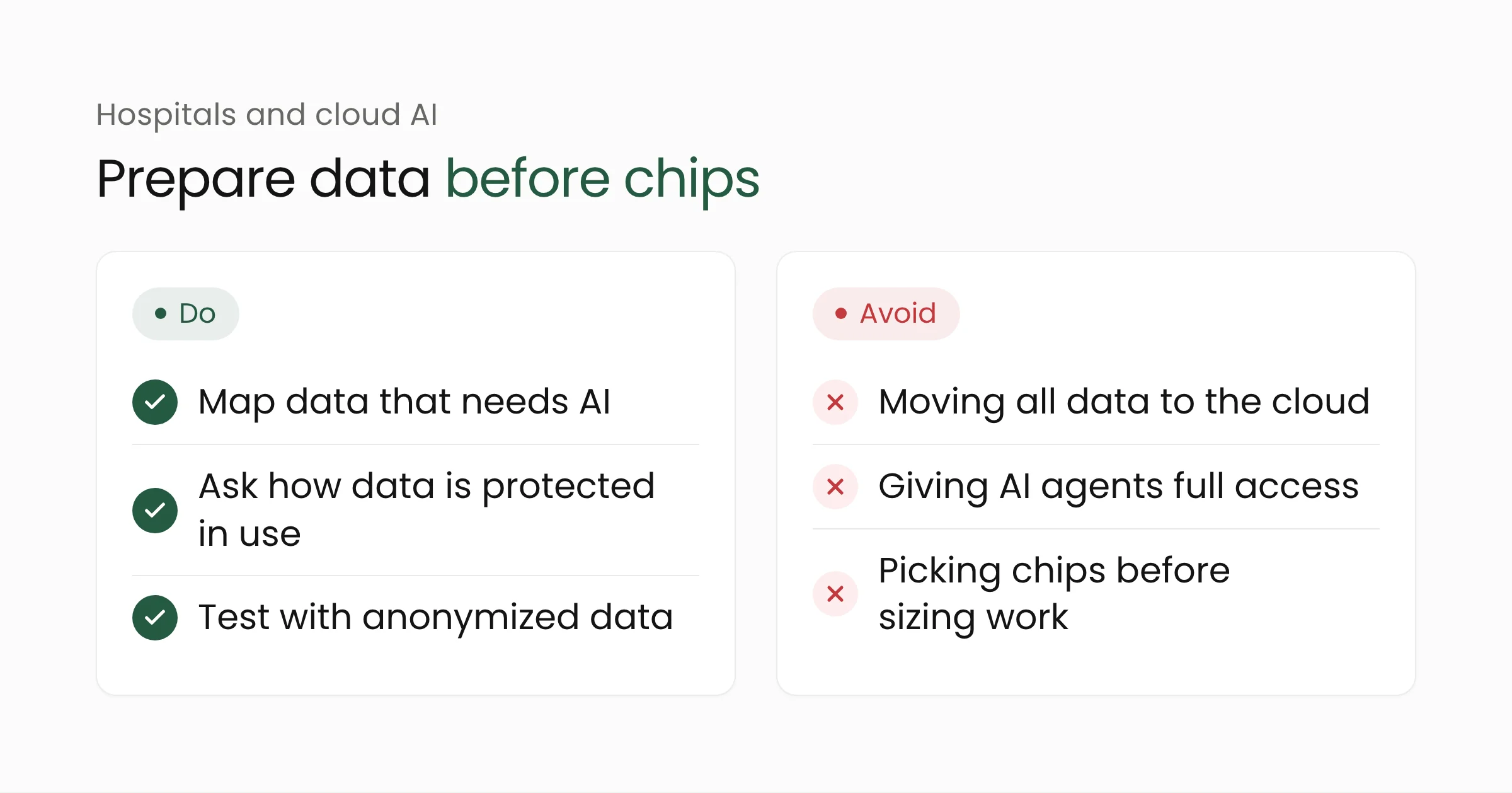
First, map which data actually needs AI processing. Medical record summaries, radiology results, and claims records carry different levels of sensitivity. Data that does not need to leave the hospital should stay on internal systems.
Second, ask your cloud provider how data is protected during processing. Encryption at rest and in transit is now standard. The next questions are whether data stays protected in memory while the model runs, how that environment is attested, and who holds the encryption keys. A cloud computing services team can help draft these questions before a contract is signed.
Third, limit AI agent access from the first design. Confidential computing keeps data away from outsiders, but an agent given access to an entire patient database can still show information to the wrong person. Apply least-privilege access, log every data request, and test with anonymized data first.
Fourth, size the workload before choosing hardware. Not every hospital AI task needs top-tier chips. Many jobs, such as summarizing visit notes or answering scheduling questions, run well on small models. Healthcare information systems should be designed so their AI components can move to more secure infrastructure once technology like TPU 8tx becomes available.
The same steps apply to banks, insurers, and government agencies that hold financial or population data.
Frequently asked questions
How is TPU 8tx different from TPU 8t?
Both use the same silicon. TPU 8t is built for large-scale training, while TPU 8tx is paired with fifth-generation AMD EPYC processors and the Boardfly network for confidential inference and small-scale training. Google claims TPU 8tx has up to 2x lower latency than TPU 8t.
When will TPU 8tx be available, and how much will it cost?
Google has not announced it. The company gave no pricing, availability dates, or cloud regions for TPU 8tx and TPU 8i Max when it unveiled them on November 9, 2026.
Does confidential computing make data completely safe?
No. Confidential computing protects data from unauthorized access during processing, including from the cloud operator when configured correctly. It does not prevent an application or AI agent that has been granted access from misusing data. Access controls, logging, and testing are still required.
Closing
TPU 8tx shows that protecting data in use is becoming a headline feature of AI chips, alongside speed and memory capacity. For hospitals and other organizations that hold specific personal data, now is a good time to tidy up data maps and access rules so they are ready when services like this reach Indonesia. If your team is weighing cloud AI for sensitive data, we are happy to help map out the first steps.
Sources
- TPU 8tx and TPU 8i Max (Google Cloud Blog, Amin Vahdat, November 9, 2026)
- Google specializes TPUs for agentic, confidential computing (TechTarget, November 9, 2026)
- Google TPU 8tx Pairs AMD EPYC Turin Hosts with Confidential Computing while TPU 8i Max Doubles Memory Bandwidth (ServeTheHome, November 9, 2026)
- Google Takes Aim at Nvidia With New AI Chips Built for Privacy and Massive Memory (Decrypt, November 9, 2026)
- Azure Confidential Computing Overview (Microsoft Learn, includes the Confidential Computing Consortium definition)
- Undang-Undang Nomor 27 Tahun 2022 tentang Pelindungan Data Pribadi (JDIH, Ministry of Communication and Digital Affairs)