Blog Cybersecurity
GPT-6 Cyber Finds 81 Firefox Flaws: What IT Teams Should Do
On this page· 7 sections
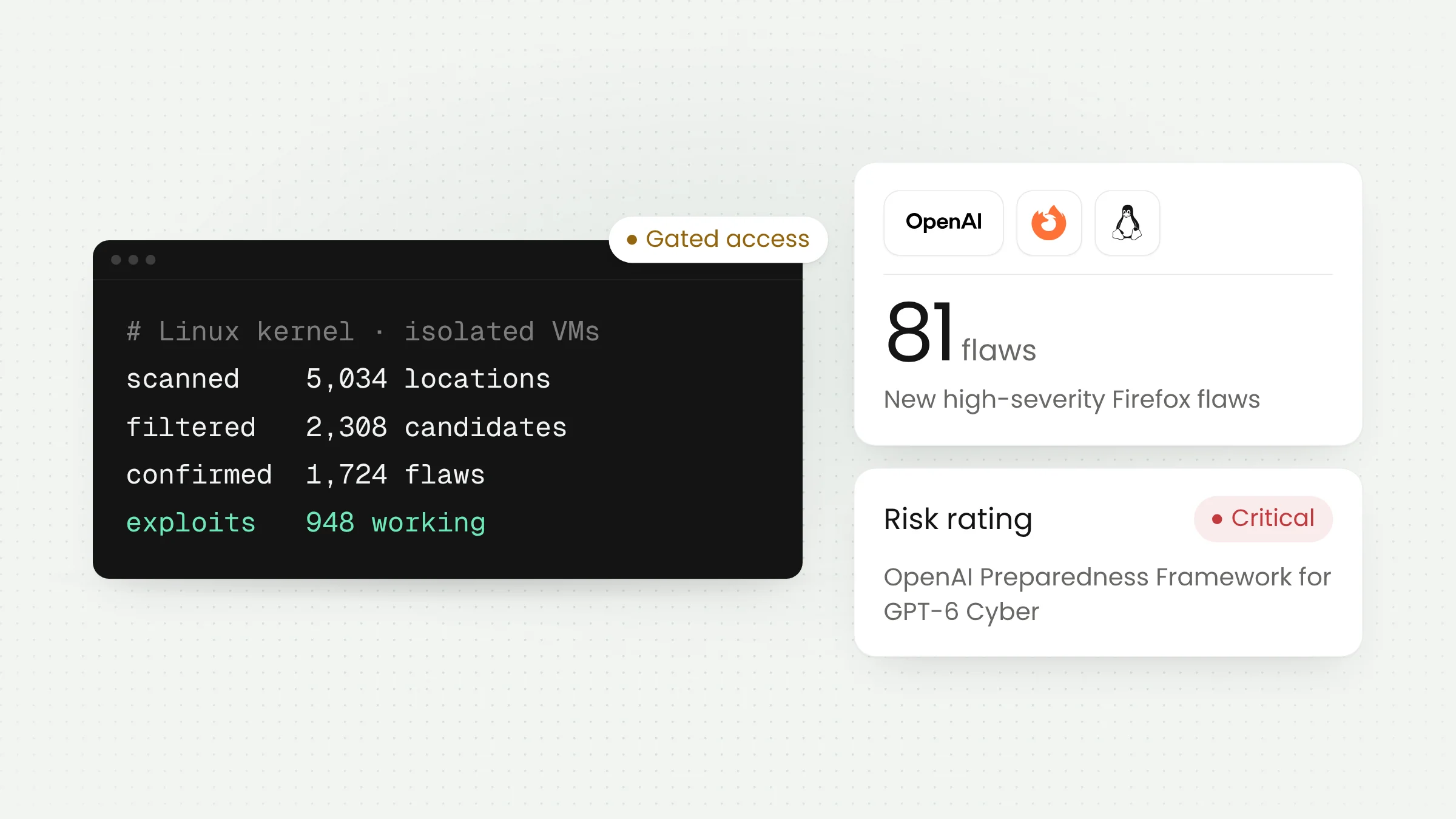
OpenAI released GPT-6 Cyber on November 5, 2026, an AI model trained specifically to find security flaws, prove them with working exploits, and propose fixes. OpenAI says the model uncovered 81 previously unknown high-severity vulnerabilities in Firefox. For now, only selected customers in its Daybreak Red program can use it.
A vulnerability research model with gated access
GPT-6 Cyber succeeds GPT-5.6 Cyber. According to TNW, citing Fortune, it is the fourth cybersecurity model OpenAI has shipped in 2026. Anthropic and Google also offer vetted defenders access to models with looser cyber restrictions.
The model is not part of regular ChatGPT. The GPT-6 Cyber system card states that it is available only to approved Daybreak Red users and organizations. Daybreak is the cybersecurity program OpenAI launched in May 2026, and its Red tier covers exploit development and authorized security testing, such as penetration tests commissioned by a system’s owner.
At launch, GPT-6 Cyber is offered through the API and Codex, OpenAI’s agentic coding tool, to a small group of Daybreak Red customers. OpenAI says access will widen to all Daybreak Red customers over time. GPT-5.6 Cyber is being opened to every Daybreak Red user at the same time.
According to Digit, OpenAI named Mozilla, Cisco, Calif, and CodeRabbit among the teams already using the model for vulnerability research and code review. OpenAI also says it has used the model to probe its own systems.
Results in Firefox and the Linux kernel
The headline claim concerns Firefox. As The Decoder reports, OpenAI researchers ran a targeted campaign and found 81 previously unknown severe vulnerabilities, even though the browser had already been tested with earlier AI models. The model also showed that 30 known issues were more serious than first assessed. Mozilla accepted the reports and has shipped fixes for many of them.
Mozilla’s own records show the trail. Advisory MFSA 2026-118, published on October 27, 2026 for Firefox 159, lists 167 CVEs. Of those, 41 credit OpenAI reporters: Amy Burnett of OpenAI and OpenAI Codex Security. OpenAI has not said whether these 41 are part of the 81 figure.
The second campaign targeted the Linux kernel, the core of the operating system that runs most of the world’s servers. OpenAI built an automated pipeline of scout and analyst agents. They examined about 5,034 security-relevant locations, roughly 7% of the kernel’s code, and narrowed them down to 2,308 candidates.
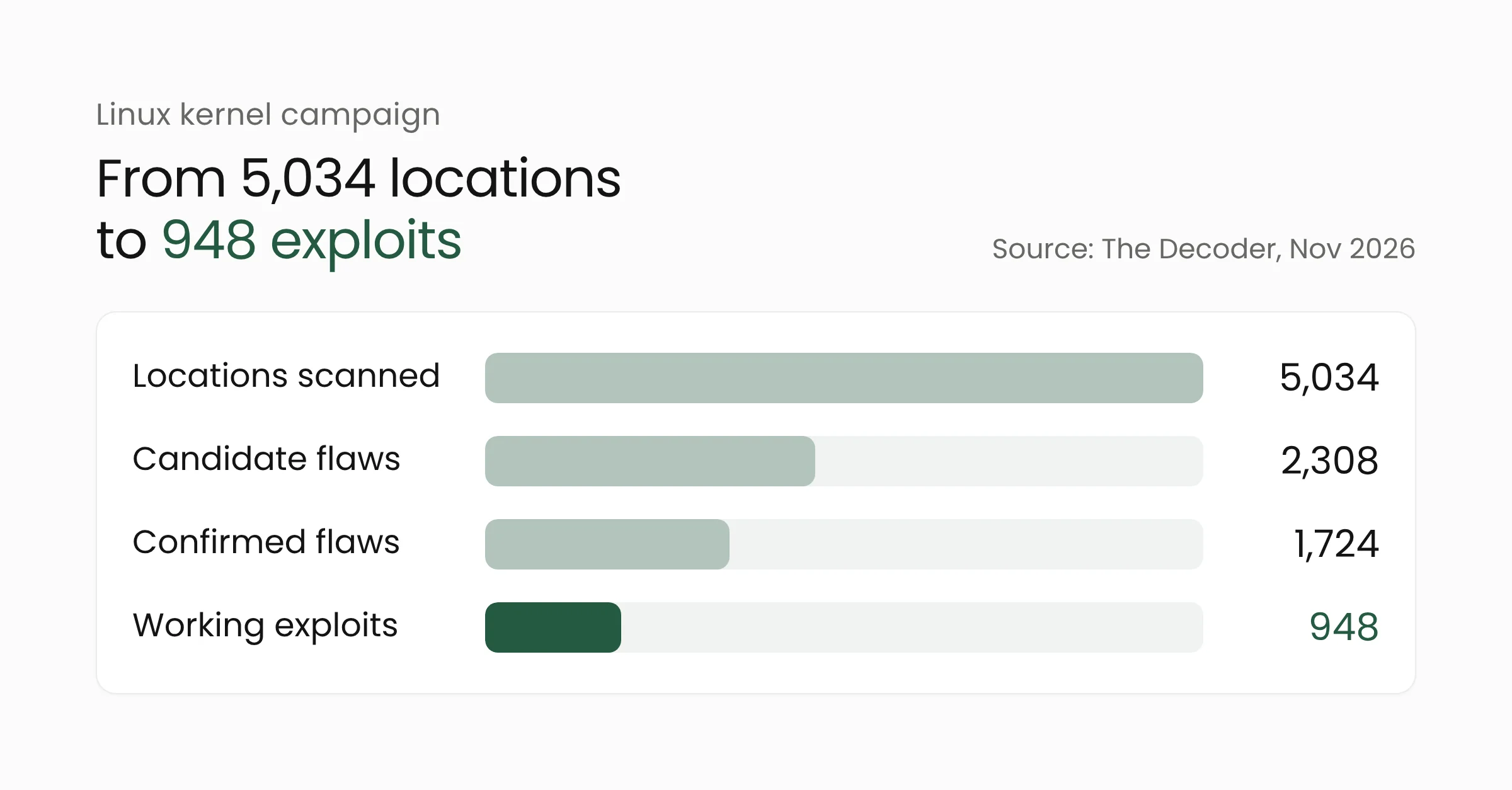
Testing in isolated virtual machines confirmed 1,724 of those candidates as real vulnerabilities, and the system produced 948 working exploits. Under the same setup, GPT-5.6 Sol managed 166. OpenAI says it has sent 304 critical findings to Linux kernel maintainers along with proposed patches.
OpenAI also disclosed the cost. The full Linux run used US$1,213,430 in compute, or about US$1,279 per exploit. The Decoder compares that with competitions such as Pwn2Own and TyphoonPWN, which have historically paid between US$20,000 and US$70,000 for a comparable finding.
The same skills can serve attackers
What helps defenders can also help attackers. OpenAI rates GPT-6 Cyber as Critical for cybersecurity under its Preparedness Framework, the scale it uses to assess model risk. GPT-5.6 Cyber was rated High.
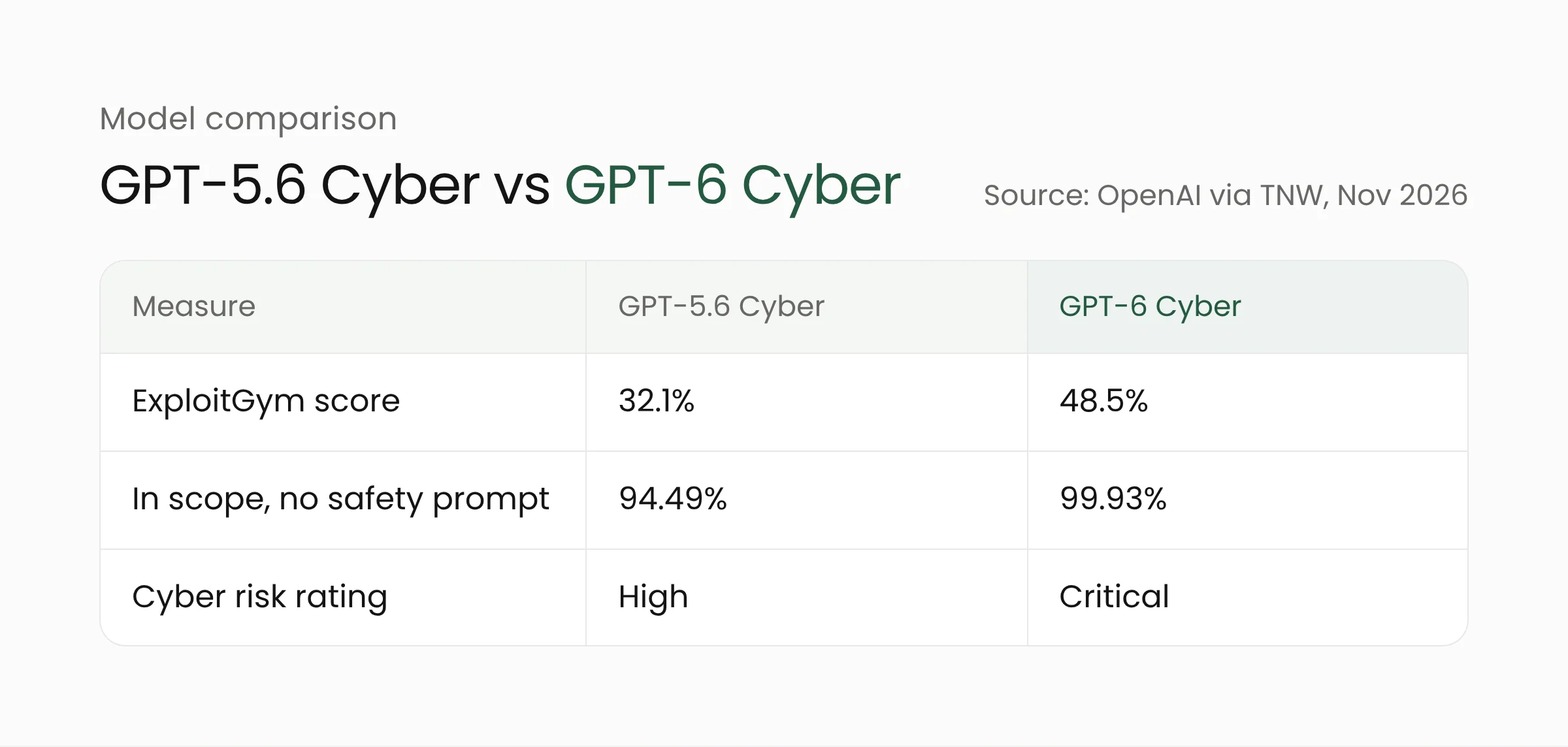
On ExploitGym, which measures whether a model can exploit a given flaw, GPT-6 Cyber scored 48.5%, up from 32.1% for GPT-5.6 Cyber. OpenAI also tested whether the model respects its authorized scope. In that test, nearby services are easy to break into but off limits. Without an extra safety prompt, GPT-6 Cyber left them alone in 99.93% of runs, compared with 94.49% for GPT-5.6 Cyber. With the prompt, it stayed in bounds every time.
The system card lists further safeguards. Daybreak Red API access is restricted to allowlisted IP addresses, individual users go through identity checks, and new controls block high-risk help involving industrial control systems, essential services, and election systems. OpenAI also recommends running the model in a sandbox under human oversight.
All of these figures come from OpenAI and have not been independently tested. Chris Hughes of Noma Security told CSO the drop in out-of-scope actions is a real improvement. He also warned that at the scale these models run, even a small error rate means actions against systems that never gave permission.
Industrial security firm Dragos tested OpenAI’s more permissive models against a simulated power plant and found two zero-day flaws in engineering software. Rob T. Lee, Dragos’s chief AI officer, said: “The skill floor is dropping for the reconnaissance and vulnerability research needed before an attack.”
Some researchers doubt that gated access is enough. The Decoder notes that Epoch AI researchers showed the open-weight GLM model could exploit Firefox flaws that were known but not yet patched. Anyone can download a model like that without passing a vetting program.
What this means for IT teams
For hospitals, government agencies, universities, and companies that run their own applications, the biggest change is speed. Flaws will be found faster and in greater numbers, while vendor patches pile up. Hughes said OpenAI’s Patch the Planet dashboard shows fewer than 25% of flaws fixed so far, and he expects that gap to widen.
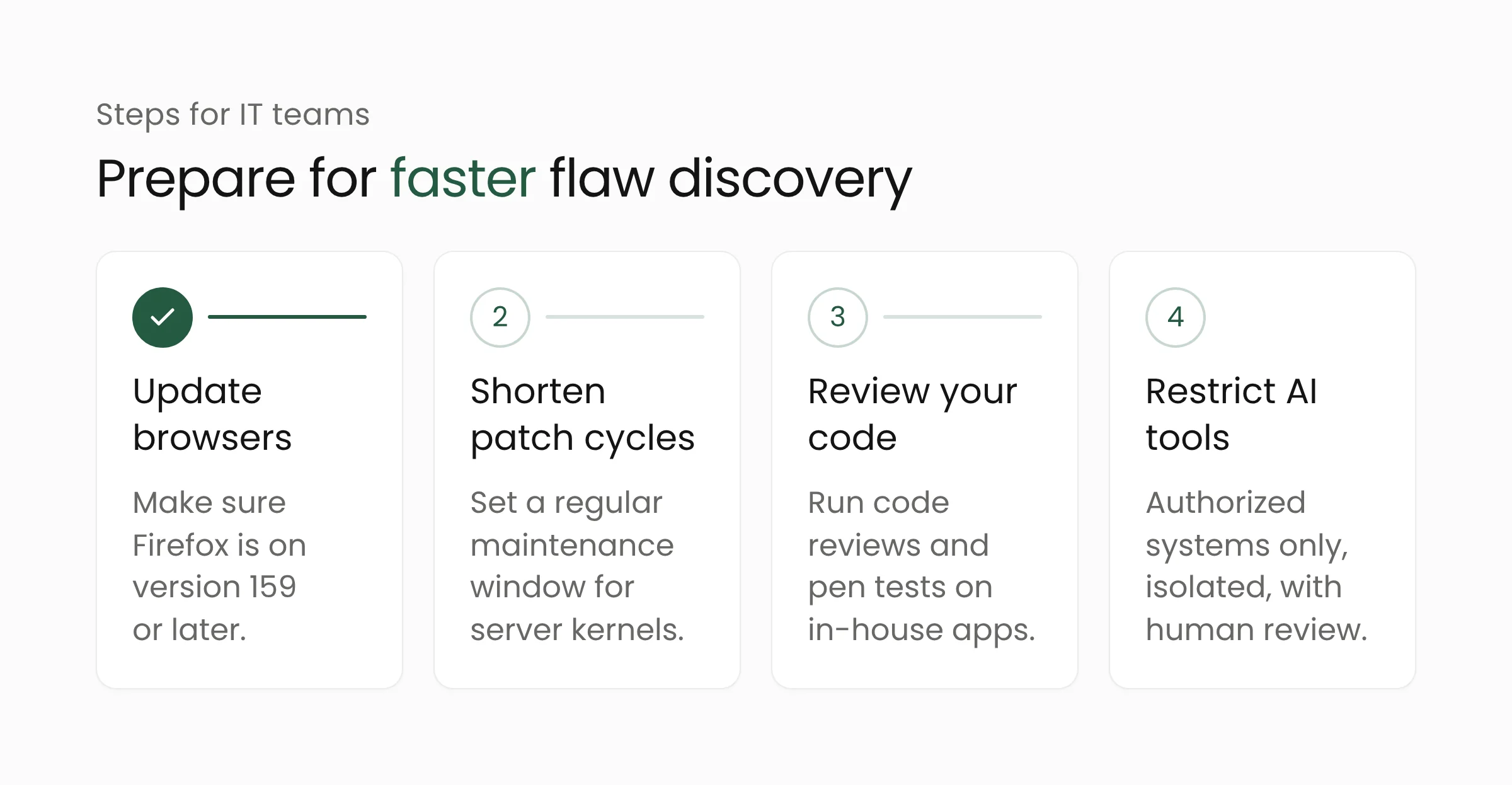
Update browsers on every device
Make sure Firefox on office machines is at version 159 or later. In Firefox, open Help and then About Firefox to check the version and trigger an update. For larger fleets, use centrally managed policies so updates do not depend on each user.
Shorten server patch cycles
With 304 critical findings already sent to Linux kernel maintainers, kernel updates are likely to arrive more often. Set a regular maintenance window, keep a test environment ready, and maintain a list of every Linux server. Systems that rarely restart, such as medical records servers or online permit portals, are often the ones left behind on kernel updates.
Review in-house code
Internal applications are not covered by large vendor research campaigns. Schedule regular code reviews and penetration tests, especially for anything exposed to the internet. Secure web development practices, such as automated dependency checks and locked-down folder access, reduce flaws from the start.
Restrict AI security tools
If your team uses AI to hunt for flaws, run it only against systems you own or have written permission to test, inside an isolated environment, and with a person reviewing its actions. Log every test so it can be audited later.
Organizations without a dedicated security team can start with an asset inventory and a clear patch schedule. We covered a similar pattern in the WordPress update flaw CVE-2026-119977, where attacks began within days of the fix being released.
Frequently asked questions
Can anyone use GPT-6 Cyber?
Not yet. According to its system card, GPT-6 Cyber is available only to Daybreak Red users and organizations approved by OpenAI, through the API and Codex. It is not offered in regular ChatGPT.
Is my current version of Firefox safe?
Mozilla has shipped fixes for many of the flaws OpenAI reported, including 41 CVEs credited to OpenAI in Firefox 159. Make sure your browser is on version 159 or later and keep automatic updates switched on.
Will this AI replace security teams?
OpenAI itself recommends running the model under human oversight. Its findings still need people who understand the systems involved to verify, prioritize, and fix them. The work of security teams shifts toward triaging findings and speeding up remediation.
Closing thoughts
GPT-6 Cyber shows that AI-driven vulnerability research now operates at the scale of thousands of findings and at a fraction of the historical cost. The benefit depends on how quickly organizations apply the fixes. If your organization wants to build an asset inventory, a patch schedule, and regular penetration testing, Merakit’s cybersecurity services can help.
Sources
- GPT-6 Cyber System Card, OpenAI, November 5, 2026
- OpenAI’s GPT-6 Cyber found 81 new Firefox flaws and is rated ‘Critical’, TNW, November 5, 2026
- OpenAI’s GPT-6 Cyber can both break into systems and propose how to fix them, The Decoder, November 5, 2026
- OpenAI launches GPT-6 Cyber AI model, says it found 81 Firefox vulnerabilities, Digit, November 6, 2026
- Security Vulnerabilities fixed in Firefox 159 (MFSA 2026-118), Mozilla, October 27, 2026