Blog Hardware
Huawei's HarmonyOS Desktop and App Readiness for Agencies
On this page· 7 sections
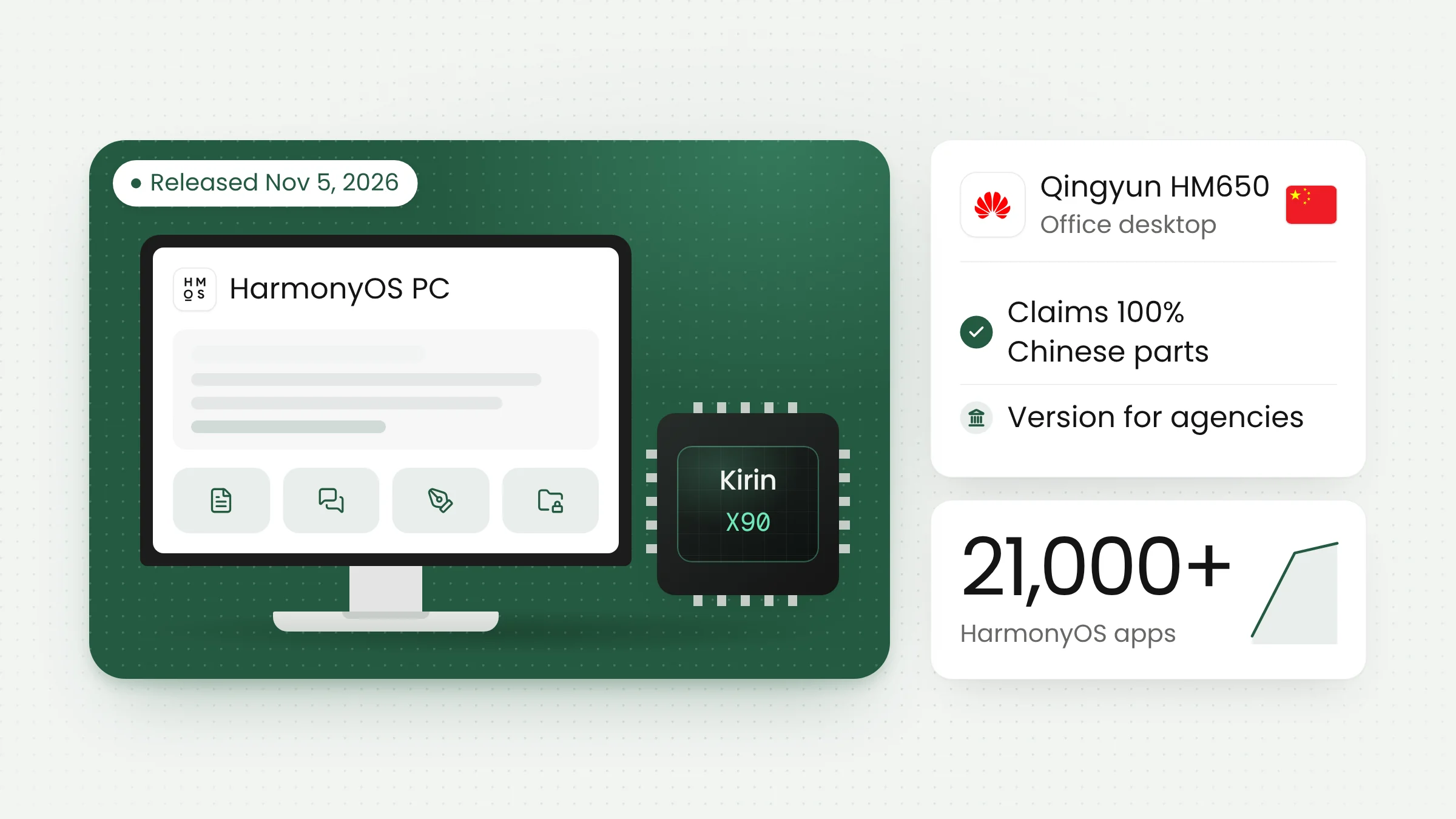
Huawei launched the Qingyun HM650, its first HarmonyOS desktop, on November 5, 2026, in Wuhan, China. The machine runs on Huawei’s own Kirin X90 processor, and Huawei says every component is sourced within China. It is aimed at government offices and businesses.
For readers in Indonesia, the launch matters for two reasons. Office computers are increasingly shaped by local content policies, which Indonesia applies to public procurement through its TKDN (domestic component level) rules. And as desks fill with a wider mix of operating systems, public service applications need to work outside Windows.
Qingyun HM650 specifications and its two versions
The Qingyun HM650 was unveiled at Huawei’s HarmonyOS Office Industry Summit in Wuhan. According to TechNode, it is the first desktop to run HarmonyOS, the operating system Huawei already ships on phones, tablets, and laptops. The same machine was previewed at Huawei Connect on September 17, 2026, as reported by IT之家 (IT Home).
The core component is the Kirin X90. TechNode’s Chinese edition describes a 10-core, 20-thread CPU paired with a hardware-accelerated GPU and an NPU, a block of the chip dedicated to running AI models on the device itself. The configuration it lists is 16 GB of memory and a 512 GB SSD, or a combination of SSD and hard drive.
TechBriefly puts the Kirin X90’s thermal design power (TDP) at 40 watts, compared with the 65 to 125 watts typical of desktop processors. Huawei also fitted a dual-layer cooling system and a dedicated AI key on the keyboard that opens its Xiaoyi assistant, known as Celia outside China.
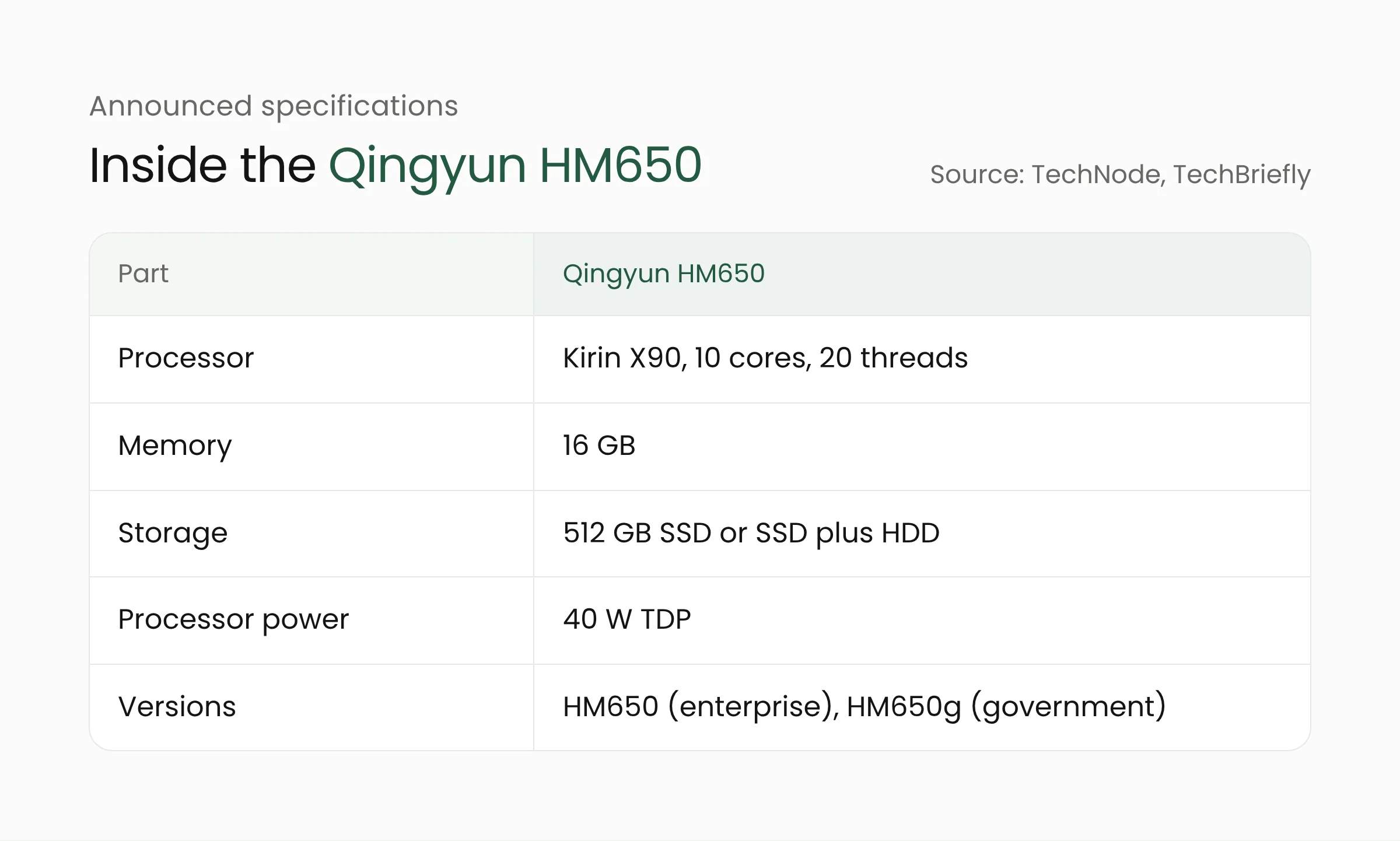
There are two versions, the HM650 and the HM650g. Chinese media reports describe the first as the enterprise model and the “g” version as the one for government users. TechBriefly says the desktop is available to commercial customers but is not yet listed on Huawei’s commercial website. Pricing and plans for sales outside China have not been announced.
The 100% domestic components claim
The most quoted figure is the share of domestic parts. According to TechNode, Huawei says the Qingyun HM650 reached 100% domestic sourcing for its components. The figure comes from Huawei and has not been independently verified.
The software is built for the same market. A report carried by Sina says the HM650 targets government and enterprise offices under xinchuang, China’s program to replace office hardware and software with domestic products. The machine ships with an enterprise edition of HarmonyOS. Reports differ on the version number: TechBriefly lists HarmonyOS PC 7.0, while IT之家 lists HarmonyOS V1.0.
IT之家 reports that the operating system has passed a Level II security and reliability certification from China’s national information security evaluation body. For device management, Huawei offers separate work and personal spaces on one machine, chip-level full-disk encryption, and zero-touch deployment. With zero-touch, IT staff upload a configuration to the cloud, and each device applies security policies and installs apps automatically once it connects to the network.
TechBriefly adds the Star Shield 2.0 security layer, which Huawei says can detect AI face swaps and altered voices to help prevent digital fraud. Huawei also claims its memory technology improves memory compression efficiency by 50% and lets users keep 40% more large files open at once. All of these performance figures are vendor claims.
HarmonyOS PC after 18 months
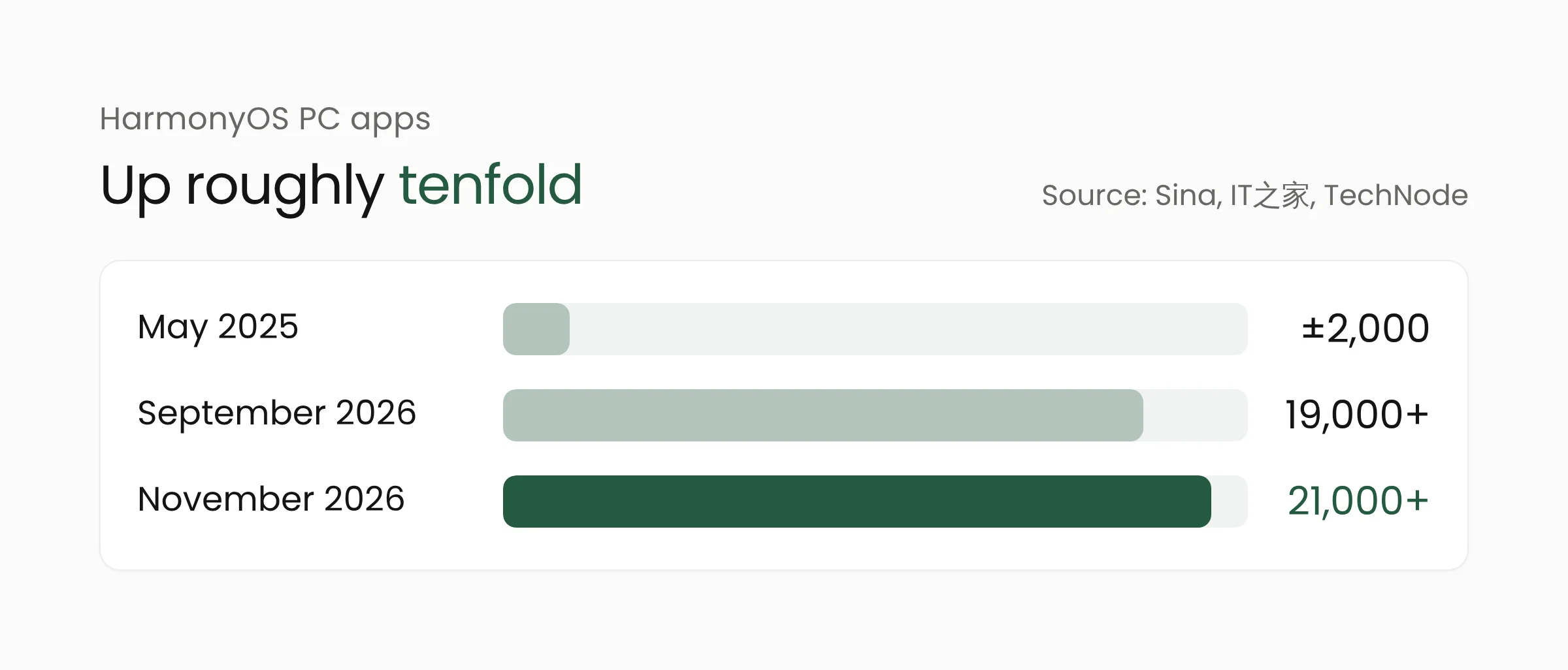
The desktop rounds out a HarmonyOS computer lineup that previously consisted of thin laptops and a foldable. At the same summit, Huawei said cumulative shipments of HarmonyOS computers passed 1 million units by the end of October 2026. It put the number of compatible apps at more than 21,000.
That app count has grown quickly. Sina reports that about 2,000 apps were available when HarmonyOS PC launched in May 2025. IT之家 counted more than 19,000 apps built for HarmonyOS PC in September 2026, two months before the desktop arrived.
The apps TechNode names are mostly work tools popular in China: WPS, WeCom, DingTalk, and Feishu, along with the engineering design programs ZWCAD, GstarCAD, and ZW3D. That mix fits the target market of Chinese government and corporate offices. Huawei said it will keep adding apps and push HarmonyOS PC from consumers into government and enterprise use.
Outside China, the 21,000 figure needs careful reading. What counts is whether the apps people use every day are available, such as regional finance systems, civil service records, or electronic signature tools. In Indonesia, most applications of that kind are built for Windows or for the web browser.
What this means for agencies and app developers
At the time of writing, there is no announcement of Qingyun HM650 sales in Indonesia. Even so, the direction Huawei is taking matches policy at home. Indonesian public procurement also favors local products: according to detikInet, version 6 of the LKPP e-Katalog automatically steers buyers toward suppliers with higher TKDN scores. The push for locally built hardware is also visible in Danantara’s plans for local chips and data center equipment.
As office hardware and operating systems diversify, applications that run on only one operating system become a weak point. A local agency that replaces its computers may find that older apps will not install, that printers or fingerprint scanners are not recognized, and that staff fall back on paper. The following steps can start now, whatever brand of computer is eventually chosen.
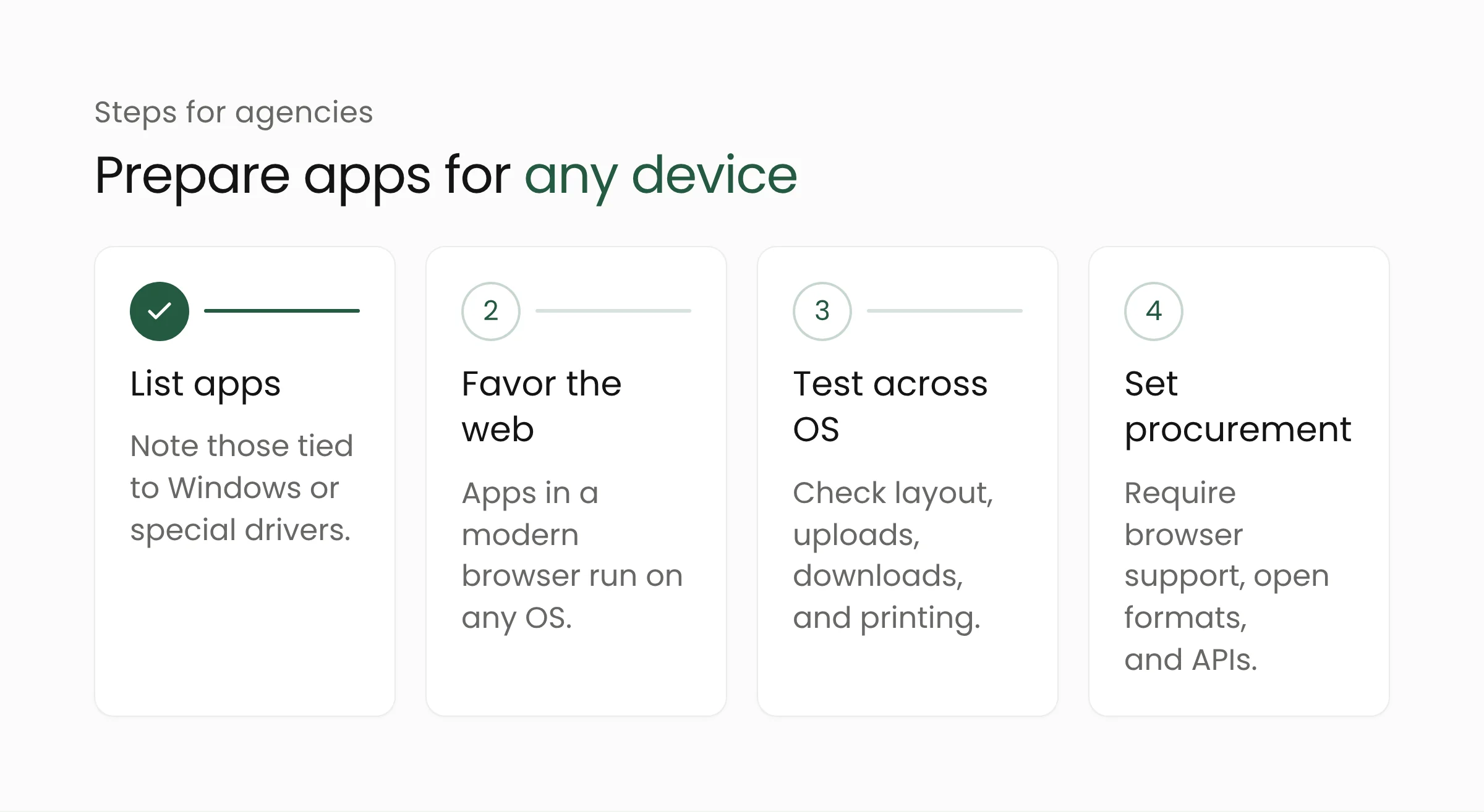
- List every application and its dependencies. Record apps that run only on Windows, apps that rely on old browser plugins or macros, and devices that need special drivers, such as printers, scanners, and electronic signature tokens.
- Favor standard web applications. Apps that run in a modern browser work on any operating system. For new services, web application development built on open standards lowers the risk of lock-in to a single vendor.
- Test on more than one operating system and browser. Add cross-platform testing to the release checklist, covering layout, file uploads and downloads, and document printing.
- Write compatibility requirements into procurement documents. Specify which browsers must be supported, open document formats such as PDF and ODF, API availability, and how long security updates will be provided.
Steps two and four match Komdigi’s effort to organize thousands of government apps through SPLP, which relies on data exchange between applications through documented interfaces. For regional governments mapping their applications, the same approach makes long-term planning for digital government services easier.
Frequently asked questions
Can the Qingyun HM650 run Windows applications?
The machine runs HarmonyOS. The sources we consulted do not mention a compatibility layer for Windows apps. Software has to be available in a HarmonyOS version or be used through a browser.
How much does the Qingyun HM650 cost, and when will it reach Indonesia?
Pricing has not been announced. According to TechBriefly, the desktop is available to commercial customers in China but is not yet listed on Huawei’s commercial website. Plans for sales in Indonesia have not been announced either.
Has the 100% domestic components claim been verified?
There is no independent verification yet. The 100% figure comes from Huawei statements quoted by the media. The Level II certification reported by IT之家 applies to the operating system.
Conclusion
The Qingyun HM650 shows that office computers are now shaped by local content policy as much as by specifications. For Indonesian agencies and app vendors, the most practical preparation is making sure services run across devices and operating systems. The Merakit team can help map existing applications and plan web-based development that is easier to move between platforms.
Sources
- TechNode: Huawei launches first HarmonyOS desktop with Kirin X90 processor (November 6, 2026)
- TechNode China: 华为发布首款鸿蒙台式机,搭载麒麟X90 (November 6, 2026)
- TechBriefly: Huawei launches first HarmonyOS desktop PC with Kirin X90 (November 5, 2026)
- Sina: report from the HarmonyOS Office Industry Summit in Wuhan (November 5, 2026)
- IT之家: First HarmonyOS desktop shown at Huawei Connect (September 20, 2026)
- detikInet: LKPP e-Katalog steers buyers to higher-TKDN products (May 9, 2025)