Blog AI Regulation
AI Content Labels: Indonesia Studies a Rule for Developers
On this page· 7 sections
Indonesia’s Ministry of Communication and Digital Affairs (Komdigi) is studying a ministerial regulation on AI content labels. Under the plan, AI developers would have to attach authenticity markers to video and digital media produced by their tools, so the public can tell synthetic content from genuine footage.
What the AI content labeling plan covers
Deputy Minister Nezar Patria outlined the plan at the Konvensi Humas Indonesia 2026, a national public relations convention held in Surakarta on 17–18 October 2026. According to state news portal InfoPublik, the ministry is preparing rules that would require developers to label AI-generated content, including video, images, and audio. The aim is to help people trace where a piece of content came from and separate authentic information from manipulated material.
Bloomberg Technoz reported that the rule under consideration would take the form of a ministerial regulation. It would target AI development companies, which would be asked to label the authenticity of the video and digital media products they generate.
The proposal is still at the study stage. As of this writing, Komdigi has not published a draft. The label format, any other parties that might be covered (such as social media platforms), penalties, and a start date have not been announced.
Nezar framed the plan as part of a wider push on AI governance. InfoPublik reported that the government is also drafting a National Artificial Intelligence Roadmap for 2026–2029, with input from more than 400 institutions, communities, ministries, and industry players. The former Ministry of Communication and Informatics had already issued Ministerial Circular No. 9 of 2023 on artificial intelligence ethics (Surat Edaran Menteri Nomor 9 Tahun 2023 tentang Etika Kecerdasan Artifisial). That circular is ethical guidance, while a ministerial regulation would carry stronger legal force.
Deepfakes are driving the push
Komdigi’s main concern is fraud and information manipulation. AI-generated faces, voices, and video are becoming harder to distinguish from real recordings. Deepfakes, meaning synthetic media that imitates real people, can be used to impersonate officials, managers, or public figures.
Nezar pointed to a case in Hong Kong in which a company lost about $25 million. The victim was engineering firm Arup, in early 2024. According to CNN’s reporting, a finance employee joined a video call with people he believed were the company’s chief financial officer and colleagues. Every other participant turned out to be a deepfake. The employee then sent HK$200 million, about $25.6 million, across 15 transactions.
Cases like this show that the threat targets everyday work processes: online meetings, voice messages, and payment requests. Labels on AI-generated content can help, but only if the marker survives as the content is shared.
How AI content labels work
Two kinds of markers
An AI content label is not always text on the screen. Broadly, there are two types.
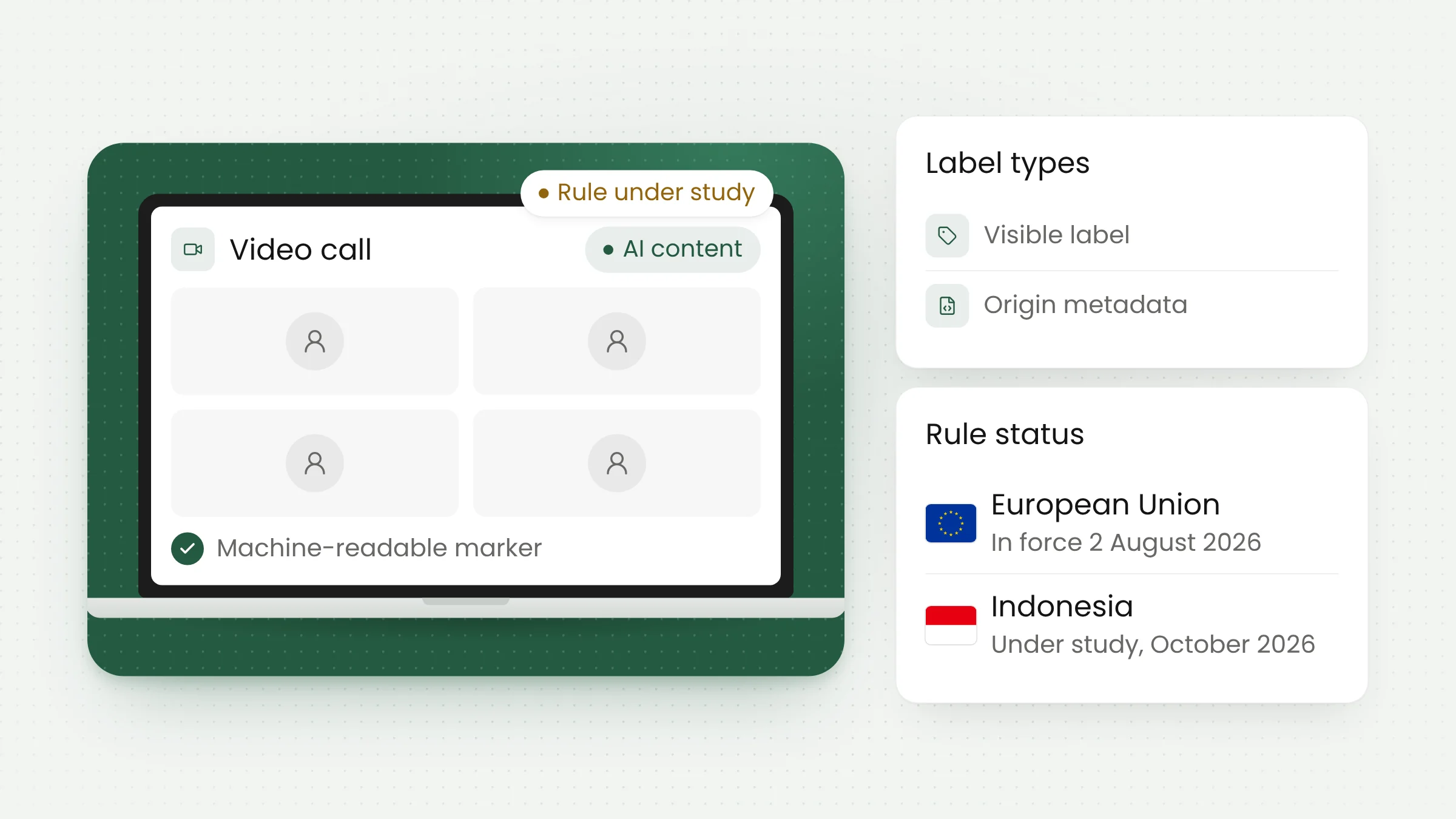
The first is a visible label, such as a “made with AI” note in the corner of a video or below a post. Viewers understand it easily, but it can also be cropped out or covered when a video is reposted.
The second is a machine-readable marker, such as metadata or a digital watermark stored inside the file. Nezar said, as reported by InfoPublik, that global technology companies are developing metadata-based authentication methods that can track a file’s origin even after AI processing. One open standard for this is C2PA, implemented as Content Credentials, which records where a file came from and how it was edited.
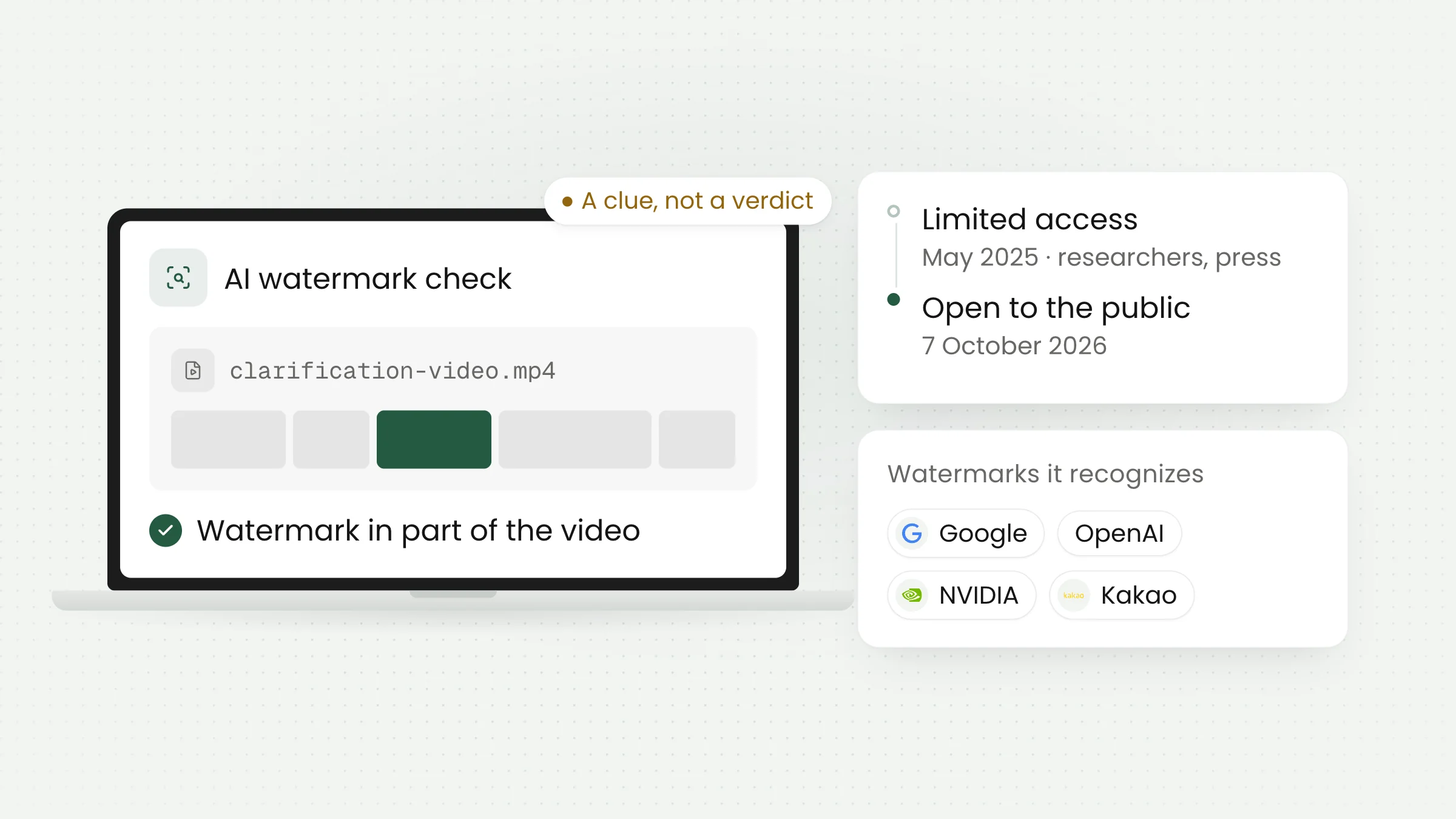
Each approach has limits. Metadata can be lost when a file is compressed or recorded from a screen. Watermarks are more durable, but detectors usually recognize only the watermarks of their own vendor. We covered these limits in our piece on SynthID Detector.
Similar rules in the EU and China
Indonesia would not be the first to act. Two major jurisdictions already require AI content markers.
In the European Union, Article 50 of the AI Act requires providers of generative AI to ensure outputs are marked in a machine-readable format and detectable as AI-generated, covering audio, images, video, and text. Anyone using AI to create deepfakes must disclose that the content was artificially generated or manipulated. These obligations have applied since 2 August 2026. Systems already on the market before that date have until 2 December 2026 to meet the machine-readable marking requirement.
China’s AI labeling rules took effect on 1 September 2025. According to law firm Loeb & Loeb, the measures, issued by the Cyberspace Administration of China and three other agencies, distinguish explicit labels (visible to users) from implicit labels (embedded in file metadata). App distribution platforms must also ask whether an app offers generative AI services.
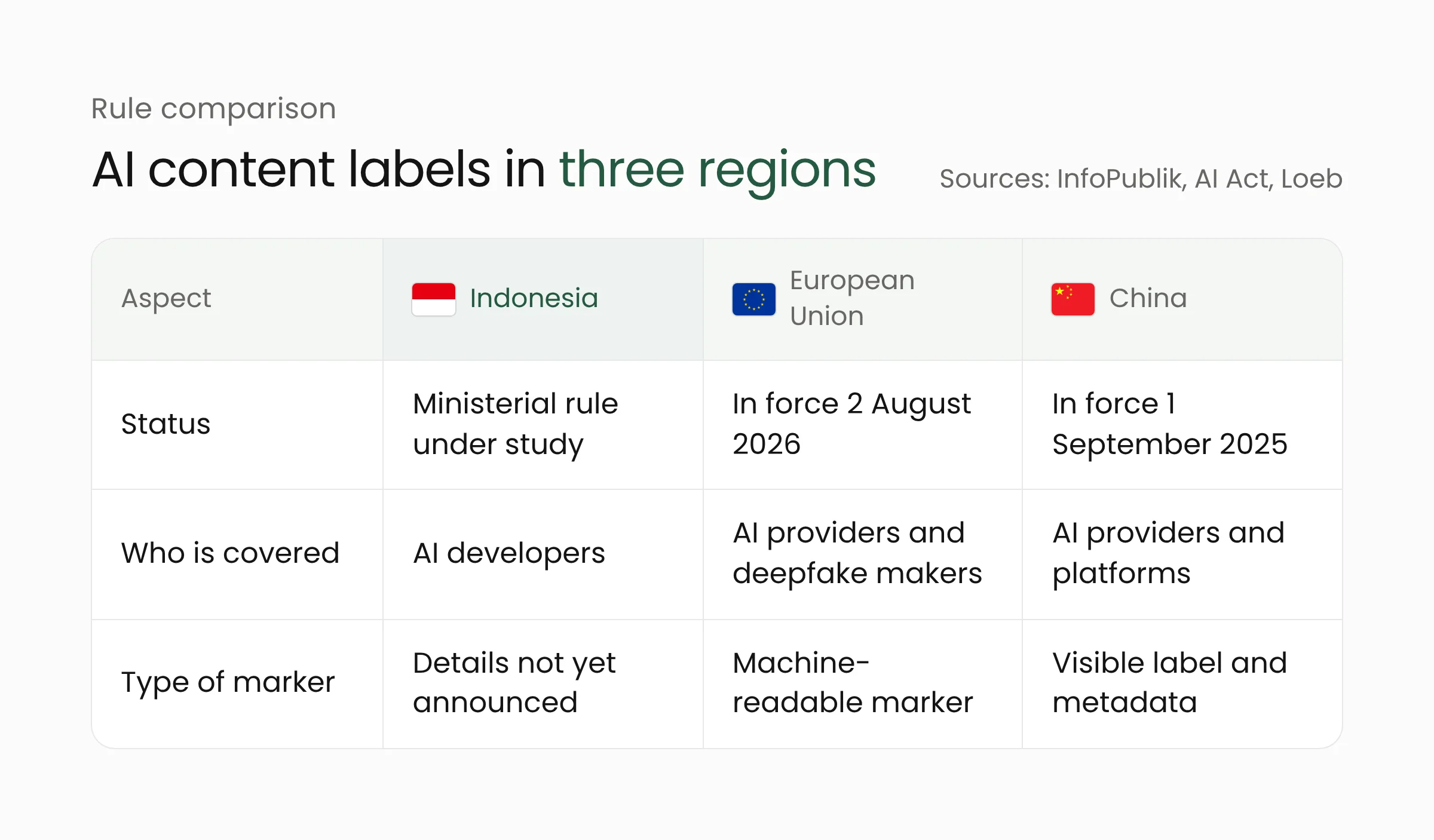
The comparison hints at where Indonesia may be heading. Komdigi’s plan so far targets AI developers. The EU and China also place obligations further downstream, on deepfake creators and platforms.
Enforcement challenges
Labeling at the source solves only part of the problem. As Gebrak.id noted, content can be edited, filtered, or reposted after it leaves the tool that made it. How well labels work depends on technical standards, authentication mechanisms, platform detection, and user awareness.
Scope is another question. Many AI tools used in Indonesia are built by foreign companies. A national rule would need to explain how obligations apply to overseas developers, including open-weight models that anyone can run on their own computer. Those details can only be assessed once an official draft is published.
What this means for agencies and organizations
The rule would target AI developers directly, but its effects reach much further: government public relations teams, banks, hospitals, schools, and companies that use AI to produce communication materials. Several steps can start before any rule is issued.
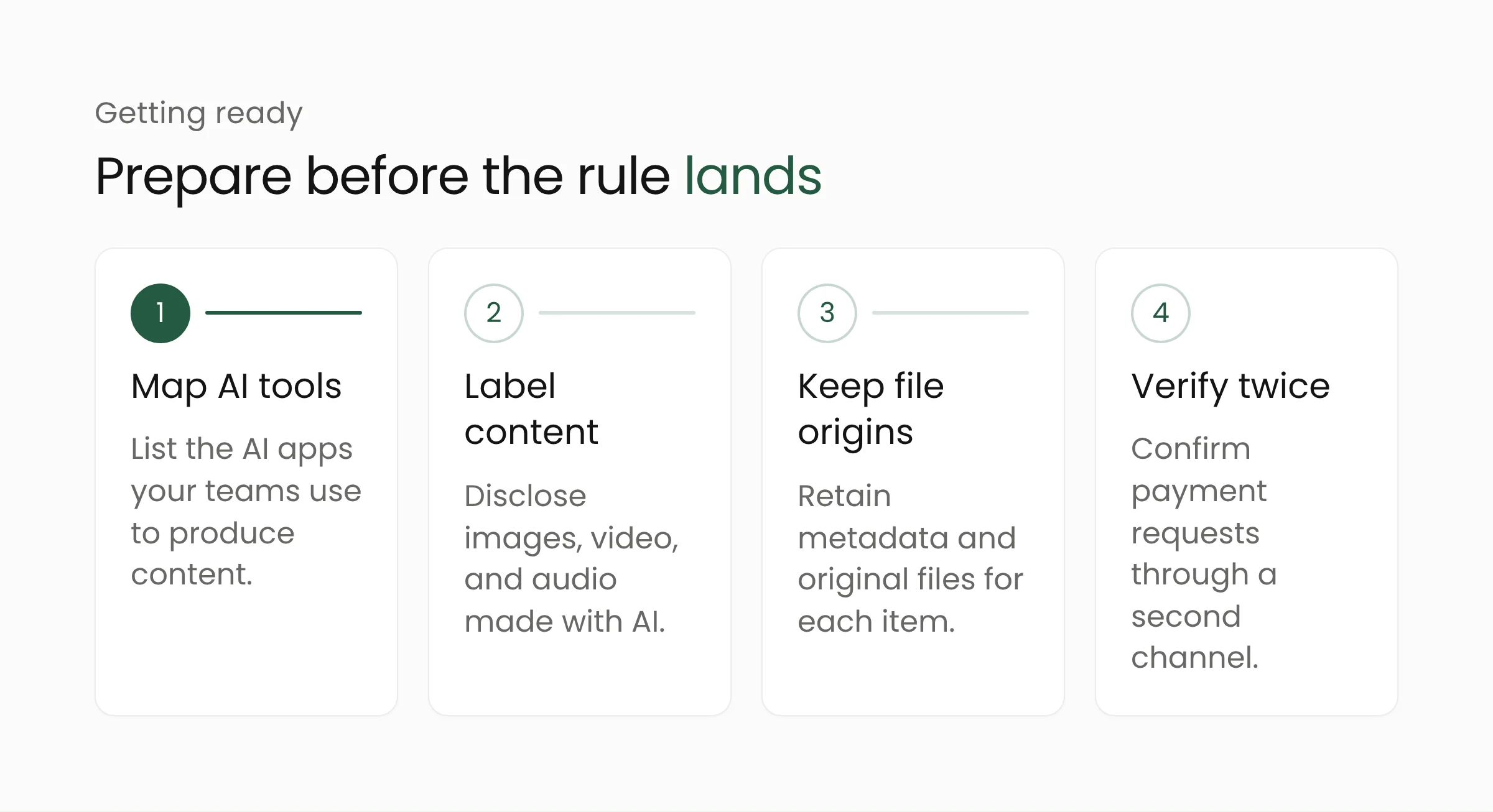
- Map the AI tools in use. List the image, video, and voice generators your teams use, including AI features inside design and editing apps.
- Label the AI-made content you publish. Agencies and companies can set an internal policy to disclose materials created or altered with AI. Such a policy matches the direction of rules in other countries.
- Keep original files and metadata. An archive of originals helps prove authenticity if an official video or photo is faked by someone else.
- Verify important requests through a second channel. Payment requests, account changes, or urgent instructions that arrive by video or voice message should be confirmed through another known channel.
For government agencies, this preparation ties directly to public trust in digital services. Teams building digital government services can design media archiving and authenticity checks from the start. Organizations developing their own AI applications should make sure their systems can embed markers in outputs, since the obligation is likely to fall on developers. Merakit’s artificial intelligence services team can help map those technical needs.
Frequently asked questions
Is AI content labeling already mandatory in Indonesia?
No. As of October 2026, Komdigi is still studying a ministerial regulation. The official draft, start date, and penalties have not been announced.
Who would be required to add labels?
According to Deputy Minister Nezar Patria, the obligation under study targets AI development companies, covering the video and digital media their tools produce. Whether platforms or users will also be covered has not been announced.
Can AI content labels be removed?
Visible labels can be cropped, and metadata can be stripped when a file is compressed or re-recorded. That is why labels need support from technical standards, platform detection, and a habit of checking sources.
Conclusion
Komdigi’s plan marks Indonesia’s move toward transparency rules for AI content, following the EU and China. While the draft is pending, organizations can start tidying up their AI use policies, media archives, and verification procedures. If your team wants to get ready, Merakit Indonesia is happy to talk.
Sources
- Kemkomdigi Kaji Aturan Pelabelan Konten AI untuk Cegah Manipulasi Informasi, InfoPublik, 19 October 2026
- Komdigi Mengkaji Regulasi Label Konten Hasil AI, Bloomberg Technoz, 19 October 2026
- Komdigi Siapkan Aturan Label Konten AI, Deepfake Makin Sulit Dibedakan dari Asli, Gebrak.id, 19 October 2026
- AI Makin Canggih, Wamenkomdigi Ingatkan Humas Perkuat Nilai Humanis, Katadata, 11 July 2026
- The EU AI Act’s Transparency Rules: A Practical Guide to Article 50, artificialintelligenceact.eu
- China’s AI Labeling Measures and Mandatory National Standards Take Effect September 1, Loeb & Loeb, March 2025
- British engineering giant Arup revealed as $25 million deepfake scam victim, CNN (via ABC 17 News), 16 May 2024
- Kominfo Terbitkan Surat Edaran Etika Penggunaan AI di Indonesia, detikInet, December 2023
- C2PA: Coalition for Content Provenance and Authenticity, C2PA