Blog AI-Generated Content
SynthID Detector: How to Check AI-Generated Content
On this page· 7 sections
Google opened SynthID Detector to the public on 7 October 2026. The free tool lets anyone upload a photo, video, or audio file to check for an invisible AI watermark. It is a handy way to check AI-generated content, but the result is a clue, not a verdict. Knowing its limits matters as much as using it.
What Google actually opened this week
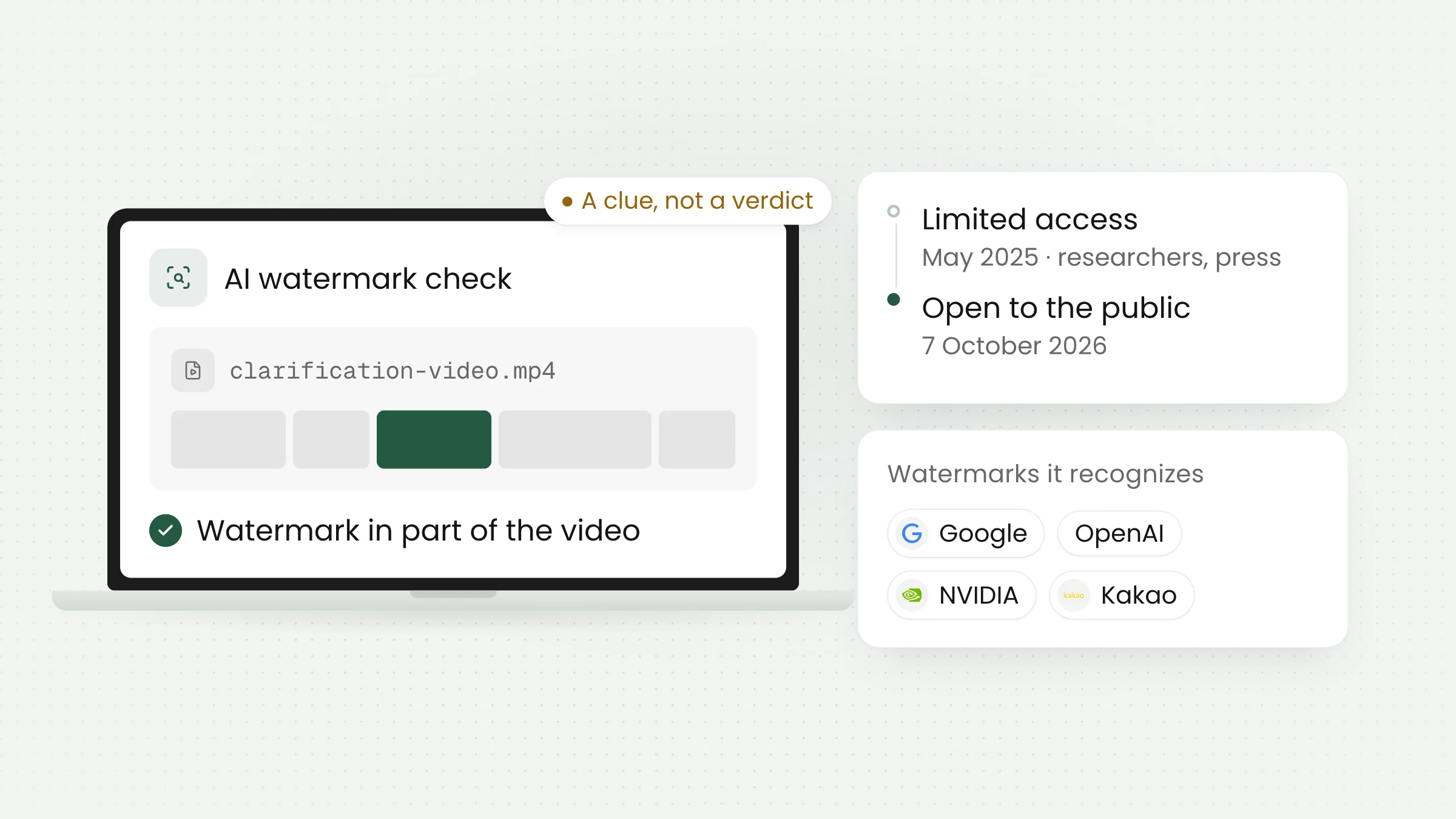
SynthID is an invisible watermark embedded in images, video, or audio when they are created or edited with certain AI tools. You cannot see it, but a checker can read it. Google introduced the portal back in May 2025, but access was limited to researchers and journalists who signed up first, as Jang reported.
What is new in October 2026 is that the door is open to everyone at synthid.com. According to GameBusiness.jp (8 October 2026), the tool handles images, video, and audio in common formats. For video and audio, it shows which segments carry the watermark instead of just giving a yes or no.
Coverage also goes beyond Google’s own products. The same report says watermarks from OpenAI, NVIDIA, and Kakao can be recognized too, with Apple support expected later. The interface is English-only and you need to sign in. Reports differ on which accounts work and how many checks you get per day. One report citing Ars Technica mentions roughly ten per day, so check the site for current terms.

What the tool can and cannot answer
Think of the watermark as a hidden stamp on a sheet of paper. If you find the stamp, you know the paper passed through a particular machine. If you do not, you still know nothing about where it came from.
Several limits come up consistently across reports:
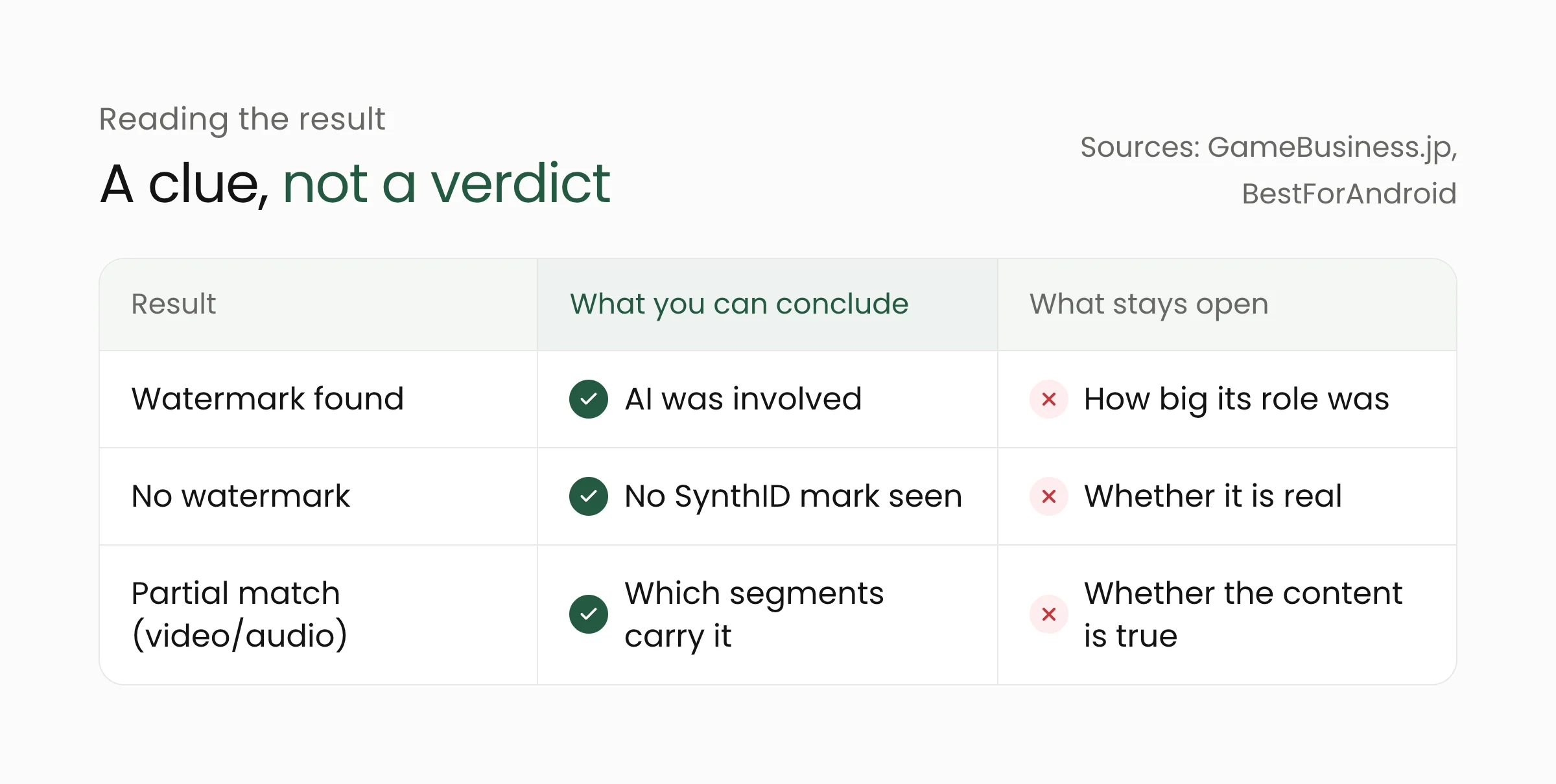
- The tool only detects SynthID watermarks. It is not a general AI detector. Content from models that do not watermark, including many open-source ones, will not register.
- A negative result does not prove the content is real. It may come from another tool, or heavy editing may have weakened the mark.
- A positive result shows AI was involved, but not how much. A real photo lightly touched up with an AI feature and a fully generated image can look the same.
- Text is not supported in this public version, according to GameBusiness.jp.
- Per BestForAndroid, Google itself advises treating results as a clue rather than a final ruling.
In short, SynthID Detector answers a narrow question quite well: does this file carry a watermark we recognize? It does not answer the bigger one: is what this file shows true?
Why it matters in Indonesia
Manipulated content is not an abstract issue for organizations here. An edited photo of a leader spreading false news, a cloned voice asking for a money transfer, or a screenshot of a fake “official announcement” circulating in WhatsApp groups are all easier to produce with AI.
For schools, the problem often involves students. A fabricated image of a classmate going around social media becomes a counseling and discipline matter, not just a technical one. We covered where AI rules for schools are heading in our piece on sector-specific AI guidelines and child protection. A checking tool can be one input among several, but it does not replace policy.
For agencies and companies, the risk is more about reputation and fraud. A communications team that receives a “clarification” video from a leader needs a quick way to be suspicious before sharing. On personal data, faces and voices are also protected under Undang-Undang Nomor 27 Tahun 2022 tentang Pelindungan Data Pribadi (Law No. 27 of 2022 on Personal Data Protection). Uploading someone else’s file to a third-party service is itself a form of data processing, so think about whether you need to.
What this means for your organization
A free tool is not automatically a good process. Here are realistic steps for a school, agency, or small-to-mid-sized company.
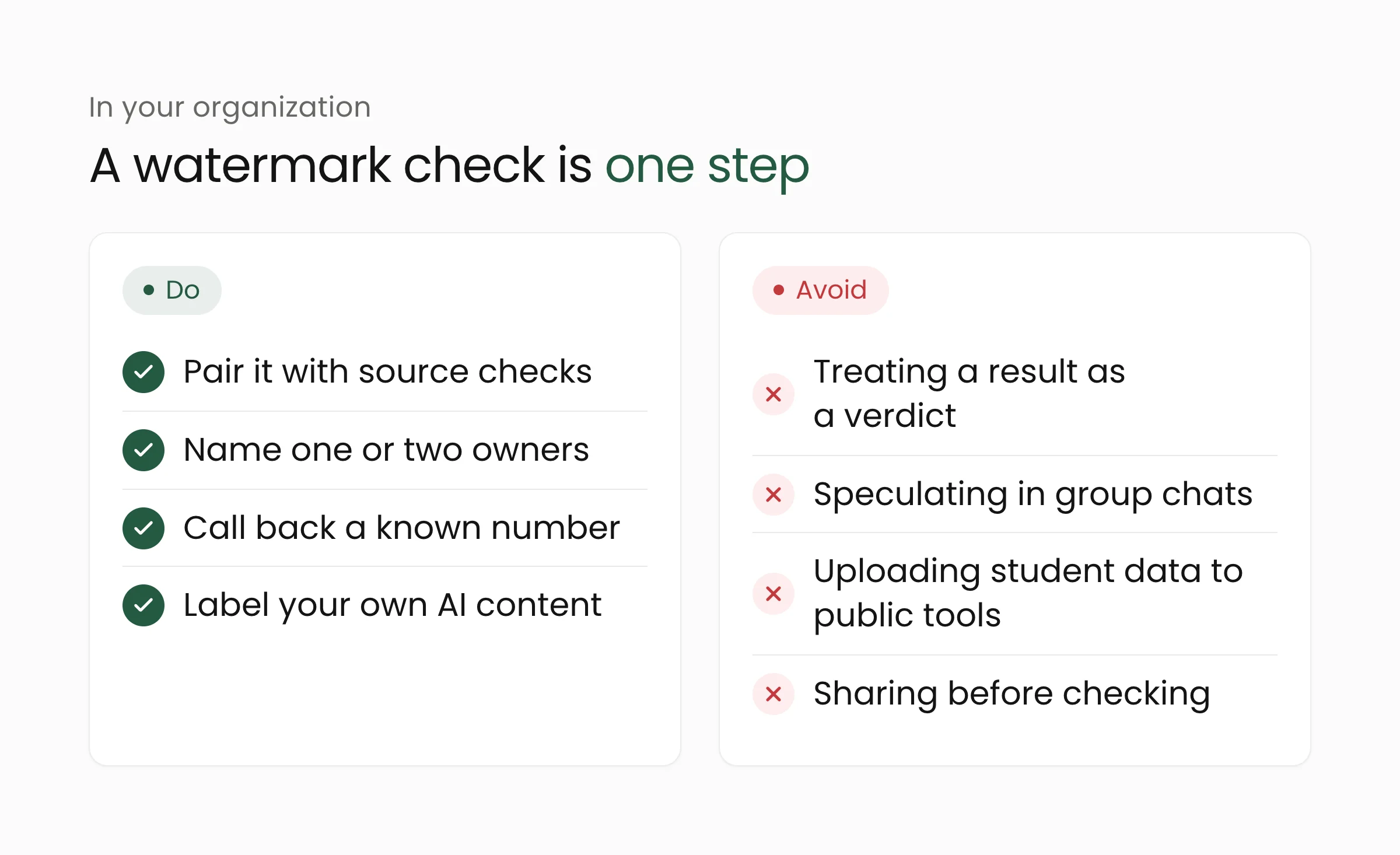
Treat the check as one step, not the only step. A watermark is just one clue. Pair it with source checks: who posted it first, is it on an official channel, and can the person involved be confirmed through another route?
Decide who checks and who decides. One or two people in communications, IT, or security is usually enough. Without a named owner, everyone speculates in the group chat.
Set a simple rule for sensitive files. Do not upload internal documents, student data, or meeting recordings to a public checker without thinking it through. For files already widely circulating, the risk is much lower.
Build a “pause before sharing” habit. For urgent requests such as fund transfers or bank account changes, require a call back to a known number. This works better than any detector against a cloned voice.
Label your own AI content. If your organization uses AI for posters, videos, or teaching materials, note which tool you used and say so honestly. It builds trust, and platforms and regulators are likely to expect it more over time.
If you want help shaping a practical AI usage policy, our team offers artificial intelligence services. Schools and campuses drafting digital content rules can look at our education technology solutions. To assess social-engineering fraud risk in your organization, we also provide cybersecurity services.
Frequently asked questions
Can SynthID Detector confirm that a photo is real?
No. If no watermark is found, it only means the tool did not see a SynthID mark. The photo could have been made with another tool that adds no watermark, or heavy editing may have removed the mark.
Can it detect all AI-generated content?
No. It only recognizes watermarks from Google and partners that embed them, such as OpenAI, NVIDIA, and Kakao according to recent reports. Content from other models without watermarks will not be flagged.
Should schools and companies start using it right away?
There is no need to rush. Try it first to learn how to read the results, then fold it into your existing verification procedure. The value lies in the habit of checking, not just the tool.
Closing thoughts
This news is worth noting, but it does not mean the fake-content problem is solved. A watermark checker adds one cheap, fast clue, while decisions still depend on common sense, source confirmation, and a clear procedure. If you would like a relaxed conversation about AI content rules or verification workflows at your organization, feel free to contact us.
Sources
- GameBusiness.jp, “Google opens its generative AI check tool to the public; SynthID Detector also verifies ChatGPT and NVIDIA images, video, and audio” (8 October 2026, Japanese)
- BestForAndroid, “SynthID Detector just went public; you can now check any photo or video for AI watermarks” (October 2026)
- Letem světem Applem, “Google will now help you spot fake photos and videos made by AI” (8 October 2026, Czech)
- Jang, “Google releases a new tool to detect AI-generated content” (22 May 2025)