Blog Digital Government
Lapor Minsos: Indonesia's AI Helpdesk for Social Aid
On this page· 7 sections
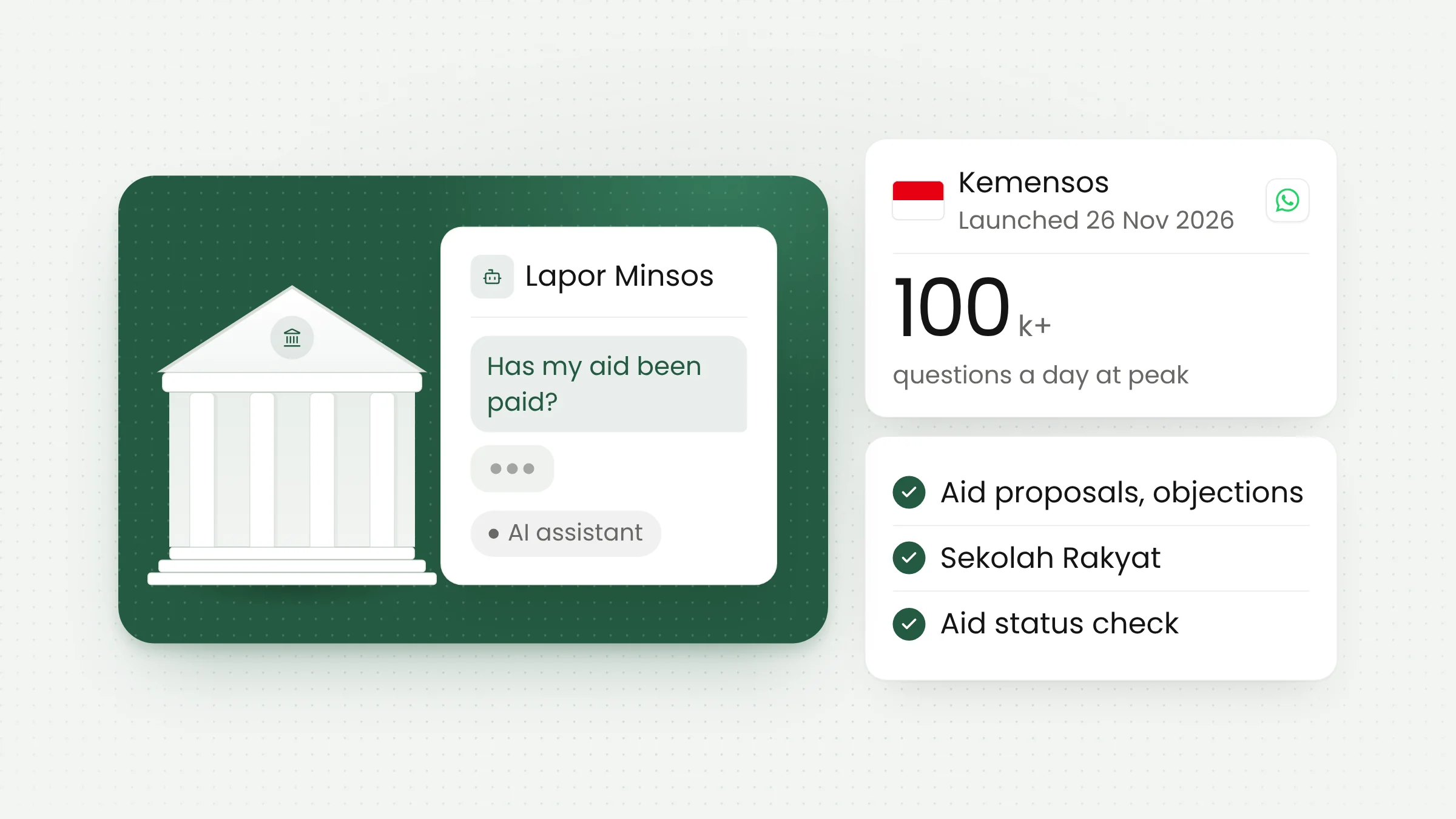
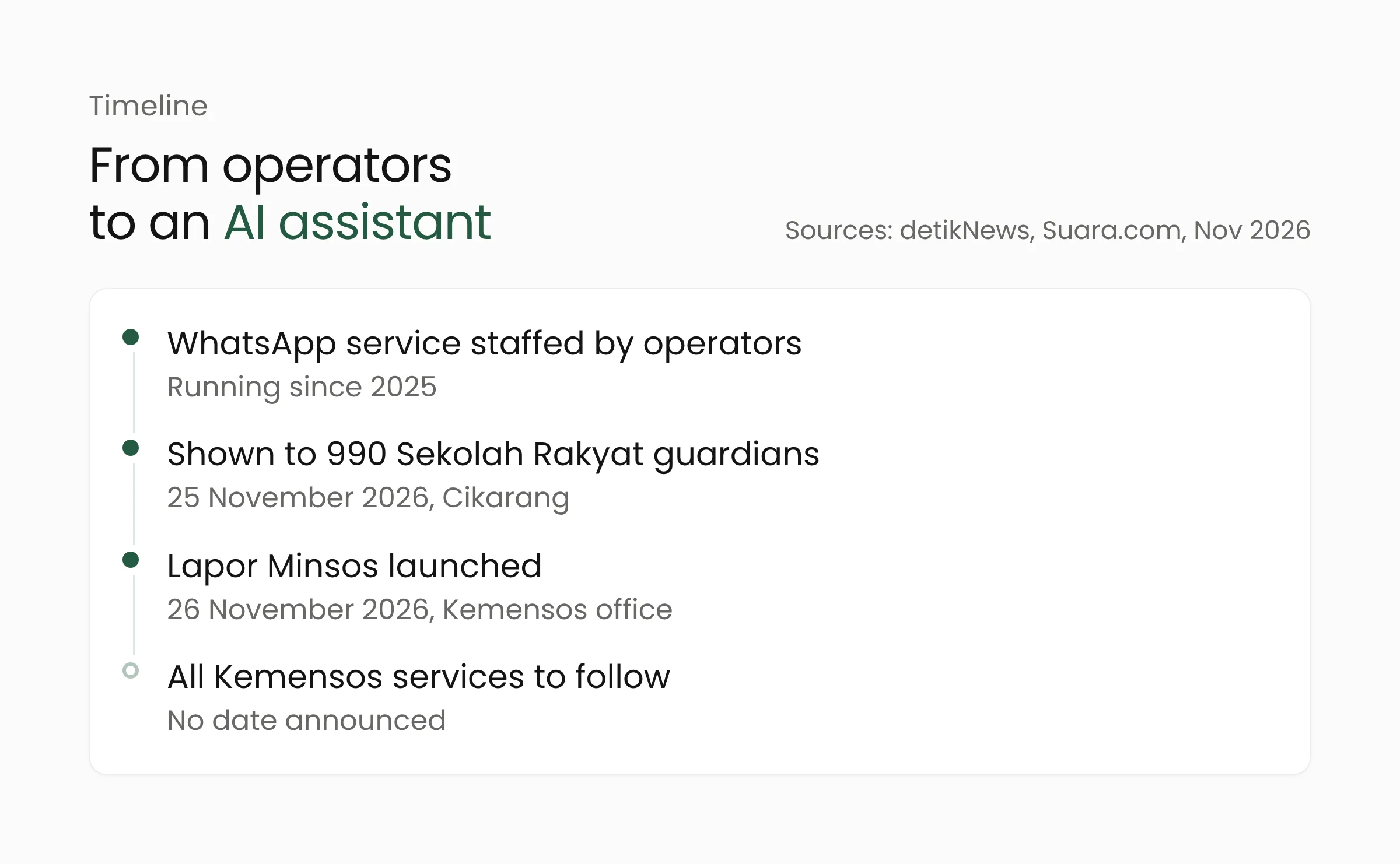
Indonesia’s Ministry of Social Affairs (Kemensos) launched Lapor Minsos on 26 November 2026. The AI-based service answers citizens’ questions about social aid, known locally as bansos, through WhatsApp and the ministry’s Cek Bansos website. It starts with three services: aid proposals and objections, information on the Sekolah Rakyat school programme, and aid status checks.
What the ministry announced
The launch was announced at a press conference at the Kemensos office in Jakarta on Thursday, 26 November 2026. According to detikNews, Social Affairs Minister Saifullah Yusuf said the ministry is moving from manual services to digital ones connected to data held by other ministries and agencies. He said he hopes the public will use the service widely, because the feedback that flows back to the ministry will help it update recipient data.
Joko Widiarto, head of the ministry’s data and information centre (Pusdatin), explained how it works. Kemensos added an automated AI system to two channels it already ran, its WhatsApp service and the Cek Bansos website. People type a question in everyday language, as they would in an ordinary WhatsApp chat, and the AI replies with the information requested, including details on aid disbursement.
Two channels
Kumparan and detikNews describe the same steps. On cekbansos.kemensos.go.id, users click the Lapor Minsos icon and are taken to a page called Customer Care Minsos, where questions are answered on the spot. On WhatsApp, users send a greeting such as “Halo” to 0887-7171-171 and are routed to a live chat.
Three services at launch
For now, Lapor Minsos covers aid proposals and objections, Sekolah Rakyat information, and aid status checks. The proposals and objections track, called usul dan sanggah, lets citizens nominate a household for aid or dispute recipient data. The minister said all Kemensos services and programmes will become available digitally over time. No schedule has been announced.
The feature was demonstrated a day earlier to trainees from the Sekolah Rakyat programme in Cikarang, Bekasi. According to detikNews and Liputan6, Lapor Minsos is meant to help people find information on ministry programmes, check whether they are receiving aid, see their welfare decile, and follow the disbursement process. Welfare deciles sort households into ten levels of economic wellbeing.
The workload behind the decision
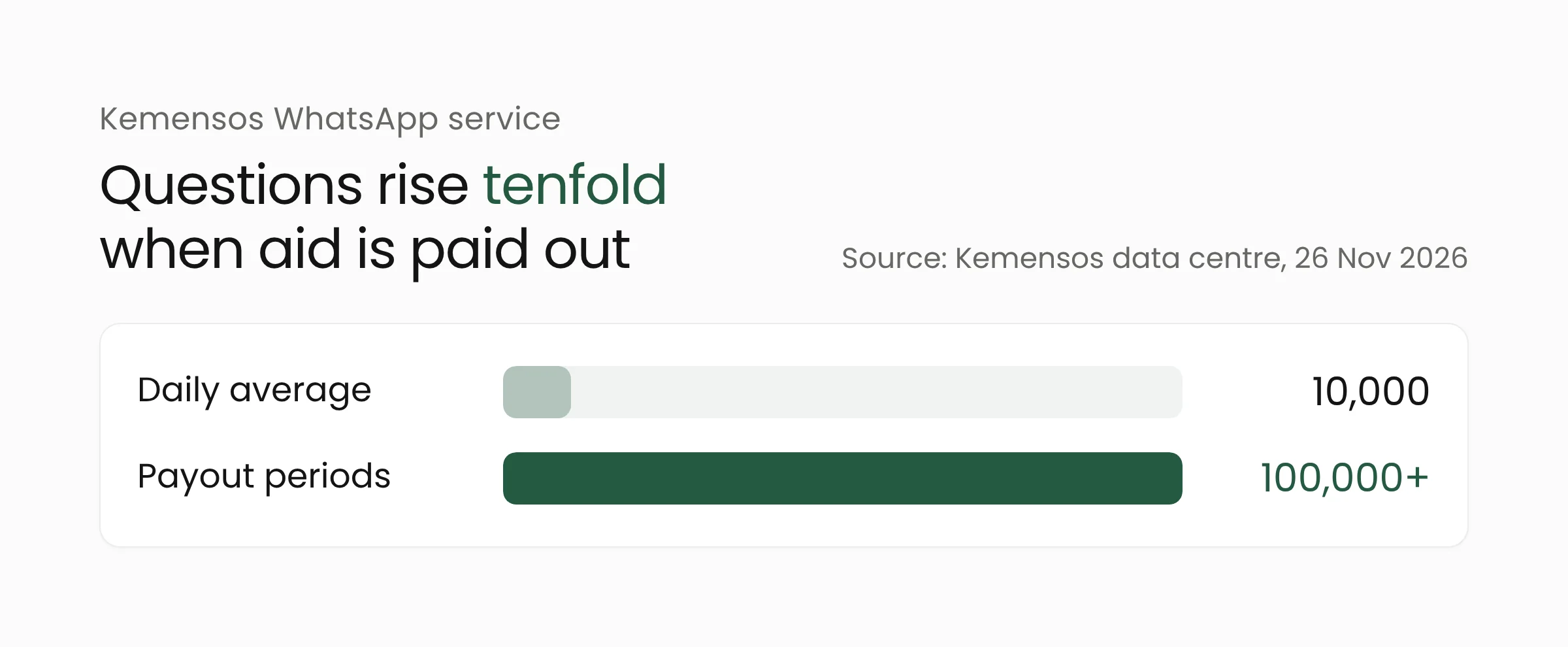
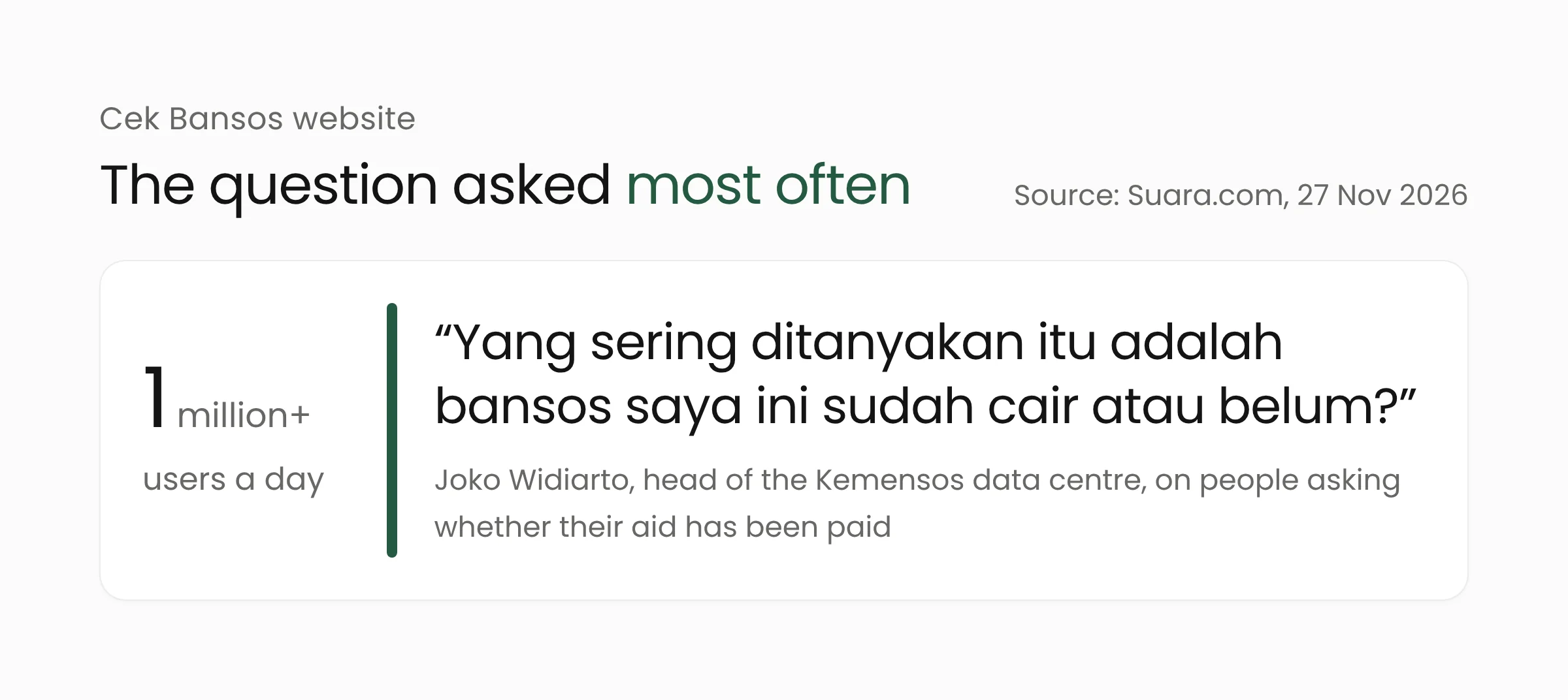
The figures Joko Widiarto shared explain why the ministry turned to AI. The Cek Bansos website is used by more than 1 million people every day. The ministry’s WhatsApp service, which has run since last year, handles about 10,000 a day on average. detikNews reports that figure as people using the service, while Suara.com reports it as questions.
When aid is being paid out, the number of questions passes 100,000 in a single day. That is roughly a tenfold jump from a normal day, and a limited team of operators could not absorb it. Joko said many questions ended up unanswered.
The ministry’s review also found that many of the incoming questions were alike. “Yang sering ditanyakan itu adalah bansos saya ini sudah cair atau belum?” Joko said, as quoted by Suara.com. In English, the question people ask most is whether their aid has been paid yet. It tends to come up when someone sees a neighbour receive aid before they do.
Repetitive questions whose answers already sit in a database are well suited to automation. Operators can then spend their time on cases that need judgment, such as an objection to incorrect data.
Details the ministry has yet to explain
Launch coverage describes the goals and the steps for using the service. Several technical points remain open.
The model and its sources. Kemensos has not named the AI model, who built it, or the data its answers draw on. Official statements say only that the ministry’s digital services are connected to data from ministries and agencies.
Accuracy. In the demonstration, the system was said to answer accurately and quickly. That statement comes from the ministry. Error rates, test results and independent evaluations have not been published, and Joko said work to improve the system is continuing.
Handover to staff. The reports we read do not say when a conversation moves from the AI to a human operator. Objections often involve household circumstances that are missing from the data.
Personal data in chats. A question about aid status involves the recipient’s identity. What data users are asked for, how long conversations are kept and who can read them have not been explained. Indonesia’s personal data protection law, Undang-Undang Nomor 27 Tahun 2022 tentang Pelindungan Data Pribadi, also applies to public bodies that process citizens’ data.
Lapor Minsos arrives alongside Perlinsos Digital, a re-registration service for aid recipients that uses face verification. According to detikNews, more than 26 million families are recorded in that system, and only about 3.3% registered on their own. The rest were helped by agents. The minister named three barriers: people without smartphones, limited digital skills, and fear that existing aid will stop. We covered the background in our article on digital social aid and face verification.
The 3.3% figure matters for Lapor Minsos too. A chat assistant on WhatsApp is easier to use than a form, yet some citizens will still need a person beside them. The ministry’s answer was to ask 990 Sekolah Rakyat guardians and dormitory wardens to act as agents who help neighbours and relatives.
What this means for local government agencies
Lapor Minsos is a national service, but social affairs offices, civil registries, regional hospitals and licensing offices face the same pressure. The city of Jambi, for example, has already added AI to its 112 emergency line on WhatsApp. A few considerations apply before building something similar.
Start from the question log. Kemensos began by reviewing which questions arrived most often and which ones operators could not handle. An agency can do the same by grouping several months of WhatsApp messages, phone calls and complaints.
Keep the first scope narrow. Three well-defined services are easier to keep accurate than an assistant expected to answer everything. Scope can grow once the first answers have proved correct.
Ground answers in official records. An answer about aid status should come from the same system that staff use. A reply composed by AI without reference to records can be wrong, and a wrong answer about aid affects a household directly. Designing this is part of artificial intelligence services work, and it should be tested with real questions before opening to the public.
Provide a path to a person. Decide when a conversation is handed to an operator, for instance when a citizen disputes data or the AI cannot find an answer. Set a deadline for follow-up as well.
Settle personal data rules early. Define what may be requested in a chat, how long it is stored and who is authorised to open it. Publish the official number and web address consistently so citizens can tell them apart from fake accounts that use the name of the aid programme.
Measure the results. Track how many questions are resolved without an operator, how many are handed over, and how many complaints concern wrong answers. Those numbers should guide any expansion, and they are part of how we approach digital government solutions.
Frequently asked questions
How do I use Lapor Minsos?
There are two ways. Open cekbansos.kemensos.go.id and click the Lapor Minsos icon, or send “Halo” to the WhatsApp number 0887-7171-171. Kemensos announced both on 26 November 2026. Check that the web address ends in go.id and that the number matches the one the ministry announced.
What can I ask Lapor Minsos?
Three services are available at the start: aid proposals and objections, Sekolah Rakyat information, and aid status checks. Kemensos says other services and programmes will follow but has not given a schedule.
Are Lapor Minsos answers always accurate?
Kemensos says the system answered accurately in its demonstration and is still being improved. No test results or independent evaluations have been published. For important decisions such as an objection, citizens should still confirm the outcome with an officer or a local agent.
Closing
Lapor Minsos shows where high-volume public services are heading. Routine questions are answered automatically on a channel people already use every day, and staff handle the harder cases. The quality of such a service depends on its data sources, the path to a human officer and personal data protection, and Kemensos has yet to explain those details. If your agency is weighing a similar service, the Merakit team is glad to talk through the design.
Sources
- Kemensos Luncurkan Lapor Minsos, Inovasi Layanan Digital Berbasis AI, detikNews, 26 November 2026
- Pertanyaan Bansos Tembus 100 Ribu Sehari, Kemensos Andalkan AI Lapor Minsos, Suara.com, 27 November 2026
- Kemensos Luncurkan Lapor Minsos, Inovasi Layanan Digital Berbasis AI, Kumparan, 26 November 2026
- Mensos Ajak Wali Asuh dan Wali Asrama Sekolah Rakyat Jadi Agen Perlinsos, detikNews, 26 November 2026
- Kemensos Kenalkan Perlinsos Digital, Petugas Sekolah Rakyat Bantu Warga, Liputan6, 26 November 2026