Blog Artificial Intelligence
MAI Code 2 in GitHub Copilot: What Web Teams Should Know
On this page· 6 sections
Microsoft introduced MAI Code 2 and MAI Code 2 Flash on November 17, 2026, as part of Ignite 2026. The two AI coding models, built by Microsoft AI, are already available in GitHub Copilot at promotional prices that run until May 17, 2027. Microsoft is pitching them for everyday programming work at a lower cost than rival models.
What Microsoft announced at Ignite 2026
MAI Code 2 is one of seven models Microsoft AI, the company’s artificial intelligence division, listed on its Ignite 2026 page. The list also includes MAI Cyber 2 Flash for cyber defense agents, MAI Image 2.7 for image generation and editing, MAI Realtime 1 for live voice conversations, Dragon Copilot Transcribe for medical transcription, and Decision 1.1, a routing model that sends requests to smaller models when possible and to larger ones only when needed.
The coding models drew the most attention because they went straight into GitHub Copilot, the programming assistant that sits inside many developers’ code editors. In its official announcement, Microsoft said both models are available in Copilot. MAI Code 2 Flash can also be tried in a limited-access preview in Microsoft Foundry, the company’s platform for building AI applications. Microsoft said the models are coming soon to OpenRouter, Vercel, Hermes, OpenCode and Kilo.
The launch shows Microsoft building more of its own models. InfoWorld described it as the company’s latest effort to reduce its reliance on OpenAI and Anthropic, two model providers that have helped power Copilot. Microsoft’s announcement is dated November 17, 2026, while InfoWorld and Techzine reported on it on November 18.
Two models for two kinds of work
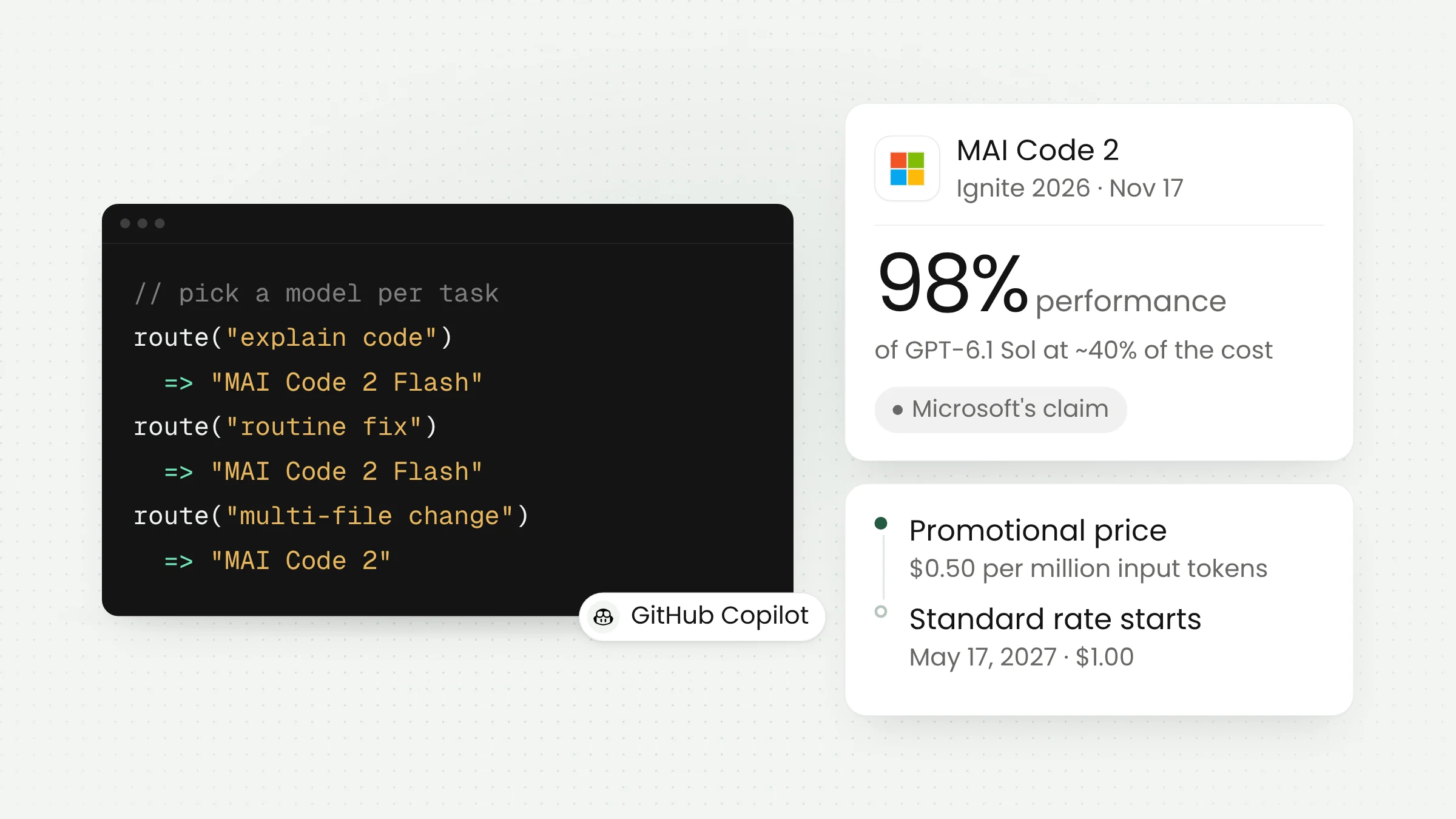
Microsoft splits the models by type of task. MAI Code 2 is aimed at heavier work such as deep debugging, changes across many files, reasoning over an entire repository, and user interface development.
MAI Code 2 Flash targets high-volume work. Examples include explaining code, making targeted edits, handling routine fixes and iterating quickly on small changes. The split resembles how a software team assigns work, with routine tickets going to whoever is fastest and larger changes going to the most experienced engineers.
GitHub’s documentation lists both models as generally available and supporting a context window of up to 1 million tokens. Tokens are the chunks of text a model counts, and the context window sets how much code a model can read in a single request. The 1 million token window is currently available only in Visual Studio Code and Copilot CLI. MAI Code 2 also supports configurable reasoning.
Microsoft was open about the limits. It said both models are not yet tuned for harder problems such as fundamental science research and very long-horizon agentic work. Microsoft also derived MAI Work Flash from Code 2 Flash to serve AI features in Microsoft 365 and FabricIQ.
Performance claims and promotional pricing
Cost per task, according to Microsoft
Microsoft tested MAI Code 2 on four coding benchmarks: DeepSWE 1.1, Terminal Bench 2.1, SWE-Atlas and FrontierCode v1.1. By the company’s account, the average result equals 98% of the performance of OpenAI’s GPT-6.1 Sol at about 40% of the cost. Against Anthropic’s Claude Opus 5.5, Microsoft says MAI Code 2 reaches 96% of the performance at about 5% of the cost.
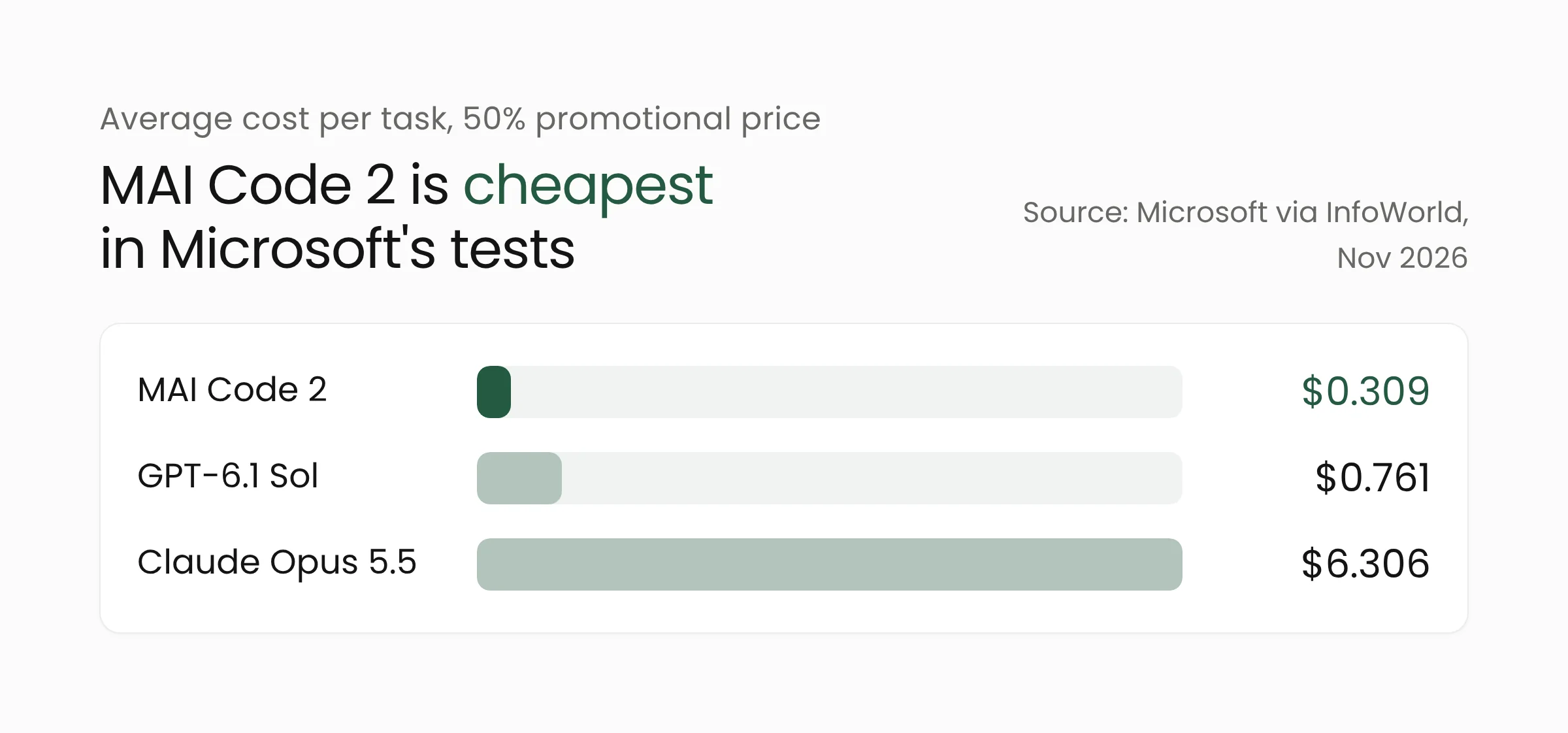
InfoWorld published Microsoft’s detailed figures. MAI Code 2 averaged 63.2%, compared with 64.1% for GPT-6.1 Sol and 65.3% for Claude Opus 5.5. Average cost per task was $0.309, $0.761 and $6.306, respectively. On SWE-Atlas, Claude Opus 5.5 led by a wide margin, scoring 57.5% against 43.1% for MAI Code 2.
MAI Code 2 Flash was compared with GPT-6 Luna and Claude Haiku 5.5 on three benchmarks. Microsoft says the results are comparable, at about 65% of the cost of GPT-6 Luna and 20% of the cost of Claude Haiku 5.5. In blind frontend evaluations with 258 annotators, developers preferred MAI Code 2 over GPT-6 Sol 64% of the time.
Two caveats apply. All models were run at maximum reasoning effort, and Microsoft says results vary by workload and configuration. The cost figures for MAI Code 2 and Flash in these comparisons also use a 50% promotional price. All of the claims come from Microsoft’s own testing and have not been verified independently.
Token rates until May 17, 2027
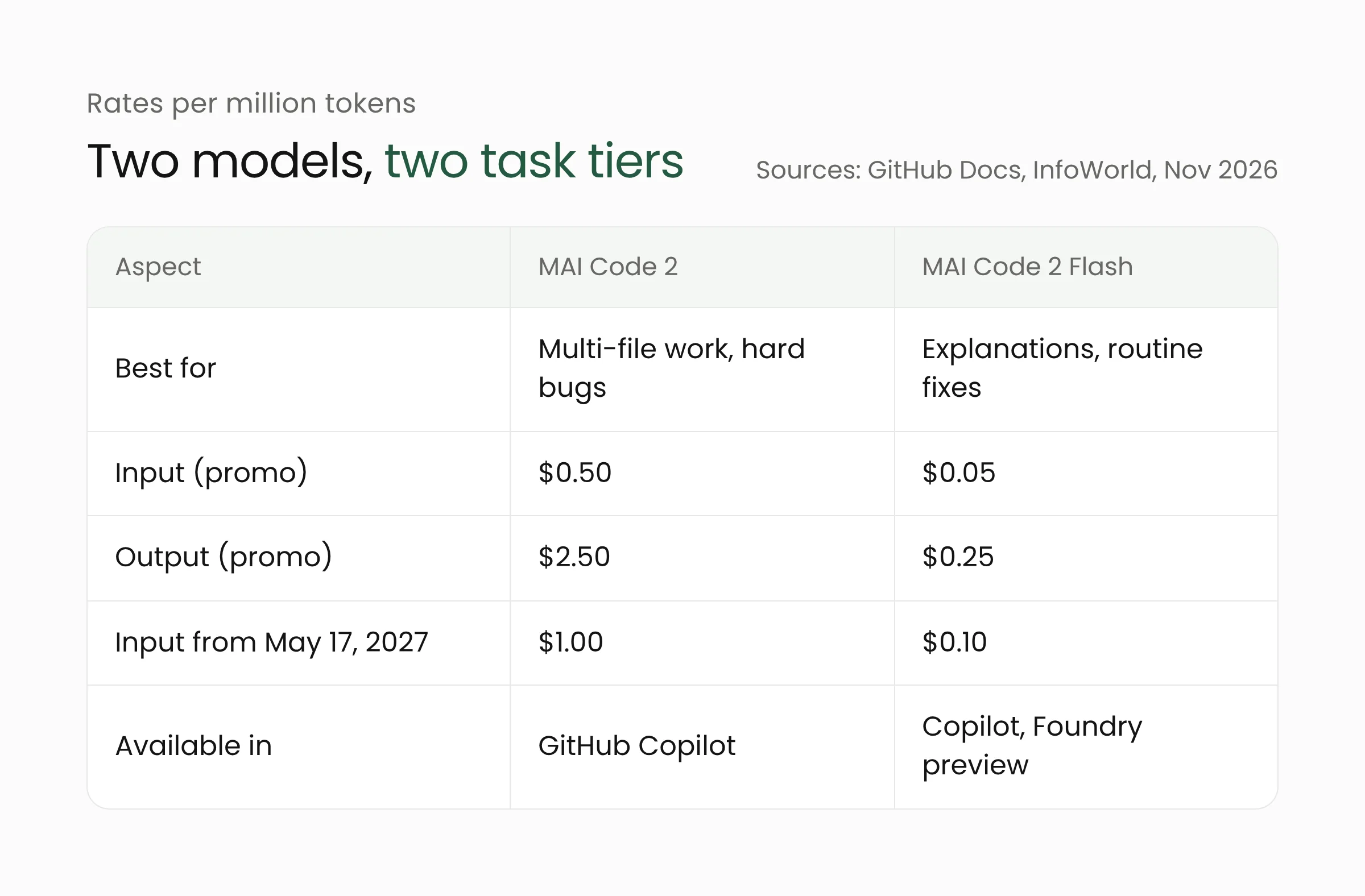
On GitHub’s Copilot models and pricing page, MAI Code 2 is listed at $0.50 per million input tokens, $0.025 per million cached input tokens and $2.50 per million output tokens. MAI Code 2 Flash is listed at $0.05 for input, $0.005 for cached input and $0.25 for output.
These are promotional rates valid until May 17, 2027. From that date, input pricing rises to $1.00 per million tokens for MAI Code 2 and $0.10 for MAI Code 2 Flash. InfoWorld reported that output prices also rise, to $5.00 for MAI Code 2 and $0.50 for Flash.
Microsoft’s announcement does not say which Copilot plans include the two models. GitHub’s documentation says only that available models depend on the Copilot plan, where Copilot is used, and the model policies an organization sets.
What analysts say
Analysts quoted by InfoWorld urged caution. “Microsoft’s own savings are measured at a 50% promotional price, so the gap narrows sharply once the promotion ends,” said Sanchit Vir Gogia, chief analyst at Greyhound Research.
Pareekh Jain, CEO of EIIRTrend & Pareekh Consulting, pointed to costs beyond the model itself. Companies still pay for integration, testing, security, human review and fixing errors in AI-generated code. He offered a simple calculation: if model usage accounts for 10% of development costs, a 60% cut in model costs saves only about 6% overall.
Gogia also noted that Microsoft’s model cards rate both models highly on offensive cyber capabilities. He recommended pilots that assess security and reliability alongside code quality. We looked at how to test per-task cost claims like these in our article on Qwen4-Max and AI task costs.
What this means for web development teams
For teams working in web application development, whether on a local government service portal, an online store or a university information system, cheaper coding models open up new options. The decision to use them should still rest on data from the team’s own repositories. Four steps are worth considering.
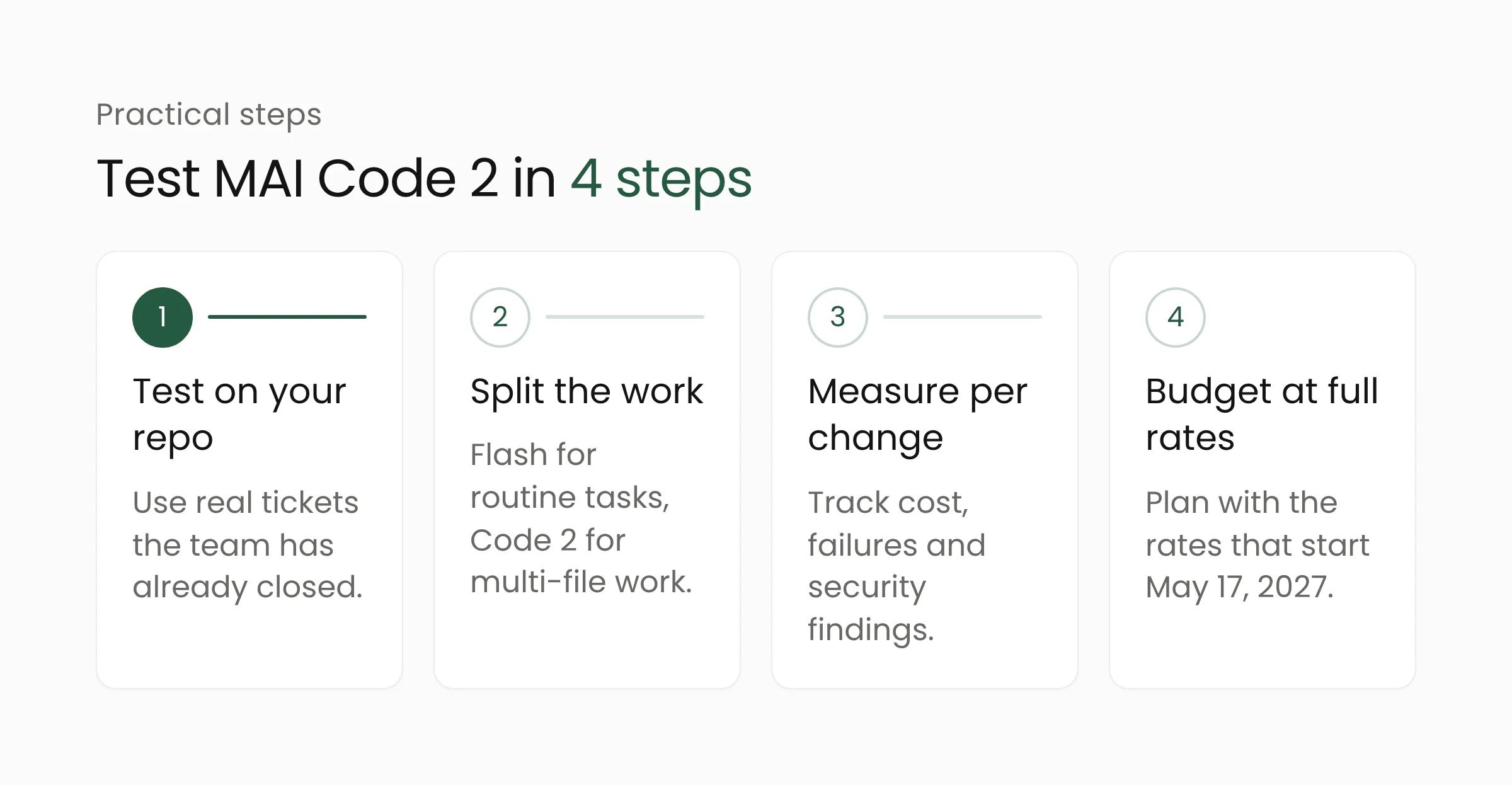
- Test on real tasks in your own repository. Pick a set of tickets the team has already closed, such as a form validation fix or a new report column. Run the same tickets through several models with the settings you would actually use day to day, then compare the results.
- Match tasks to the right tier. Send code explanations, small fixes and simple test writing to a lightweight model such as Flash. Use the stronger model for multi-file changes, difficult debugging and interface work.
- Measure cost per accepted change. Gogia suggests tracking cost per merged change, change failure rates and security findings, then comparing them with a baseline without AI tools. These figures reflect real costs better than the price per token.
- Budget at standard rates. Agencies and companies that plan budgets a year ahead should use the rates that apply after May 17, 2027, since the promotional pricing lasts only about six months.
AI-generated code should still pass the same review, automated tests and security scans as code written by people. On Copilot plans for organizations, administrators can restrict which models are allowed through model policies, so a pilot can start with one team before expanding. If your team is considering coding agents that work more independently, we covered the risks in our article on DeepSeek Super-agent.
Frequently asked questions
What is the difference between MAI Code 2 and MAI Code 2 Flash?
MAI Code 2 is designed for heavier work such as complex debugging, multi-file changes and understanding an entire repository. MAI Code 2 Flash is lighter and cheaper, built for high-volume tasks such as explaining code, small edits and routine fixes.
How much will MAI Code 2 cost after the promotion ends?
According to GitHub, from May 17, 2027, input pricing becomes $1.00 per million tokens for MAI Code 2 and $0.10 for MAI Code 2 Flash. InfoWorld reported output pricing rising to $5.00 and $0.50 per million tokens, respectively.
Does MAI Code 2 outperform GPT-6.1 Sol and Claude Opus 5.5?
By Microsoft’s own figures, MAI Code 2’s average score is slightly below both, while its cost per task is much lower. The claims have not been tested independently, so results on your own codebase may differ.
Conclusion
MAI Code 2 and MAI Code 2 Flash add more choice to GitHub Copilot, with the promise of much lower costs. Their real value will show only after testing against a team’s own code, review process and budget, including after promotional pricing ends in May 2027. If your team is shaping an AI-assisted workflow for application development, Merakit can help through our artificial intelligence services, from pilot design to measuring results.
Sources
- MAI Code 2 and Code 2 Flash: Everyday coding at scalable prices, Microsoft AI, November 17, 2026
- Seven new world-class models at scalable price-performance, Microsoft AI, November 17, 2026
- Models and pricing for GitHub Copilot, GitHub Docs, accessed November 19, 2026
- Supported AI models in GitHub Copilot, GitHub Docs, accessed November 19, 2026
- Microsoft launches MAI Code 2 models to challenge OpenAI and Anthropic in AI coding, InfoWorld, November 18, 2026
- Microsoft MAI Code 2 generates code at a fraction of the price, Techzine, November 18, 2026