Blog Digital Health
FDA Clears MiniMed Fit, a Seven-Day Tubeless Insulin Pump
On this page· 7 sections
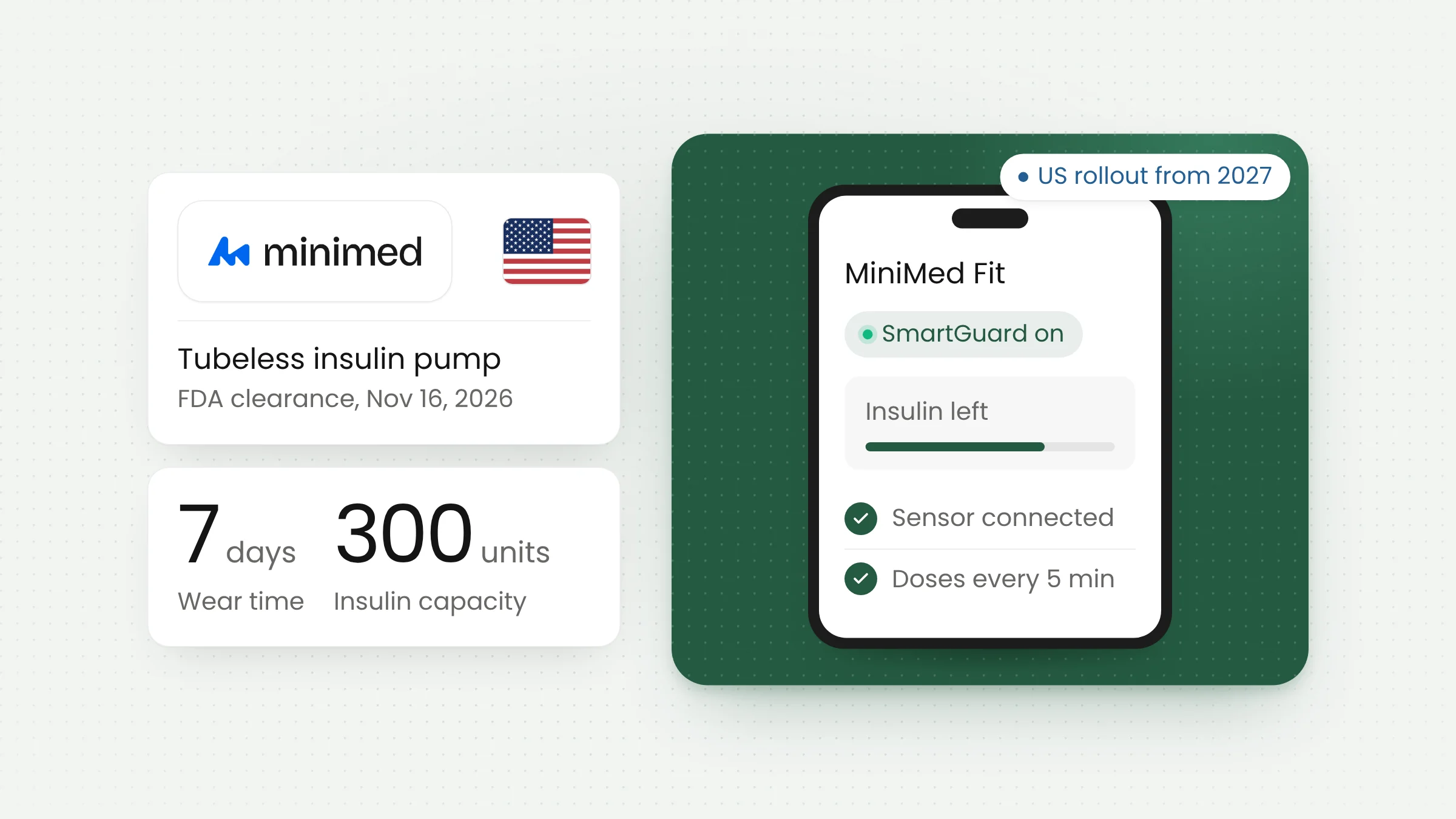
The U.S. Food and Drug Administration has cleared MiniMed Fit, the first tubeless insulin pump from MiniMed, the company announced on November 16, 2026. The pump can be worn for up to seven days and holds 300 units of insulin. A phased U.S. rollout is expected to begin in spring 2027.
What the FDA cleared
An insulin pump is a small device that delivers insulin under the skin around the clock, replacing repeated injections. Conventional pumps connect to the body through thin tubing. Tubeless pumps, often called patch pumps, stick directly to the skin, so there is no tubing to manage or snag.
According to MiniMed’s press release, the clearance covers people with Type 1 and Type 2 diabetes aged 7 and older. The pump is controlled through an app on compatible iOS and Android devices. At commercial launch, users will be able to pair it with one of two glucose sensors: MiniMed’s own Simplera Sync, worn for up to seven days, or Instinct, made by Abbott, worn for up to 15 days.
The company lists the back of the arm, lower back, upper buttocks, abdomen and thigh as wear locations. The pump is waterproof to 2.4 meters (8 feet) for 1 hour and 45 minutes. MiniMed notes that if users stay connected in water, sensor readings may not reach the pump.
Wear time and capacity claims
MiniMed says the Fit offers up to twice the wear time and 50% more insulin capacity than other tubeless pumps. In its footnotes, the company compares it with Omnipod, worn for up to three days; Mint, worn for three days plus a 12-hour grace period; and Tandem Mobi, which can be worn for seven days but requires a cartridge change on day three. All three hold 200 units, according to MiniMed.
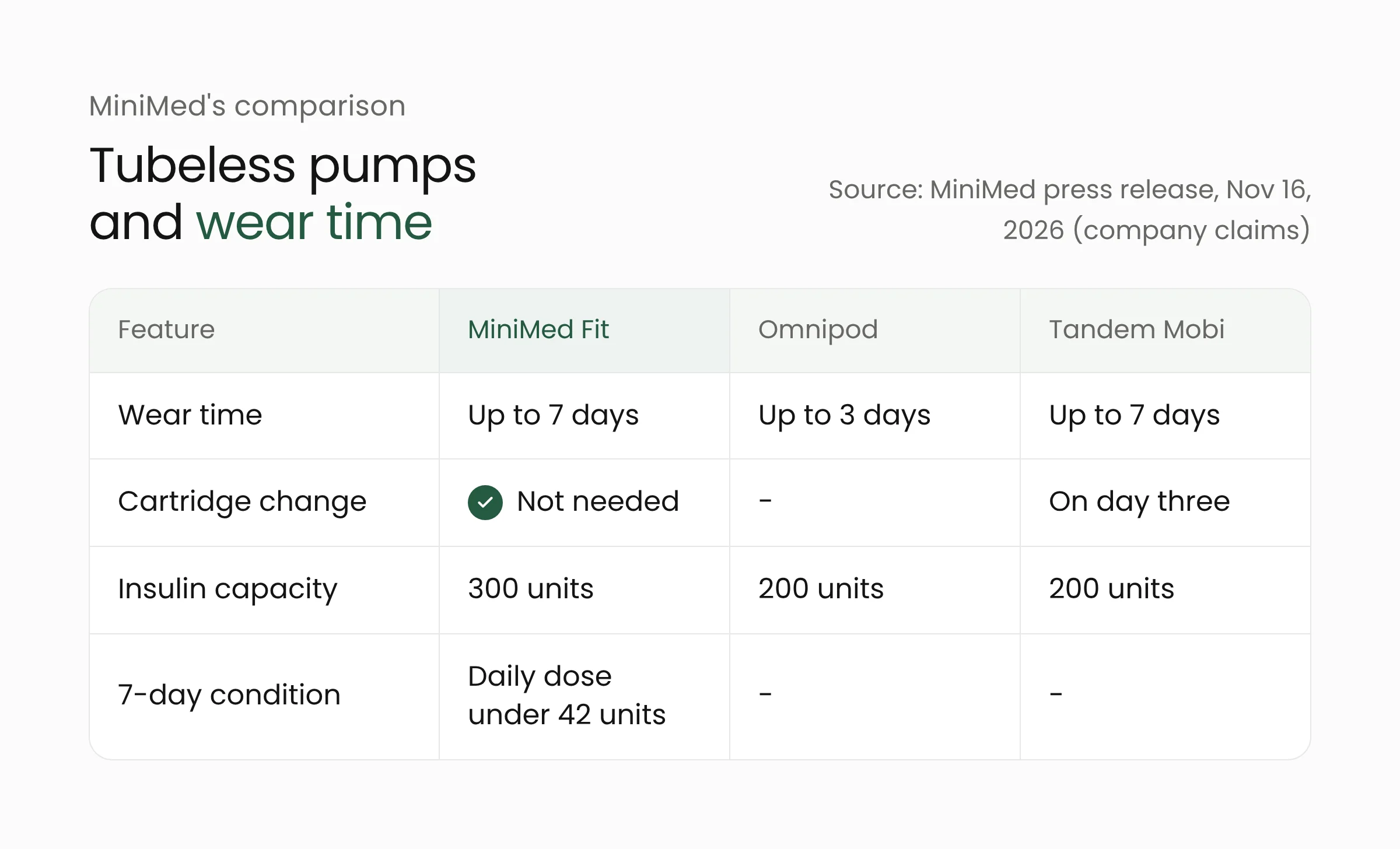
The seven-day figure comes with a condition. A MiniMed footnote says seven-day wear is achievable with a total daily dose of less than 42 units, so people who need more insulin will change pumps more often. The comparisons are company claims and have not been tested independently.
How the pump, sensor and app work together
MiniMed Fit operates as a system of connected devices. A continuous glucose monitor (CGM) worn on the skin measures glucose levels at regular intervals. That data goes to the pump, where the SmartGuard algorithm decides how much insulin to deliver.
MiniMed says SmartGuard adjusts insulin delivery automatically and can deliver correction doses every five minutes. A feature called Meal Detection can add insulin when a meal dose is missed or underestimated. The phone app is where users check status and control the pump.
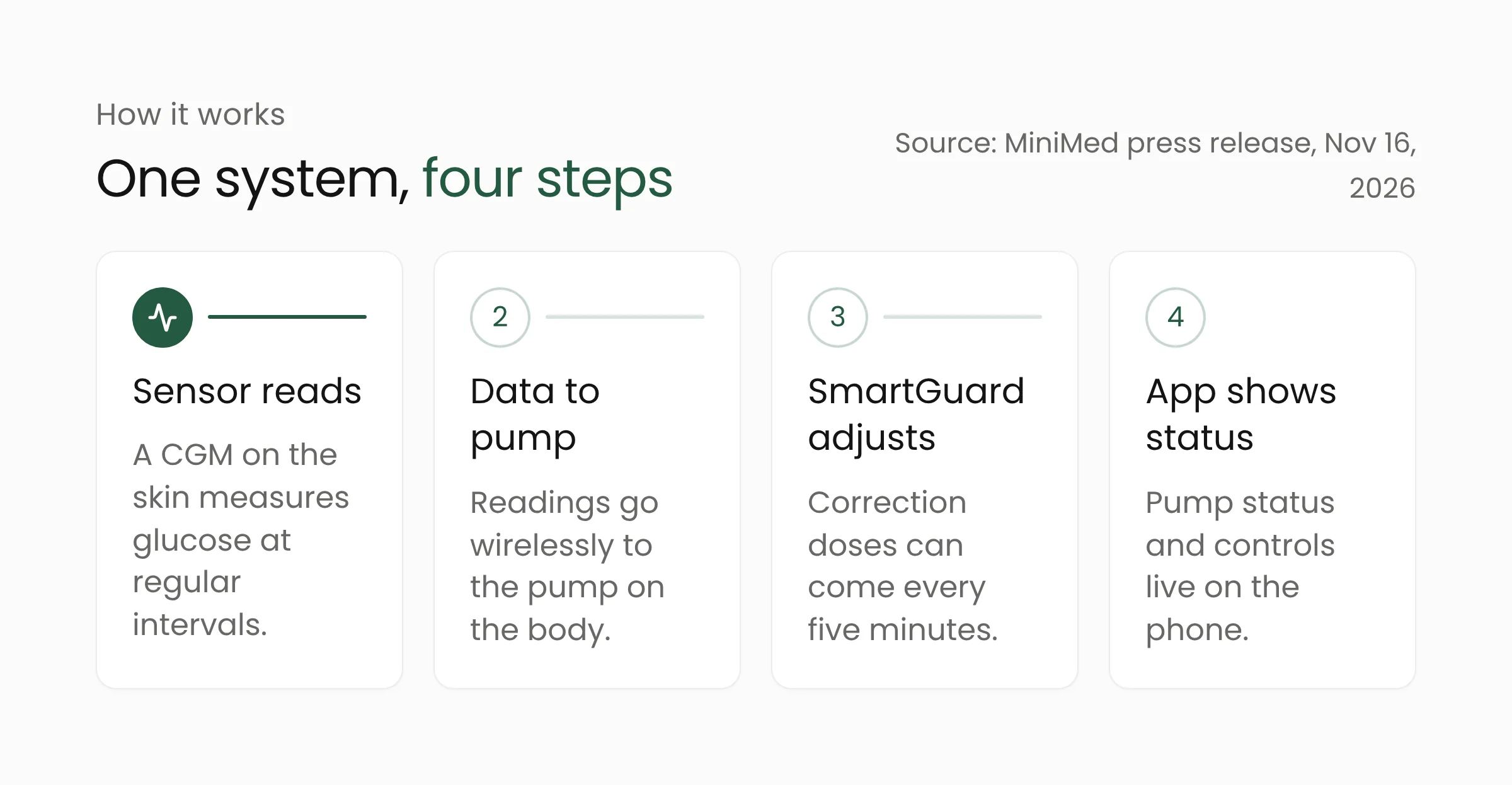
The loop resembles an industrial Internet of Things (IoT) setup: a sensor measures, a controller decides, an actuator acts and a screen reports. The difference is that a fault in a medical device affects the wearer’s body directly. Wireless reliability, battery life and secure device pairing therefore become part of patient safety.
Limits of the outcome claims
MiniMed says real-world SmartGuard users have reached up to 80% time in the target glucose range with recommended settings. That data comes from users of the MiniMed 780G pump, collected in Europe, the Middle East and Africa according to the references in the release. The company itself advises caution when applying the results to new patients and notes that individual results may vary.
Launch timing and competition
MiniMed plans an early customer experience phase in the fourth quarter of its fiscal year 2027, followed by a phased U.S. rollout starting in spring 2027. The pump will be sold through the pharmacy channel. Pricing has not been announced, and neither have plans for markets outside the United States.
“People with diabetes shouldn’t have to choose between the freedom of tubeless wear and the health outcomes they deserve,” said Que Dallara, MiniMed’s chief executive, in the release. The company said the clearance came ahead of schedule and that it plans to expand manufacturing capacity as commercialization progresses.
The clearance lands in MiniMed’s first year as a standalone public company. MedTech Dive notes that MiniMed separated from its former parent, Medtronic, in 2026. One week after its IPO, the company won FDA clearance on March 18, 2026, for MiniMed Flex, a screenless, phone-controlled pump about half the size of the MiniMed 780G.
MedTech Dive describes Insulet, maker of Omnipod, as the leader in tubeless pumps. Dallara told an investor conference in September that MiniMed was bringing a differentiated patch system to market, and she named manufacturing as one of the biggest challenges for patch pumps because it requires experience with sterile products at high volume.
What this means for hospitals and clinics
MiniMed says it serves people with diabetes in 80 countries, but it has not said whether MiniMed Fit will be sold in Indonesia. Imported medical devices also need a distribution permit from Indonesia’s Ministry of Health before they can be marketed there. The direction of travel is still clear: diabetes care increasingly depends on devices that generate data every few minutes.
Diabetes in Indonesia
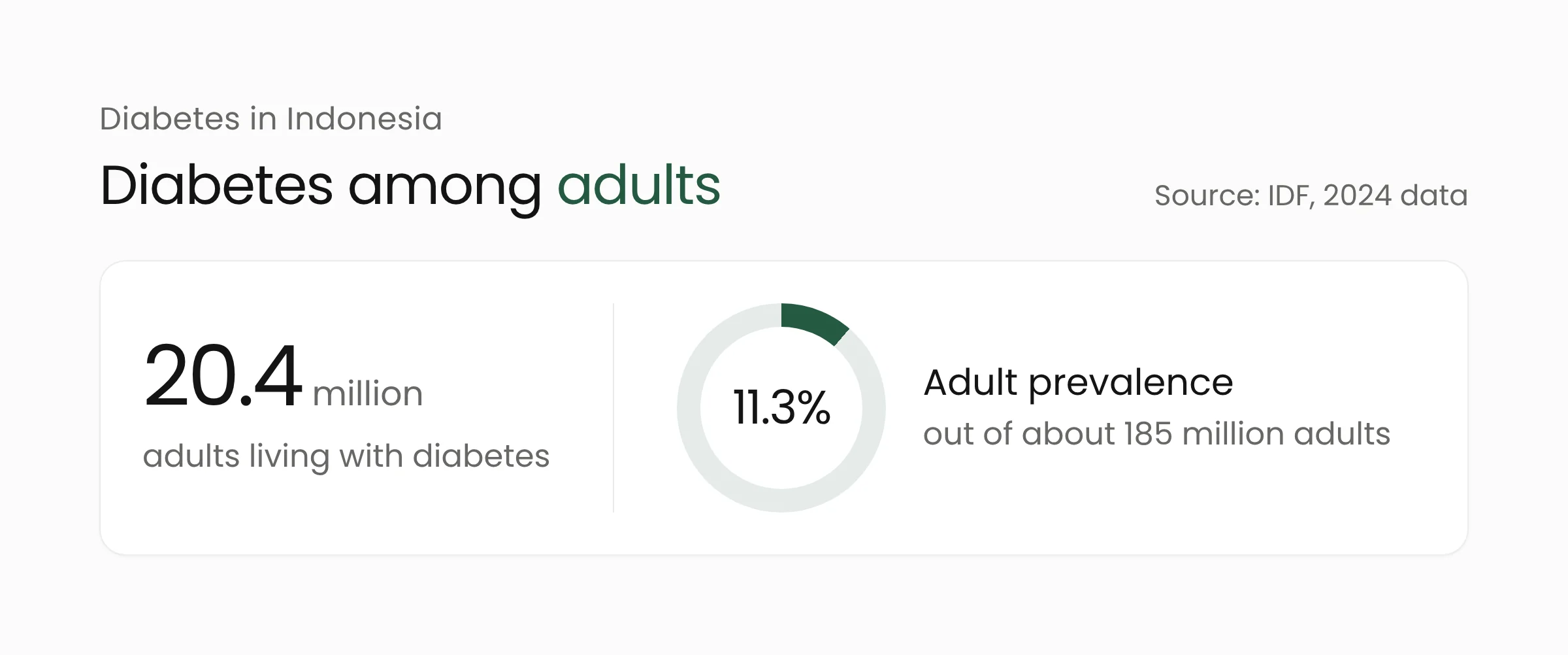
The International Diabetes Federation (IDF) counts 20,426,400 adults living with diabetes in Indonesia in 2024, or 11.3% of the adult population. At that scale, hospitals and clinics will see more patients arriving with data from glucose sensors, insulin pumps or smartwatches.
Steps to prepare
First, decide how device reports will be read during consultations. CGM data is usually summarized as daily graphs and a percentage of time in the target range. Doctors and diabetes educators should agree on the formats they accept, such as a PDF export from the patient’s app, so appointments are not spent opening several apps.
Second, record the source of device data in the medical record. Readings from a patient’s device should be labeled with the device and the date captured, kept separate from laboratory results. For hospital information systems, that means clear fields and upload flows, including integration with existing electronic medical records. Teams designing healthcare information systems can start from these requirements.
Third, treat glucose data as sensitive. Article 4 of Law No. 27 of 2022, Undang-Undang tentang Pelindungan Data Pribadi (Indonesia’s Personal Data Protection Law), classifies health data and information as specific personal data. Patient consent, access limits and logs of who opened the data should be set up from the start.
Fourth, for health app developers, devices like this set the standard patients will expect: secure pairing, dependable alerts and data that can be exported. Building IoT solutions for healthcare means testing dropped connections, low batteries and software updates before patients rely on them. We covered a similar question for 24-hour blood pressure tracking on a smartwatch.
Finally, patient education still matters most. Patients interested in an insulin pump from abroad should talk to their doctor, because dose settings, sensor supplies and after-sales support need to be available where they live.
Frequently asked questions
Is MiniMed Fit available in Indonesia?
No. MiniMed has only announced a phased U.S. rollout starting in spring 2027. Plans for other countries, including Indonesia, and pricing have not been announced.
How does a tubeless insulin pump differ from a conventional one?
A conventional pump sits in a pocket or on a belt and connects to the skin through tubing. A tubeless pump sticks directly to the skin and is replaced when its wear period ends. For MiniMed Fit, that period is up to seven days, provided the total daily dose stays below 42 units.
Can people with Type 2 diabetes use MiniMed Fit?
Yes. The FDA clearance covers people with Type 1 and Type 2 diabetes aged 7 and older. MiniMed’s chief executive told MedTech Dive that the 300-unit reservoir suits adults and people with Type 2 diabetes who need more insulin.
Conclusion
MiniMed Fit adds a longer-wear option to the tubeless pump market, although its comparisons still come from the company and the product will only reach U.S. patients in 2027. For healthcare providers in Indonesia, the larger lesson is about data: more patients will arrive with glucose records from connected devices.
Merakit Indonesia helps hospitals and clinics build systems that can receive and protect data from patient devices. Contact our team if your facility wants to discuss how that data should flow.
Sources
- FDA Clears MiniMed Fit, World’s First and Only Tubeless Insulin Pump with Up to Seven-Day Wear and Zero Interruptions, MiniMed press release, November 16, 2026
- MiniMed gets FDA nod for tubeless insulin pump, MedTech Dive, November 16, 2026
- MiniMed Announces FDA Clearance of MiniMed Flex, MiniMed press release, March 18, 2026
- Diabetes in Indonesia (2024), International Diabetes Federation
- Article 4, Law No. 27 of 2022 on Personal Data Protection, Pasal.id