Blog Space Technology
Starship Caught by Its Tower From Orbit: Automation Lessons
On this page· 7 sections
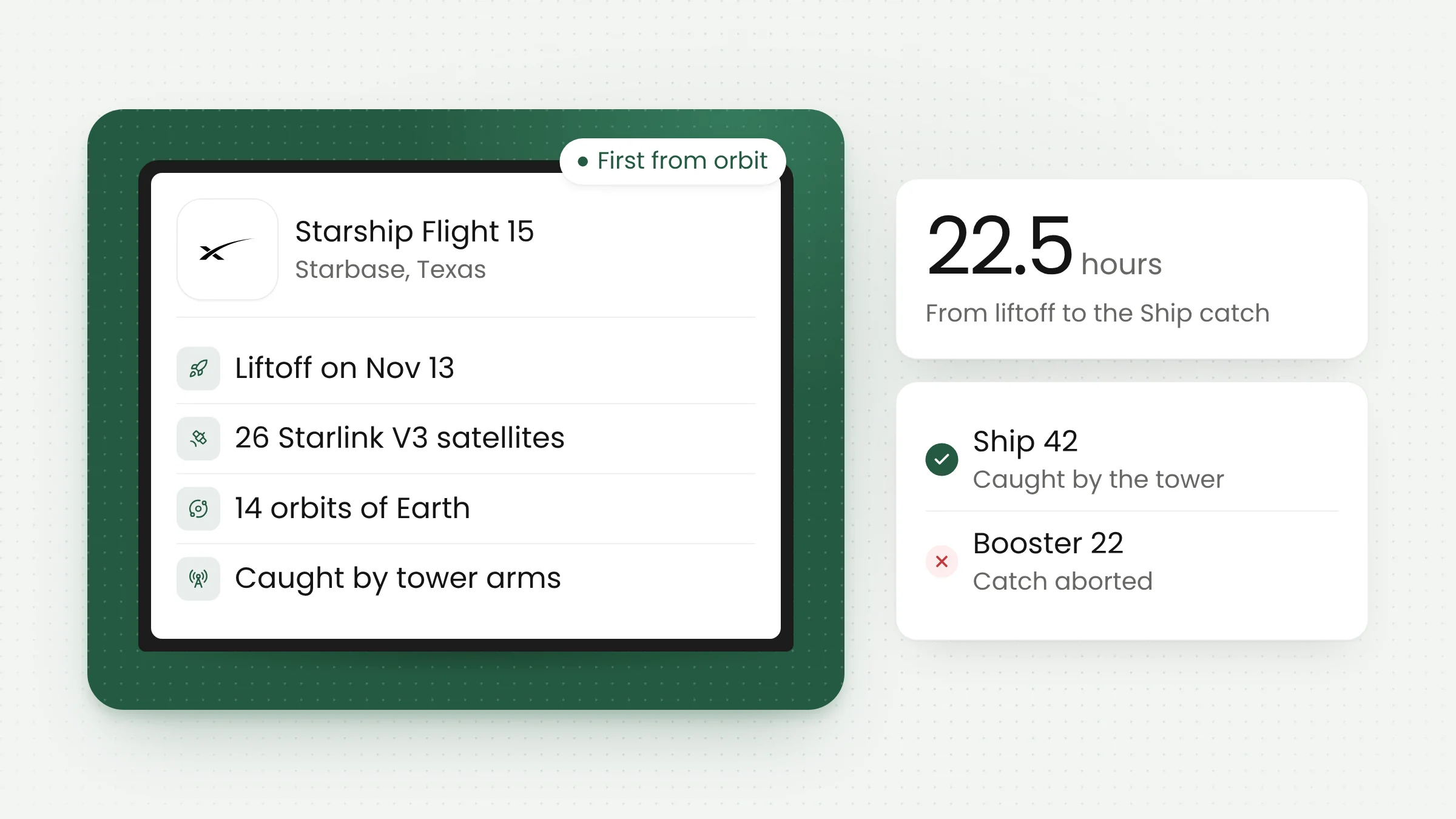
SpaceX has caught a Starship upper stage returning from orbit for the first time. On Starship Flight 15, the vehicle known as Ship 42 circled Earth 14 times before the launch tower’s arms grabbed it at Starbase, Texas, on November 14, 2026. Its Super Heavy booster aborted its own catch and was destroyed over the sea.
How Starship Flight 15 unfolded
Starship has two stages. The lower stage is the Super Heavy booster with 33 Raptor engines, and the upper stage, called Ship, carries payloads to orbit. SpaceX designed both to return to the launch site and fly again, much like an airliner that lands and is refueled for its next trip.
Flight 15 lifted off from Starbase on Friday, November 13, 2026, at about 4:47 p.m. Texas time (5:47 a.m. Saturday in Jakarta). The vehicles were Booster 22 and Ship 42. According to New Space Economy, satellite deployment began about 35 minutes after launch and wrapped up around minute 77. The payload was 26 Starlink V3 satellites, a new generation of SpaceX internet satellites designed around Starship’s larger cargo capacity.
Ship then orbited Earth 14 times at an altitude of roughly 275 kilometers. Space.com reported that several of the Starlink satellites carried cameras that imaged Ship’s heat shield. Those images were combined with footage from ground-tracking cameras to confirm the heat shield was in good shape before reentry.
The catch came on Saturday, November 14, at 3:20 p.m. Texas time (4:20 a.m. Sunday in Jakarta), roughly 22.5 hours after liftoff. Ship 42 descended through the clouds and settled between the tower’s two arms, nicknamed the “chopsticks.” SpaceX calls the tower Mechazilla. According to CNBC, it was the first time a Starship upper stage had been caught after returning from orbit.
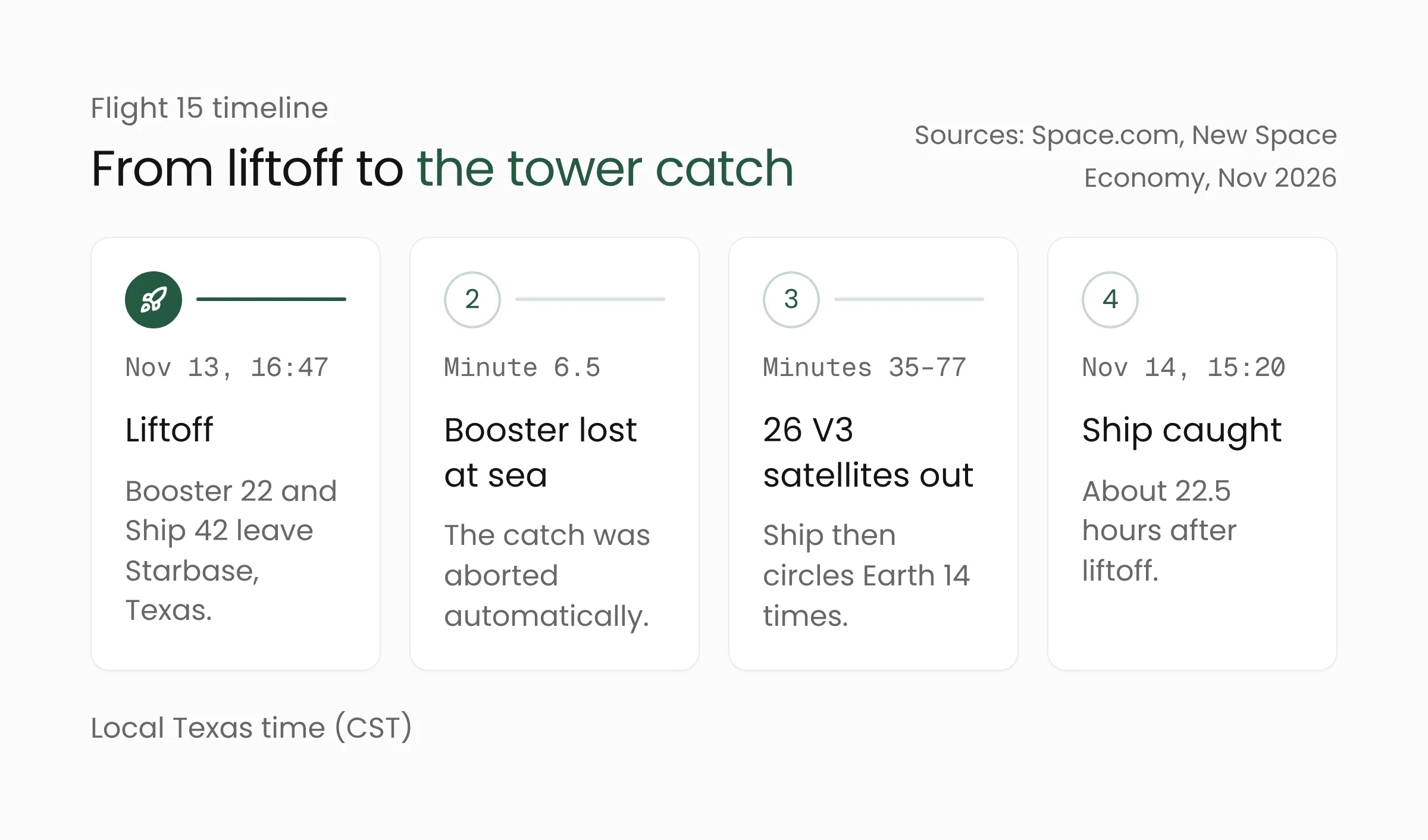
Flight 15 was only the second Starship mission to reach orbit. The first was Flight 14 on September 28, 2026, which also deployed 26 Starlink V3 satellites, bringing the number of V3 satellites in orbit to 52.
The booster called off its own landing
SpaceX planned to catch both stages on a single mission, something no orbital rocket had done before. The first half of that plan did not work. Booster 22 headed back toward Starbase minutes after separating from Ship, then steered itself to a contingency landing zone in the Gulf of Mexico.
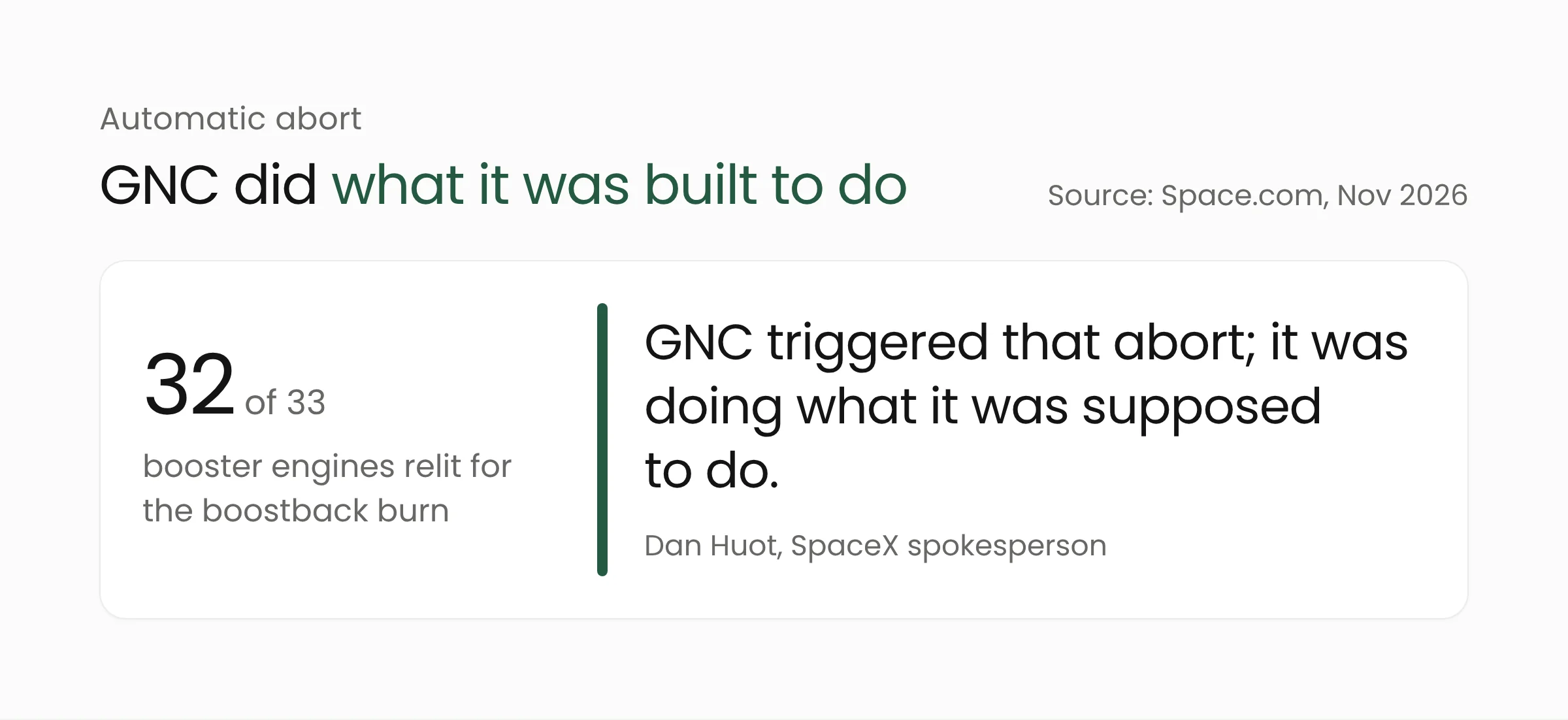
According to Space.com’s report, all 33 engines fired during ascent, and 32 relit for the boostback burn that sends the booster home. For the landing burn, the booster lit 13 engines as planned, hovered briefly and shut down. Its flight termination system then triggered, and the booster exploded a few feet above the water about 6.5 minutes after liftoff.
SpaceX spokesperson Dan Huot first pointed to a problem with the guidance, navigation and control (GNC) system. A day later he corrected himself. In Huot’s account, GNC worked as designed: it detected that the booster was not where it needed to be for a catch, aborted automatically and sent the booster offshore.
“GNC triggered that abort; it was doing what it was supposed to do,” Huot said during SpaceX’s live coverage. A separate Space.com report said the booster had experienced a low-fuel alarm. SpaceX says it is still investigating the root cause.
Space.com notes that guidance systems like this exist to keep a returning rocket from veering off course and damaging Starbase or nearby populated areas. SpaceX had caught Super Heavy boosters on three earlier test flights. This time, the automated decision to abort put the booster in the sea, far from the tower.
Why catching Ship matters for Starlink and the Moon
Ship is a harder target than the booster because it flies higher, farther and faster, and it must survive the heat of reentry before landing. Catching Ship 42 moves SpaceX closer to a rocket that can be reused in full. According to Space.com, SpaceX says tower catches allow quicker inspection, refurbishment and reflight.
The nearest payoff is Starlink, which CNBC describes as SpaceX’s current profit center. The constellation already counts more than 11,000 satellites, and SpaceX says a single Starship can carry up to 60 V3 satellites. Space.com reports that SpaceX plans to grow the V3 constellation to as many as 100,000 satellites.
Each satellite is also more capable. According to an ABI Research analysis from October 2026, SpaceX rates every V3 satellite at 1 terabit per second (Tbps) of downlink capacity, roughly 10 times a V2 Mini satellite in the current constellation. A 26-satellite launch like Flight 15 therefore adds about 26 Tbps of nameplate capacity. ABI cautions that usable capacity is far below nameplate, and describes the assumptions in its own long-range scenario as optimistic.
Beyond Starlink, NASA has picked Starship as one of two commercial landers to carry Artemis astronauts to the Moon in 2028. Space.com also notes that SpaceX sees Starship as central to Starmind, a planned network of AI data centers in orbit. So far, that plan exists only as company statements.
What this means for factories and field operations
For Indonesia, Flight 15 has no immediate effect. Starlink has been available in the country since 2024, including through a trial at remote community health centers with the Ministry of Health, but SpaceX has not announced when V3 capacity will serve users there.
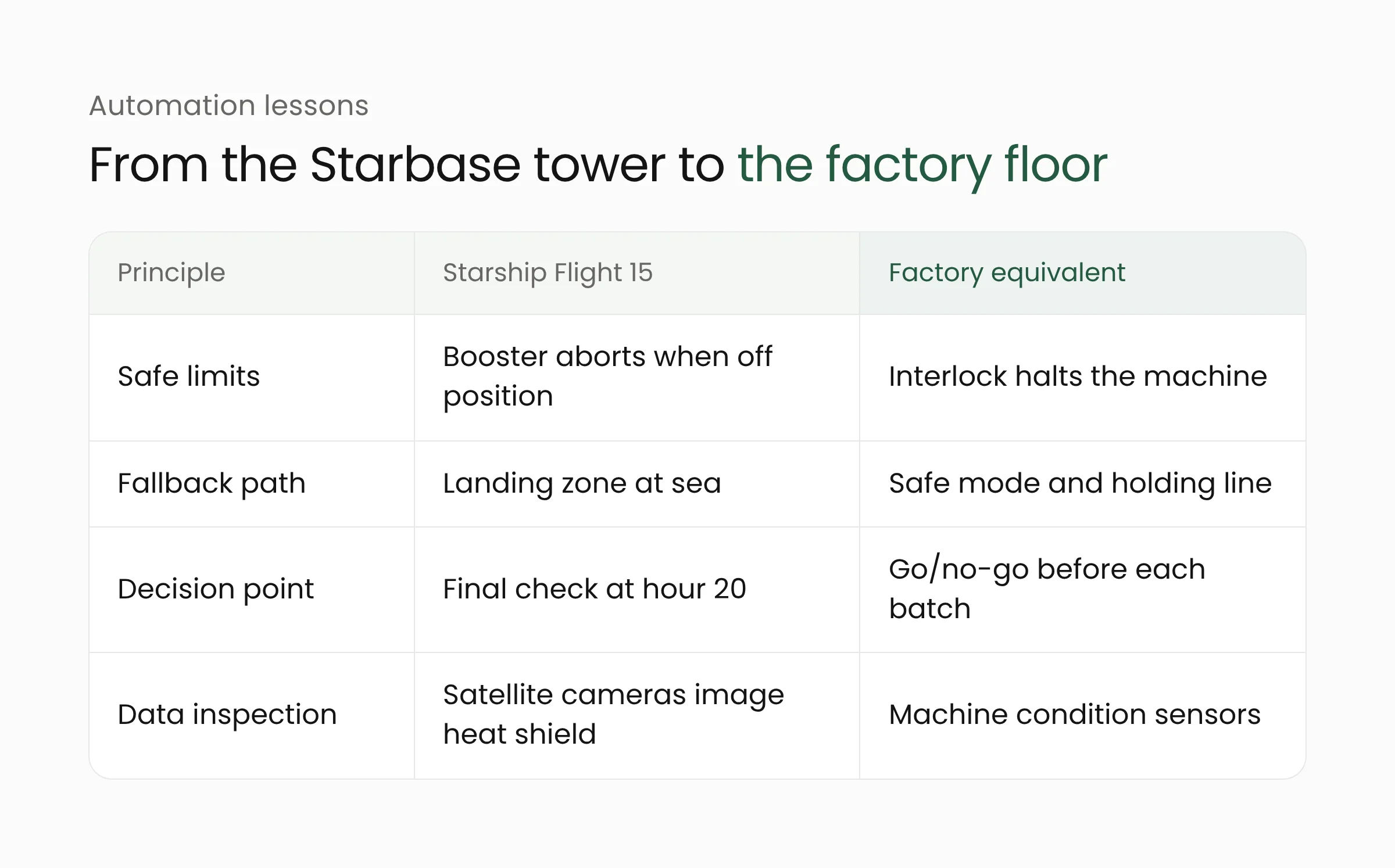
The more practical takeaway is how Starship makes decisions on its own. Factories, mines, plantations and ports that run automated equipment face a smaller version of the same question: when should a machine keep going, and when should it stop by itself? Four points are worth reviewing.
- Define safe limits that trigger an automatic abort. Booster 22 called off its catch because its position did not meet the criteria. On a factory floor, the equivalent is an interlock that halts a robot arm or conveyor when a sensor reads outside its limits, without waiting for an operator.
- Prepare a safe fallback path. When the catch was called off, the booster went to a contingency zone at sea. Production machines need an equally clear safe mode, such as stopping in a parked position or diverting product to a holding line.
- Make go/no-go decisions on data. According to Space.com, SpaceX ran a final check around hour 20 of the mission to decide whether Ship would land at Starbase or make an early splashdown off Hawaii. A plant can apply the same pattern before a production batch starts, using data from machine condition sensors.
- Keep telemetry to find root causes. SpaceX is still tracing the booster failure and has already revised its first explanation. Without complete sensor records, a plant team will struggle to tell a broken system from one that did exactly what it was designed to do.
Connectivity matters too. Sensors at remote sites such as mines, palm oil estates, fish farms or vessels need a network to send data to a monitoring center. Low Earth orbit satellite internet is already one option, and Merakit has covered another in its piece on Starlink Mobile and terrestrial 5G networks. If V3 capacity eventually reaches Indonesia, such links could support more devices. Applications should still be built to store data on site when the link drops.
Teams building these systems usually combine industrial automation solutions for machine control and safety logic with IoT services for sensors, gateways and monitoring dashboards. Both should be tested together, including scenarios in which a sensor fails or the network goes down.
Frequently asked questions
What does it mean that Starship was caught by its tower?
Starship has no landing legs. On its return, the vehicle descends slowly beside the launch tower, and two large arms on the tower hold it in place. That leaves the vehicle right next to the pad, where it can be inspected and prepared to fly again.
Why did the Super Heavy booster explode?
The booster automatically aborted its catch because its position did not meet the criteria, then headed to a contingency landing zone at sea. After hovering and shutting down its engines, its flight termination system triggered. SpaceX has not yet announced the root cause and is still investigating.
Is Starlink V3 available in Indonesia?
Nothing has been announced. V3 satellites have flown on only two Starship missions, and SpaceX has not said when or in which countries their capacity will begin serving customers. Prospective users should follow official Starlink announcements.
Closing thoughts
Flight 15 showed a Ship that came home as planned and a booster that called off its landing automatically when its conditions were not met. Both outcomes give SpaceX valuable data for the next flight. If your organization is designing automated equipment or a sensor network at remote sites and wants to work through safe limits and monitoring, the Merakit Indonesia team is ready to talk.
Sources
- ‘Now everything changes’: SpaceX catches Starship upper stage for 1st time ever, Space.com, November 14, 2026
- SpaceX still investigating why Starship Flight 15 booster aborted ‘chopsticks’ landing catch, Space.com, November 14, 2026
- SpaceX catches upper stage of Starship rocket in historic first, CNBC, November 14, 2026
- Starship Flight 15 Deploys 26 Starlink Satellites After Booster Catch Is Aborted, New Space Economy, November 14, 2026
- Starship Launches First Batch of V3 Satellites: The Next Wave of Satellite Broadband Disruption Begins, ABI Research, October 7, 2026
- Kemenkes dan Starlink akan Sediakan Akses Internet di Puskesmas Terpencil dan Terluar (Ministry of Health and Starlink to provide internet access at remote health centers), Indonesian Ministry of Health, May 19, 2024