Blog AI Chips
Nvidia Reportedly Halts AI Server Shipments to Indonesia
On this page· 7 sections
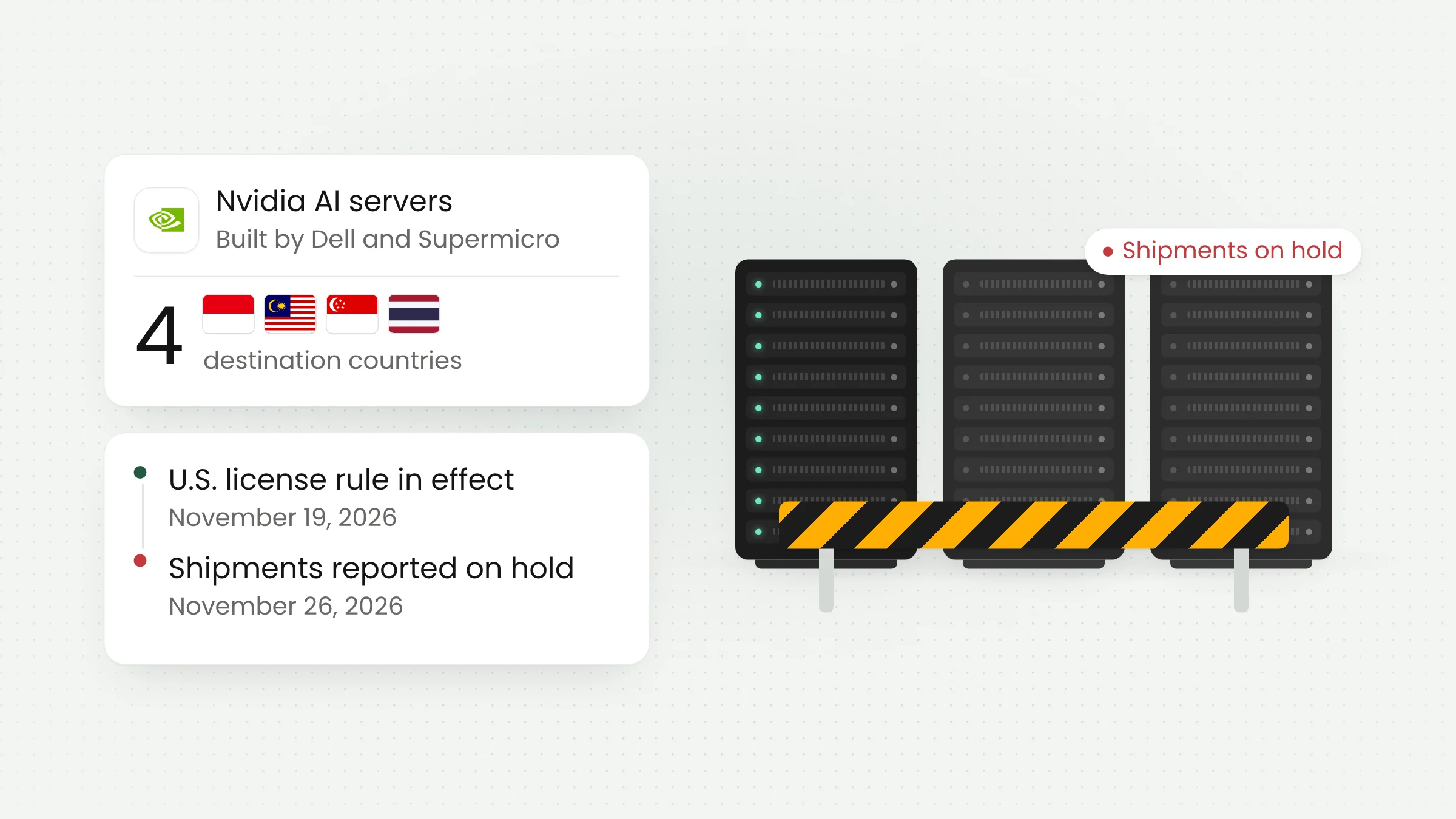
Nvidia has reportedly halted AI server shipments to Indonesia, Malaysia, Singapore and Thailand. The Financial Times reported on November 26, 2026 that Dell and Supermicro have told buyers in the four countries their orders cannot ship for now. Nvidia has not confirmed the report, and nobody has said how long the halt will last.
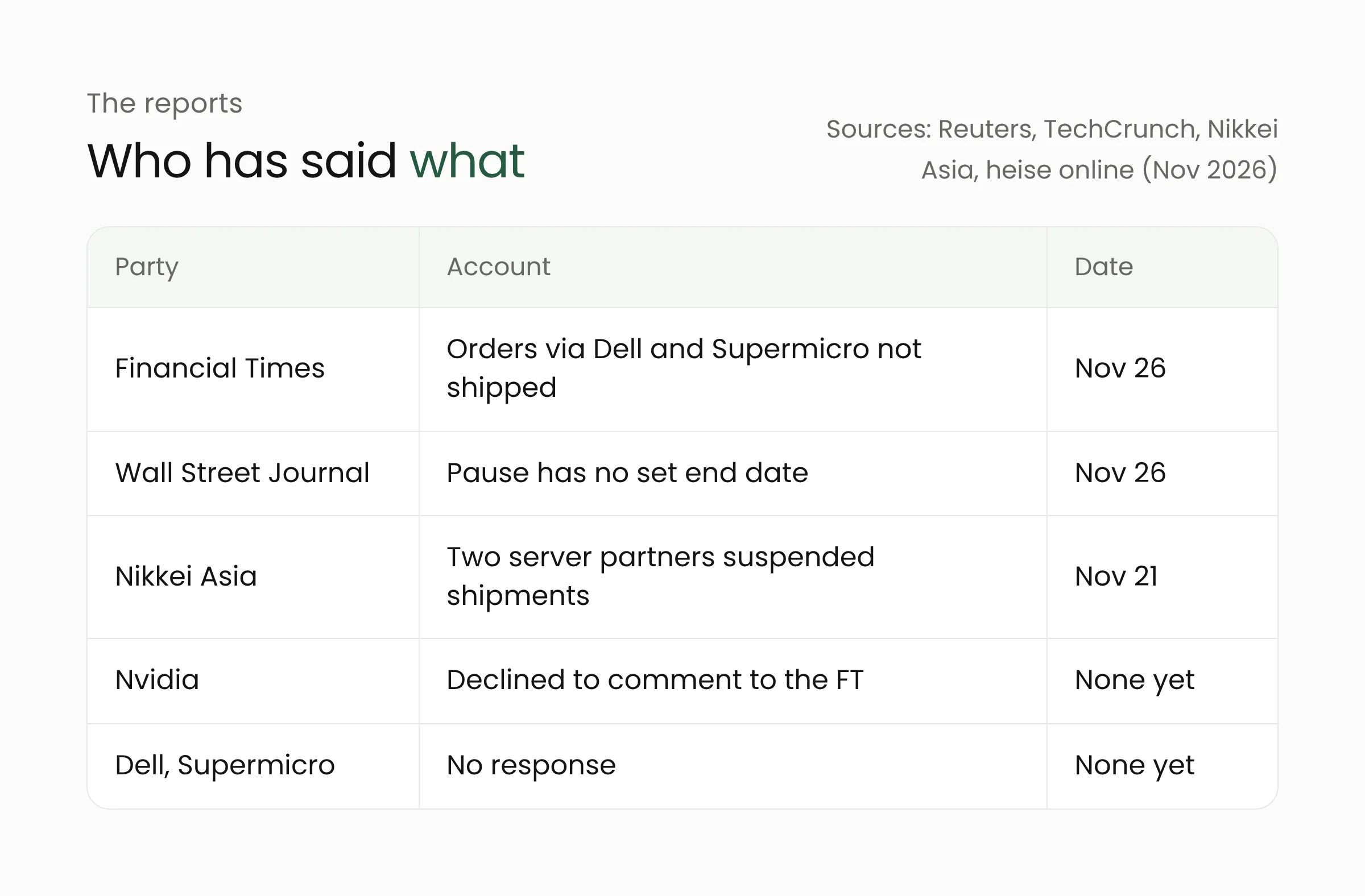
What the Financial Times and Wall Street Journal reported
The Financial Times (FT) broke the story on Thursday, citing three people familiar with the matter. According to Reuters, as carried by The Manila Times, Nvidia told its manufacturing partners to stop shipping servers that contain its chips to the four countries. Reuters said it could not immediately verify the report.
Dell and Supermicro build servers around Nvidia chips and sell them to data center operators. The FT said both companies told buyers that Nvidia would not allow their orders to ship.
The Wall Street Journal (WSJ) reported the same instruction separately. TechCrunch, summarizing the WSJ, wrote that the pause has no set end date and that Nvidia is using it to assess whether its regional partners meet U.S. export requirements. The FT’s account is that Nvidia and its partners are still working out how to comply with new rules. Tech Times noted that the two explanations do not necessarily conflict.
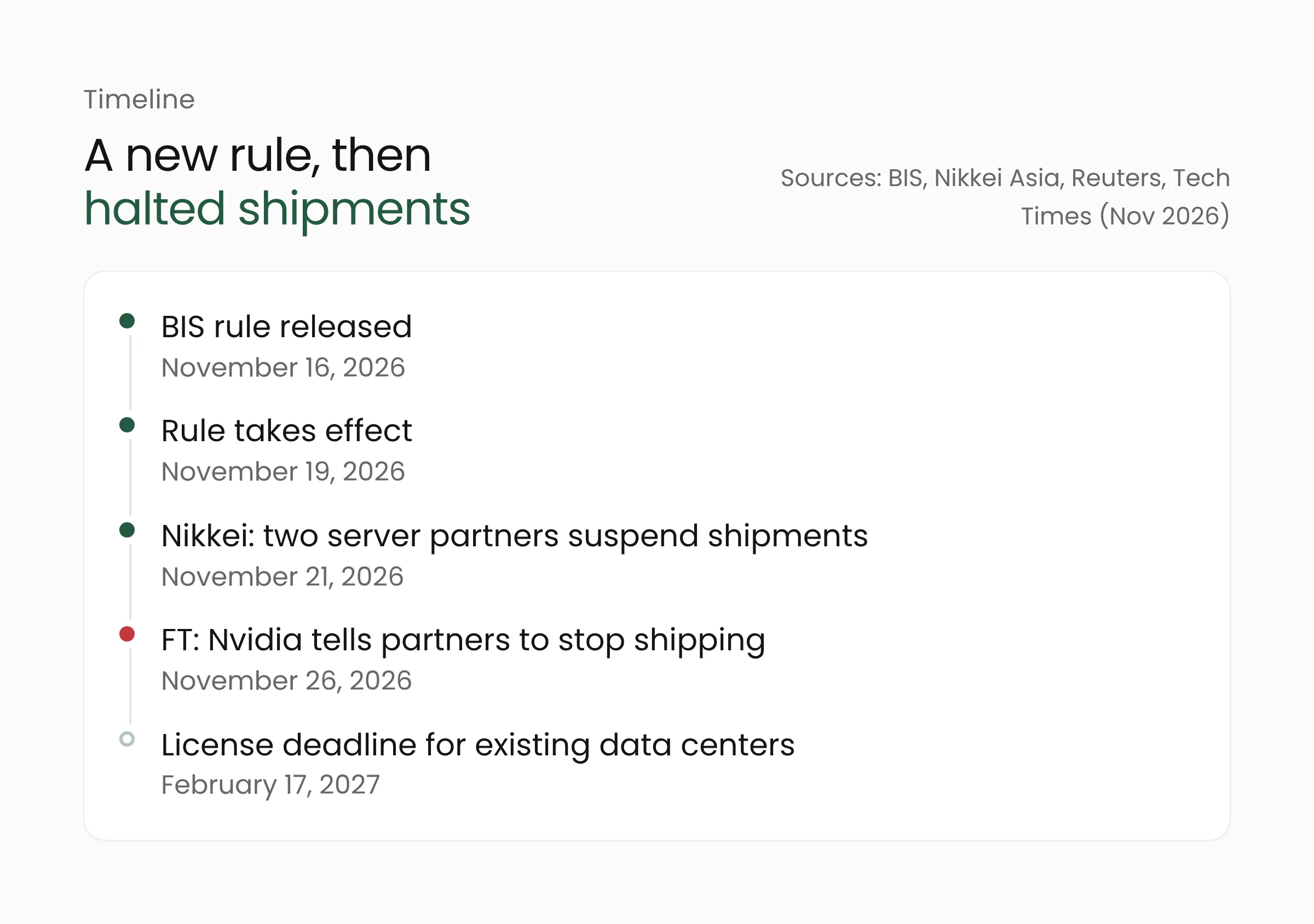
Nikkei Asia reported on November 21 that at least two of Nvidia’s server partners had suspended shipments to clients in Southeast Asia.
The companies have said little. According to heise online, Nvidia declined to comment to the FT, while Dell and Supermicro did not respond. It is unclear which chips the halt covers. detikInet pointed out that the reports concern servers only, so there is no basis to conclude that other Nvidia products, such as consumer graphics cards, are being held back.
The U.S. export rule behind the halt
The halt came one week after a new rule from the U.S. Commerce Department’s Bureau of Industry and Security (BIS) took effect. The rule, released by BIS on November 16, 2026, has applied since November 19. It requires a license to ship advanced AI chips, and servers containing them, to Indonesia, Malaysia, Singapore, Thailand and Brazil. We covered the details in our article on the U.S. license requirement for AI chips bound for Indonesia.
The rule targets remote access. Chinese companies that are barred from buying advanced U.S. AI chips can still rent computing power from data centers in other countries. TechCrunch, citing the Institute for Progress, reported that such data centers supply about 24% of China’s AI computing power.
Brazil is covered by the BIS rule but is not named in the reports about the shipment halt. Indonesian outlet Katadata reported that on November 23 the Commerce Department added seven companies in Singapore, Malaysia and Thailand to the Entity List, which restricts access to U.S. technology without a special license. No Indonesian company appears in the list Katadata published.
The 90-day license deadline
Data centers already in operation have 90 days from November 19 to obtain a license. Tech Times calculated that the deadline falls on February 17, 2027.
The process is unclear to operators. According to heise online’s summary of the FT report, cloud providers must prove that none of their customers are restricted entities, while one regional cloud executive complained that there is no guidance on how to apply. That uncertainty appears to be why suppliers have chosen to hold shipments.
Government responses and early effects in the region
Indonesia’s government has not responded to the FT report specifically. The statement most widely quoted was made a day earlier. On Wednesday, November 25, Coordinating Minister for Economic Affairs Airlangga Hartarto was asked whether tighter U.S. export controls would disrupt data center investment. “Tidak, tidak mengganggu,” he replied, meaning no, they would not, as quoted by detikFinance.
Airlangga described Indonesia’s position as relatively safe because the country has an Agreement on Reciprocal Trade (ART) with the United States that includes a digital clause. He also said Nvidia chips in Indonesia are used in domestic data centers and are not re-exported. CNBC Indonesia carried the same remarks and dated them November 26.
The project he cited is in the Kabil area of Batam. detikFinance put the investment at US$4.5 billion and said it is under construction. Katadata reported that the project, named Nvidia DSX AI Factory, involves Australia’s Firmus Technologies and Singapore’s DayOne, with an estimated capacity of 360 megawatts and a target of starting operations in the first quarter of 2027. No party has said whether servers for this project are among those on hold.
Neighboring governments are also asking for clarity. Tech Times reported that Singapore is in talks with U.S. authorities and that Malaysia will notify all 117 approved data center projects once the requirements are known. Indonesia’s Government Communications Agency said on November 18 that it was reviewing the restrictions and seeking industry input.
Project financing is stalling too
The first visible effect is on funding. Bloomberg, as cited by Tech Times, reported that bankers froze work on a US$480 million loan to Aolani Cloud, a Singapore-based provider, for a Malaysian data center that ByteDance planned to use remotely. The FT put the figure at about US$500 million.
According to the FT, as summarized by heise online, Nvidia’s Singapore subsidiary posted revenue of US$104 billion in 2025, up 72% from the year before. Part of that figure comes from business with customers in Taiwan and China that is billed through Singapore.
What is still unknown
Nobody has said whether the halt will be lifted once the licensing process is clear. Gizmodo, citing The New York Times, wrote that one person with knowledge of the freeze described it as a temporary measure until the U.S. administration defines how future sales can proceed.
The status of goods already on the way is also unclear. According to the copy of the rule on the Federal Register, items in transit when the rule was published may still be delivered if they arrive within 30 days. The rule also exempts buyers headquartered in the United States from the five-country license requirement, but the reports do not say whether those buyers are affected by Nvidia’s halt.
What this means for GPU users in Indonesia
The reports concern new server shipments. None of them says that servers already installed in data centers are affected, so GPU capacity you rent today should keep running as usual. The risk sits with expansion plans, both at cloud providers and at organizations that buy their own hardware.
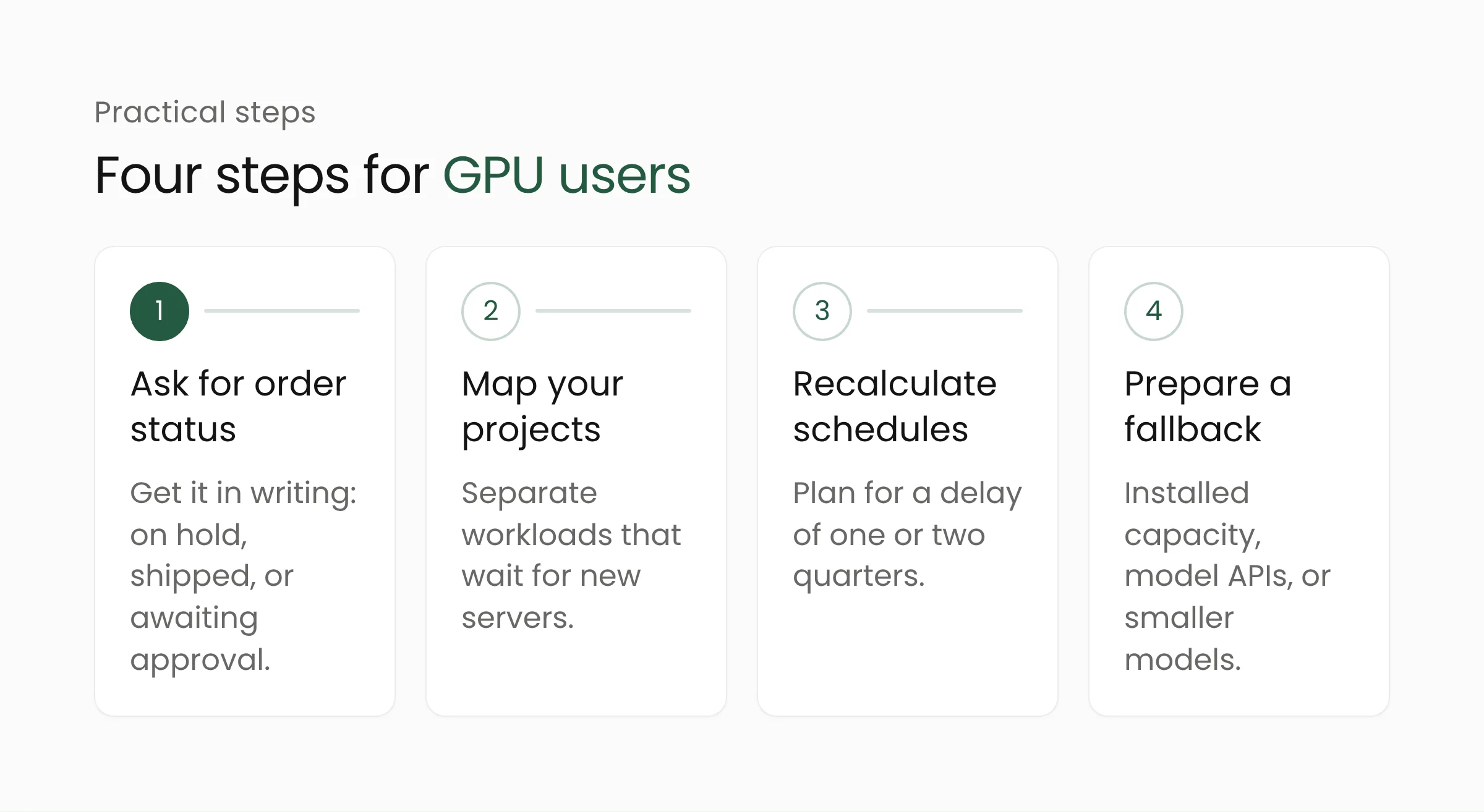
- Ask for order status in writing. A bank, university or company that is buying GPU servers should ask its distributor whether the order is on hold, already shipped or waiting for approval. GPU renters can ask whether their provider’s expansion plans have changed.
- Map the projects that depend on new capacity. Separate workloads that can run on existing capacity from those waiting for new servers, such as large model training scheduled for early 2027.
- Recalculate schedules and contracts. Plan for hardware arriving one or two quarters late. Review supply delay clauses in contracts with suppliers and with your own clients.
- Prepare a fallback. Options include renting from a provider whose capacity is already installed, using models through an API, or running smaller models. Before moving workloads to a cloud region abroad, check the data location rules that apply to your sector.
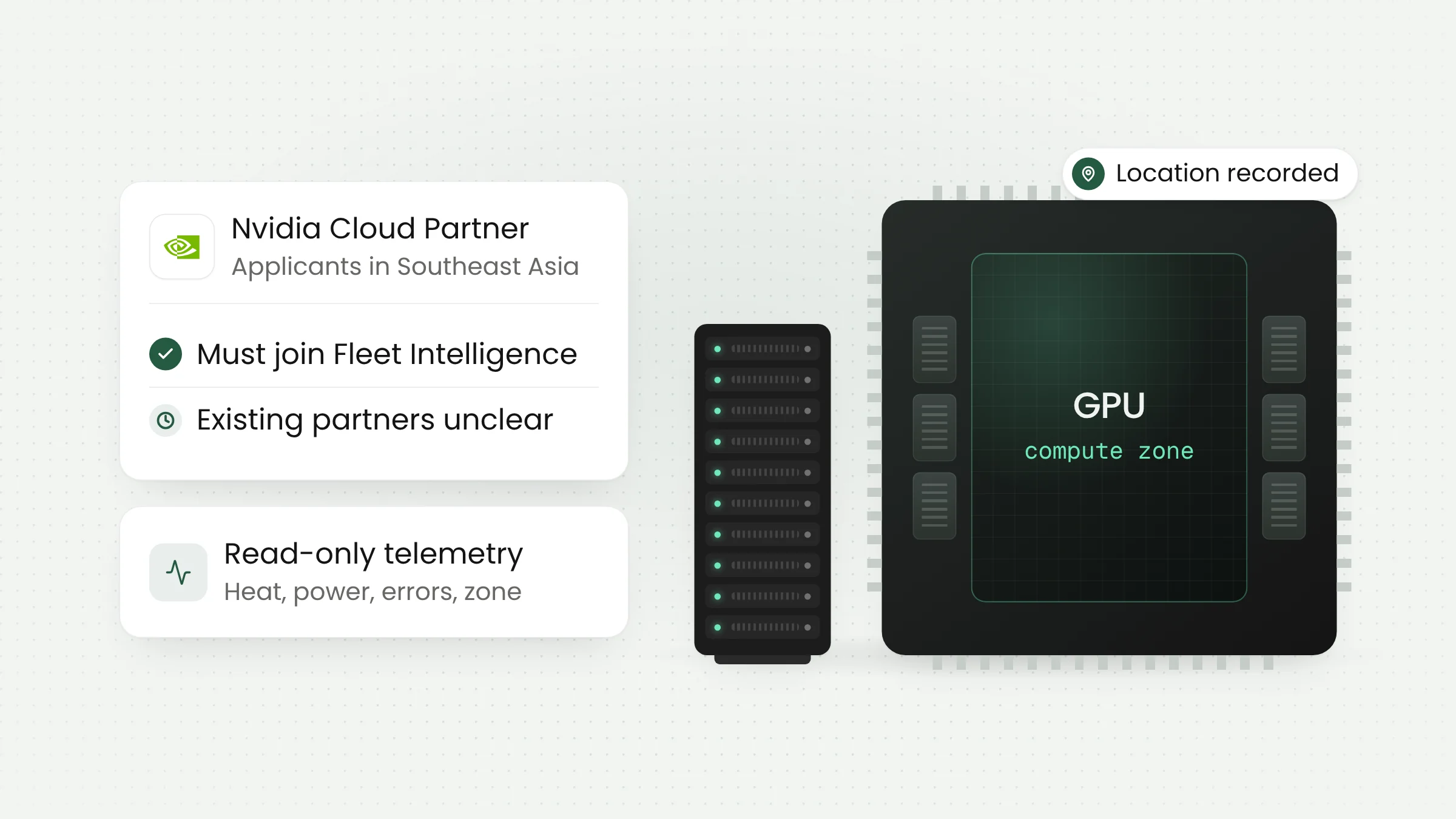
For data center operators and GPU providers, ownership documents and customer lists are worth putting in order now, because license applications are reviewed case by case and exporters will ask for that information. The GPU tracking requirement for Nvidia’s prospective cloud partners, reported in early November, points in the same direction.
Buying through unofficial channels is best avoided. Hardware without valid export paperwork may come without warranty or support.
Choosing providers, spreading workloads across locations and sizing GPU needs are part of Merakit’s cloud computing services. For projects still on the drawing board, model size and deployment method can be matched to the capacity that is really available, which is part of AI solution development.
Frequently asked questions
Has Nvidia blocked Indonesia?
The FT and WSJ reports describe a halt on shipments of servers containing Nvidia chips to four countries, Indonesia among them, and Nvidia has not confirmed it. The BIS rule itself does not ban sales. It requires a license that is reviewed case by case.
Are graphics cards for PCs and laptops affected?
No report says so. The coverage so far concerns servers for data centers only.
How long will the shipment halt last?
That is not known. The WSJ said the pause has no set end date, and the FT wrote that it is unclear whether it is temporary. The only firm date is the license deadline for existing data centers, February 17, 2027.
Closing
The reported halt shows that U.S. export rules now shape the timing of AI projects in Indonesia, even though the rule does not ban sales. Until Nvidia or the U.S. government explains more, organizations are better off planning for new hardware to arrive late. If you are recalculating GPU needs or comparing providers, the Merakit team is open to a conversation.
Sources
- Reuters, carried by The Manila Times, November 27, 2026
- TechCrunch, November 26, 2026
- Tech Times, November 27, 2026
- heise online, November 27, 2026
- Nikkei Asia, November 21, 2026
- Gizmodo, November 26, 2026
- detikInet, November 27, 2026
- detikFinance, November 25, 2026
- Katadata, November 27, 2026
- CNBC Indonesia, November 26, 2026
- Federal Register, document 2026-23529
- BIS, November 16, 2026