Blog Cyber Resilience
OJK Cyber Resilience Guideline: First Steps for P2P Lenders
On this page· 7 sections
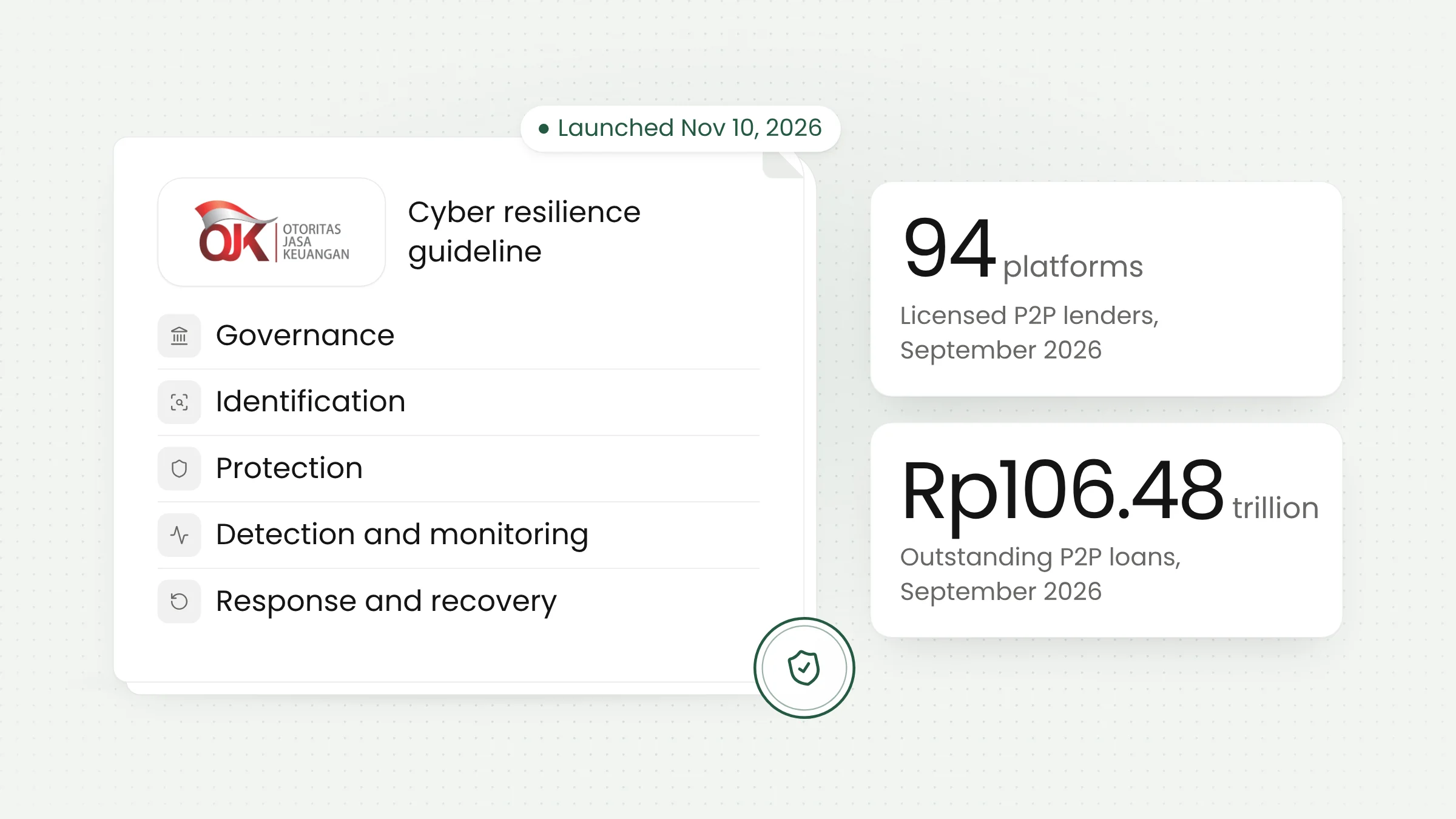
Indonesia’s Financial Services Authority (OJK) launched a cyber resilience guideline for peer-to-peer (P2P) lending platforms in Jakarta on November 10, 2026. The guideline covers five areas, from governance to incident recovery, and includes a self-assessment tool. Platforms are expected to prepare for attacks and restore services quickly when one gets through.
What the OJK cyber resilience guideline covers
The document’s full name is the Pedoman Keamanan dan Ketahanan Siber (Cyber Security and Resilience Guideline) for providers of Layanan Pendanaan Bersama Berbasis Teknologi Informasi (LPBBTI). LPBBTI is OJK’s formal term for P2P lending, known locally as pindar: online platforms that match lenders with borrowers.
The guideline was presented by Agusman, OJK’s Chief Executive Supervisor of Financing Institutions, Venture Capital, Microfinance Institutions, and Other Financial Services Institutions. OJK announced it in press release SP 221/DKPU/OJK/XI/2026, dated November 11, 2026. The launch itself took place the day before, which is why some outlets report November 11 as the date.
According to OJK, the guideline rests on five areas:
- cyber security governance;
- cyber security identification;
- cyber security protection;
- detection and monitoring;
- cyber incident response and recovery.
It also comes with a self-assessment instrument. Platforms can use it to rate the maturity of their cyber security, find weak spots, and plan measurable improvements. OJK says the guideline should be applied in a proportionate, risk-based way that reflects each provider’s size, complexity, and characteristics.
The guideline was drafted with input from the National Cyber and Crypto Agency (BSSN), the Indonesian Joint Funding Fintech Association (AFPI), the digital lending association AFTECH LPD, and ISACA Indonesia Chapter. OJK’s press release does not mention a compliance deadline or penalties, and the full text of the guideline has not appeared in media coverage.
A pledge on debt collection
At the same event, P2P lenders and debt collection companies (PJP) signed an integrity pact on ethical collection and consumer protection. According to Kontan, Agusman said collection must protect consumers and keep personal data confidential. OJK’s press release adds that collection must be free of intimidation and violence.
The two measures are linked. Borrower data such as ID card photos, phone numbers, and loan histories is what collection teams work from. If that data leaks from a platform or one of its collection partners, the borrower bears the damage.
From cyber security to cyber resilience
The central message of the launch is a change in mindset. As reported by ANTARA, Agusman urged the industry to shift its focus from cyber security to cyber resilience, defined as the ability to anticipate, detect, and respond to incidents and to restore services quickly afterward.
He also said that no system is fully immune to cyberattacks. That statement changes how success is measured. The question becomes how quickly a platform recovers and how little data it loses once an attacker gets in, rather than how many attacks it blocks.
Agusman added that cyber security is part of corporate governance and risk management. Directors, commissioners, and all employees therefore need to be actively involved, and responsibility cannot sit with the IT department alone.
The five areas map closely to the NIST Cybersecurity Framework (CSF) 2.0, the US framework released on February 26, 2024. CSF 2.0 has six functions: Govern, Identify, Protect, Detect, Respond, and Recover. OJK’s guideline folds the last two into a single area covering response and recovery.
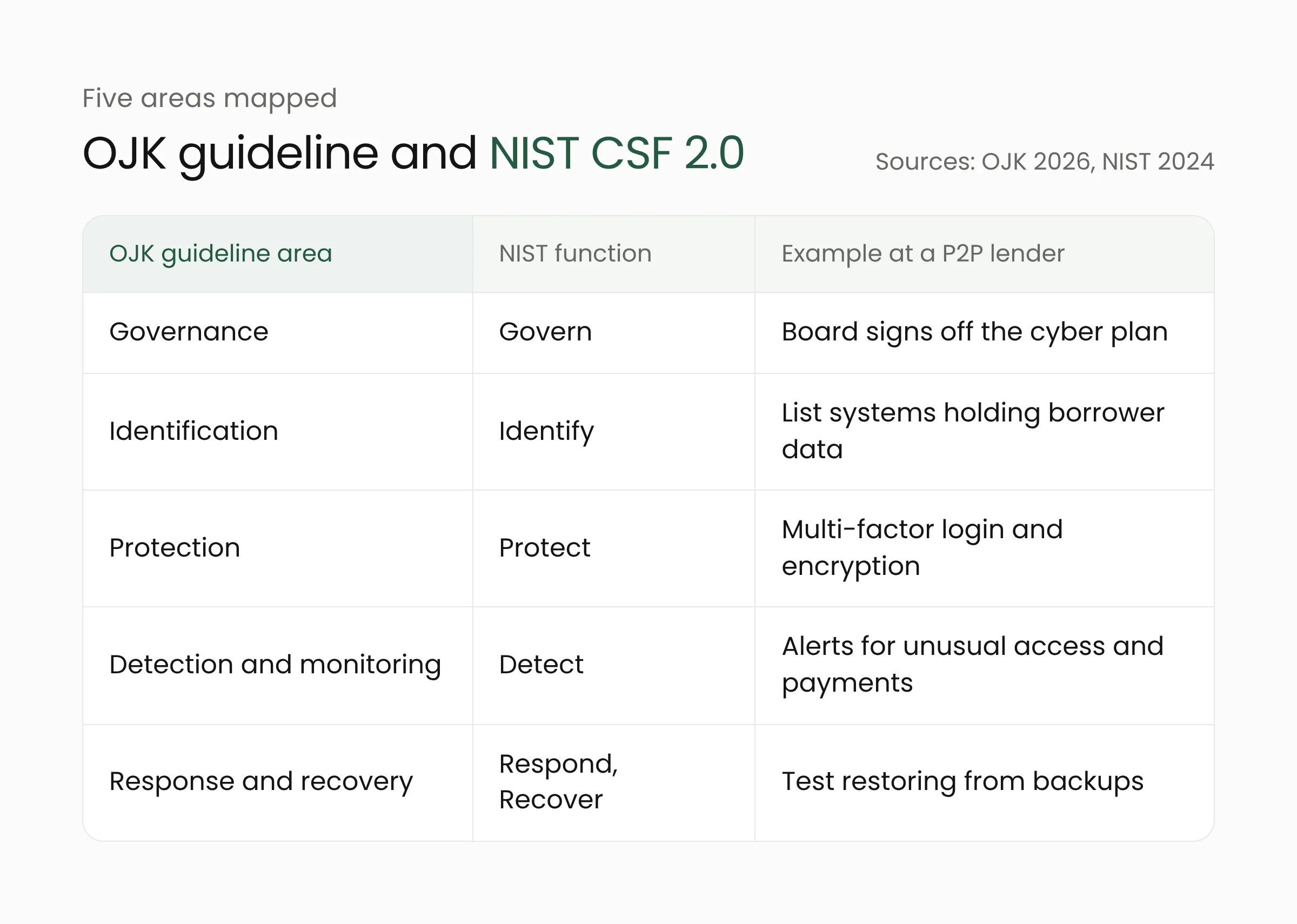
The overlap helps platforms that already follow an international framework such as NIST or ISO/IEC 27001. Existing control mappings can be reused to complete the OJK self-assessment, so teams do not have to start from scratch.
Why P2P lending gets its own guideline
Every step of the P2P lending business runs on digital platforms, from sign-up and credit scoring to disbursement and collection. Agusman made that point in August 2026, when OJK said it was drafting the guideline. According to Investor Trust, he asked platforms to manage cyber risk adequately and to run regular risk assessments.
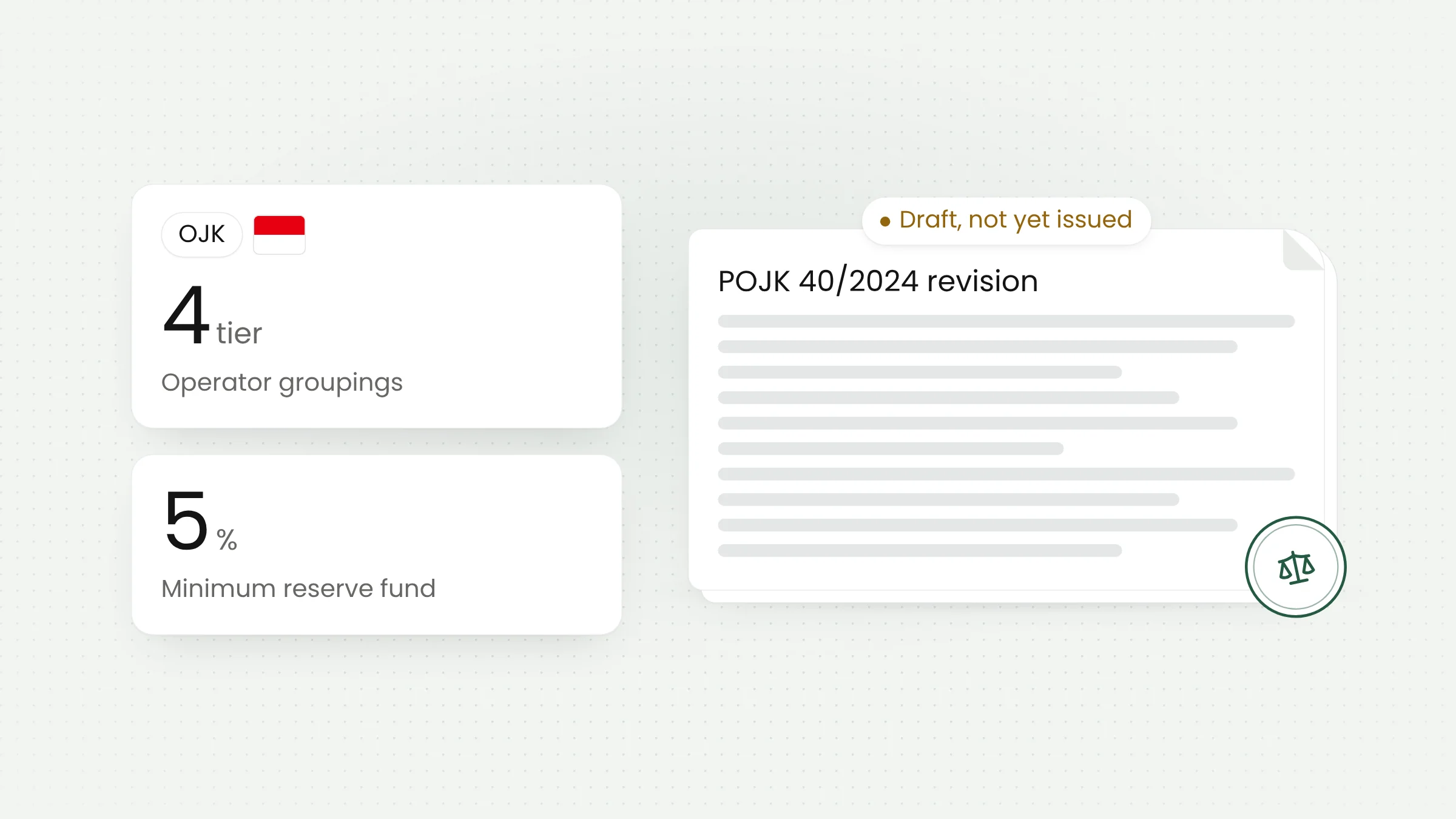
The industry keeps growing. Kontan reported outstanding P2P loans of Rp106.48 trillion as of September 2026, up 17.02% from a year earlier. The number of licensed platforms, meanwhile, has shrunk to 94 as of September 2026, down from a peak of 149 at the end of 2020. OJK links the decline partly to capital requirements and business sustainability. On the rules side, OJK is also drafting a revision of the P2P lending regulation that would group platforms into four tiers.
At the launch, Slamet Aji Pamungkas, BSSN’s Deputy for Economic Cyber Security and Cryptography, described cyber threats as a business risk that can cause financial losses, disrupt operations, and damage reputations. The warning echoes OJK’s call for banks to stay on 24-hour alert against attacks on the financial sector during the same week.
The guideline adds to OJK’s set of sector-specific cyber security references. OJK previously issued a cyber security guideline for Financial Sector Technology Innovation (ITSK) providers in 2024 and one for digital financial asset traders, including crypto, in August 2025.
The industry association welcomed the move. AFPI chair Kuseryansyah said the sector’s growth must be matched by stronger governance and risk management, Investor Trust reported. AFPI is encouraging members to run regular evaluations, build staff skills, and set measurable follow-up plans, and it has pledged to support adoption through outreach and the sharing of good practice among platforms.
What this means for P2P lenders and fintech firms
The guideline gives platforms, supervisors, and auditors a shared vocabulary. For IT teams, self-assessment results can justify security budgets in terms the board will accept. The following first steps can start now, ahead of more detailed guidance from OJK and the industry associations.
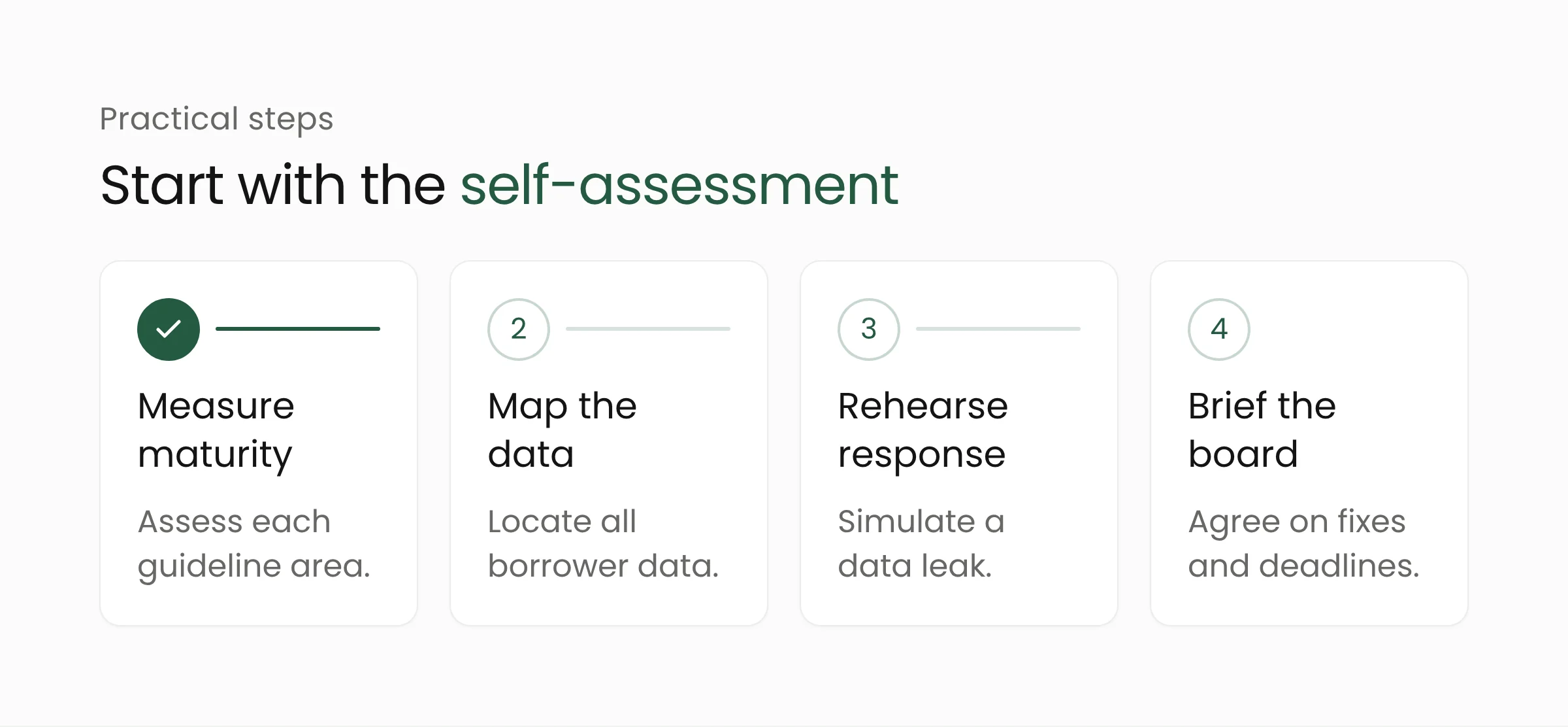
- Measure maturity with the self-assessment. Score each area honestly. A low score in one area is useful because it sets priorities.
- Locate all borrower data. List every system that stores personal data, including cloud providers, identity verification services, and collection agencies. Data spread across many partners raises the risk of a leak.
- Rehearse incident response. Simulate a data leak and a service outage, then test restoring from backups. Record how long it takes for services to return to normal.
- Brief the board. Because OJK treats cyber security as part of corporate governance, the remediation plan and its deadlines should be agreed by directors and commissioners.
Banks, rural banks, and cooperatives that lend through P2P platforms should also ask their partners for self-assessment results. The same applies to technology vendors serving P2P lenders, since their systems also store or process borrower data.
Teams without in-house security specialists can begin with a simple data map and then bring in help for penetration testing, monitoring, and recovery planning. Merakit offers cybersecurity services and builds financial services solutions that can support those steps.
For borrowers, the basics stay the same. Check that a platform is registered with OJK, never share one-time passwords, and report any collector who threatens you or spreads your personal data.
Frequently asked questions
Is the guideline mandatory for every P2P lender?
OJK’s press release says the guideline applies in a proportionate, risk-based way according to each provider’s size and characteristics. It does not mention a deadline or penalties. AFPI is urging all members to build the guideline into their governance, so platforms are better off starting now.
What is the difference between cyber security and cyber resilience?
Cyber security focuses on preventing attacks. Cyber resilience covers prevention plus the ability to detect an attack, respond to it, and restore services quickly. OJK uses the second term because no system is fully immune.
Does the guideline affect borrowers?
Indirectly, yes. Platforms that apply it should be better prepared to protect personal data and recover from outages. The integrity pact signed at the same event also states that collection must keep data confidential and be free of intimidation.
Conclusion
OJK’s cyber resilience guideline gives P2P lenders a clear map from governance to recovery. The self-assessment tool is a practical place to start, especially for platforms with small IT teams. If your organization wants to map its cyber readiness and plan the fixes, the Merakit team is ready to talk.
Sources
- OJK Perkuat Ketahanan Siber dan Pelindungan Konsumen Industri LPBBTI, OJK press release SP 221/DKPU/OJK/XI/2026, November 11, 2026
- OJK rilis pedoman penguatan keamanan siber dan teknologi informasi, ANTARA, November 11, 2026
- OJK Luncurkan Pedoman Keamanan dan Ketahanan Siber Industri Fintech Lending, Kontan, November 11, 2026
- AFPI Sebut Pedoman Ketahanan Siber OJK Bisa Perkuat Tata Kelola dan Manajemen Risiko Pindar, Investor Trust, November 13, 2026
- OJK Godok Pedoman Keamanan dan Ketahanan Siber untuk Pindar, Investor Trust, August 5, 2026
- Pembiayaan Fintech Lending Tumbuh 17,02% per September 2026, Kontan, November 5, 2026
- Jumlah Fintech Lending Menyusut Jadi 94, OJK Ungkap Penyebabnya, Kontan, September 15, 2026
- OJK Terbitkan Pedoman Keamanan Siber Penyelenggara Perdagangan Aset Keuangan Digital di Indonesia, OJK press release, August 13, 2025
- NIST Releases Version 2.0 of Landmark Cybersecurity Framework, NIST, February 26, 2024