Blog P2P Lending
OJK Plans Four Tiers and Reserve Funds for P2P Lenders
On this page· 7 sections
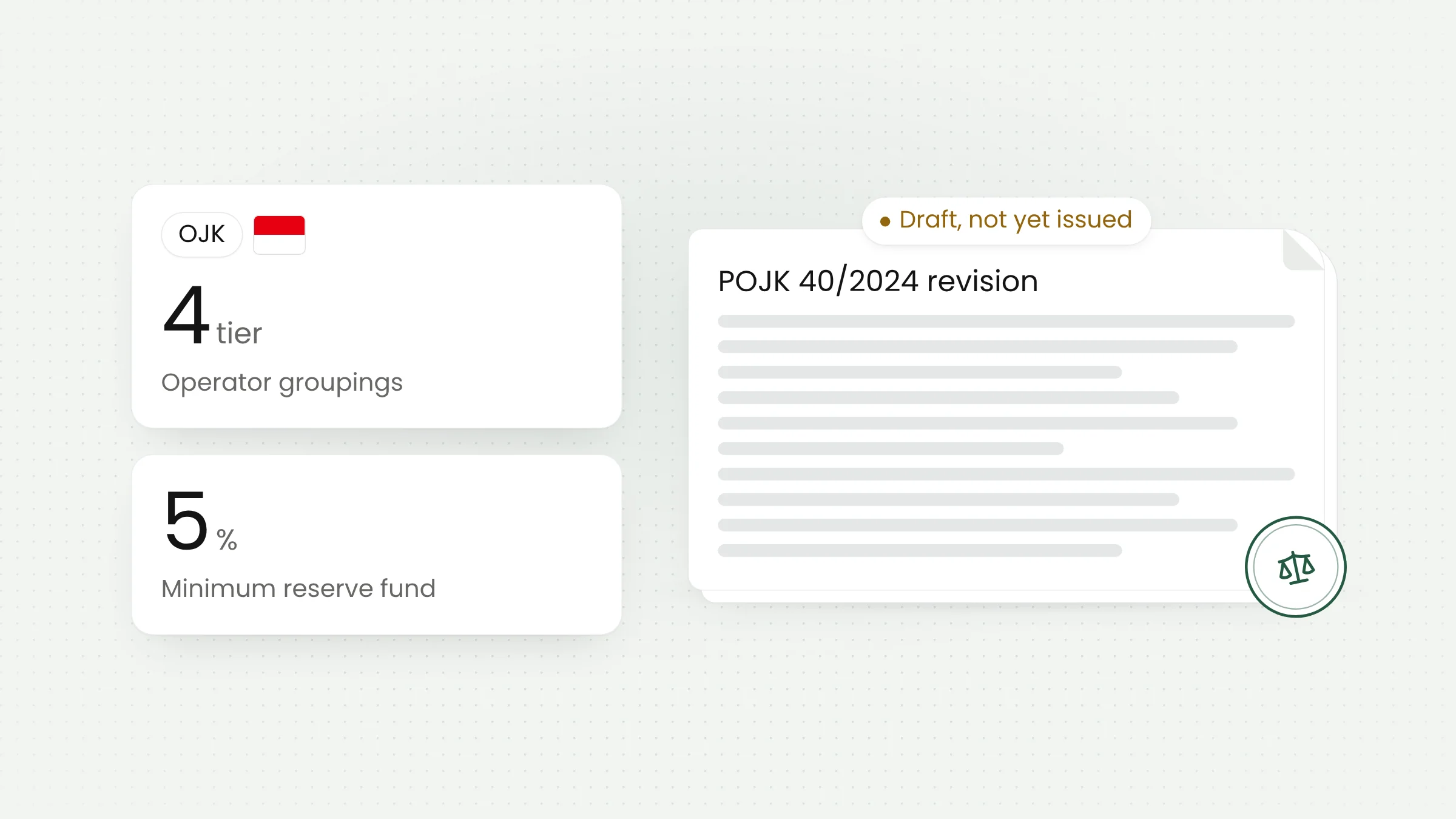
Indonesia’s financial regulator, the Otoritas Jasa Keuangan (OJK), is drafting an amendment to POJK Number 40 of 2024, the regulation covering technology-based joint funding services, better known as fintech lending or P2P lending. The draft would sort operators into four tiers, require reserve funds to protect lenders and extend the default threshold. It has not been issued yet and is targeted for 2026.
What OJK announced
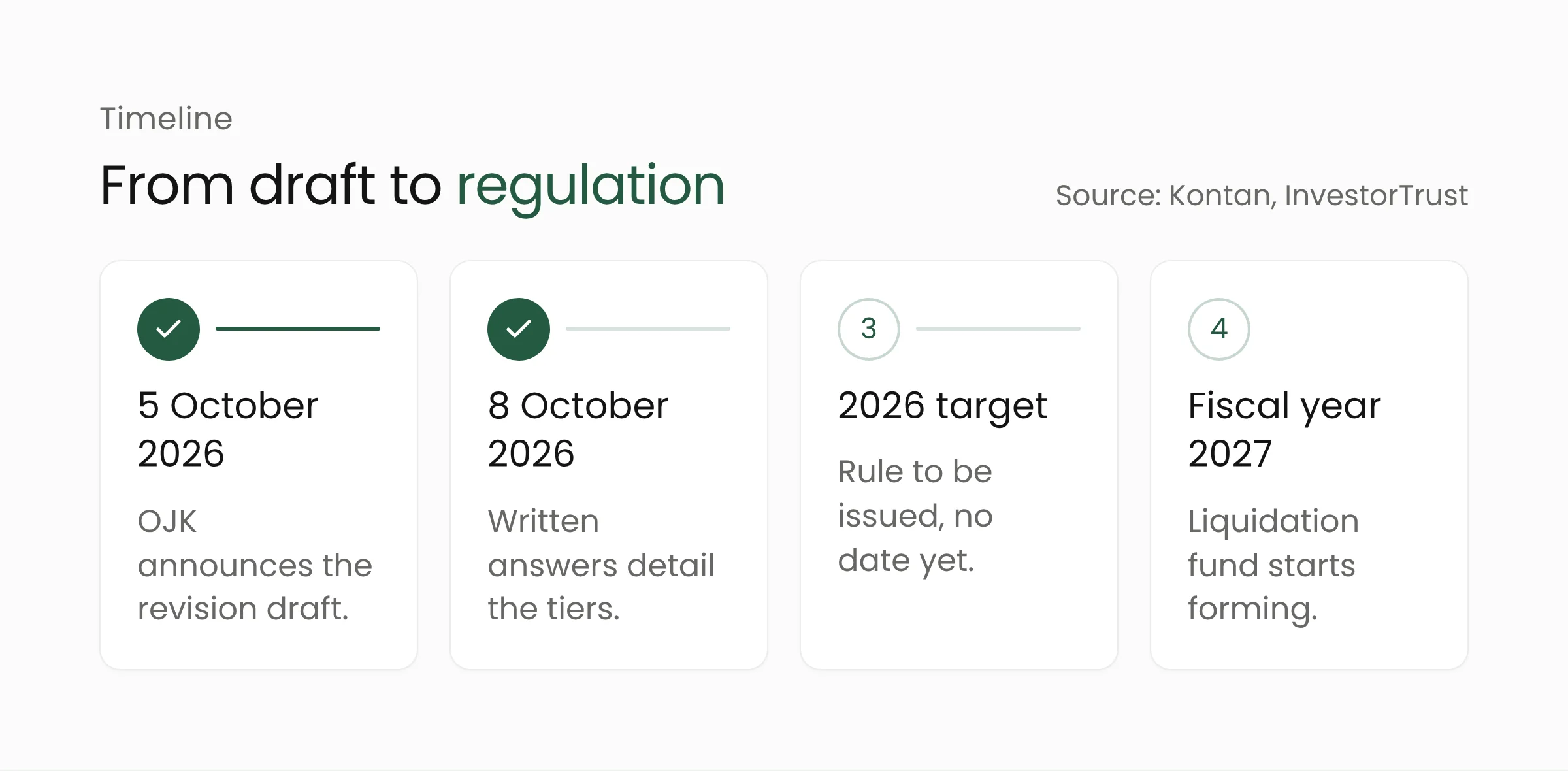
Agusman, OJK’s Chief Executive of Supervision for Financing Institutions, Venture Capital Firms, Microfinance Institutions and Other Financial Services Institutions, outlined the plan at a press conference on 5 October 2026, following the regulator’s monthly Board of Commissioners meeting. Kontan reported that the revision aims to strengthen protection for lenders and the P2P lending industry as a whole by updating the rules.
The draft covers stronger risk mitigation and stronger agreements between lenders and borrowers, so that lenders’ funds managed by operators are better protected. More detail came in OJK’s written answers, quoted by Kontan and InvestorTrust. Kontan notes the answers were delivered on 8 October 2026. Because this is still a draft, the figures and provisions below may change before the rule is issued.
Fintech lending, also called pindar in Indonesian, connects lenders and borrowers through digital platforms. Lenders can be licensed financial institutions (LJK in Indonesian, such as banks) or parties outside that group. The platform operator handles disbursement, collection and reporting, which is why the management of funds and risk is central to the regulation.
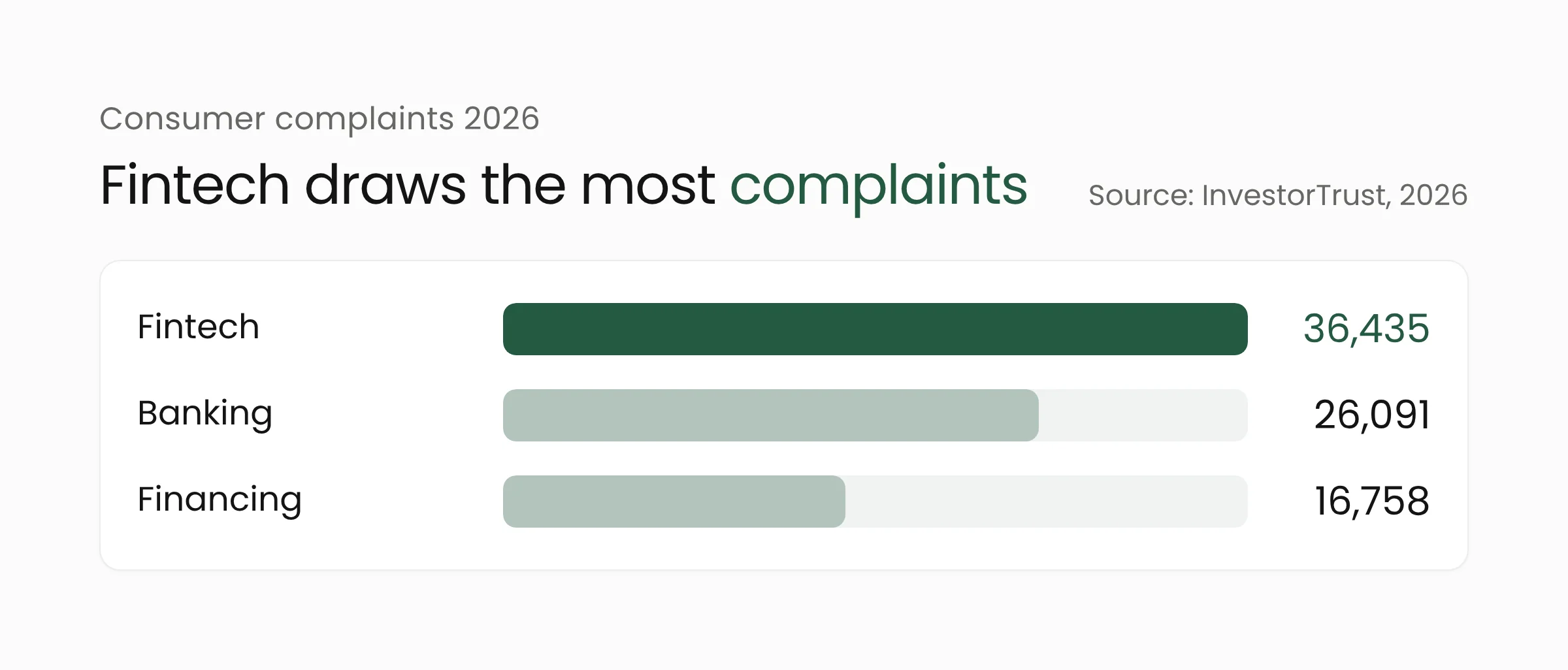
The backdrop is a heavy complaint load. OJK recorded 82,092 consumer complaints through its consumer protection portal between 1 January and 14 September 2026. Fintech accounted for the most, with 36,435 complaints, about 44 percent of the total, followed by banking at 26,091 and financing companies at 16,758.
InvestorTrust also reported that the Satgas Pasti task force shut down 951 illegal online lending entities between January and September 2026. For both borrowers and lenders, checking an operator’s licence with OJK remains the first step.
Four tiers based on performance
The most discussed part is a new chapter on incentives. According to Kontan, Article 216A of the draft groups operators by three indicators: financial health, the share of funding distributed to micro, small and medium enterprises (MSMEs), and the ratio of rejected consumer complaints. Agusman described the aim in one sentence: “Sekaligus memberikan insentif bagi penyelenggara yang memiliki kinerja baik dan menjaga perlindungan konsumen.” (Roughly: while rewarding operators with good performance and protecting consumers.)
Higher tiers may earn looser funding limits. Current rules cap funding at Rp2 billion per borrower, rising to Rp5 billion for productive funding if the operator’s bad loans stay at or below 5 percent over the previous six months and it is not under a business sanction. Under the draft, tiers 2 to 4 would be exempt from that standard cap.
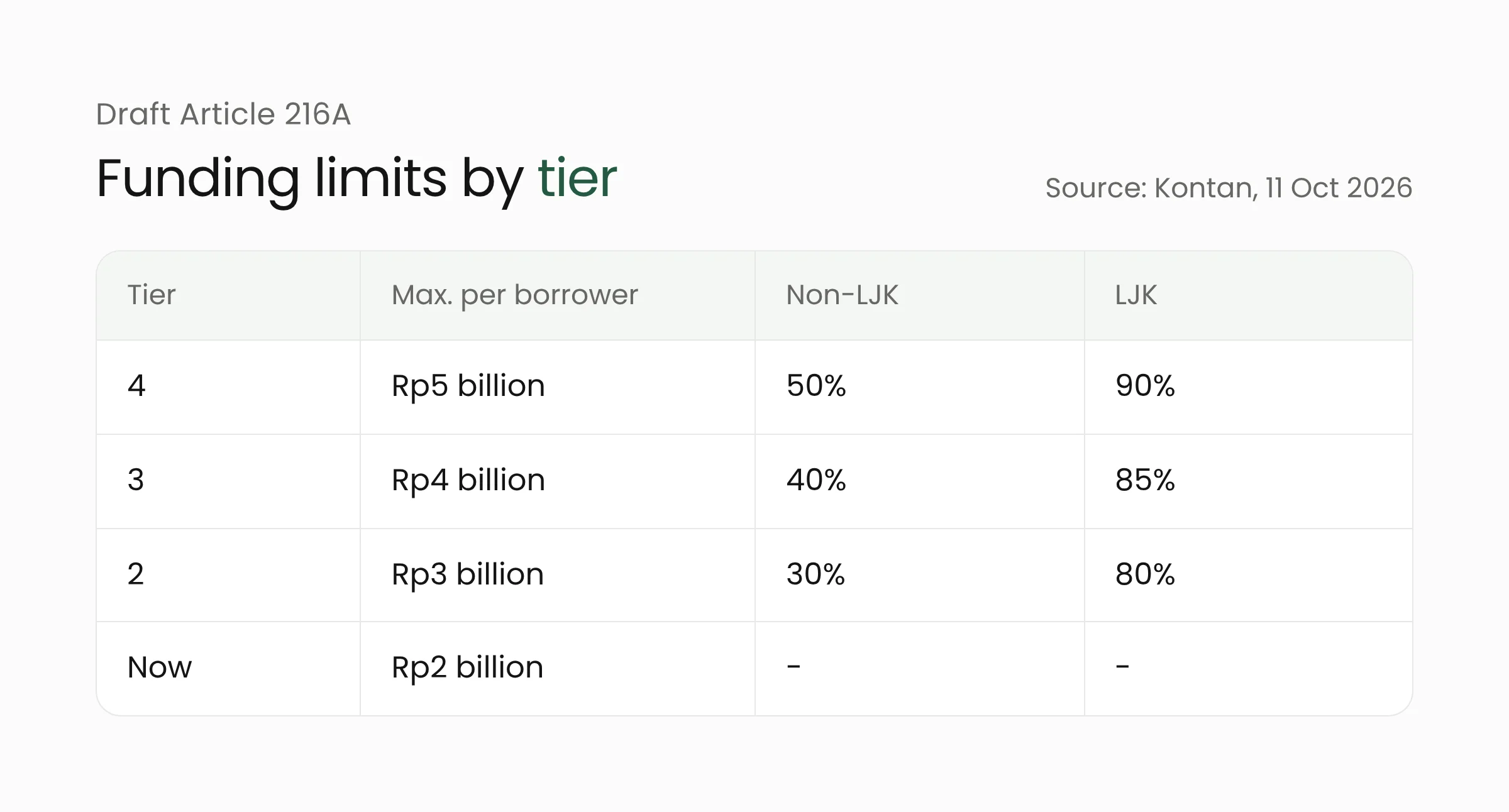
Kontan listed the per-tier limits shown in the table. It gave no criteria or limits for tier 1. OJK will set the detailed tier calculation in follow-up rules, so it is not yet known which operators would land in which tier.
Reserve funds, a liquidation fund and the default rule
InvestorTrust reported three further provisions from the same written answers. First, operators would have to set aside at least 5 percent of net platform fees on each funding disbursement. The money would be placed in bank deposits and/or government securities. Agusman said the provision is, in principle, meant to strengthen lender protection.
Second, draft Article 129A would require a liquidation preparation fund of at least 20 percent of minimum equity. It would start at Rp500 million and rise to at least Rp2.5 billion within three years, with formation planned from fiscal year 2027. If an operator can no longer function, a portfolio management team formed by the Indonesian Joint Funding Fintech Association (AFPI) would handle administration during the transition.
Third, a loan would count as non-performing after more than 180 calendar days past due, up from 90. OJK says this aligns P2P lending with bank collectibility rules, since banks are the largest institutional lenders on these platforms. The draft also opens the door to credit insurance or guarantees to transfer funding risk, though implementation is still under discussion.
Productive lending is still below target
The draft arrives alongside an OJK push for more lending to productive sectors. As of July 2026, financing to productive sectors including MSMEs reached Rp35.25 trillion, up 28.88 percent year on year. That is 33.38 percent of the industry’s outstanding loans, against a roadmap target of 40 to 50 percent for 2025 to 2026.
AFPI says many small cash loans used by MSME owners for business purposes are still recorded as consumer loans. OJK has asked operators to strengthen how they record and analyse the use of funds so that productive and consumptive lending can be mapped better, without loosening prudential principles or consumer protection.
What this means for fintech lending operators
Because the MSME funding ratio and the rate of rejected complaints are tier indicators, clean data will shape an operator’s position. A few practical considerations:
Record the purpose of each loan at application. If borrowers fill in a structured purpose, MSME owners who use small loans for their business can be identified as productive lending. Teams that need to design this kind of recording and reporting can look at our data analytics services.
Manage complaints as a measured number. The ratio of rejected complaints is part of the assessment. Operators can separate complaint types, measure resolution time and trace recurring causes in the app or the collection process.
Model the cash impact of the reserve and liquidation funds. A 5 percent set-aside from net platform fees and a liquidation fund that rises over three years will affect 2027 financial planning. Run scenarios now while final figures are pending.
Prepare systems for the 180-day threshold. A new definition of non-performing loans affects asset-quality reporting and the logic of collection systems.
For small businesses that borrow, nothing changes directly yet. Still, per-tier funding limits may affect the ceilings platforms offer later. Digital payments for shops are covered in our article on zero-percent QRIS MDR.
Frequently asked questions
Is the POJK 40/2024 revision already in force?
No. OJK says the draft is still being prepared and is targeted for issuance in 2026. The exact date has not been announced, and implementing rules will still set out how tiers are calculated.
What changes for lenders?
According to InvestorTrust, the draft adds a reserve fund of at least 5 percent of net platform fees, a liquidation preparation fund and a portfolio management team if an operator stops operating. OJK says the aim is to strengthen lender protection.
Will borrowing limits go up?
Only for operators in certain tiers. The draft exempts tiers 2 to 4 from the standard Rp2 billion cap, with per-tier limits as reported by Kontan. Limits for tier 1 have not been detailed.
Conclusion
The revision shows where OJK supervision is heading: operators that manage risk, handle complaints and channel funds to productive sectors may earn more room to grow. Industry players should prepare data and systems now, before final figures are published. If your organisation wants to discuss reporting and processing of financial data, the Merakit Indonesia team is ready to help through our financial services solutions.
Sources
- OJK Susun Rancangan Revisi POJK 40/2024 tentang Fintech Lending, Kontan, 6 October 2026
- OJK Akan Membagi Fintech Dalam 4 Tier Berdasarkan Kesehatan dan Rasio Pendanaan, Kontan, 11 October 2026
- OJK Dorong Fintech Lending Perkuat Pencatatan dan Analisis Penggunaan Dana oleh UMKM, Kontan, 12 October 2026
- OJK Siapkan Aturan Anyar Pindar, Lender Bakal Lebih Terlindung, InvestorTrust, 13 October 2026
- Pengaduan ke OJK Tembus 82.092, Fintech Paling Banyak Dikeluhkan, InvestorTrust, 6 October 2026