Blog Data Centers
OpenAI Grid Protectors: How AI Data Centers Cut Peak Power
On this page· 7 sections
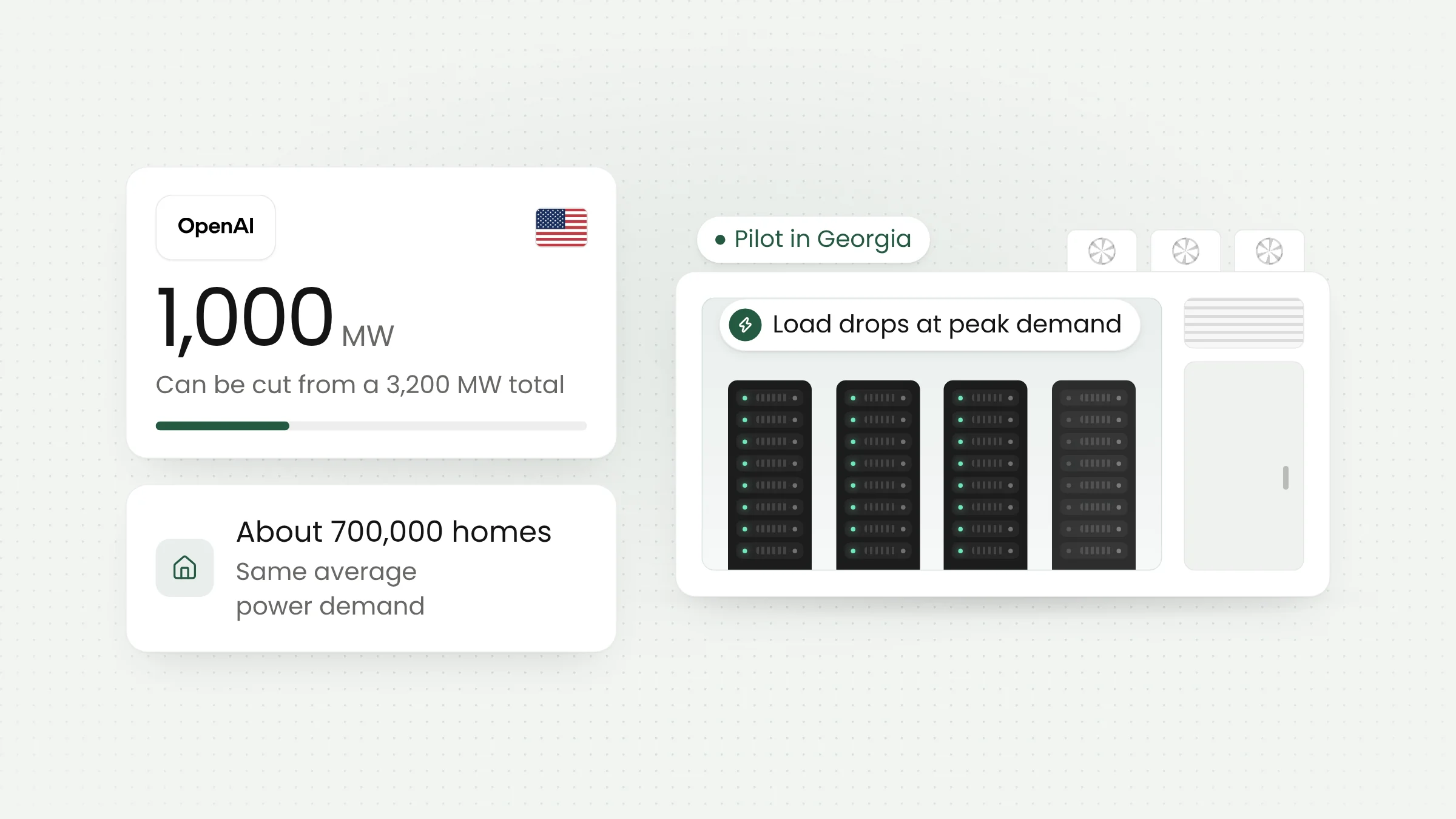
OpenAI launched its Grid Protectors Program on November 2, 2026, committing its future data center campuses to use less electricity when local power grids are under strain. The first pilot is in Effingham County, Georgia, where the utility can cut deliveries to the planned campus by up to 1,000 megawatts during busy periods.
What the Grid Protectors Program covers
AI data centers ask for more electricity than any single customer has requested before. In the United States, rising household power bills have started to stall some data center projects, as The Next Web noted in its coverage. Grid Protectors is OpenAI’s response to that pressure.
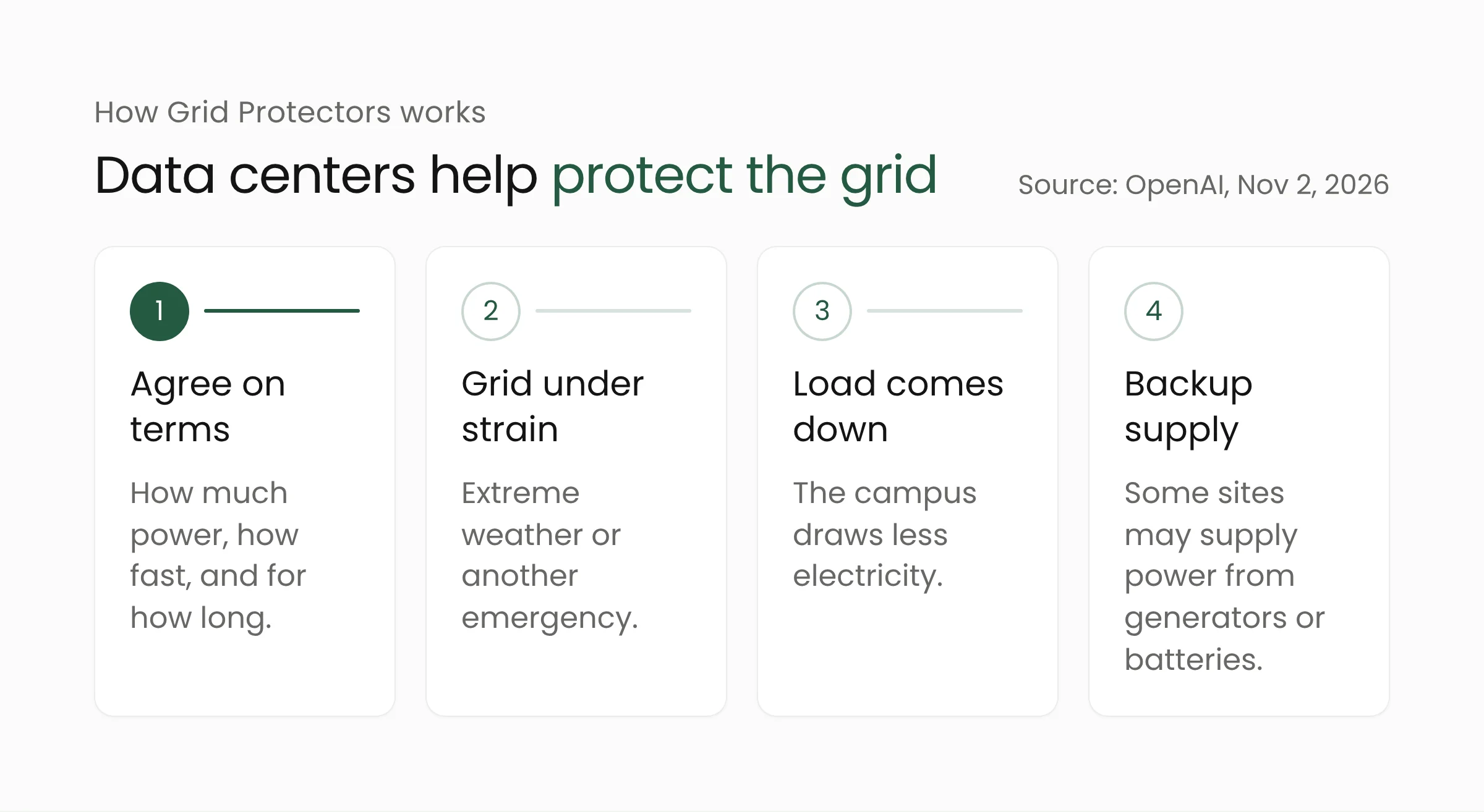
According to OpenAI’s announcement, the program rests on four commitments:
- OpenAI campuses will reduce electricity use when the local grid is strained, for example during extreme weather or another emergency.
- For each site, OpenAI and the local utility agree on three terms: how much load can be dropped, how quickly, and for how long.
- OpenAI pays the full cost of the transmission lines and electric service its campuses require, so those costs do not fall on other customers.
- Some sites may send power back to the grid from on-site generators or batteries, depending on local needs.
OpenAI summed up its reasoning in one line: “Families and small businesses should not be asked to subsidize a compute campus’s electricity needs.”
In the power industry, this arrangement is called demand response. A large customer agrees to cut consumption at certain times, so the utility does not have to build extra generation to cover a few peak hours each year. Factories and commercial buildings have used the approach for decades. The scale is what has changed. The Effingham campus alone is expected to need about 3,200 MW.
OpenAI has not said which workloads would slow down during a curtailment, such as model training or ChatGPT traffic. It has also not named any site beyond Georgia, and says terms for future campuses will be shared once they are finalized.
The first pilot in Effingham County, Georgia
The first campus in the program sits in Effingham County, about 45 minutes outside Savannah. A Georgia Power press release dated July 22, 2026 said the facility is expected to need about 3,200 MW. OpenAI will provide up to 1,000 MW of flexible demand response under a 25-year agreement, which lets Georgia Power reduce the energy delivered to the site during certain periods to support grid reliability.
Georgia Power describes the deal as among the largest single-facility demand response commitments in the country, and says the flexibility will let it invest in fewer new generation resources. OpenAI says the 1,000 MW figure equals the average power demand of roughly 700,000 homes.
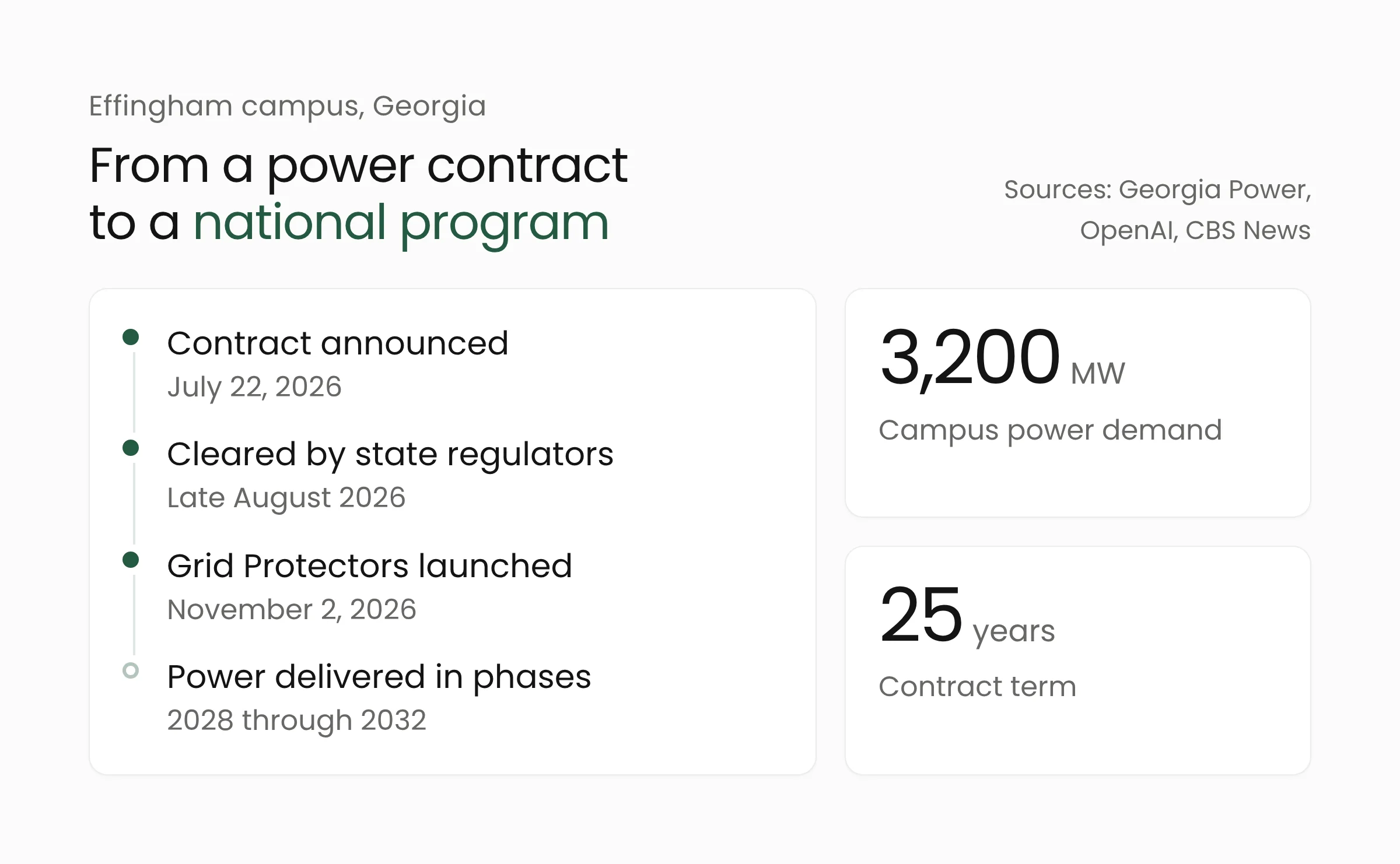
The contract has already cleared state review. CBS News Atlanta reported that Georgia Public Service Commission staff examined the agreement and declined to object, with no public vote. The project, known as Project Camellia, will receive power in phases from 2028 through 2032, and OpenAI describes it as a long-term investment of $20 billion.
Georgia Power has also promised gains for households. According to FOX 5 Atlanta, the utility’s portfolio of large-load contracts is projected to bring in about $950 million a year in additional revenue starting in 2029. A typical residential customer using 1,000 kWh a month is expected to save $180 a year, up from an earlier estimate of $102. These figures cover all of Georgia Power’s large customers, including OpenAI, and remain company projections.
Limits and open questions
OpenAI itself acknowledges that flexible demand cannot replace new power plants and transmission lines. Dropping 1,000 MW helps during the tightest hours, but the campus will still draw enormous amounts of power the rest of the time. Demand response lowers peak needs, while total annual energy use depends on how much computing the campus runs.
Several important details remain undisclosed. So far, OpenAI has not published how much notice it needs before cutting load, how long a curtailment can last in Georgia, or how often one is expected. It has also not said whether on-site backup would rely on fossil-fuel generators, batteries, or both.
The move comes amid growing policy pressure. The Next Web notes that the White House has asked data center builders to sign a voluntary pledge to cover their own power costs, that Google and Nvidia have formed an alliance to make data centers flex their power use, and that Congress has considered requiring large users to pay for grid upgrades.
Indonesia faces similar questions. A planned 640 MW AI data center in Jatiluhur, West Java, was temporarily halted because its permits were incomplete, as covered in our report on the Jatiluhur AI data center. As projects of that size multiply, the question of who carries grid load and grid costs will follow.
What this means for factories and building operators
Grid Protectors is a deal between an AI company and a US utility. The principle, however, applies to any facility that uses a lot of electricity, from a textile mill in Central Java to an office tower or a hospital. Operators who understand their own load are better prepared for tariff increases, capacity limits, or supply disruptions.
Practical steps to start with:
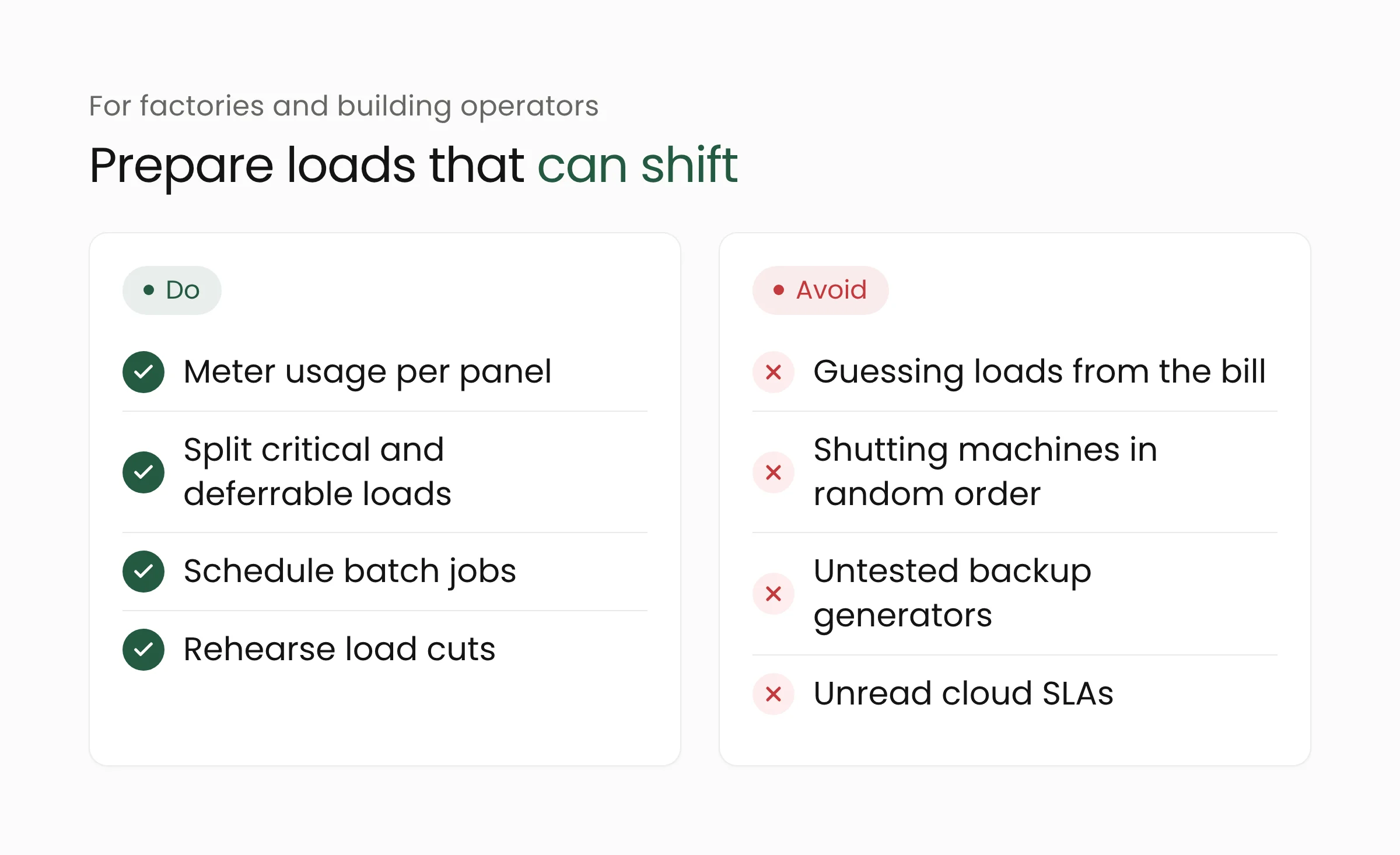
- Meter consumption per panel or production line. A monthly bill only shows the total. Energy sensors and Internet of Things (IoT) monitoring reveal which machines draw the most power and at what time.
- Separate critical loads from deferrable ones. Server room cooling and medical equipment must keep running, while water pumps, heaters, or electric vehicle charging can usually shift by a few hours.
- Move heavy jobs out of peak hours. In a factory, that may be batch processes. On the IT side, backups and report processing can run overnight.
- Rehearse a load-shedding procedure. A clear shutdown order prevents equipment damage and defective output. Industrial automation systems can run that sequence automatically when a signal from the main panel arrives.
- Test generators and UPS units regularly. Backup power that is never exercised often fails when it is needed most.
Organizations that run systems in the cloud have one more task. Read your provider’s service level agreement (SLA) and ask how it handles power constraints at its data centers. For services that cannot go down, consider running them in more than one location.
Frequently asked questions
Will ChatGPT slow down when the grid is strained?
OpenAI has not said which workloads would be reduced under Grid Protectors. The Effingham campus will only start receiving power in phases from 2028, so there is no real-world track record yet.
How is demand response different from rolling blackouts?
Demand response is agreed in advance with specific customers, including how much load is cut, how fast, and for how long. Rolling blackouts happen when a utility no longer has enough supply, and they usually hit many customers at once.
Does the program apply outside the United States?
So far, OpenAI has named only Georgia as its first site and has not announced any others. The company says the terms for each campus will differ according to local grid needs.
Conclusion
Grid Protectors shows that electricity is now part of an AI data center’s design from day one, alongside chips and cooling. The same lesson applies to factories and buildings in Indonesia: facilities that understand and can control their load cope better when supply changes. If you want to start mapping energy use or automate load shedding, the Merakit team can help design the right system.
Sources
- OpenAI, Introducing the Grid Protectors Program (November 2, 2026)
- The Next Web, OpenAI launches Grid Protectors to ease AI’s strain on power grids (November 2, 2026)
- Georgia Power, Georgia Power to serve OpenAI project in Effingham County (July 22, 2026)
- CBS News Atlanta, Georgia Power gets clearance to serve OpenAI’s massive AI data center in Effingham County (August 27, 2026)
- FOX 5 Atlanta, Georgia Power approves OpenAI contract in Effingham County (August 27, 2026)