Blog Retail Technology
Sainsbury's AI Self-Checkout Reaches Convenience Stores
On this page· 7 sections
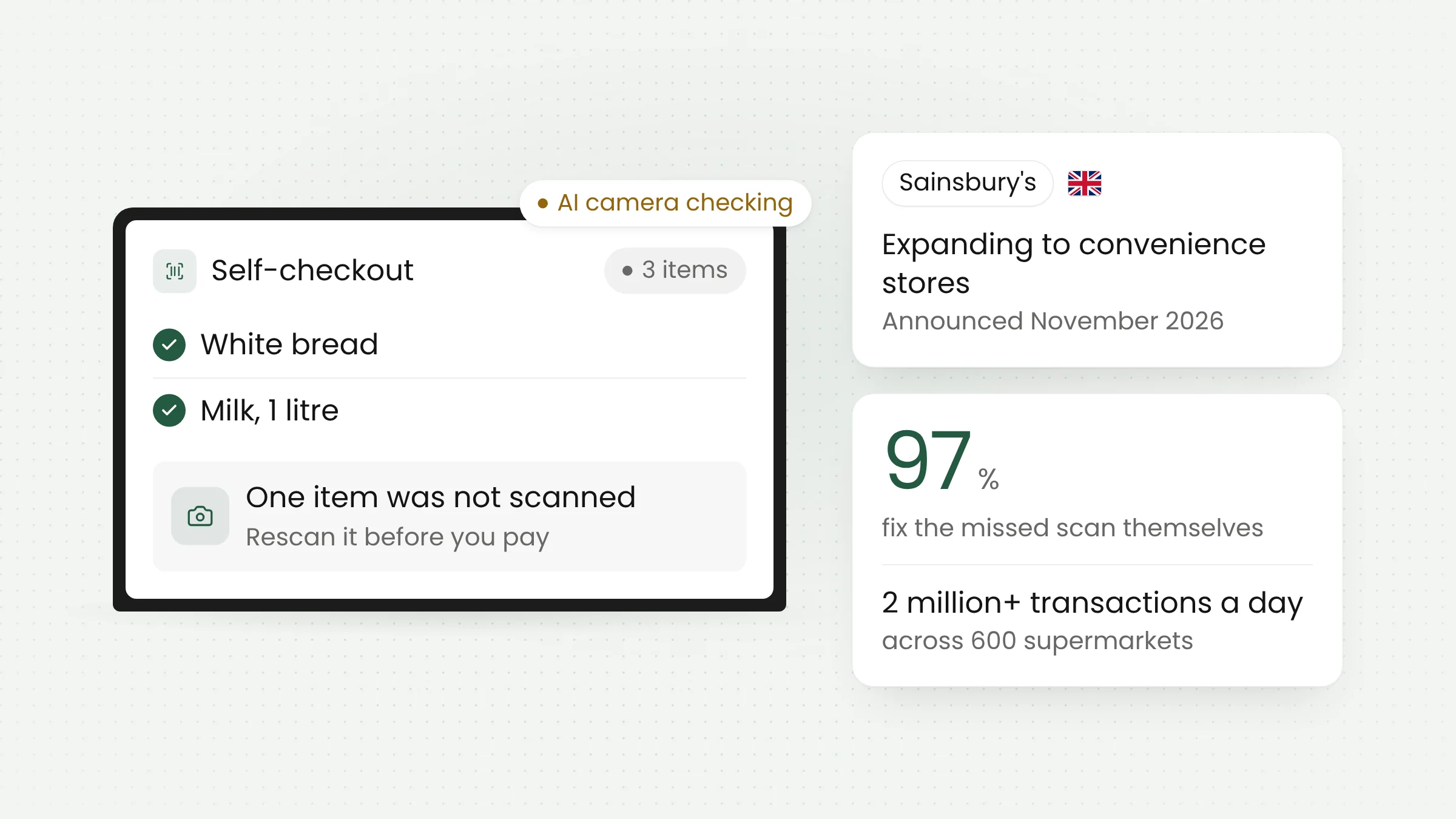
Sainsbury’s is bringing its AI self-checkout system to convenience stores after running it in about 600 UK supermarkets. Cameras at the till spot an item that may have been missed, and the screen asks the shopper to rescan it. The move was reported on 26 November 2026, alongside a renewed partnership with technology supplier SAI Group.
This article covers how the system works, the figures Sainsbury’s has reported, what has yet to be disclosed, and what retailers in Indonesia and elsewhere should weigh before putting AI cameras over their own tills.
From supermarkets to convenience stores
According to Retail Systems, Sainsbury’s has renewed a multi-year partnership with SAI Group, a retail technology company. The software was first deployed in the grocer’s larger supermarkets and is now going into its convenience estate. The outlet notes this is the first time the technology has been used in that part of the business.
Sainsbury’s has announced neither the number of convenience stores involved nor a rollout timeline. The value and length of the contract were also left out of the coverage.
Reports differ slightly on the supermarket footprint. Retail Rewired says SAI’s technology is live in 600 supermarkets. Asian Trader and KamCity cite the company’s interim results, which put self-checkout video analytics in nearly 600 stores.
The two companies will also explore further uses. Emma Quinn, Sainsbury’s Retail and Digital Director, and Som Sinha, SAI’s chief executive, pointed to tackling retail crime and improving safety for staff and shoppers. Neither gave details of the features planned.
How the AI works at the till
Built on cameras already in place
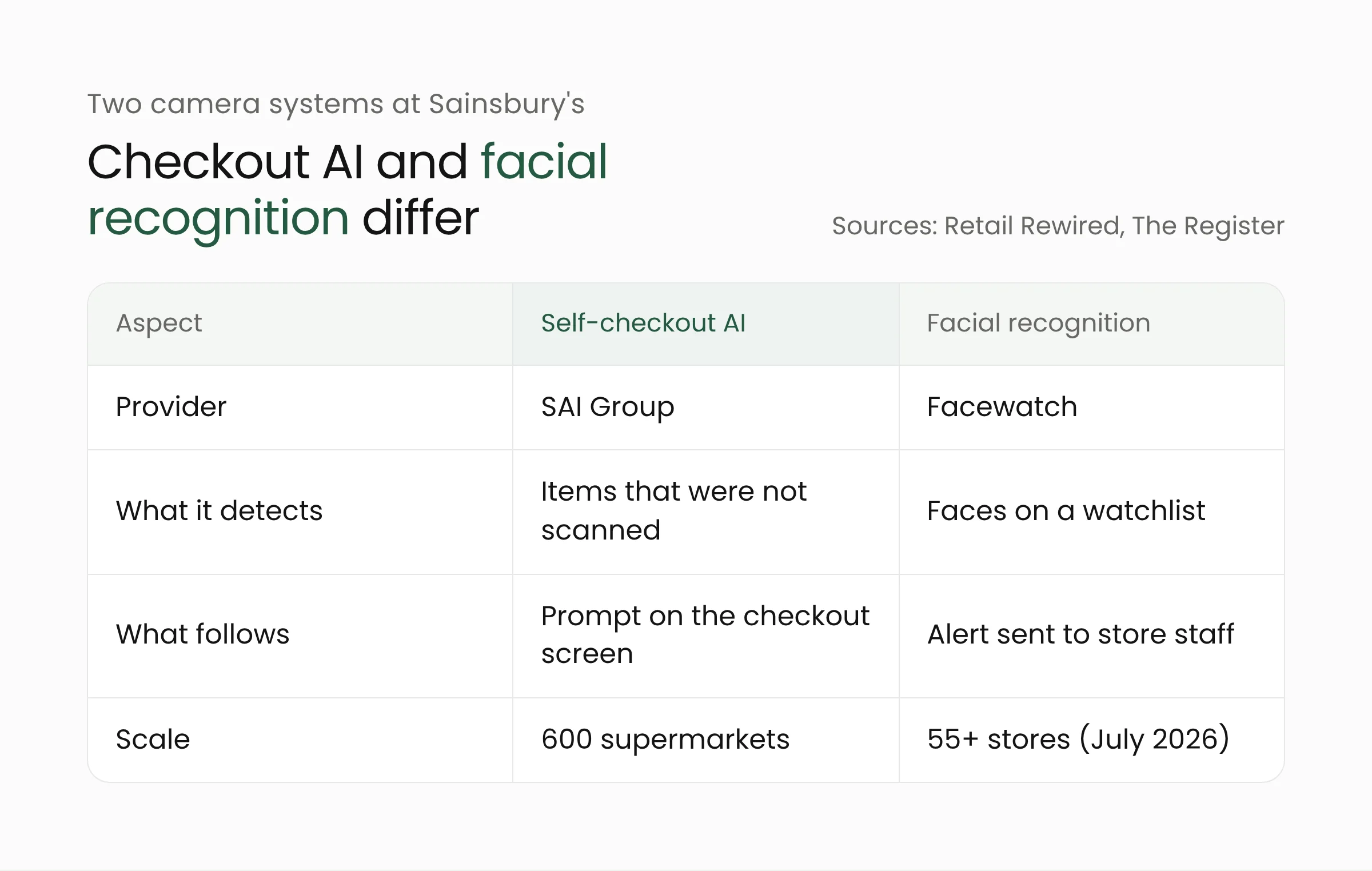
The system runs on cameras that are already installed around the self-checkout area. SAI’s software analyses the footage and recognises when an item may have gone unscanned, for example a product that goes straight into a bag without passing the scanner.
When that happens, a message appears on the checkout screen. The shopper can rescan the item before paying, with no need to wait for a member of staff. As Retail Technology Innovation Hub puts it, the prompt gives customers the chance to correct the scan themselves.
The design treats a missed scan as a mistake that can be fixed on the spot, and a shopper who simply forgot is told so by a screen.
The figures Sainsbury’s reports
Sainsbury’s says more than two million self-checkout transactions a day pass through the system. Of the customers who receive a prompt, 97% correct the scan themselves.
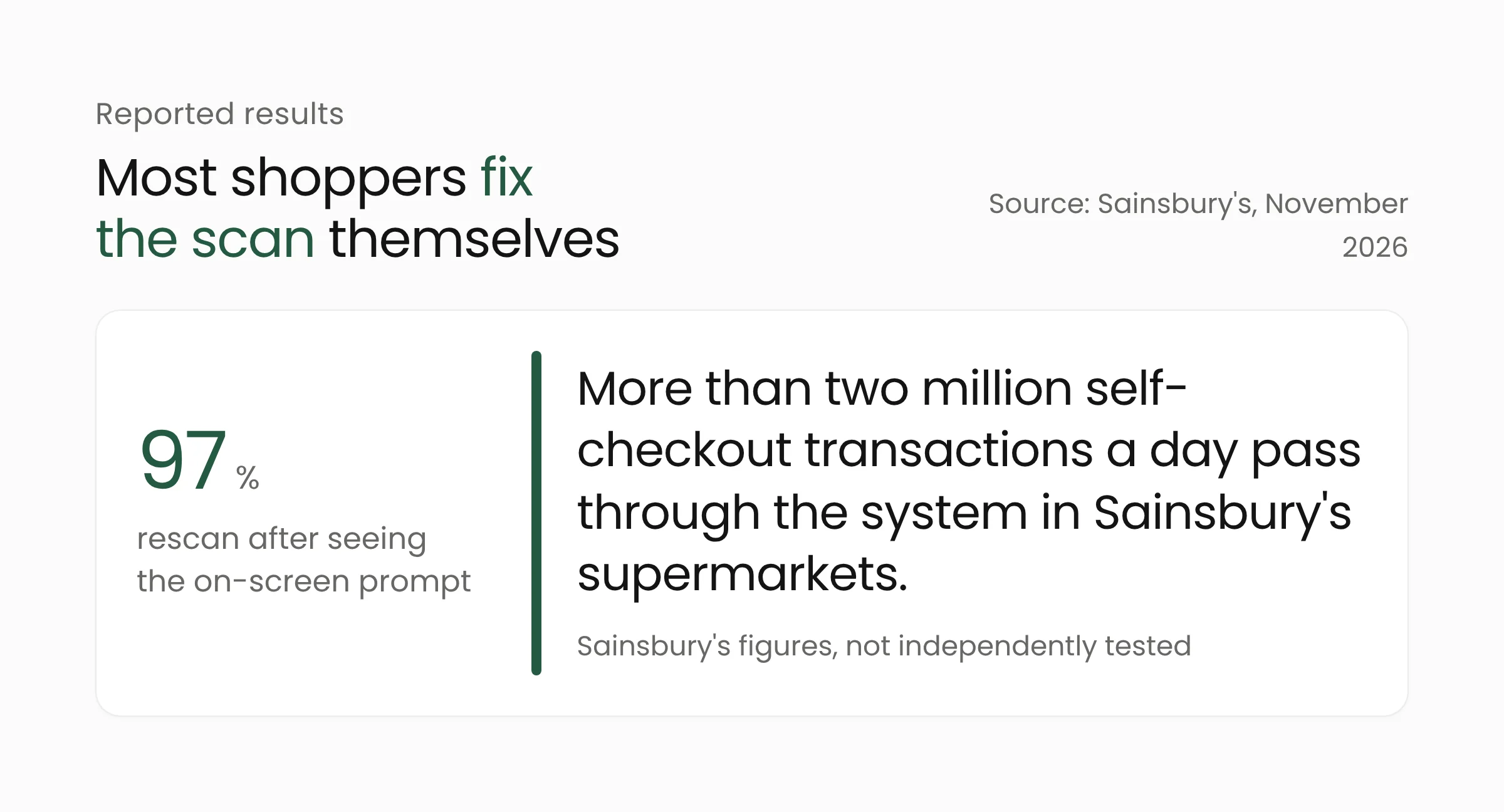
The retailer also says the technology has significantly reduced theft at its self-checkouts. It has published no figure for that reduction, and all of the numbers come from the company itself, with no independent testing.
The technology behind SAI Group
SAI calls its approach Vision AI, a combination of computer vision and generative AI. Computer vision is a branch of machine learning that trains models to recognise objects and movement in images or video.
Retail Rewired reports that the SAI One platform uses a visual language model to analyse live video feeds and send alerts to store staff. The platform is said to draw on input from more than 30,000 cameras across more than 1,000 UK retail locations every day.
Sainsbury’s is one of several customers. Frozen food chain Iceland reported an 80% reduction in retail losses after deploying SAI’s system across its estate, according to the same report. That figure, too, comes from the parties involved.
SAI has also issued a forecast for the UK’s peak trading season. Its platform data points to 19 December 2026 as the biggest single day for shoplifting incidents, with Saturday 28 November in second place. The forecast comes from the company selling the system and should be read as such.
Limits and criticism of AI cameras in stores
What has yet to be disclosed
Coverage of the expansion leaves out several points that matter to shoppers and to any retailer thinking of following suit. The false alert rate is missing, although it determines how often honest customers receive a mistaken prompt. How long footage is kept, and who can view it, is also unexplained.
The 97% figure can be read two ways. Some shoppers had forgotten to scan an item. Others may have rescanned something that had already gone through because the machine asked them to. Without false alert data, the two cannot be told apart.
KamCity’s commentary notes that honest customers would have to accept the camera surveillance and the double-checking. In its view, behaviour in store will show whether the approach works.
Facial recognition is a separate system
Sainsbury’s also uses facial recognition from Facewatch, which is a different system from the self-checkout AI. The Register reported on 6 July 2026 that the grocer began trials in September 2025, had the technology in more than 55 supermarkets, and planned to reach up to 200 stores by the end of 2026.
That system has drawn criticism. Privacy campaign group Big Brother Watch has called for the rollout to be halted. The Register also describes a London shopper who was wrongly asked to leave a store. Sainsbury’s apologised and said the fault lay with staff approaching the wrong person.
The case matters for checkout cameras because it exposes the same weak point. An alert from a machine becomes a problem when a person acts on it without checking. SAI’s system lowers that risk by sending the message to the shopper first, but the plan to use it for crime prevention will test that boundary.
What this means for retailers in Indonesia
Sainsbury’s deployed the system across hundreds of stores with uniform cameras and checkout hardware. A retailer in Indonesia with a handful of outlets can take the lessons without matching the scale.
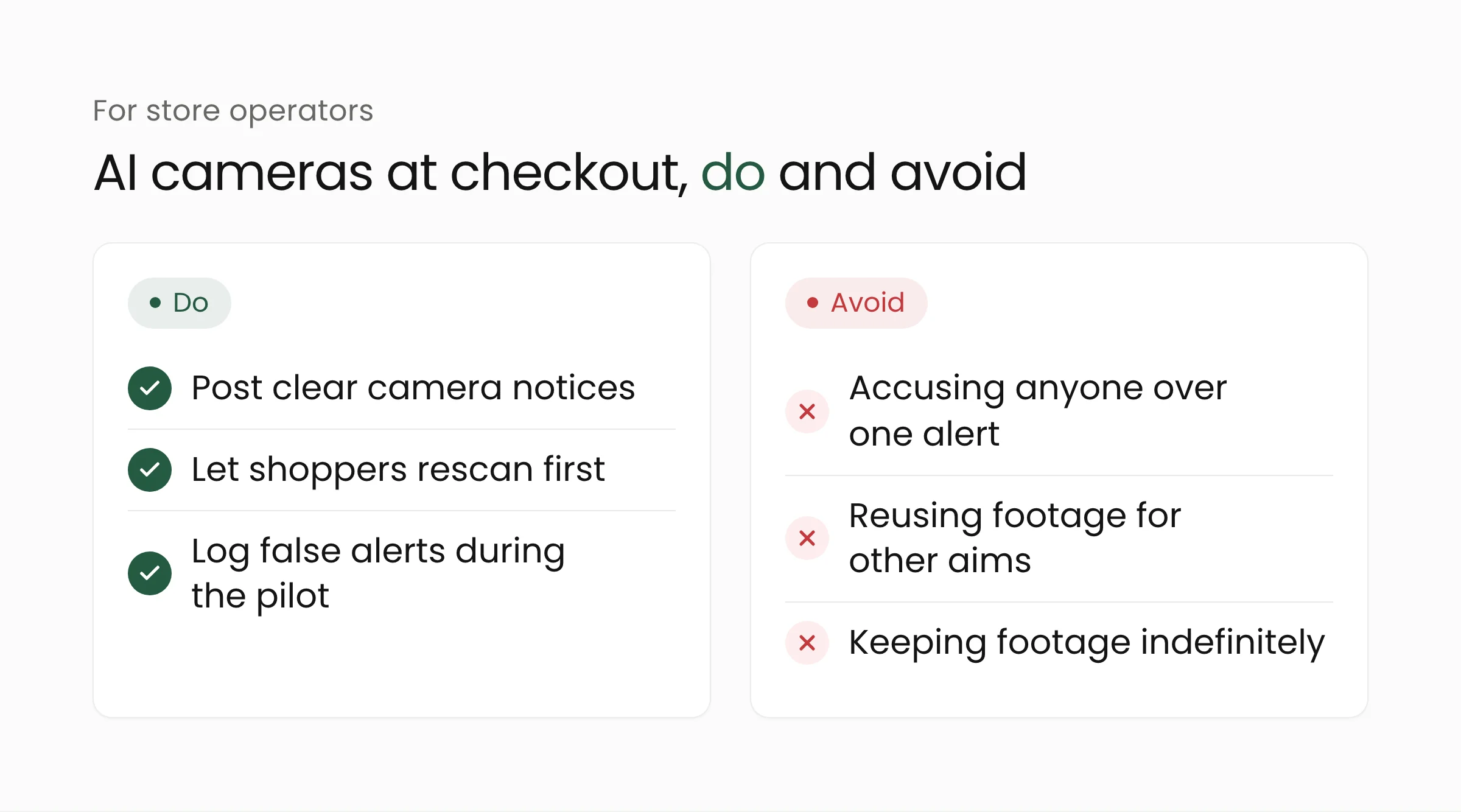
Measure your losses before buying a system. Stock discrepancies have many causes, including recording errors, damaged goods, and receiving mistakes. A camera at the till addresses one of them. Stock count data per outlet shows whether the till is the largest source.
Design a prompt that lets shoppers put things right. The 97% figure suggests most customers resolve the issue themselves when told politely. Staff step in only when the prompt is ignored.
Track false alerts from the pilot onward. Ask the vendor for its false alert rate, then compare it with your own records in one or two outlets before expanding. Packaging, lighting, and shopping habits in Indonesia differ from the UK data the models were trained on.
Meet data protection rules. Footage that shows people is personal data. In Indonesia, Article 17 of Undang-Undang Nomor 27 Tahun 2022 tentang Pelindungan Data Pribadi (the Personal Data Protection Law) governs visual data processing devices in public places. According to a Hukumonline review updated on 1 October 2026, the implementing regulation requires a notice stating that a device is operating, with a contact person, placed at the entrance or where it can be read before entering the monitored area. That regulation, PP 33/2026, takes effect on 16 January 2027, as covered in our article on the Indonesian DPO Association.
Set limits on how footage is used. Decide how long recordings are kept, who may view them, and for what purpose before the system is switched on. Footage collected to check scans should stay within that purpose unless there is a clear basis for anything else.
Stores without self-checkout can apply the same thinking to staffed tills, for instance by matching sales data against stock to find patterns in discrepancies. The Merakit team helps retailers build systems of that kind through its retail management solutions, from sales data to stock across outlets. On physical security, we previously reviewed Ring’s security robots for stores and their limits.
Frequently asked questions
Does Sainsbury’s self-checkout AI recognise shoppers’ faces?
Coverage of the SAI system mentions only the detection of unscanned items at the till. Facial recognition at Sainsbury’s is a separate Facewatch system used in some stores. The sources we read do not specify what data the SAI system records or stores.
What happens if a shopper ignores the on-screen prompt?
The available sources do not describe the next step. They state only that 97% of customers who receive a prompt correct the scan themselves, which means staff are not needed in most cases.
Does this kind of technology require new cameras?
According to the coverage, SAI’s software works with the self-checkout cameras already installed in Sainsbury’s stores. What another store needs depends on the position and quality of its existing cameras, and a pilot is the way to confirm that.
Closing
Sainsbury’s move into convenience stores shows one way to use AI cameras in a shop, which is to remind the customer first and involve staff second. The reported results look promising, while false alerts and footage handling remain undisclosed. If your store is weighing self-checkout or camera analytics, the Merakit team is ready to discuss which data to prepare first.
Sources
- Sainsbury’s extends AI self-checkout technology to convenience stores, Retail Systems, 26 November 2026
- Sainsbury’s and SAI to roll-out AI self-checkout technology across convenience store estate, Retail Technology Innovation Hub, 26 November 2026
- Sainsbury’s extends partnership with SAI for AI loss prevention across its c-store estate, Retail Rewired, 26 November 2026
- Sainsbury’s rolls out AI tech across its convenience stores, Asian Trader, 27 November 2026
- Sainsbury’s Extends AI Self-Checkout Technology To Convenience Stores, KamCity, 27 November 2026
- Brit supermarket giant triples down on facial recog to nab shoplifters, The Register, 6 July 2026
- Aturan Pemrosesan Data Visual Menurut UU PDP, Hukumonline, updated 1 October 2026