Blog Retail Technology
Square Kiosk: AI Voice Ordering Kiosk and What It Costs
On this page· 7 sections
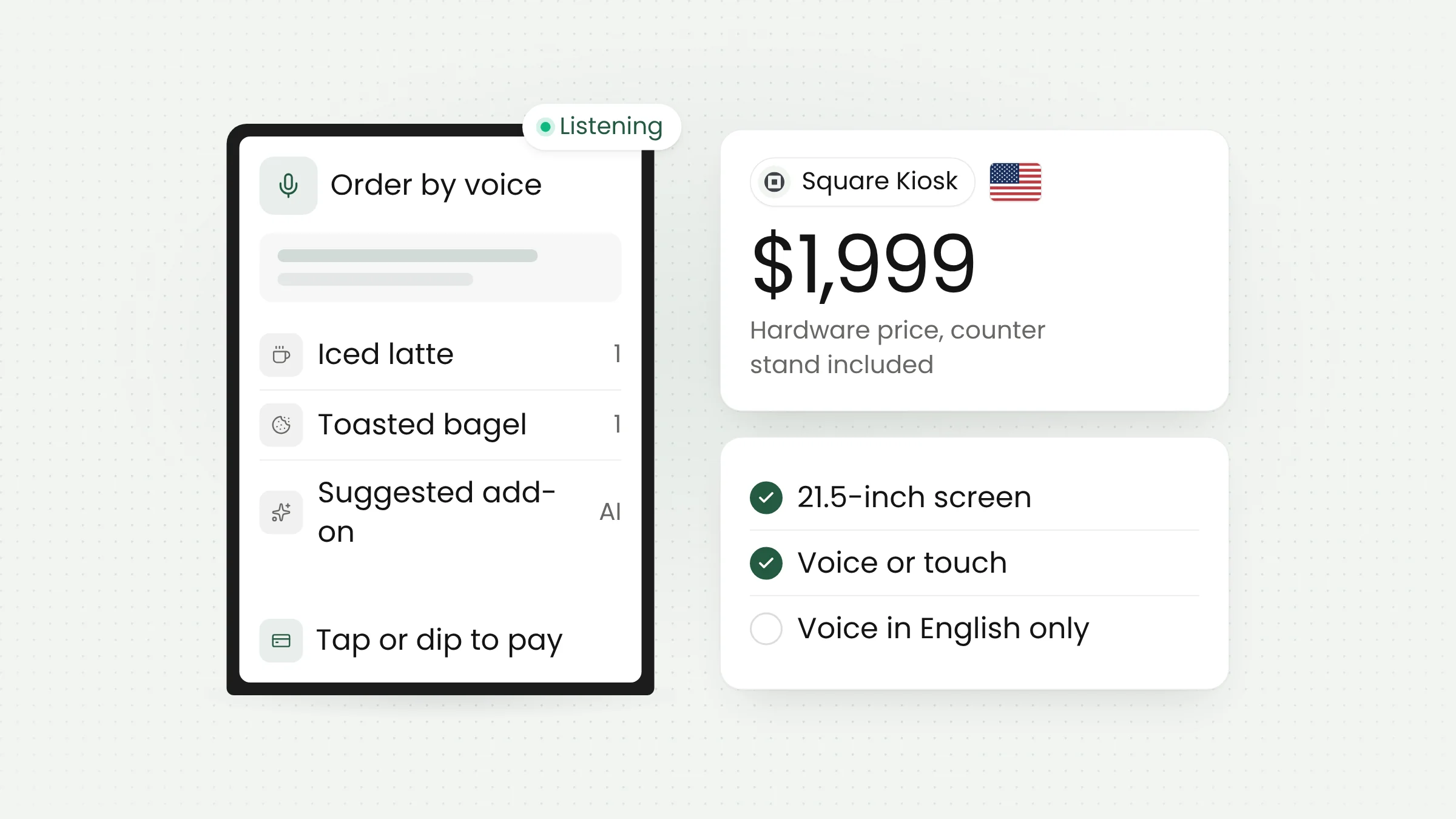
On October 14, 2026, Square, a unit of Block, introduced Square Kiosk, a self-order kiosk with a 21.5-inch screen that takes orders by voice or touch. The hardware costs $1,999, and the software subscription adds $99 per month. It is built for restaurants, and its voice feature currently understands only English.
What Square launched
Square Kiosk is a self-service ordering device with a 21.5-inch display, built-in payments, and an AI layer that can hold a conversation with guests. According to Digital Transactions, it replaces the kiosk Square introduced a little over two years ago. That earlier setup relied on the operator’s own iPad as the screen, while the new unit ships with its own display. Square calls it the first voice ordering-enabled POS device it offers.
Sales start in the United States. Square’s product page gives no shipping date, and the sources we read name no plans for other countries. Pricing, timing, and language support for Indonesia have not been announced.
Square also announced tools for quick-service restaurant franchises to manage menus, reporting, and gift cards. Pricing for those tools has not been disclosed. According to Fast Casual, Square says the goal is to ease pressure at the front of the house during peak hours so staff can focus on food and hospitality.
How the kiosk works at the counter
The device has three directional microphones with AI noise filtering, plus a sensor that detects the direction and distance of an approaching person. According to Square’s product page, the screen wakes before the guest arrives. The guest then orders by voice, by touch, or by switching between the two mid-order.
The AI layer is built on the owner’s menu and sales data. Fast Casual reports that guests can ask about menu items, request modifications and substitutions, and receive recommendations. The kiosk also suggests add-ons based on popular items, the time of day, and what is already in the cart. It can answer questions about allergens and vegetarian options, and Digital Transactions notes that fuller item descriptions, allergen data, and images improve the AI’s performance.
Payment happens on the same device by tap, dip, or PIN, and a barcode scanner handles gift cards. Guests can also check in to Square Loyalty to earn and redeem rewards.

Behind the screen, the kiosk connects to the kitchen display, printers, the POS, and the Square dashboard. Menus, prices, and modifiers transfer from an existing Square account. Price changes and sold-out items sync to every kiosk, and kiosk orders appear in sales reports alongside counter and online orders.
Costs and subscription requirements
The cost has several parts. The hardware is $1,999 with a counter stand, and the final price varies by stand type. The software costs $99 per month per device and requires a Square Plus or Square Premium subscription. According to Fast Casual, Plus is $49 per location per month and Premium is $149. Square’s product page adds a processing fee of 2.5% plus 15 cents per tap or dip payment on the Plus plan, and hardware financing of $97 per month over 24 months.
From those figures, one location with one kiosk on the Plus plan pays $148 per month in subscriptions, before processing fees and tax. That is our arithmetic, and Square does not publish a total. The kitchen display, POS hardware, and kitchen printers are sold separately.

For owners on a legacy Square restaurant plan, the product page says the plan must be switched to a current Square plan. Other customers can keep using Square Stand for iPad, which Digital Transactions lists at $149, with the Kiosk Lite app as a lower-cost option.
Claims, limits, and privacy
Every sales benefit Square describes, such as shorter lines and extra orders from AI suggestions, is a vendor claim. Digital Transactions notes that no independent testing or customer data accompanies it, and Square’s product page states that it does not guarantee higher sales. One Square partner, Boba Nation Grand, said the kiosks tested well and that it plans to expand their use this year, according to Fast Casual. That is the experience of a single party.
Square lists several limits. Voice ordering is available only in English. Voice may work poorly in very loud places such as music venues, and Square recommends touch ordering there. Kitchen printers must connect through Square POS hardware, and a direct connection is described as coming soon. Square also recommends placing kiosks at least 24 inches apart.
On privacy, a Square spokesperson quoted by Digital Transactions said: “When Square Kiosk is on its idle screen, voice is disabled, and it is not listening.” According to the same report, the kiosk listens only during an active ordering session, has no camera, and voice is optional for both the guest and the operator. These are Square’s statements and have not been independently tested.
What this means for retail and restaurant businesses
Square Kiosk is sold for the US market, so most Indonesian businesses cannot buy it yet. Its direction still matters for cafes, restaurants, and shops weighing self-ordering. The points below can serve as a checklist.
Calculate the monthly cost before buying. Hardware, subscription, processing fees, and financing add up to a total that differs from the sticker price. Compare it with the cost of one cashier during your busiest hour.
Test language and accents. Square’s voice feature supports only English. Customers in Indonesia may order in Indonesian, regional languages, or a mix of both. Voice ordering that misses an accent can slow the line, so keep touch as the main path.
Confirm that your customers’ payment methods are supported. Square names tap, dip, and PIN payments. QRIS support is not mentioned in the sources we read, so verify it if your business accepts QRIS. Our review of zero MDR for QRIS explains what QRIS fees mean for merchants.
Prepare clean menu data. The quality of the AI’s answers depends on descriptions, allergen data, and menu photos. The same work pays off for online menus and printed menus.
Plan the layout and kitchen flow. A kiosk that takes orders faster helps only if the kitchen can fulfill them. Make sure printers or kitchen screens are connected correctly before the kiosk goes live.
For businesses that want to build their own self-ordering, such as an ordering app or a kiosk connected to an existing POS, our team can help through AI development and retail management solutions.

Frequently asked questions
How much does Square Kiosk cost?
The hardware is $1,999 with a counter stand. The software is $99 per month per device and requires a Square Plus subscription ($49 per location per month) or Premium ($149). Square also offers financing at $97 per month over 24 months.
Does Square Kiosk understand Indonesian?
Not yet. Square’s product page says voice ordering is available only in English. Touch ordering remains available.
Does the kiosk record customers all the time?
According to a Square spokesperson, the kiosk listens only during an active ordering session and does not listen on its idle screen. The device also has no camera. This comes from Square, and we have not found independent testing of it.
Conclusion
Square Kiosk shows how in-store ordering is moving from touchscreens toward conversation with AI. The benefit is clearest at peak hours, but results will depend on customer language, menu data quality, and kitchen readiness. If you are planning self-ordering or connecting your point of sale to AI, the Merakit team can talk it through on our contact page.