Blog Online Marketplaces
Temu's EU Action Plan: What Online Marketplaces Can Learn
On this page· 7 sections
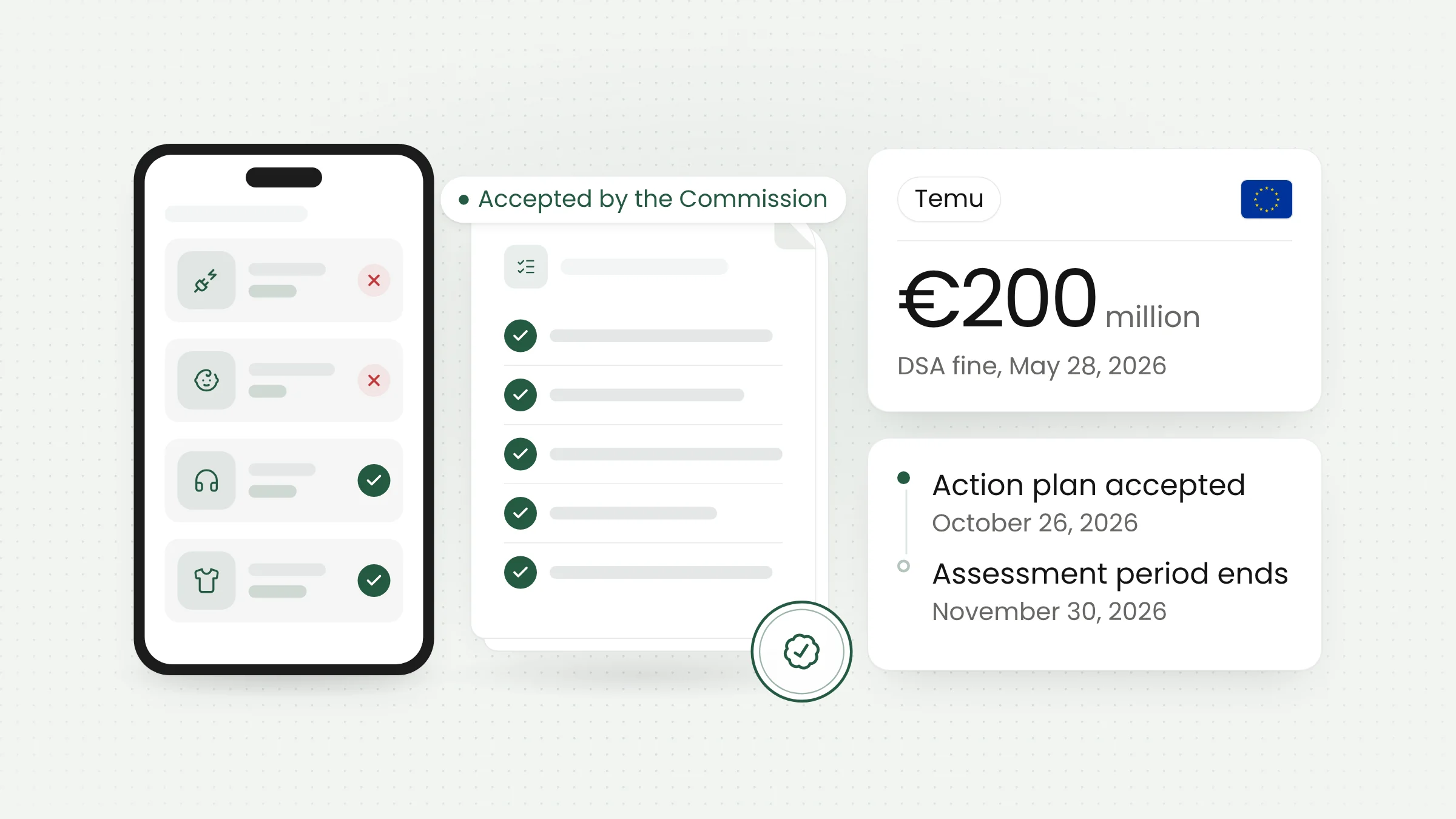
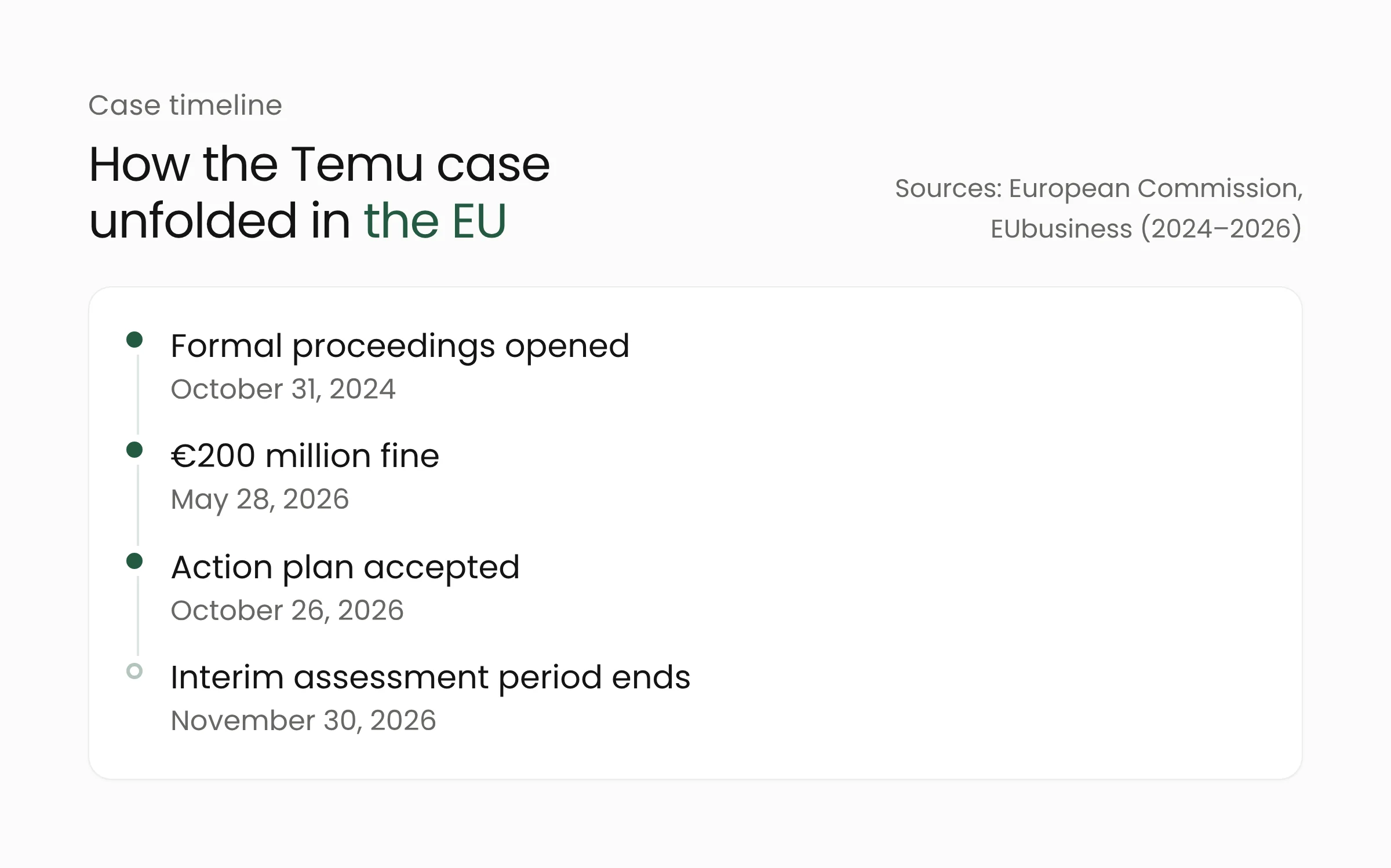
The European Commission accepted Temu’s action plan on October 26, 2026. The Temu action plan sets out five measures to curb illegal products on the marketplace and comes five months after the company was fined €200 million for breaching the Digital Services Act (DSA), the EU’s rulebook for online platforms.
The decision matters well beyond Europe. Marketplace operators and online sellers in Indonesia face the same underlying question: who is responsible for making sure that goods sold on a platform are safe and legal, and how that responsibility is proven with data.
What the accepted Temu action plan contains
According to EUbusiness, the Temu action plan includes five corrective measures:
- A risk analysis specific to Temu’s platform, built on its own data.
- Reliable metrics to show whether mitigation measures actually reduce the spread of illegal content.
- An assessment of the limits of its content moderation system.
- An analysis of whether and how its recommender systems amplify illegal goods.
- A review of deliberate manipulation, including sellers who exploit platform features to spread potentially illegal listings.
Temu has four months to deliver an interim risk assessment covering the six months up to November 30, 2026. That assessment will be used to check whether the measures are in place. Agence Europe adds that Temu must also commission an external, independent audit of the measures.
Executive Vice-President Henna Virkkunen described the measures as another example of the DSA helping to strengthen consumer protection online, Agence Europe reported. If Temu fails to deliver, the Commission can impose periodic penalty payments.
How a €200 million fine led here
The Commission opened formal proceedings against Temu on October 31, 2024, and issued preliminary findings in July 2025. Its non-compliance decision followed on May 28, 2026, together with a €200 million fine, according to the Commission’s press release.
The Commission found that Temu had failed to diligently identify, analyse and assess the systemic risks of illegal products sold on its platform. Temu’s 2024 risk assessment relied on general information about the e-commerce sector instead of evidence specific to its own service, such as public reports and testing. As a result, the Commission said, it seriously underestimated how likely European consumers were to come across illegal items.
The Commission also commissioned mystery shopping from an independent testing organisation. A very high percentage of the selected chargers failed basic safety tests, and a high percentage of the baby toys tested posed medium to high risks, either from chemicals above legal limits or from small parts that could detach and cause choking. The press release did not publish the exact percentages.
Temu also failed to properly assess how its recommender systems and influencer-affiliated promotion programmes could amplify illegal products. Announcing the fine, Virkkunen said: “Risk assessments are not box‐ticking exercises.”
Temu called the fine disproportionate. A Temu spokesperson said the decision concerned the company’s first DSA assessment from 2024 and did not reflect its current systems, according to EU Perspectives. The same outlet noted that the Commission’s investigation into Temu continues on other issues, including potentially addictive design, recommender systems and researchers’ access to data.
Indonesia addresses similar ground with Permendag 19/2026
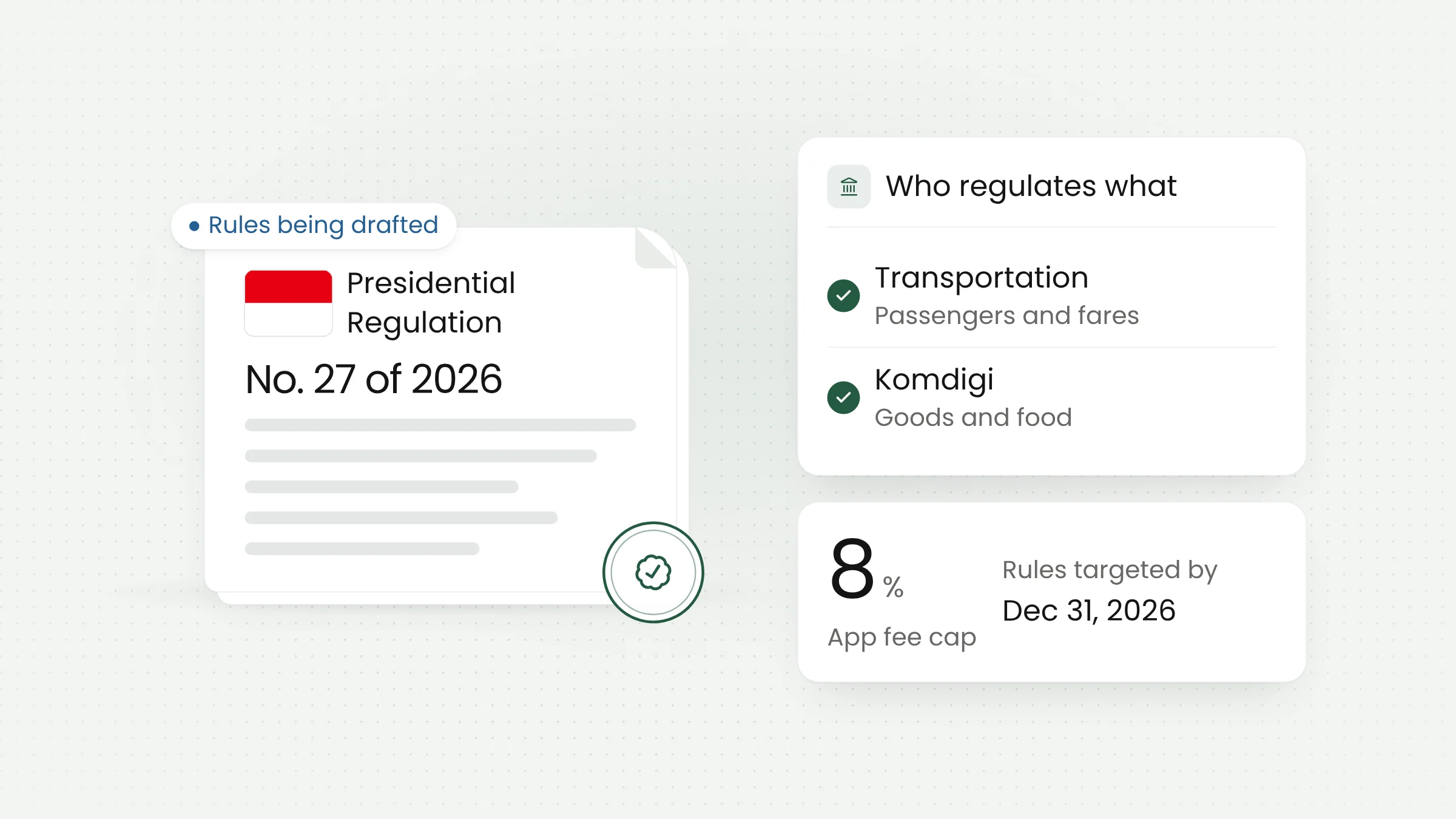
Indonesia does not apply the DSA, but it has tightened marketplace obligations through Peraturan Menteri Perdagangan Nomor 19 Tahun 2026 (Trade Minister Regulation No. 19 of 2026) on electronic-system trade, known locally as PMSE. The regulation took effect on June 8, 2026, and replaced Permendag 31/2023, according to Iqbal Shoffan Shofwan, the trade ministry’s director general of domestic trade, as quoted by Tajam.
According to CNBC Indonesia, Article 4(4) requires platforms to reject registrations from domestic sellers that do not hold a business licence. Article 4(5) sets the minimum as a trade-sector business identification number (NIB), plus compliance with product standards and technical requirements where these apply.
Sellers without a licence may still be accepted with a “Dalam Proses Legalisasi” (licensing in progress) label on their account under Article 17(3), and they have six months to complete it. After that, the marketplace must restrict their access, temporarily or permanently. At a media briefing on July 20, 2026, Iqbal said new sellers would get 6 months while existing sellers would get 18 months.
IKPI, the Indonesian tax consultants’ association, lists further obligations. Marketplaces must provide a facility that connects sellers to the government’s OSS licensing system. Foreign sellers must submit business identity details, a business licence from their home country, proof of product standards and bank account information, use Indonesian in product descriptions, and state the country of origin of their goods.
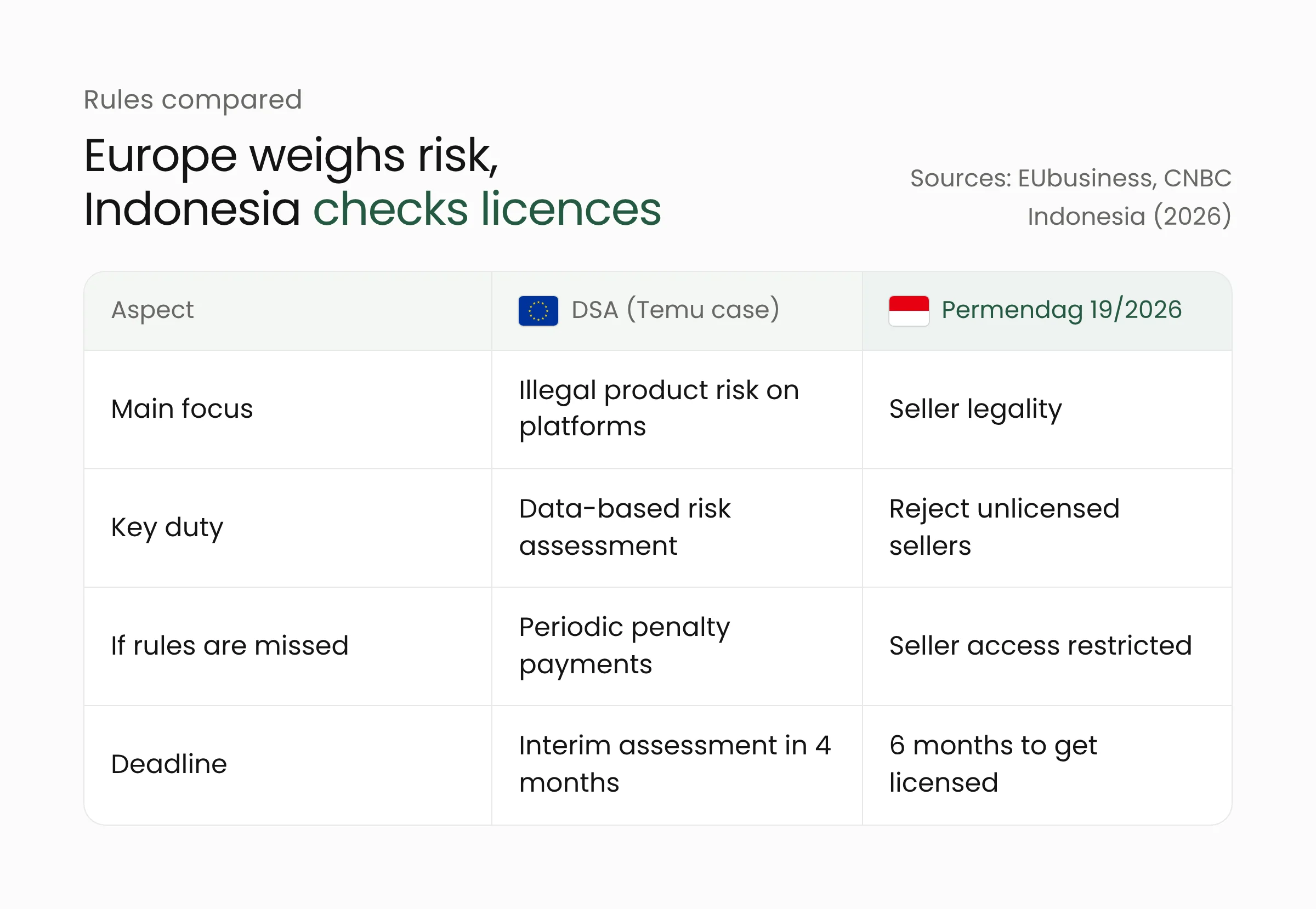
The two regimes start from different places. Permendag 19/2026 focuses on seller legality at the point of entry, while the Temu case shows the Commission assessing the whole journey of a product on the platform, including how algorithms put it in front of buyers. For teams running retail management systems and marketplaces, both point to the same need: clean, auditable data on sellers and products.
What this means for marketplaces and sellers
The Temu case shows the kind of questions a regulator may ask once it wants evidence. The following steps apply to marketplaces, brand-owned online stores and sellers in Indonesia.
For marketplace and online store operators:
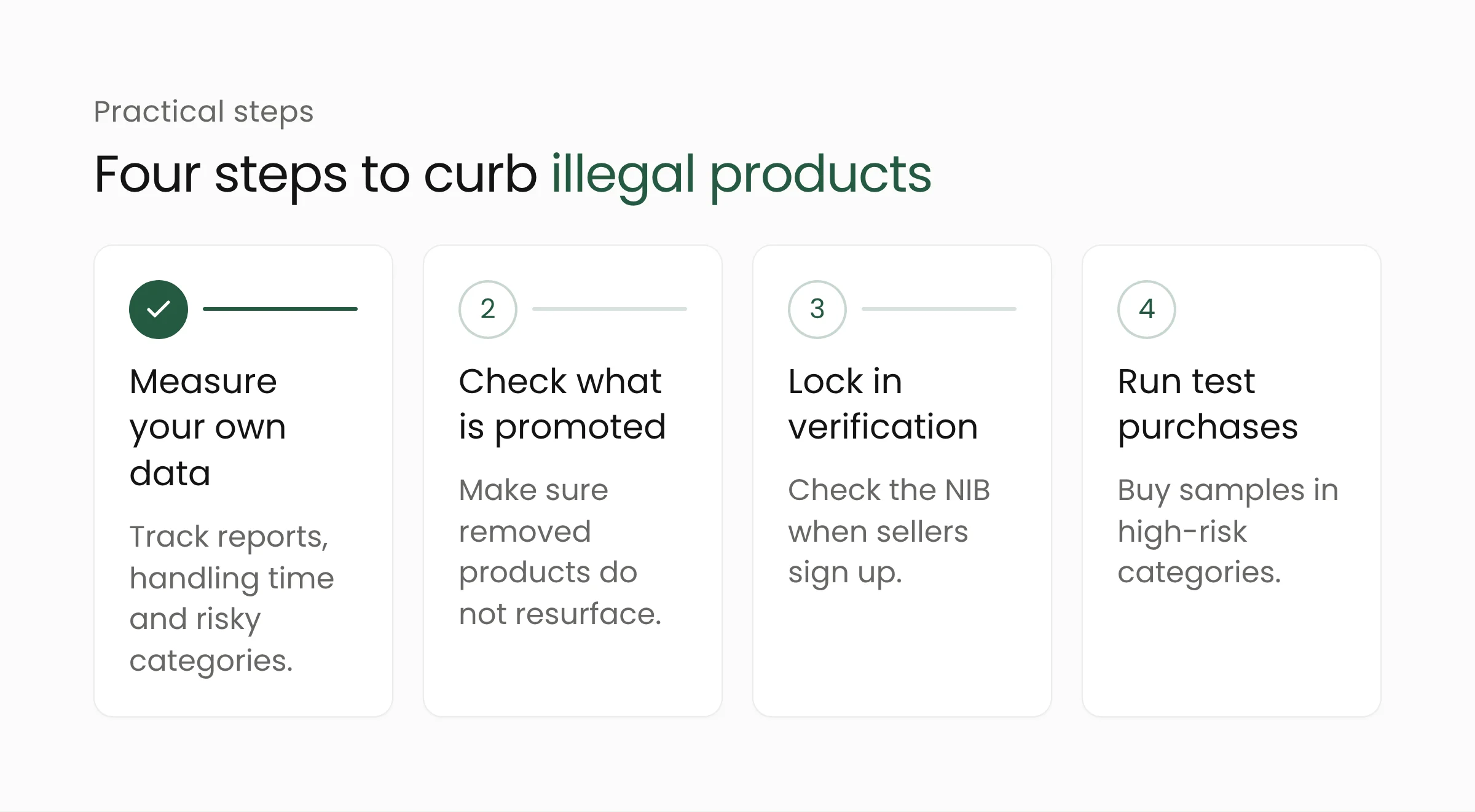
- Measure with your own platform data. Temu’s central mistake was relying on a general picture of the sector. Track the number of problem-product reports, handling times and the most-reported categories, and keep them on a monitoring dashboard that is updated regularly.
- Test recommendations and promotions. Check whether products that were taken down still appear in recommendations, ads or affiliate links. Recommendation algorithms are part of what the Commission assessed.
- Lock verification in at registration. Connect seller sign-up to NIB checks, the “licensing in progress” label and automatic reminders before the six-month window closes.
- Run your own test purchases. Mystery shopping in high-risk categories such as chargers and children’s toys gives stronger evidence than assumptions.
For sellers and brands:
- Complete a trade-sector NIB and keep proof that products meet any applicable standards.
- Make sure product descriptions match what is shipped, including the country of origin for imported goods.
- Keep supplier documents on file, since platforms under closer scrutiny tend to ask for more evidence.
Most of this is data work: bringing together seller records, buyer reports and moderation outcomes, then turning them into indicators that stand up to scrutiny. A data analytics team can help build these metrics early, before a regulator asks for them.
Platform risk is also showing up in other Indonesian rules. Indonesia’s communication and digital minister, for example, has named YouTube, Instagram and Threads as high-risk platforms for children under the PP Tunas regulation, as covered in our report on high-risk platforms for children. The logic is similar: platforms are expected to understand their own risks and prove how they handle them.
Frequently asked questions
Does Temu have to pay another fine?
The €200 million fine was imposed in May 2026. The action plan accepted on October 26, 2026, sets out the fixes that follow it. If Temu fails to implement the plan, the Commission can impose periodic penalty payments.
What is the Digital Services Act?
The Digital Services Act is the EU’s law on digital services, including marketplaces and social networks. Very large platforms must assess systemic risks on their services, such as the spread of illegal products, and take steps to reduce them.
Do sellers on Indonesian marketplaces need an NIB?
Under Permendag 19/2026, marketplaces must reject registrations from domestic sellers that lack a business licence, at minimum a trade-sector NIB. Sellers without one get a transition period, and their accounts carry a “licensing in progress” label.
Closing thoughts
Temu’s action plan shows where marketplace oversight is heading: regulators now expect evidence drawn from the platform’s own data, including how algorithms surface products. Indonesia is moving in a similar direction with Permendag 19/2026. Marketplaces and sellers that organise their seller, product and buyer-report data now will be better prepared as oversight tightens. The Merakit team is happy to talk if you want to build compliance systems and dashboards for your retail platform.
Sources
- EUbusiness: EU accepts Temu plan on illegal products following €200m fine (October 26, 2026)
- Agence Europe: European Commission accepts Temu action plan to comply with DSA (October 26, 2026)
- The Next Web: EU accepts Temu’s plan to curb illegal products after €200M fine (October 26, 2026)
- Heise: Temu must make recommendation algorithms transparent to curb illegal goods (October 26, 2026)
- EU Perspectives: No more toxic toys? Temu promises to clean up its shelves as Brussels watches (October 26, 2026)
- European Commission: Commission fines Temu €200 million under the Digital Services Act (IP/26/1178) (May 28, 2026)
- CNBC Indonesia: New e-commerce rule requires an NIB or accounts are blocked (June 10, 2026)
- IKPI: New trade regulation requires marketplaces to reject sellers without an NIB (June 18, 2026)
- Tajam: Trade ministry gives marketplace sellers an NIB transition period (July 21, 2026)