Blog AI Agents
Walmart Agent Gateway Lets AI Agents Shop Within Limits
On this page· 7 sections
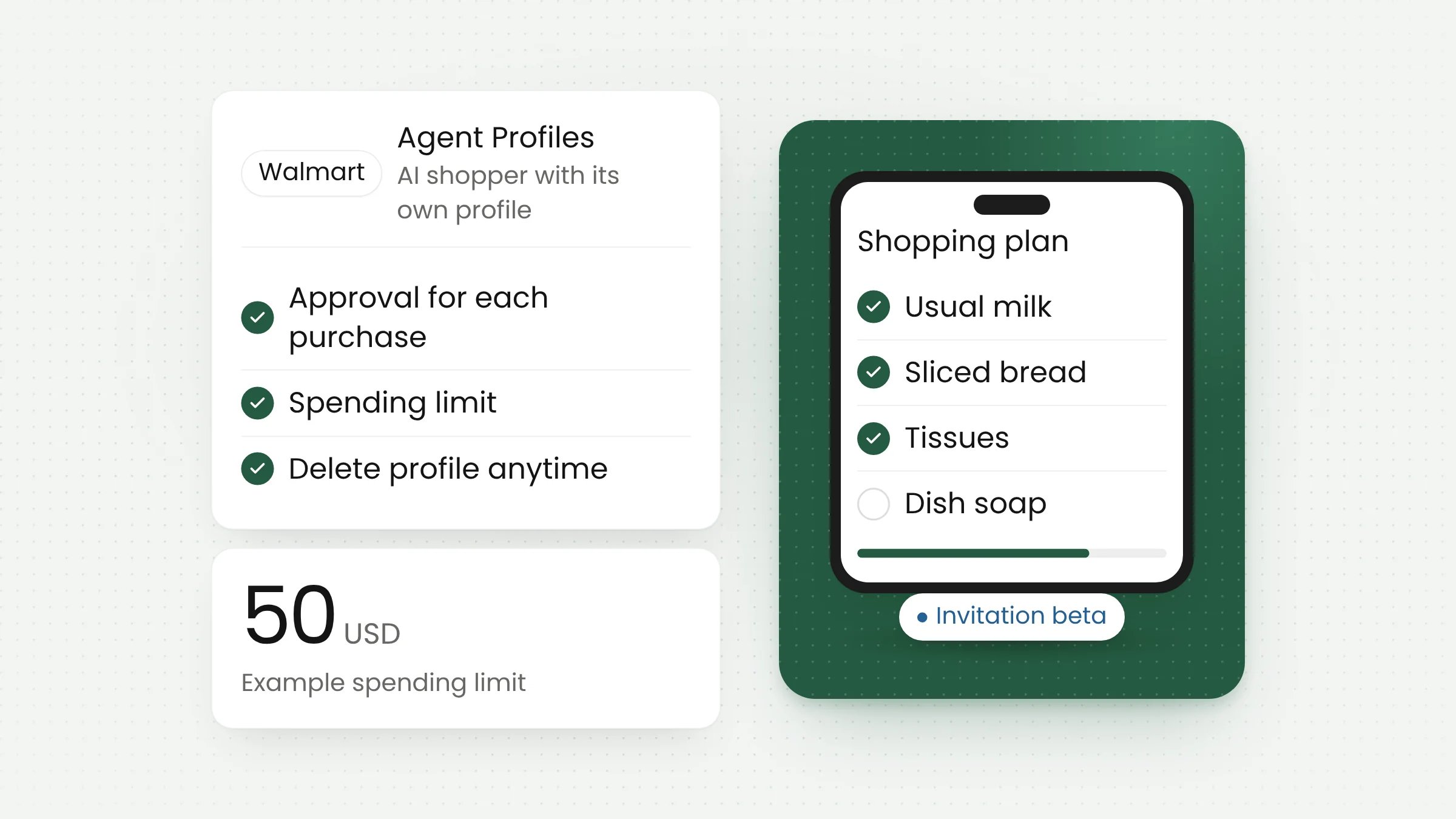
On October 21, 2026, Walmart announced the Walmart Agent Gateway, Agent Profiles and a set of terms for AI agents. Shoppers on Walmart.com and at Sam’s Club can let an agent of their choice buy for them, either with approval for each purchase or within a spending limit such as $50, $100 or $200. The Gateway is still a beta for companies and developers.
The announcement and its three parts
According to Walmart’s newsroom post, the aim is to let customers shop at Walmart and Sam’s Club through the AI agents they choose themselves. Walmart describes three components: Agent Profiles, the Walmart Agent Gateway, and terms for AI agents. Profiles set what an agent may do on a customer’s behalf, the Gateway provides the technical channel, and the terms define how agents must behave.
Agent Profiles
Each AI agent gets its own profile inside the customer’s account, so purchases made by the agent appear separately from the customer’s own. Customers can require approval for every purchase, or let the agent buy as long as the amount stays under a limit they set. Walmart’s examples are $50, $100 and $200. Customers can switch limits off and delete a profile at any time.
A profile is created automatically the first time a customer shops through an agent using the Gateway. The customer then links it by signing in to their Walmart account, and Walmart says only it can see that information. Walmart says Agent Profiles will launch in the next month, so the feature is not yet available at the time of writing.
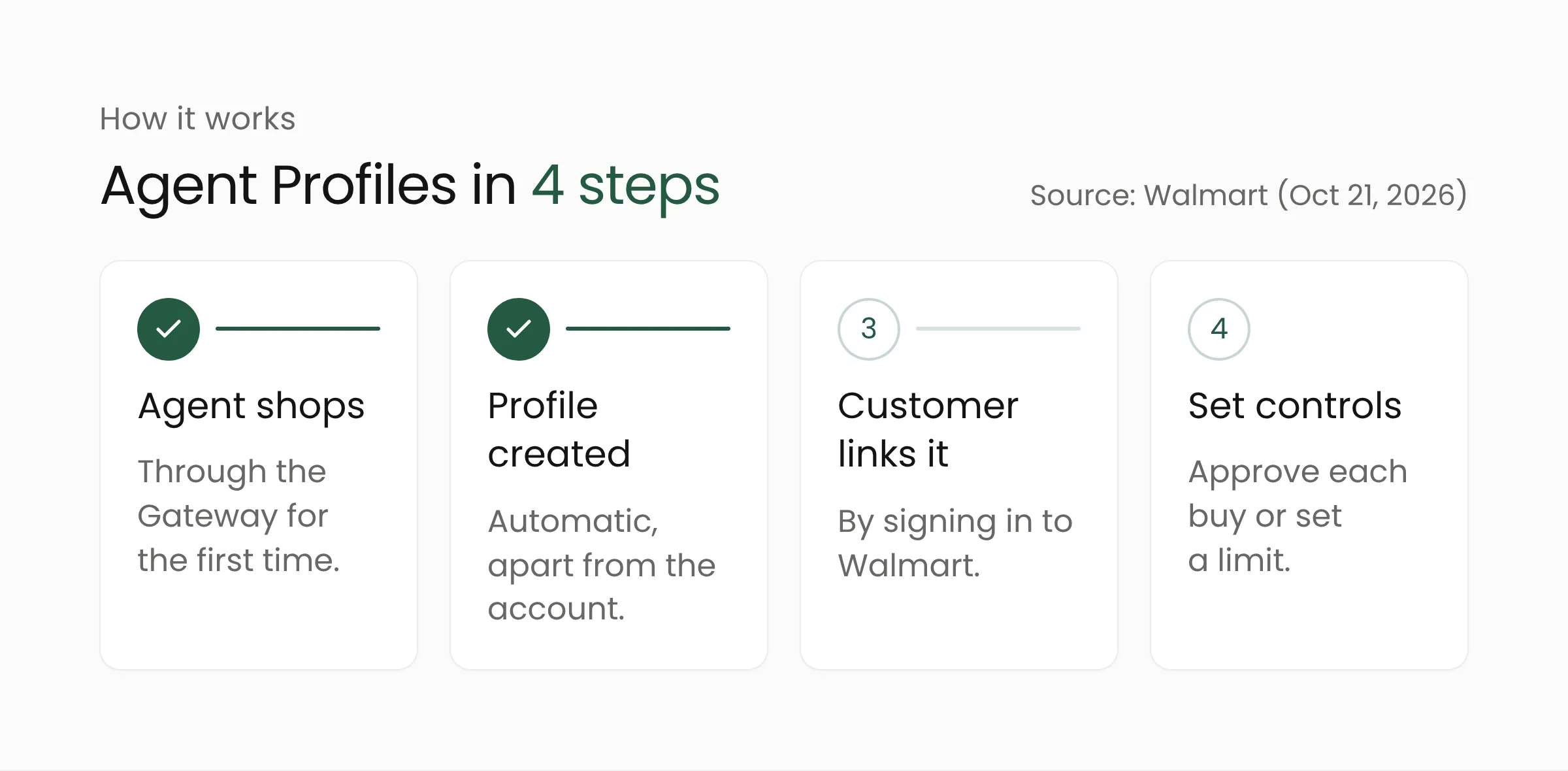
Several details remain open. PPC Land notes that Walmart does not say whether a limit applies per order, per day or per month, and the effective date of the terms is also unclear in the documents we read.
The same prices for agents
Walmart says agents see the same prices a human shopper sees on Walmart.com, with offers and fees shown before purchase. According to The Keyword, the company’s line on this is “We price products, not people.” That matters for customers who worry that an AI agent might be quoted a different price.
Agent Gateway and the rules for agents
The Walmart Agent Gateway is an MCP server, meaning a server that uses the MCP protocol so AI agents can connect to a service directly. Without a channel like this, an agent has to open the website and click through pages like a browser, which Walmart describes as slow and error-prone. With the Gateway, the agent talks to Walmart’s systems directly.
The Gateway launches as a beta for companies and developers. Based on the Gateway page quoted by The Keyword, access is by invitation only and the service can be suspended at any time. There is no general release date and no list of participating agent companies. PPC Land adds that Walmart mentions safeguards such as category restrictions and rate limits, without specifying the categories or numbers.
For items a customer buys regularly, Walmart says an agent can help reorder, for example a loaf of bread or a particular brand of milk, without receiving the customer’s wider purchase history or personal information.
Terms for AI agents
Walmart sets out several rules agents must follow.
- Purchases by agents must be approved by the customer by default. Walmart may ask for extra approval even when the amount is under the limit.
- Agents must not act beyond the shopper’s intent.
- Agents do not receive payment card details and cannot add or change payment methods.
- Agents can access only the information the task needs and the customer allows.
- The agent’s own privacy policy governs how it uses information shared with its app, while information the agent gives Walmart is handled under Walmart’s Privacy Notice.
- Walmart’s returns process still applies, including when an agent does not act as intended.
- Agents that break the terms will be blocked from Walmart’s site.
How Walmart will detect violations has not been explained, according to PPC Land.
Amazon and Shopify take different routes
The large retailers are not taking the same path. The Keyword reports that in September Amazon blocked Meta’s Muse agent from shopping on Amazon.com, saying it had never agreed to Muse operating there and that the agent did not identify itself while browsing. Walmart, by contrast, lists Muse among its existing conversational commerce integrations, and also works with ChatGPT and Gemini through its assistant, Sparky.
Shopify has chosen a third route. According to The Keyword, it opened its catalog and checkout to any agent that connects to its Shop MCP server, which offers 17 tools. The comparison shows that no single model has clearly won: some retailers close the door, some open it to everyone, and some open it with conditions.
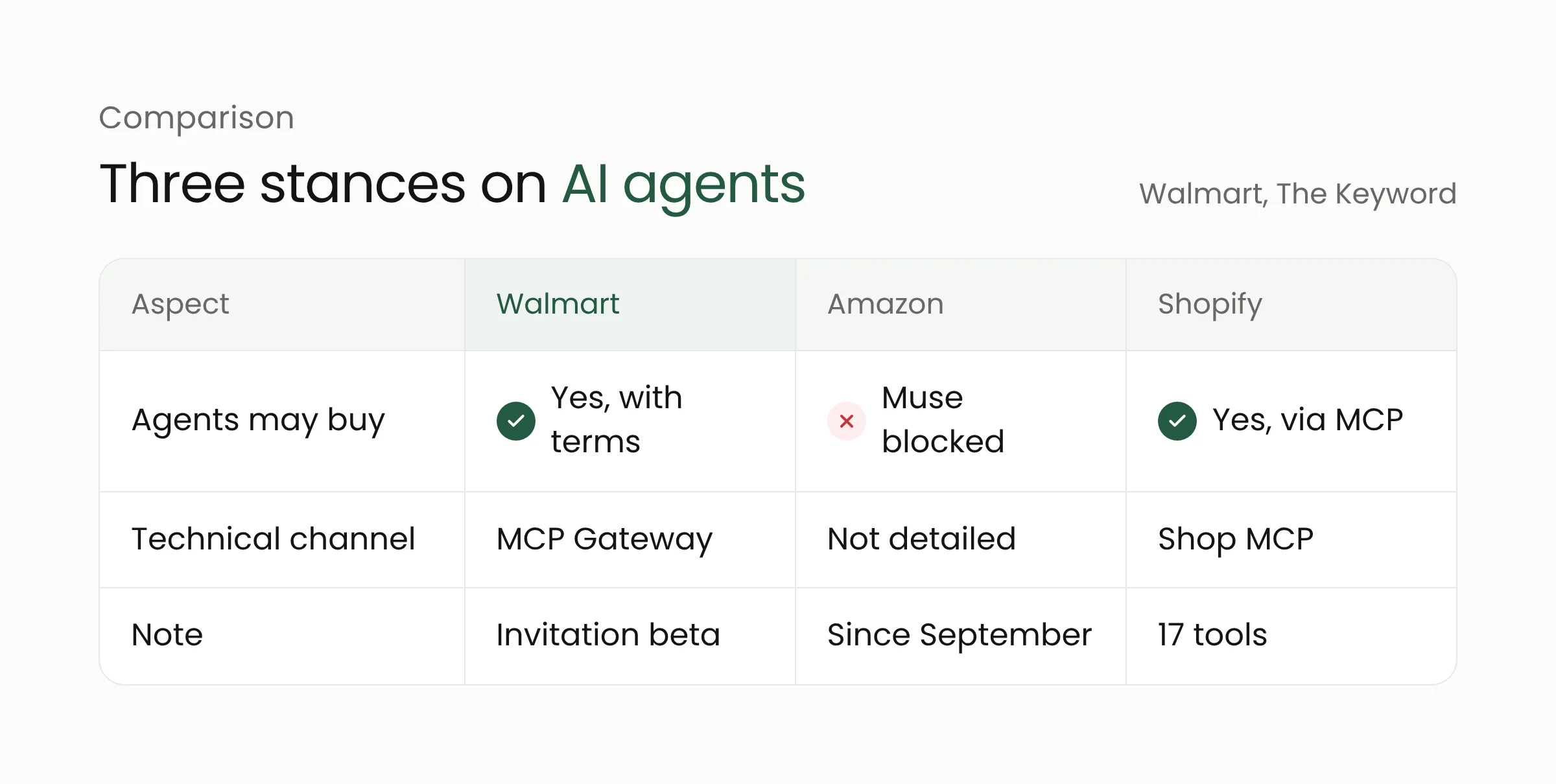
Before this announcement, Walmart moved Sparky onto ChatGPT in March 2026 after calling sales through Instant Checkout disappointing. According to PPC Land, Walmart said purchases inside ChatGPT converted three times worse than shoppers sent to its own site. The new plan keeps purchases inside an account that Walmart controls rather than inside another company’s app.
We have covered related angles before: banks in the United States and their handling of agents in our report on US banks blocking AI agents, and agent identity standards in our look at the Personal Agent Protocol.
What this means for retailers
Retailers in Indonesia may not meet AI agents as customers right away. Walmart’s approach still offers material for drafting a policy early. The questions to answer are who may transact on a customer’s behalf, up to what value, and how the customer withdraws that permission.
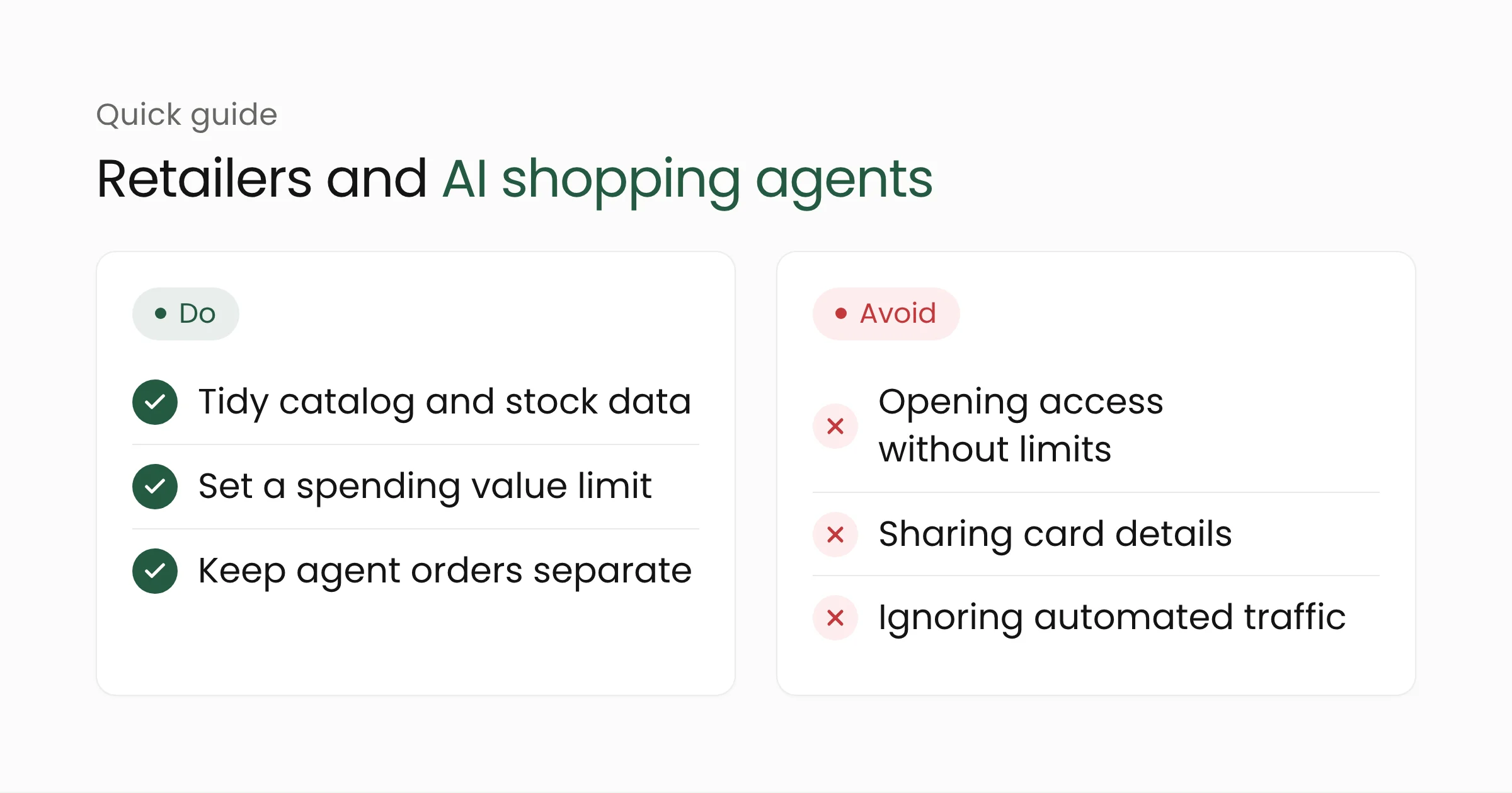
Online store owners and teams working on retail management solutions can consider the following steps.
- Tidy up catalog, price and stock data. An agent can shop only as well as the data it can read, and Walmart itself stresses identical prices for agents and humans.
- Set a maximum order value and extra approval for large or suspicious transactions, following the limits and layered approval used in Agent Profiles.
- Keep agent orders separate in your order system, as Walmart keeps agent profiles apart from customer accounts, so returns and disputes are easy to trace.
- Do not hand card details or full purchase history to agents. Walmart limits agent access to what the task needs.
- Monitor automated traffic and apply rate limits. Walmart mentions similar safeguards for its Gateway.
For technical teams, an MCP interface can become one integration point. Teams weighing an agent or an order integration can talk to us through our artificial intelligence services.
Frequently asked questions
Is the Walmart Agent Gateway available to everyone yet?
No. The Gateway is a beta for companies and developers, with access by invitation. Walmart says Agent Profiles will arrive within a month of October 21, 2026. It has not given a general release date for the Gateway.
Can an AI agent see my payment card number?
No. Walmart’s terms say agents do not receive payment card information and cannot add or change payment methods. Customers link an agent profile by signing in to their own Walmart account.
What spending limit can I set?
Walmart gives $50, $100 and $200 as examples. Customers can also choose approval for each purchase, and Walmart may require extra approval even when a purchase is under the limit.
Closing thoughts
Walmart is trying to govern AI shopping agents through profiles, spending limits and clear terms, while Amazon and Shopify pick different directions. Retailers that start preparing catalog data and transaction policy now will be readier when automated buyers arrive. If you are designing a similar integration, the Merakit team can help map the requirements.