Blog Child Online Safety
Indonesia Rates YouTube High Risk for Kids: What Schools Do
On this page· 8 sections
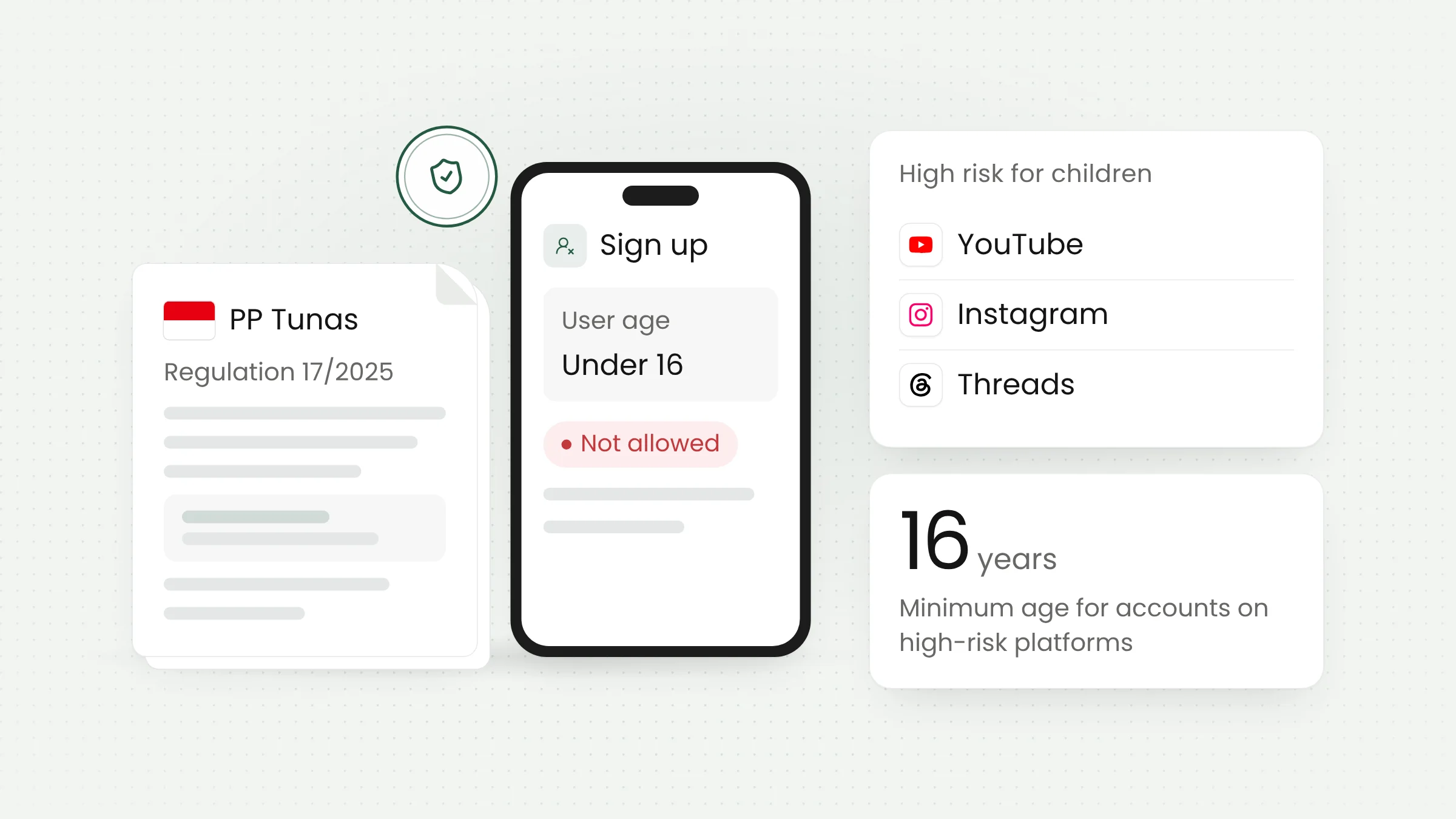
Indonesia’s Minister of Communication and Digital Affairs, Meutya Hafid, said YouTube, Instagram, and Threads are high-risk platforms for children under the country’s child online protection rules, known as PP Tunas. Children under 16 may not hold accounts on such services. For schools, the statement reaches into daily routines: video assignments, school channels, and class groups.
The minister’s statement on October 26, 2026
Meutya made the assessment at a public discussion titled “Darurat Perundungan di Sekolah” (a school bullying emergency), hosted by Kosgoro 1957 at the parliament complex in Senayan, Jakarta, on Monday, October 26, 2026. According to Okezone, she said, “Platform YouTube kita anggap berisiko tinggi, berarti tidak boleh untuk anak-anak,” meaning the ministry considers YouTube high risk and therefore off limits to children.
The same assessment applies to every platform in the Meta group, including Instagram and Threads. Meutya added that the status can change. A platform that redesigns its service to be child friendly can have its risk level lowered, at which point children may use it again.
Detik reported that Meutya wants platforms to assess their own risk and display age labels similar to film ratings, such as content for viewers 17 and over or content for children. Platforms are also expected to apply settings and age verification. She said platforms had long treated their services as safe for users aged 13 and up.
A different path from Australia
Meutya contrasted the policy with Australia, which names specific social media services as banned for children. Indonesia instead rates the risk of each platform and restricts children’s access based on that rating. According to Suara.com, she put the number of Indonesian children under 16 at about 70 million.
Seven risk criteria
The assessment uses seven criteria drawn up with experts, academics, and doctors. Suara.com listed them as follows:
- Content: material that is inappropriate for children.
- Contact: features that let children interact with strangers, such as direct messages.
- Addiction: design elements that may drive compulsive use.
- Commercialization: commercial practices involving children.
- Mental health: potential psychological harm.
- Physical condition: effects of overuse, for example on the eyes.
- Data security: protection of children’s personal data.
These criteria matter to anyone building services for children. A learning app with user-to-user chat, for example, immediately touches the contact and data security criteria.
Age limits under PP Tunas
PP Tunas is the short name for Government Regulation No. 17 of 2025 on the governance of electronic systems for child protection (Peraturan Pemerintah Nomor 17 Tahun 2025 tentang Tata Kelola Penyelenggaraan Sistem Elektronik dalam Pelindungan Anak). It was signed on March 27, 2025, and phased in from March 28, 2026. Technical rules on age limits, age verification, and service risk assessment sit in Ministerial Regulation No. 9 of 2026 (Peraturan Menteri Komunikasi dan Digital Nomor 9 Tahun 2026).
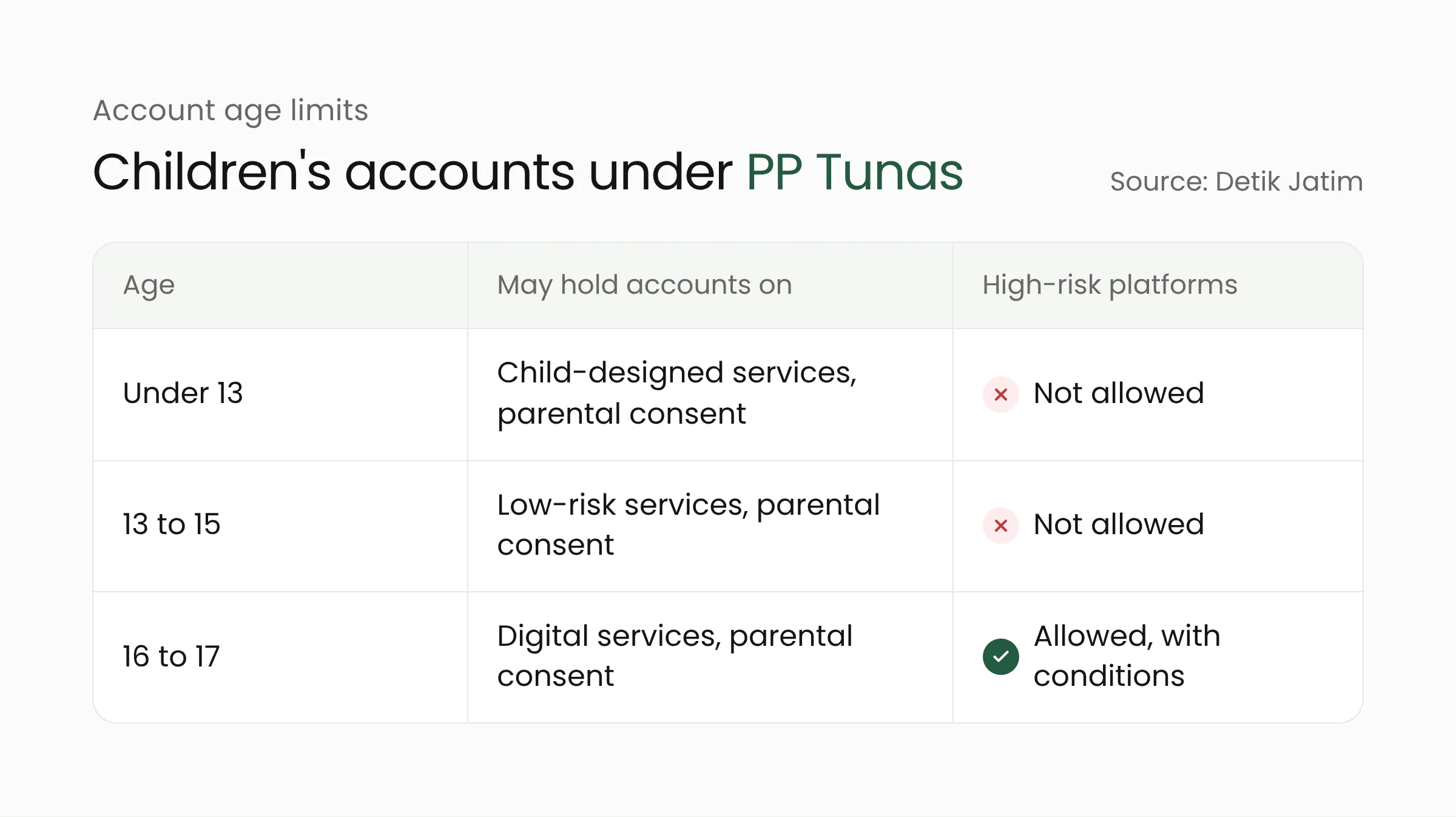
According to an explainer from Detik Jatim, PP Tunas defines a child as anyone under 18. For services that require an account, the rules split by age:
- Under 13: accounts only on products or features designed for children with a low risk profile, with consent from a parent or guardian.
- 13 to 15: accounts only on low-risk services, with parental consent.
- 16 to 17: accounts with parental consent, including on high-risk services if age and other requirements are met.
The regulation does not ban children from the internet. It governs account ownership by age and by the risk level of each service. Platform operators, in turn, must assess the risk of their products and features and provide age verification, parental oversight tools, and channels for reporting content that harms children.
Results after six months
The government has published several progress reviews. In its October 7, 2026 evaluation, Okezone reported that TikTok had deactivated 9 million accounts of users under 16, up from more than 4 million in its previous report. Meta blocked 85,000 Instagram accounts and 99,000 Facebook accounts belonging to children under 16 and moved 22.5 million child accounts into Teen Accounts.
A month earlier, Katadata reported that the ministry had assessed 60 platforms as of September 6, 2026, rating 22 as high risk and 38 as low risk. YouTube had reported action against more than 600,000 child accounts in April 2026, but the ministry said many children could still reach the platform. Roblox drew praise for age checks that include facial age estimation and for removing chat with unknown users on child accounts.
Administrative sanctions are tiered, from written warnings and administrative fines to cutting off access to specific features or an entire service. Platforms that have not finished their self-assessment by the end of 2026 may have their risk profile set by the government.
What this means for schools
Many Indonesian schools use YouTube and Instagram for lessons and publicity. Junior high students and some first-year senior high students are still under 16, so these habits deserve a second look. The following steps can start this week.
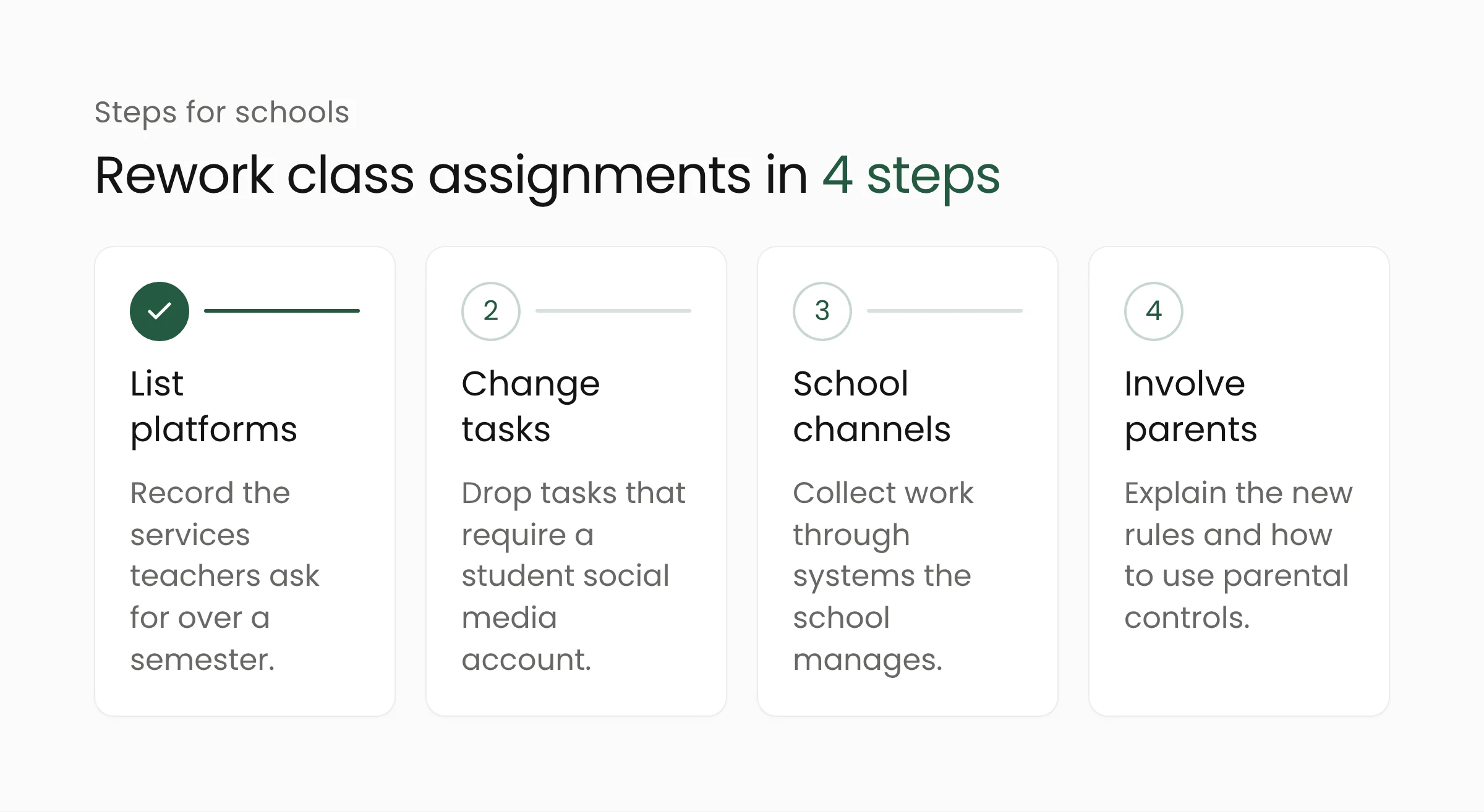
1. List the platforms in use. Record the apps and services teachers ask students to use over a semester: where assignments are submitted, class groups, extracurricular accounts, and school channels. Flag the ones that require students to hold their own account.
2. Change assignments that require an account. Tasks such as “upload a video to YouTube and send the link” or “post your work on Instagram and tag the school” require students under 16 to hold accounts on high-risk platforms. Replace them with file submissions that do not depend on a student’s social media account.
3. Move submissions to school channels. A school’s own learning system, school-managed file storage, or an assignment portal limited to the school community is easier to supervise. The best work can still be published through an official school account run by teachers, with parental consent for every student face and name shown.
4. Involve parents. Explain the new classroom rules through a letter or a parents’ meeting. Include how to turn on parental controls on a child’s phone, such as Google Family Link on Android or Screen Time on iPhone, along with YouTube’s supervised experience.
When a school or education office runs its own app
Schools, foundations, and education offices that run learning apps for students should review their features against the seven criteria. Student-to-student chat, public profiles, and personal data collection deserve the closest look. Teams building education technology solutions can design age settings, parental consent, and limits on contact between users from day one.
The same applies to developers of apps for children. Age verification, parental controls, and content reporting are operator duties described in explanations of PP Tunas. They belong in the design stage of mobile app development, since adding them after thousands of students already use an app is far harder.
The issue also connects with the AI rules for schools that the government is preparing, which we covered in our article on sector-specific AI guidelines and child protection.
Frequently asked questions
Are children under 16 banned from watching YouTube?
The age rules in PP Tunas govern account ownership on services that require registration. Meutya said high-risk platforms are off limits to children, but news reports have not detailed how this applies to viewers without an account. YouTube itself offers YouTube Kids and a supervised experience for age-appropriate use.
Is a high-risk rating permanent?
No. Meutya said a platform that becomes child friendly can have its risk level lowered so that children can use it again. The rating relies on seven criteria, from content and contact with strangers to data security.
What happens to platforms that do not comply?
Administrative sanctions are tiered: written warnings, administrative fines, and access cut-offs for specific features or the whole service. The ministry reviews compliance regularly, most recently on October 7, 2026.
Conclusion
Rating YouTube, Instagram, and Threads as high risk shows that PP Tunas now reaches the platforms most often used in classrooms. Schools do not need to wait for further rules to rethink assignments, publishing channels, and communication with parents. If your school or education office is preparing a learning platform that keeps students safe, the Merakit team is ready to help you design it.
Sources
- Menkomdigi Sebut YouTube dan Instagram Platform Berisiko Tinggi untuk Anak, Ini Alasannya, Okezone, October 26, 2026
- Menkomdigi: Instagram, Threads hingga YouTube Berisiko Tinggi untuk Anak, Detik, October 26, 2026
- YouTube hingga Instagram Dinilai Berisiko Tinggi, Kemenkomdigi Batasi Akses Anak, Suara.com, October 26, 2026
- Menkomdigi Sebut Instagram hingga YouTube Berisiko Tinggi untuk Anak-anak, Ini Alasannya, IDX Channel, October 26, 2026
- PP TUNAS: Batas Usia Anak di Ruang Digital dan yang Perlu Diketahui Orang Tua, Detik Jatim, October 25, 2026
- Implementasi PP Tunas, Menkomdigi: TikTok Nonaktifkan 9 Juta Akun Anak, Okezone, October 7, 2026
- PP Tunas Sudah Berlaku Enam Bulan, Komdigi Menilai X hingga TikTok Belum Patuh, Katadata, September 14, 2026