Blog Ride-Hailing Regulation
Indonesia Ride-Hailing Rules: 8% App Fee Cap Explained
On this page· 7 sections
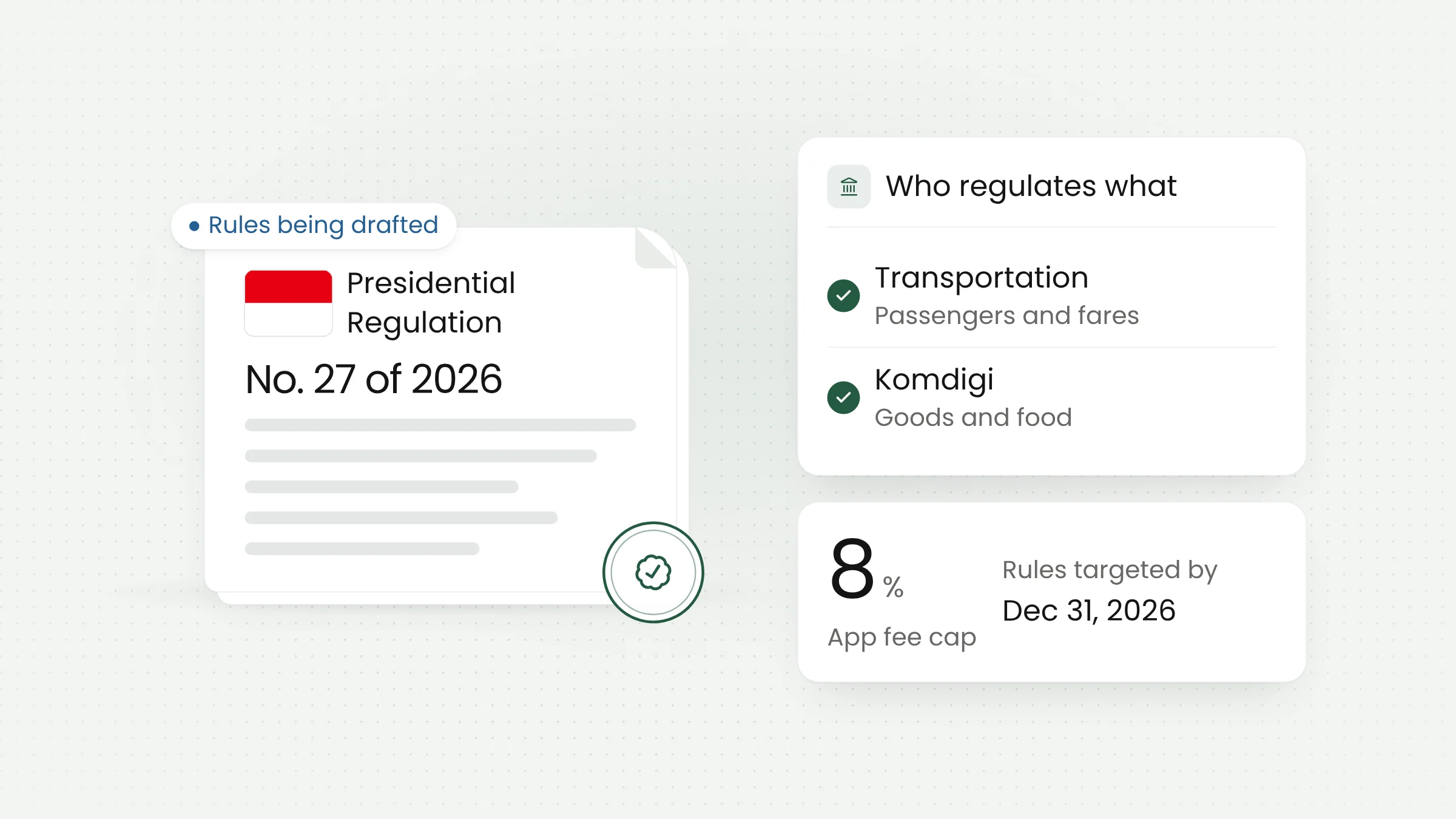
Indonesia issued Presidential Regulation No. 27 of 2026 on the Protection of the Digital Platform-Based Transportation Ecosystem on October 8, 2026. The rule covers passenger transport as well as goods and food delivery, and the Ministry of Transportation says it caps app fees at 8%. Implementing rules are targeted for release before December 31, 2026.
Core provisions and who regulates what
According to Warta Ekonomi, the regulation was issued on Thursday, October 8, 2026. The Ministry of Transportation, in its official statement, lists fairness, safety, transparency, and sustainability as its principles. Hukumonline describes the scope: partnership relations, safety standards, the division of authority among ministries, app fee limits, and social protection and taxation for partner drivers.
Deputy State Secretary Bambang Eko Suhariyanto explained the division of authority, as quoted by Hukumonline. The Ministry of Transportation handles passenger transport and its fares, while the Ministry of Communication and Digital (Komdigi) handles goods and food delivery. The split was designed to avoid overlapping authority.
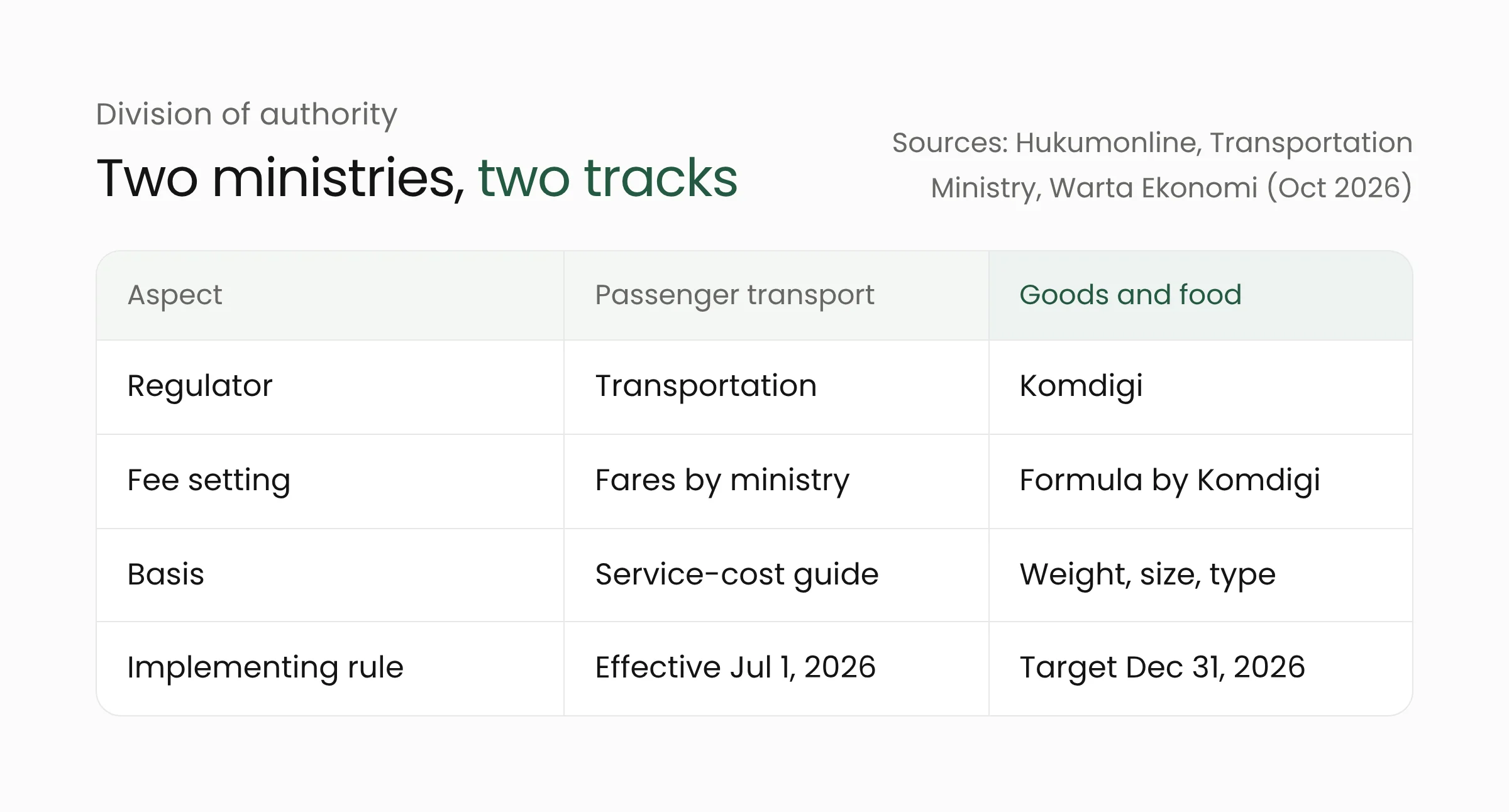
The Transportation Ministry adds that the Minister of Micro, Small and Medium Enterprises, Maman Abdurrahman, oversees partnership agreements between drivers and app companies, according to House Deputy Speaker Sufmi Dasco Ahmad. Hukumonline reports that a forum chaired by the SME minister, together with the Transportation Ministry and Komdigi, will keep the implementing rules aligned. Warta Ekonomi calls it a joint secretariat.
The rule is broad because it touches three parties at once: drivers, app companies, and customers. For readers in technology, the most important part is the set of duties that require changes to systems, such as fee information, receipts, and service records.
Hukumonline also describes the regulation as legal certainty for two-wheeler ride-hailing drivers, whose status was previously unclear. Transportation Minister Dudy made a similar point in the ministry’s statement.
App fees and driver rights
The cap on the app service fee is 8%. The Transportation Ministry says the cap appears in both a ministerial decision and the regulation. The ministerial decision took effect on July 1, 2026 and governs passenger transport on digital platforms. Minister Dudy said the 8% limit answers drivers’ expectations.
As a simple worked example of our own, not data from the sources: if a transaction is worth Rp100,000, an 8% cap means the app fee cannot exceed Rp8,000. How the transaction value is calculated for goods and food delivery will depend on the formula Komdigi prepares, so this example may not hold equally for every service.
The relationship between drivers and app companies is set out in a Platform Partnership Agreement. According to the ministry, the document must be clear, fair, transparent, and easy to understand. It covers rights and duties, the cost structure, incentives, social security, access to transaction data, algorithm-based automated systems, and complaint and dispute mechanisms.
Drivers also gain the right to transparent fee information, personal data protection, and an explanation of algorithm-based automated systems. Further rights include a complaint mechanism and at least health, work-accident, and death insurance under prevailing law. An algorithm here means the automated rules that decide, for example, which orders are offered to a driver.
On the consumer side, app companies must provide a complaint center that is easy to reach, responsive, transparent, and documented. Companies must respond to complaints no later than seven days after receiving them.
Delivery price transparency and the adjustment period
Komdigi is preparing implementing rules for goods and food delivery. Deputy Minister Nezar Patria spoke after a coordination meeting on following up the regulation at the Parliament Complex in Jakarta on October 8, 2026. According to Suara.com, Article 11(4) tasks Komdigi with setting delivery service fees for goods and food.
Nezar said the rules will explain delivery guarantees and how platforms form their prices. The details will appear in a Komdigi ministerial regulation. The fee scheme and the transparency mechanism have not yet been detailed, and the government is still running simulations.
Warta Ekonomi reports that the rule will include a fee calculation formula that takes weight, dimensions, and type of goods into account. Nezar also noted that delivering goods costs differently from delivering food. The rule will not set detailed minimum and maximum tariffs. Minister Dudy said the fares set by the Transportation Ministry will serve as a reference for Komdigi.
Six months to adjust systems
According to the Transportation Ministry, app companies and drivers have six months from when the provisions take effect to adjust four things: partnership agreements, fee and income information systems, transaction receipts, and service records. All implementing rules are targeted for completion before December 31, 2026.
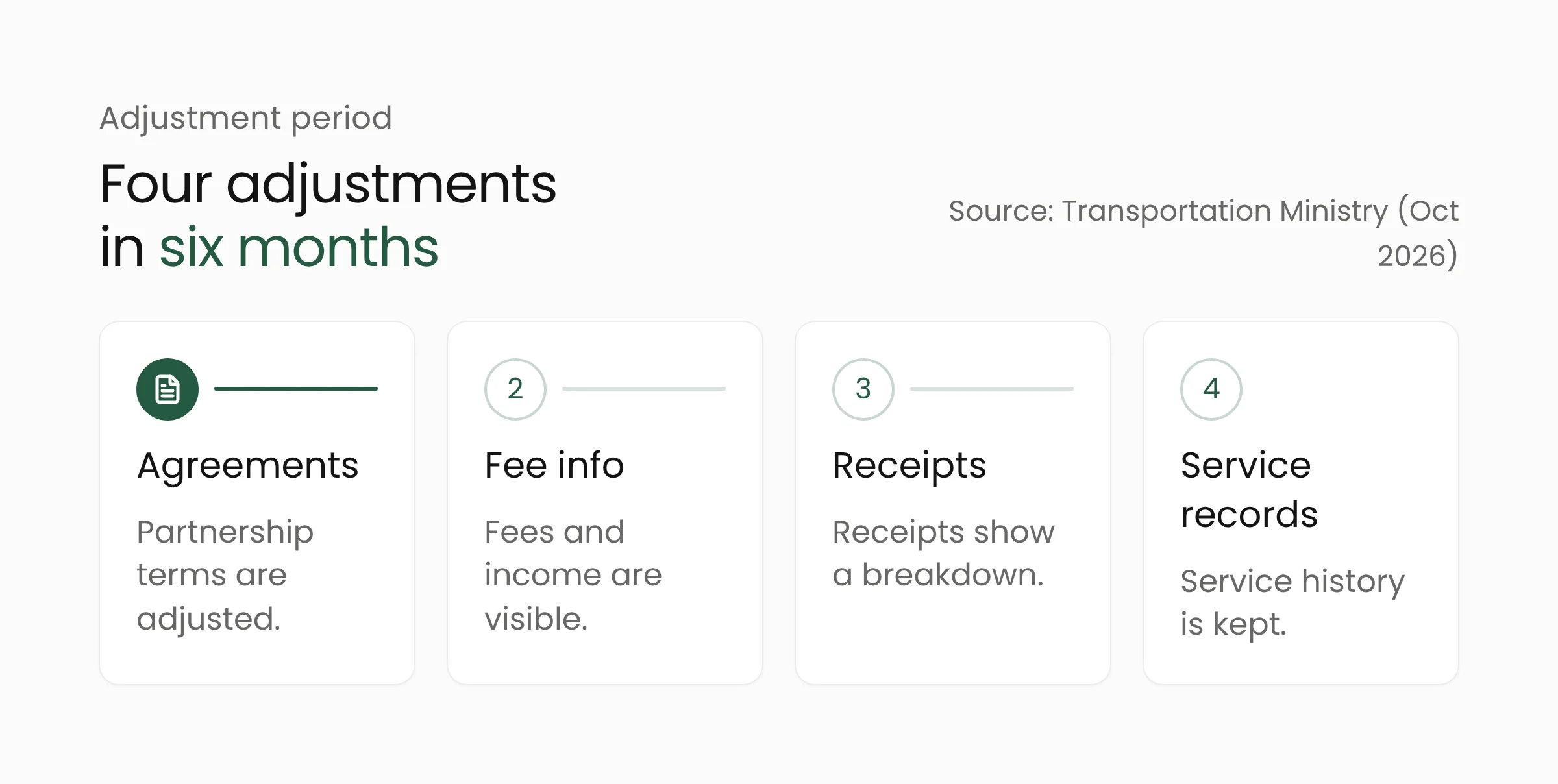
The four sources reviewed do not include the full regulation text. Article numbers other than Article 11(4) could not be verified, and the fee charged to merchants has not been stated. Suara.com notes that commission percentages and merchant-specific rules do not appear in its report.
What this means for retail businesses and app providers
Shops, restaurants, and small businesses that sell through delivery apps should follow the Komdigi ministerial regulation. It will determine how delivery fees are formed and explained to customers. Before the rule is final, owners can start recording delivery fees and platform deductions for each order, then ask the platforms they use for those breakdowns.
App providers, including businesses that run their own delivery fleets, should read the full regulation and its implementing rules to confirm whether these duties apply to their service. If they do, the four six-month adjustments are concrete system work: receipts that itemize fees, an earnings dashboard for partners, well-kept service records, and a complaint channel with a seven-day deadline counter.
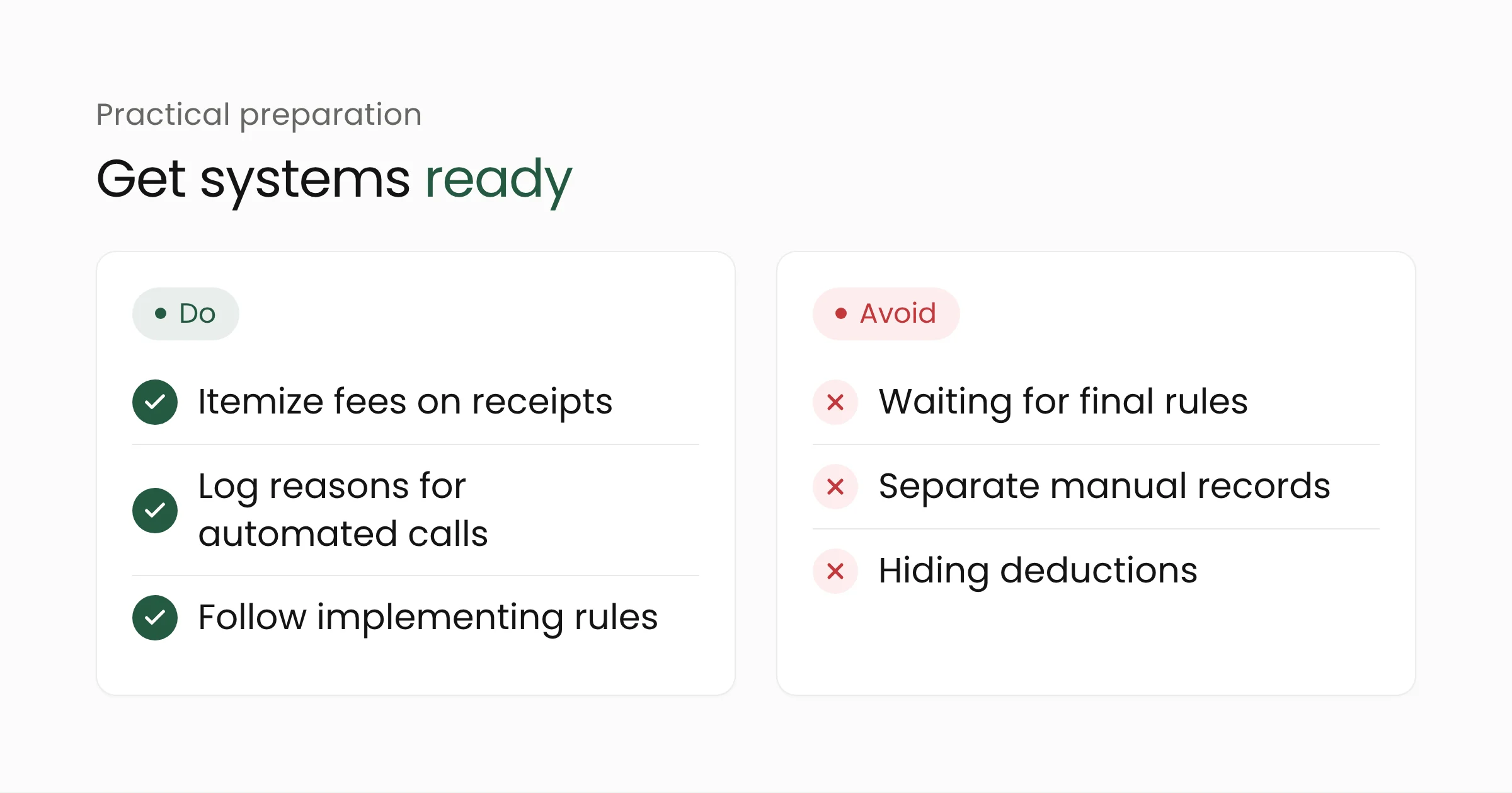
These implementation examples are our own suggestions for consideration and are not duties named by the sources. Explaining an algorithm, for instance, requires a system that records the reason behind automated decisions, which is easier to build from the start than to add later. Local government offices that oversee similar services can also use well-kept transaction records to check compliance.
For technical planning, see our mobile app development and web development services, along with our retail management and digital government solutions.
Frequently asked questions
What is the app fee cap under the ride-hailing regulation?
The Transportation Ministry says the app service fee is capped at 8%, and the cap appears in a ministerial decision and in the regulation. The ministerial decision took effect on July 1, 2026 for passenger transport. The reports reviewed do not detail a figure for goods and food delivery.
When will the implementing rules for Regulation 27/2026 be issued?
The government targets completing all implementing rules before December 31, 2026. App companies and drivers have six months from when the provisions take effect to adjust agreements, fee and income information systems, receipts, and service records.
Who sets food delivery fees?
Komdigi is responsible for setting fees for goods and food delivery, according to Deputy Minister Nezar Patria. Passenger transport fares remain with the Transportation Ministry. Komdigi will provide a calculation formula without detailed minimum and maximum tariffs.
Conclusion
Regulation 27/2026 moves part of the work from the meeting room into systems: fees must be explainable, records must be orderly, and complaints must be handled on time. The most important details, especially the delivery fee rules, will only become clear once the ministerial regulation is issued. If your organization is preparing an app or a transaction recording system, Merakit Indonesia can help map the requirements.
Sources
- Suara.com, October 9, 2026: Komdigi prepares pricing rules for GoFood and goods delivery
- Ministry of Transportation, October 10, 2026: Government issues Presidential Regulation No. 27 of 2026
- Hukumonline, October 10, 2026: Presidential Regulation 27/2026 governs ride-hailing partnerships and application fees
- Warta Ekonomi, October 13, 2026: Komdigi prepares ride-hailing delivery fee formula