Blog Education Technology
UCL Moves Coursework Off Turnitin Over AI Training Terms
On this page· 7 sections
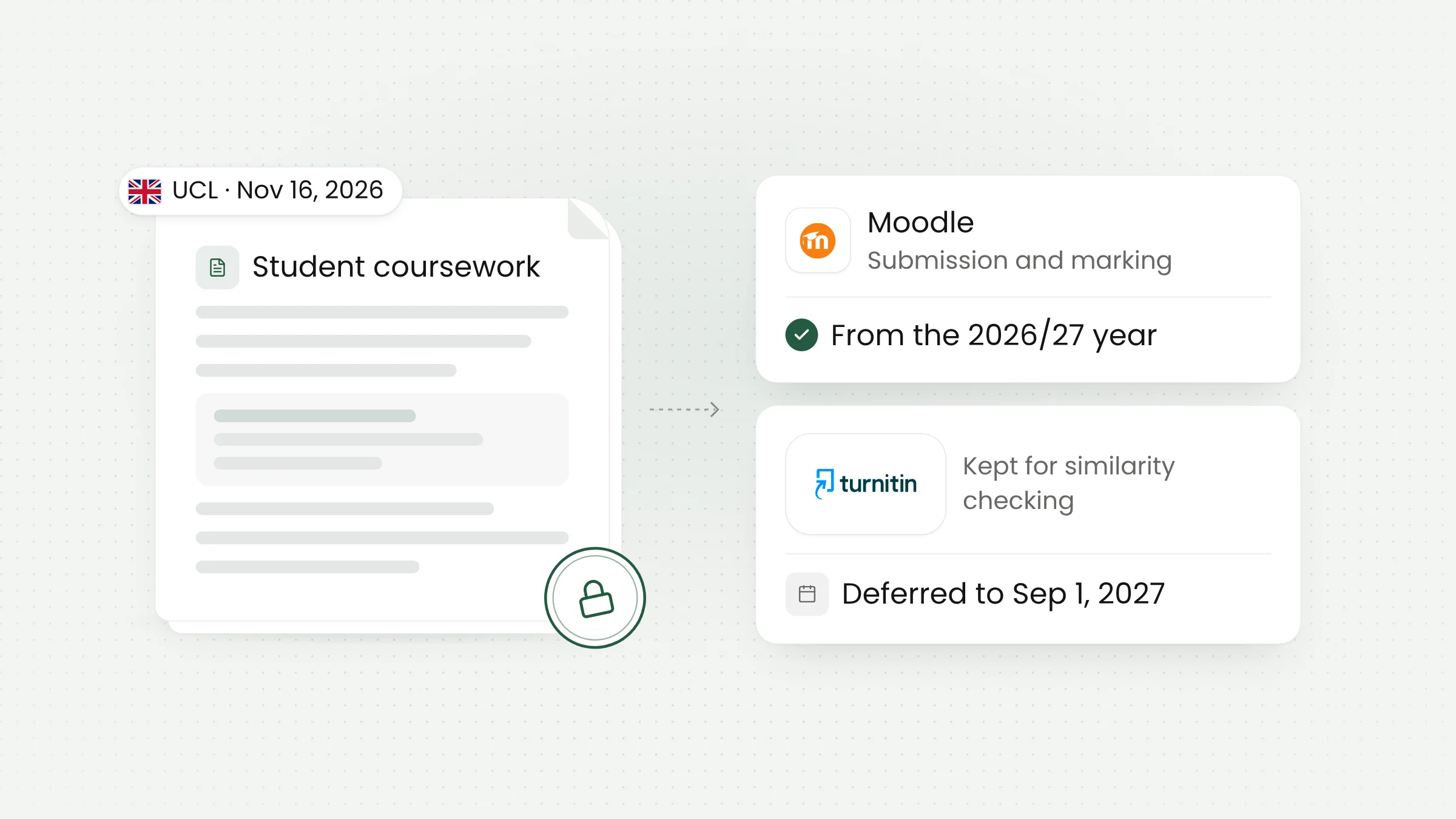
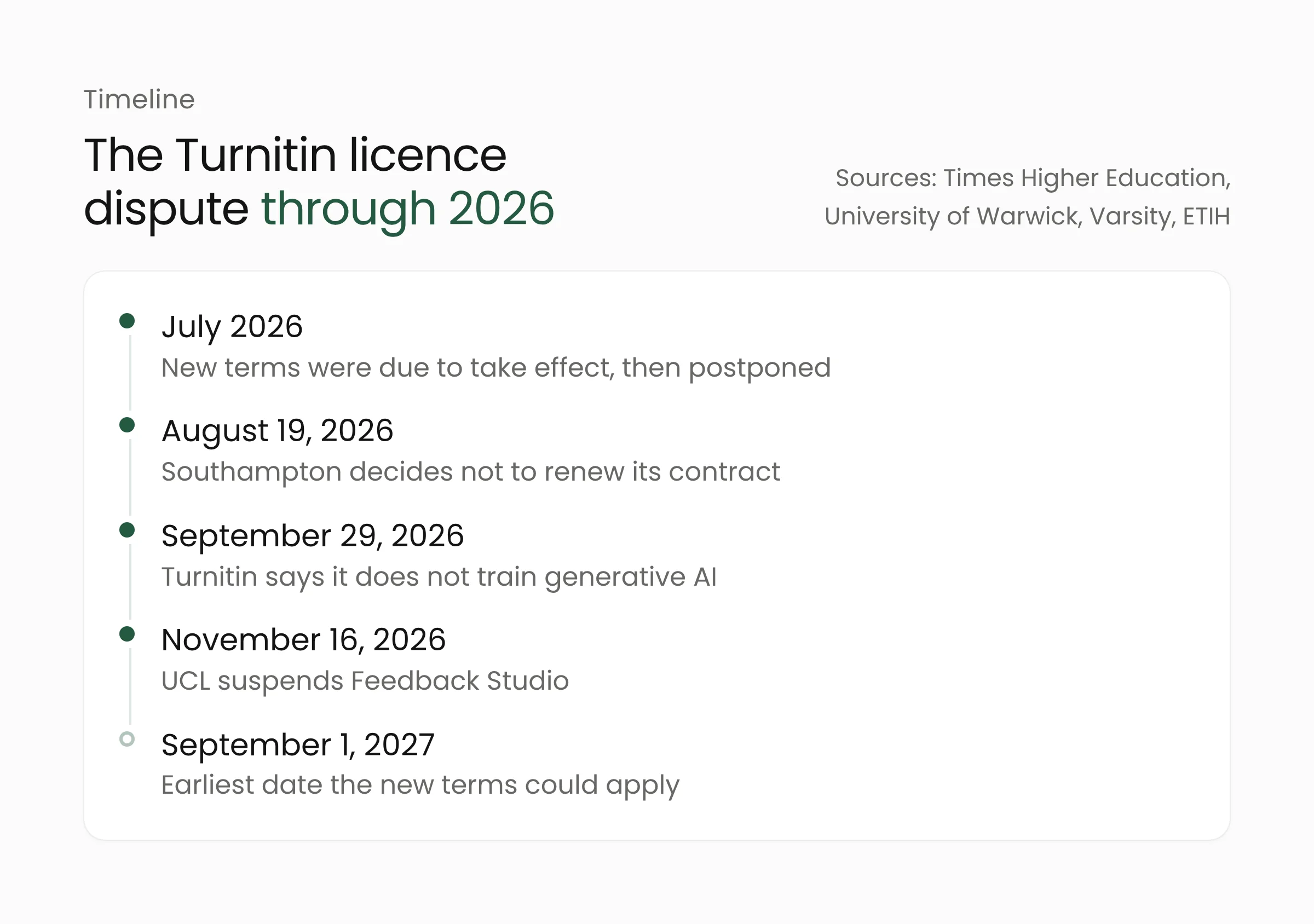
University College London (UCL) has suspended Turnitin Feedback Studio as its tool for coursework submission and marking. The decision, announced on November 16, 2026, follows Turnitin’s proposal to change its licence terms in a way that UCL says could allow student work to train AI systems. Coursework now goes through Moodle.
UCL suspends Turnitin Feedback Studio
Turnitin is best known as the text similarity checker universities use to detect plagiarism. At many institutions its role is wider. Through the Feedback Studio product, students upload assignments, staff read and grade them, and every file sits in Turnitin’s systems.
According to EdTech Innovation Hub, UCL announced on November 16, 2026 that it would suspend Feedback Studio for both tasks. Most affected assessments will be submitted through Moodle Assignment or Moodle Coursework. Moodle is the open source learning management system UCL already runs for teaching.
Times Higher Education (THE) reported that the change will be phased in during the 2026/27 academic year. UCL’s reasoning is that the current licence terms protect student submissions until September 1, 2027, while Turnitin’s approach after that date is uncertain. The university also said it would not support licence changes that allow student data to be used that way in future.
Turnitin is not leaving UCL altogether. Students’ Union UCL explained that similarity checking continues, including for work submitted through Moodle. UCL says work sent for similarity checking is not used to train generative AI models, and the university does not use Turnitin’s AI writing detection.
The licence proposal that drew objections
The dispute started with the End User Licence Agreement (EULA), the terms every user accepts when using Turnitin. According to the University of Warwick, Turnitin notified UK universities in late June 2026 of EULA changes due to take effect on July 7. The University of Sussex records a different date, July 14.
The substance was reported by the University Times, the student newspaper at Trinity College Dublin. Turnitin would be permitted to use submissions, in aggregated, anonymised, or de-identified form, to improve and develop AI tools and other products and features.
Universities and UCISA, the UK association for higher education IT, raised concerns. Turnitin then postponed the change. Sussex notes that on July 23 Turnitin confirmed there would be no EULA updates during the 2026/27 academic year. The company later said the new EULA was postponed until September 2027 and would be redrafted with UCISA.
What Turnitin says
Turnitin denies that student work is used to build generative AI. In a September 29, 2026 statement quoted by Warwick, the company wrote: “no student or staff data has been used to develop any generative artificial intelligence (AI) models.” It also said it has no plans to use student essays in that way.
What Turnitin does acknowledge is a different use. According to EdTech Innovation Hub, the company may use anonymised submissions to train its AI writing classifier, a model that estimates whether a text was written by AI. That applies when an institution has AI detection enabled.
In an interview with THE on November 13, Turnitin chief executive Chris Caren conceded the company had erred by not giving customers enough time to review the new agreement. He said about 100 customers raised concerns, around 90 of them UK institutions. Caren put Turnitin’s customer base at 16,000 worldwide.
Caren also argued that some universities walked away because of budget pressure, with the licence dispute only one factor. The University of Southampton said cost-cutting played no part in its decision.
How other UK universities responded
UCL chose a middle path. Several other universities went further.
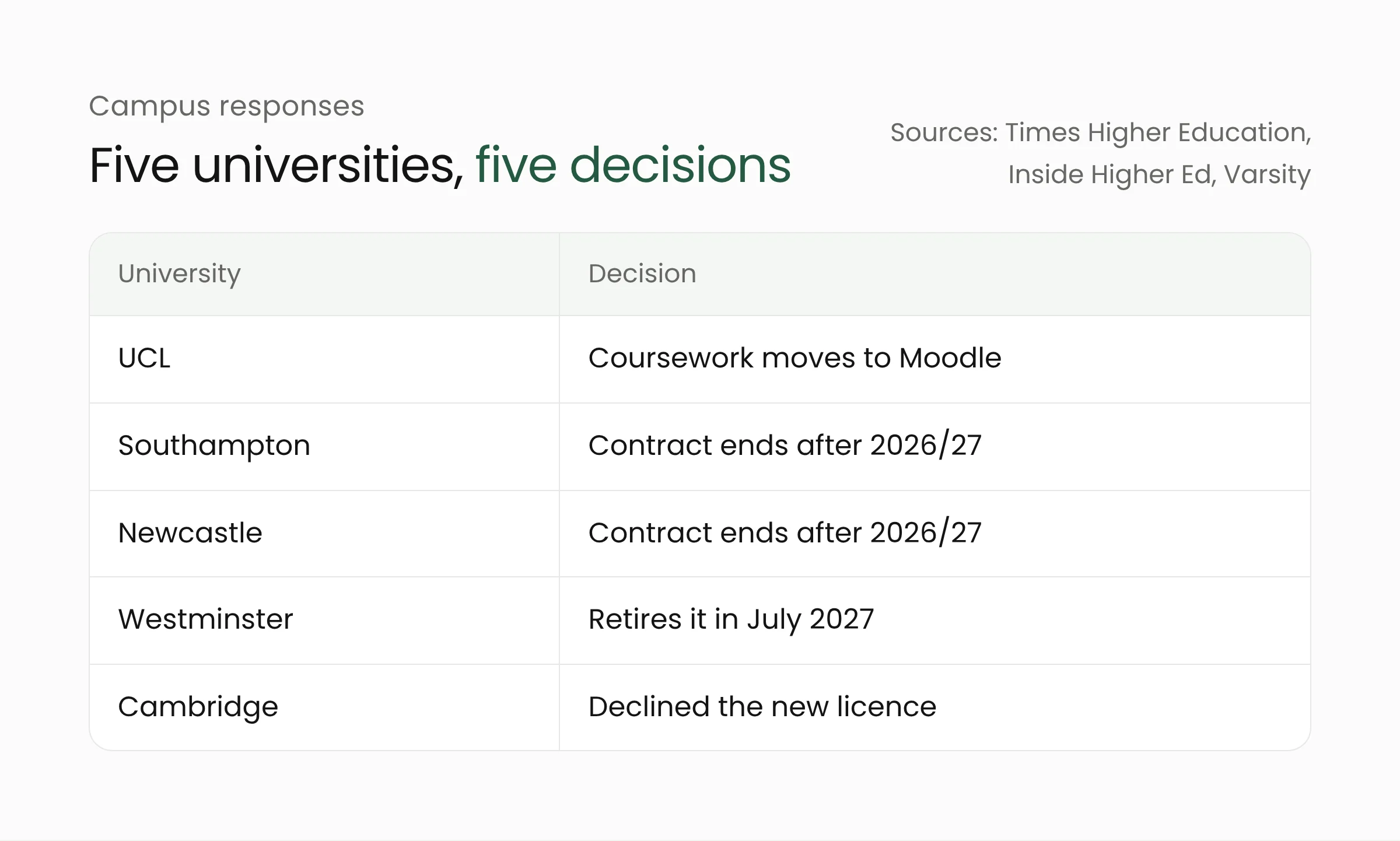
- The University of Southampton said it would not renew its contract beyond the 2026/27 academic year and would start phasing the service out, THE reported on August 19, 2026.
- Newcastle University announced on October 1, 2026 that its contract would not be renewed beyond the end of 2026/27. Its education committee weighed the other plagiarism detection tools already available, the student experience, and concern over the possible use of staff and student data for AI purposes.
- The University of Westminster will retire the product when its contract ends in July 2027. According to a THE report carried by Inside Higher Ed, Westminster judged the plagiarism checker to be of limited use against generative AI and described AI detectors as probabilistic, with a risk of false positives.
- The University of Cambridge declined to sign the new licence in July 2026. Student newspaper Varsity reported that Cambridge is on the old terms until July 2027 while it explores alternatives.
The scale of the dispute reflects Turnitin’s market position. Varsity cited Uni Compare data showing that 98% of UK universities use Turnitin products.
Cost is part of the discussion. The same THE report says Southampton paid £87,621 for Turnitin between September 1, 2024 and September 30, 2025. Thomas Lancaster, who teaches at Imperial College London, told THE that finances are a deeper driver than the AI debate.
What this means for universities and schools in Indonesia
The UCL case is British, but the pattern can occur anywhere. Indonesian universities and schools also hand student work to third parties, from similarity checkers and learning management systems to online exam platforms.
Indonesia’s Undang-Undang Pelindungan Data Pribadi (Law No. 27 of 2022 on personal data protection) treats the institution that sets the purpose of processing as the data controller. An institution therefore needs to know every purpose a vendor uses entrusted data for, including when that purpose changes partway through a contract.
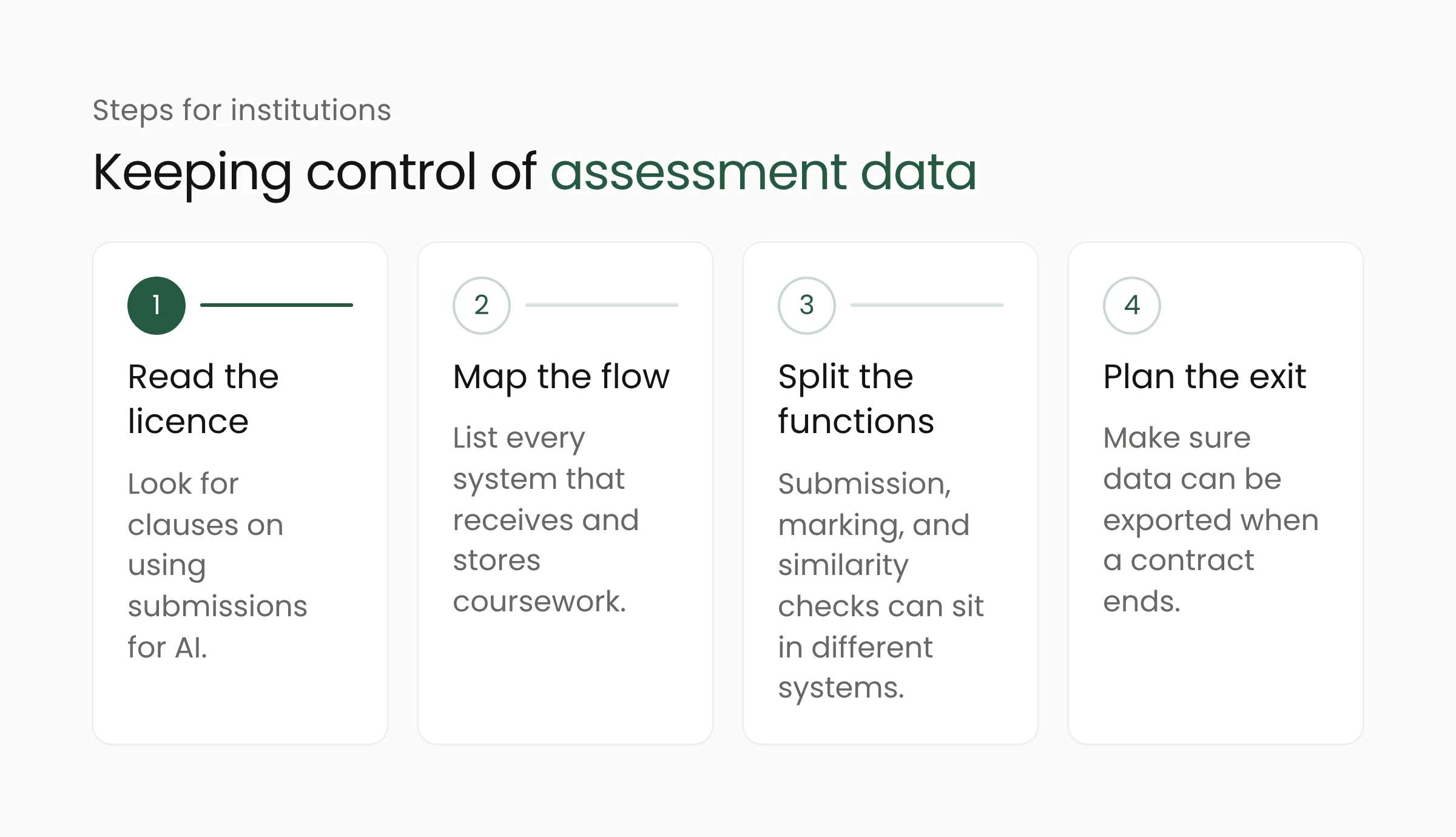
Some steps to consider:
- Read the end user licence agreement. Students and staff often accept it at first sign-in, separately from the institutional contract. Look for clauses on using submissions for product development and AI model training, and for how the vendor announces changes.
- Map where coursework goes. Record which systems receive files, where files are stored, how long they are kept, and which features are switched on.
- Separate the functions that can be separated. UCL keeps submission and marking in a system it manages and sends text to a third party only for similarity checking. That reduces how much data sits outside the institution’s control.
- Plan the exit. Make sure assignments, grades, and feedback can be exported in a format another system can read. Southampton, Newcastle, and Westminster each timed their decisions to their contract end dates.
- Involve students. In the UK, students’ unions helped push for change. A plain explanation of where coursework is sent and why prevents confusion.
- Revisit how academic integrity is protected. Similarity checkers do not answer the question of AI-written work. A law lecturer quoted by the University Times suggested research trails, document version histories, and oral assessments as ways to verify student work.
The same questions are fair to put to any online exam provider, including to us as the developer of Merakit Exam. An institution is entitled to know where candidates’ answers are stored and what the data is used for. In education technology solutions projects, ownership and data flows are best settled before a system goes into use.
This topic connects to two earlier pieces of ours, on Indonesia’s Digital Maturity Index for universities and on Google turning off Gemini and Search for student accounts.
Frequently asked questions
Does Turnitin use student work to train AI?
Turnitin says no student or staff data has been used to develop generative AI and that it has no plans to do so. It acknowledges that it may use anonymised submissions to train its AI writing classifier when an institution has AI detection enabled. These are company statements and have not yet been written into a revised licence agreement.
Has UCL stopped using Turnitin?
Not entirely. UCL suspended Feedback Studio for submission and marking and moved those tasks to Moodle. Similarity checking still uses Turnitin. According to THE, UCL has not committed to ending its contract as Southampton, Newcastle, and Westminster have.
When will Turnitin’s new terms take effect?
No date is fixed. Turnitin has postponed the new EULA until September 1, 2027 at the earliest and is redrafting it with UCISA. The revised wording has not been published.
Closing
UCL’s decision shows that a change to one licence clause can alter how a university handles its students’ coursework. Turnitin has postponed its terms and denies training generative AI on student work, yet several universities have chosen to take back control of how assignments are submitted.
Merakit helps schools and universities design learning and assessment systems with clear data flows from the start. If your institution is reviewing the platforms it uses, our education technology solutions team is ready to talk.
Sources
- Times Higher Education: UCL rethinks Turnitin use amid AI training concerns (November 23, 2026)
- EdTech Innovation Hub: UCL moves coursework from Turnitin to Moodle over AI data terms (November 24, 2026)
- Students’ Union UCL: An update on Turnitin (November 2026)
- Times Higher Education: Turnitin chief: universities walked away due to ‘budget crisis’ (November 13, 2026)
- University of Warwick: Turnitin update: no changes for 2026/27 academic year (October 22, 2026)
- University of Sussex: Turnitin End User License Agreement (EULA) and AI changes (October 6, 2026)
- Newcastle University: Turnitin statement (October 1, 2026)
- Inside Higher Ed: More U.K. Universities End Turnitin Contracts (October 15, 2026)
- University Times: British and Irish Students Express Concern Over Turnitin AI Policy (October 18, 2026)
- Varsity: Uni opposes Turnitin AI training plans (October 2, 2026)