Blog Education Technology
Google Turns Off Gemini and Search for Student Accounts
On this page· 7 sections
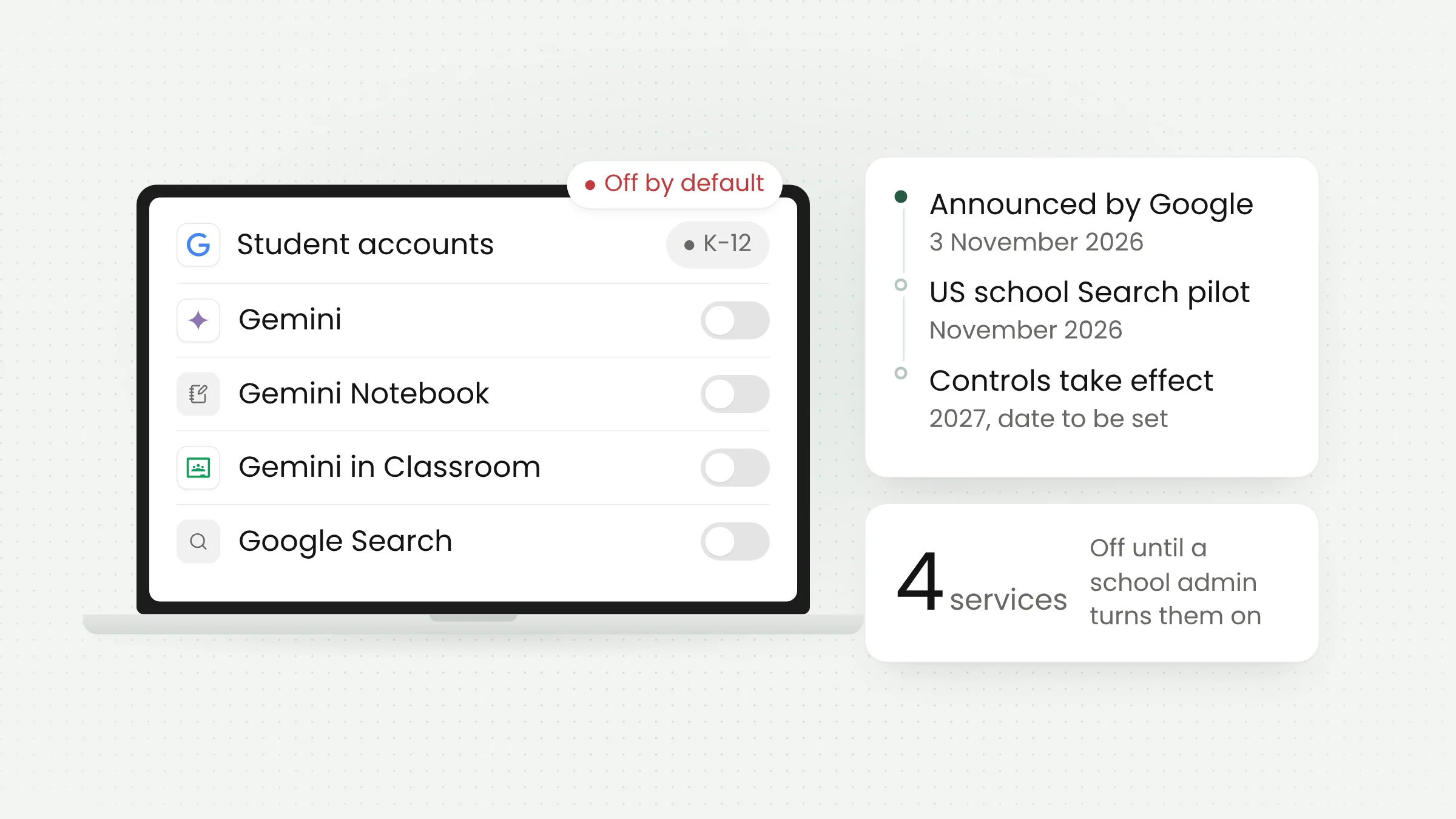
Google said on 3 November 2026 that Gemini, Gemini Notebook, Gemini in Classroom and Google Search will be switched off by default for K-12 student accounts until school administrators turn them on. As a result, schools that reject AI altogether will also lose Google Search for their students.
K-12 covers schooling from kindergarten through grade 12, roughly primary through senior high school. The affected services are also used by schools in Indonesia, including through the government-issued belajar.id accounts. This piece explains what Google announced, why Search is tied to the decision, how educators reacted, and what schools can prepare.
What changes for student accounts
The announcement came from Chris Phillips, Google’s Vice President and General Manager for Education, in a post on Google’s official blog. Google said it is revising its approach for four services: Gemini, Gemini Notebook, Gemini in Classroom and Google Search. For K-12 student accounts, all four will be entirely off until a school administrator explicitly enables them.
According to Engadget, administrators can enable the services one at a time. A school could, for example, allow Gemini in Classroom while keeping the general Gemini app off.
Timeline and regional scope
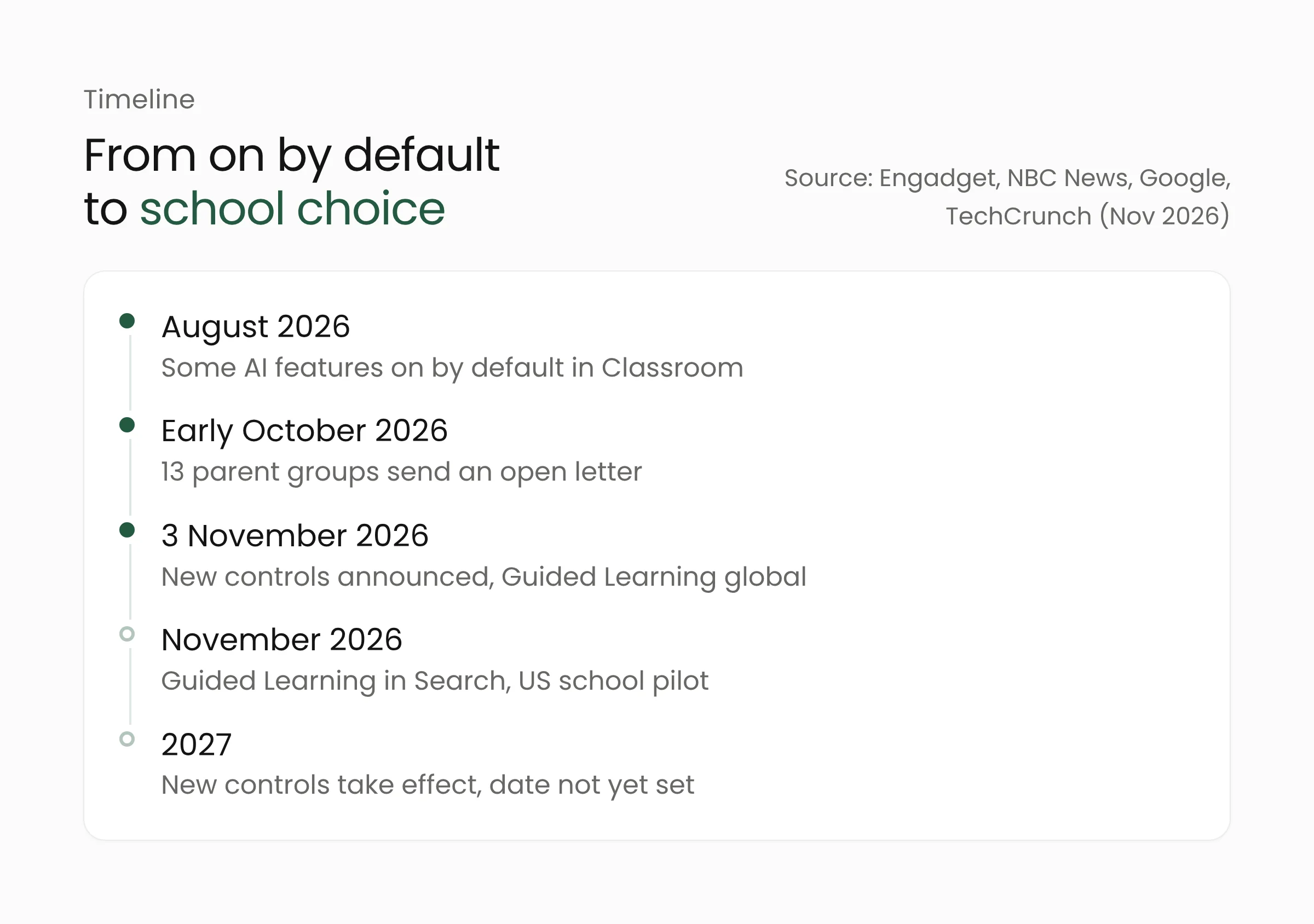
The new controls are not live yet. TechCrunch reported that Google plans to apply them next year, and Google said it will share specifics with schools in the coming months so they have time to prepare. No exact date has been announced.
Google has also not said whether the new controls apply in every country. The announcement refers only to K-12 student accounts and lists no regions. Schools in Indonesia should watch for official notices in their admin consoles.
Search is bundled with AI
The most debated part of the change concerns Google Search. According to TechCrunch, Phillips summed up the reasoning in one line: “Search and AI are deeply integrated.” Because AI features are now built into Search, a school that restricts AI completely also turns off Search for students. Engadget reported that those students will see a message saying Search is unavailable.
After the pushback, Google clarified that schools can still enable Search without the other Gemini products. However, NBC News noted that this version of Search still carries some AI features, such as AI-generated summaries of search results. There is no option for Search with every AI feature removed.
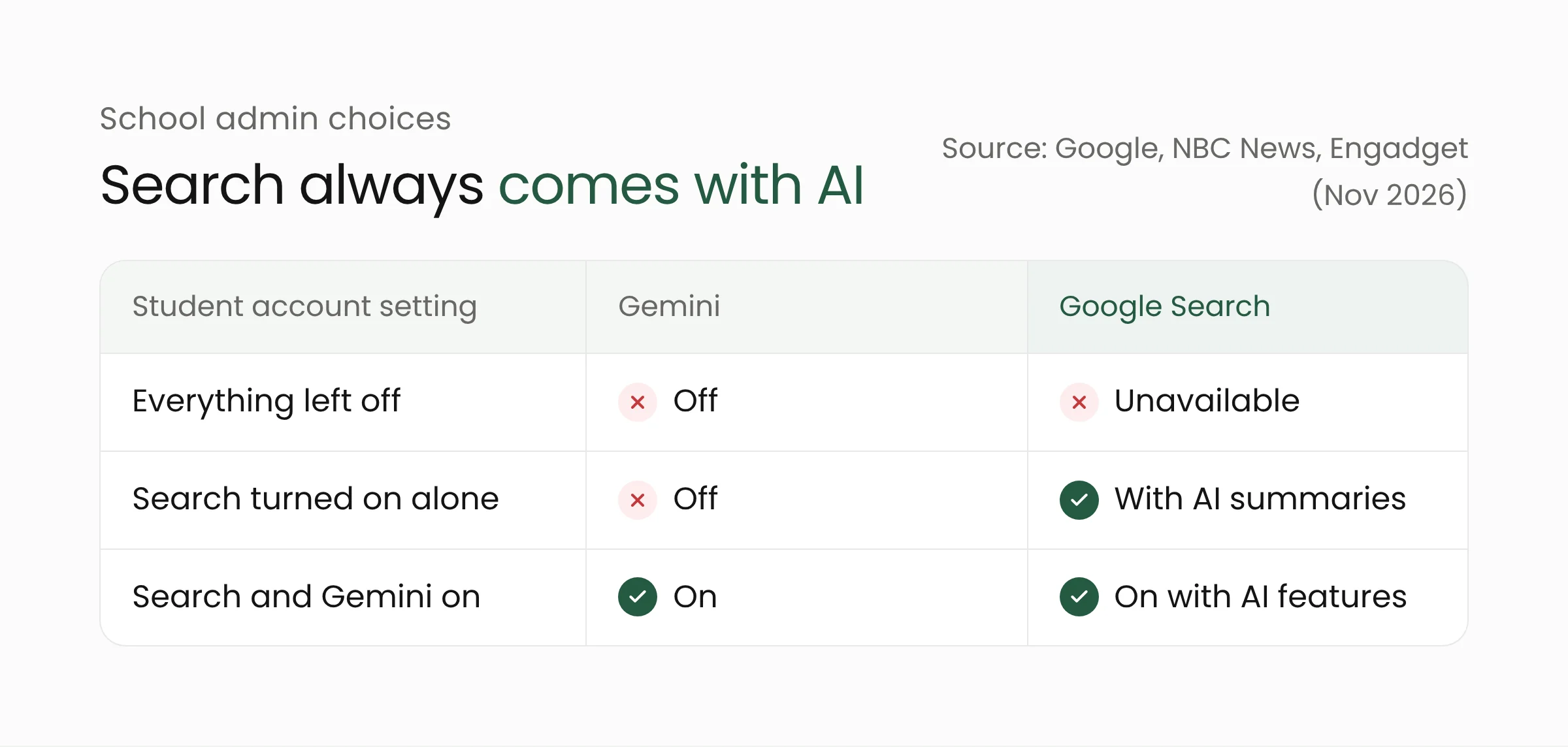
In a social media statement cited by NBC News, Google said the changes give schools more choice. Speaking to TechCrunch, Phillips said the goal is to give school leaders the control and confidence to use AI products in classrooms as they see fit.
Criticism from teachers and parents
The announcement follows months of protest. Engadget reported that in August 2026 Google turned on some AI features by default in Google Classroom, a move that drew objections from educators. NBC News also reported that in early October, 13 parent advocacy groups sent an open letter urging school districts to switch off Gemini and YouTube.
The new policy has not settled the criticism. Randi Weingarten, president of the American Federation of Teachers, said Google had put its business interests ahead of children’s education. Josh Golin, executive director of Fairplay, accused Google of pressuring schools into using its AI products.
The stakes are high because schools rely heavily on Google. NBC News cited a 2023 Schoolytics report that found nearly two-thirds of school assignments use a Google product. The same outlet noted that the Stanford SCALE Initiative has found no high-quality causal studies on the effects of student AI use.
Guided Learning for schools that opt in
Alongside the announcement, Google launched Guided Learning in Google Classroom globally from 3 November 2026. The feature works as a one-to-one study companion tied to class material, and teachers get real-time insight into where the class needs more support.
Google is also bringing Guided Learning to Google Search for student accounts. When the system detects that a student is looking for homework help, Search will walk them through the problem step by step and prompt critical thinking instead of handing over the answer. A pilot starts in select US schools in November 2026, with more districts to follow in the coming months.
The learning benefits are Google’s own claim. The company points to its research showing measurable learning gains but gave no figures in the announcement.
The Indonesian context: belajar.id and age settings
Many Indonesian students use Google services through belajar.id accounts. According to Medcom.id, the Ministry of Education launched these accounts through its Data and Information Technology Center (Pusdatin) in December 2020 as Google accounts on the @belajar.id domain, with access to G Suite for Education, now called Google Workspace for Education. Schools can also run their own Google Workspace for Education domains.
For schools that manage their own domain, the decision to enable or disable services sits with the domain administrator. Google Workspace already offers age-based access settings under Account settings, then Age-based access settings. In primary and secondary schools, any user not designated as 18 or older automatically gets a restricted experience, such as SafeSearch turned on by default.
Google has not explained how the new controls will identify K-12 student accounts. Even so, age labels already determine which services are open to users under 18. If teacher or staff accounts are wrongly labelled as under 18, they can also lose access to some services. Reviewing organisational units now will reduce confusion once the change takes effect.
At the policy level, Indonesia is also preparing guidance on AI use in education. That work is covered in our article on sector-specific AI guidelines and child protection in schools.
What this means for schools
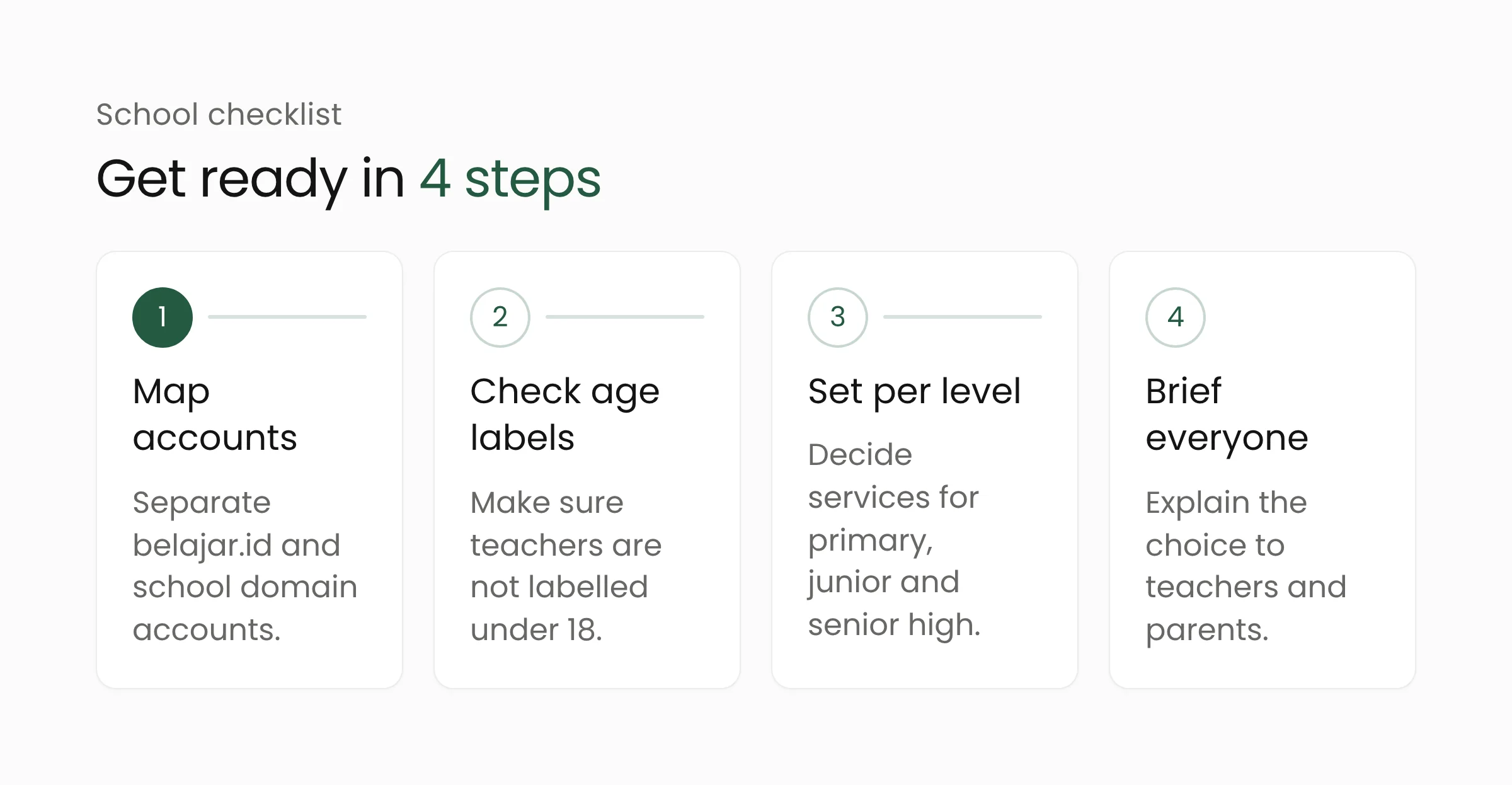
The change moves the decision about AI from Google to each school. Several steps can be prepared before the new controls arrive.
- Map student accounts. List which students use belajar.id accounts and which use the school’s own domain. Each may be managed by a different party.
- Check age labels in the admin console. Make sure student, teacher and staff organisational units carry the right age label so teacher accounts are not restricted by mistake.
- Set a policy for each level. Primary, junior high and senior high students can receive different access. Decide whether Search is enabled with AI summaries, and whether Gemini in Classroom is opened for specific assignments.
- Plan for Search being off. If the school turns off all AI features, prepare alternative learning resources, such as a digital library or another search engine the school has reviewed.
- Brief teachers and parents. Explain which services are on, why, and how to report problems.
The choice to enable AI also affects how schools assess students. Homework with answers that are easy to look up may need redesigning, while exams that count toward grades are best held in a controlled environment. Exam platforms such as Merakit Exam are built for that purpose.
Every school starts from a different level of readiness. Merakit’s education technology solutions team can help design account policies, access settings and digital learning workflows that fit school rules and student needs.
Frequently asked questions
When will Google’s new student account controls take effect?
Google has not announced an exact date. TechCrunch reported that the change is planned for next year, and Google has promised to share details with schools in the coming months.
Can schools enable Google Search without Gemini?
Yes. Administrators can enable Search without the other Gemini products. However, Search still includes some AI features, such as AI-generated summaries. If every AI feature is switched off, students lose access to Search.
Does the change apply to belajar.id accounts?
Google has not specified the regional scope of the change. belajar.id accounts are Google Workspace for Education accounts, so schools and account managers should watch for official announcements from Google and the Ministry of Primary and Secondary Education.
Sources
- Google: Designing responsible AI for learning (3 November 2026)
- Google: AI and learning, 2026 education updates (3 November 2026)
- TechCrunch: Google will let schools disable its AI tools, but not without sacrificing Search (3 November 2026)
- NBC News: Google to shut off search for schools that opt out of AI (3 November 2026)
- Engadget: Google says students in schools that ban AI won’t have access to Search (3 November 2026)
- Google Workspace Admin Help: Control access to Google services by age
- Medcom.id: Kemendikbud launches the belajar.id learning account (11 December 2020)