Blog QRIS
QRIS 0% MDR Is Live: What Changes for Merchants
On this page· 7 sections
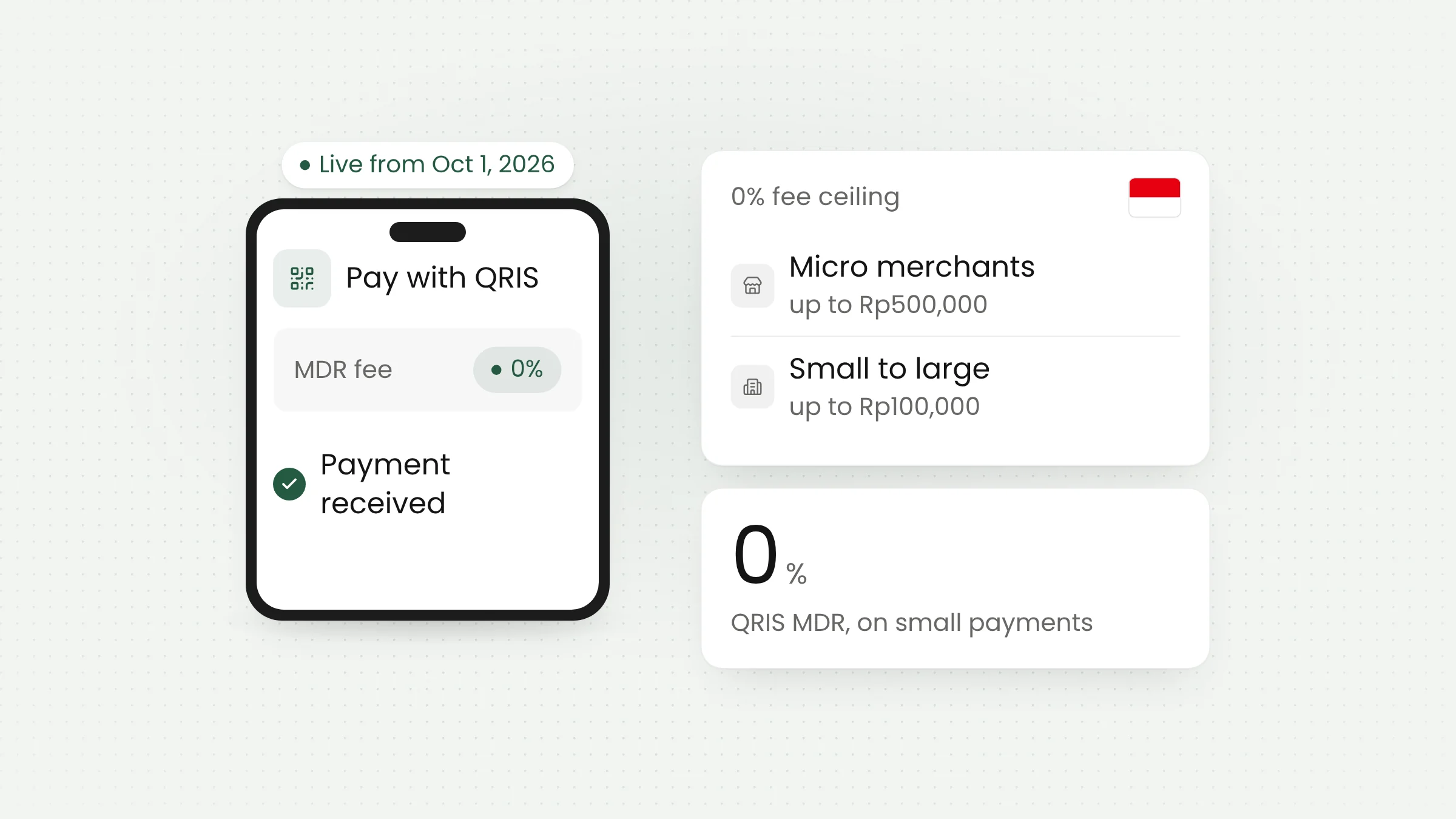
Since October 1, 2026, the 0% QRIS merchant fee is no longer just for micro businesses. Bank Indonesia has extended it to every merchant category for payments of up to Rp100,000. A coffee, a snack, or a daily grocery run can now be paid by QRIS without the merchant discount rate (MDR) coming out of the seller’s pocket.
What changed on October 1
Bank Indonesia announced the policy on August 17, 2026, in Jakarta. According to Infobank, Acting Governor Destry Damayanti said it takes effect on October 1, 2026. Micro businesses already had 0% MDR. What is new is that small, medium, and large merchants get it too for payments up to Rp100,000, which were previously charged 0.7%.
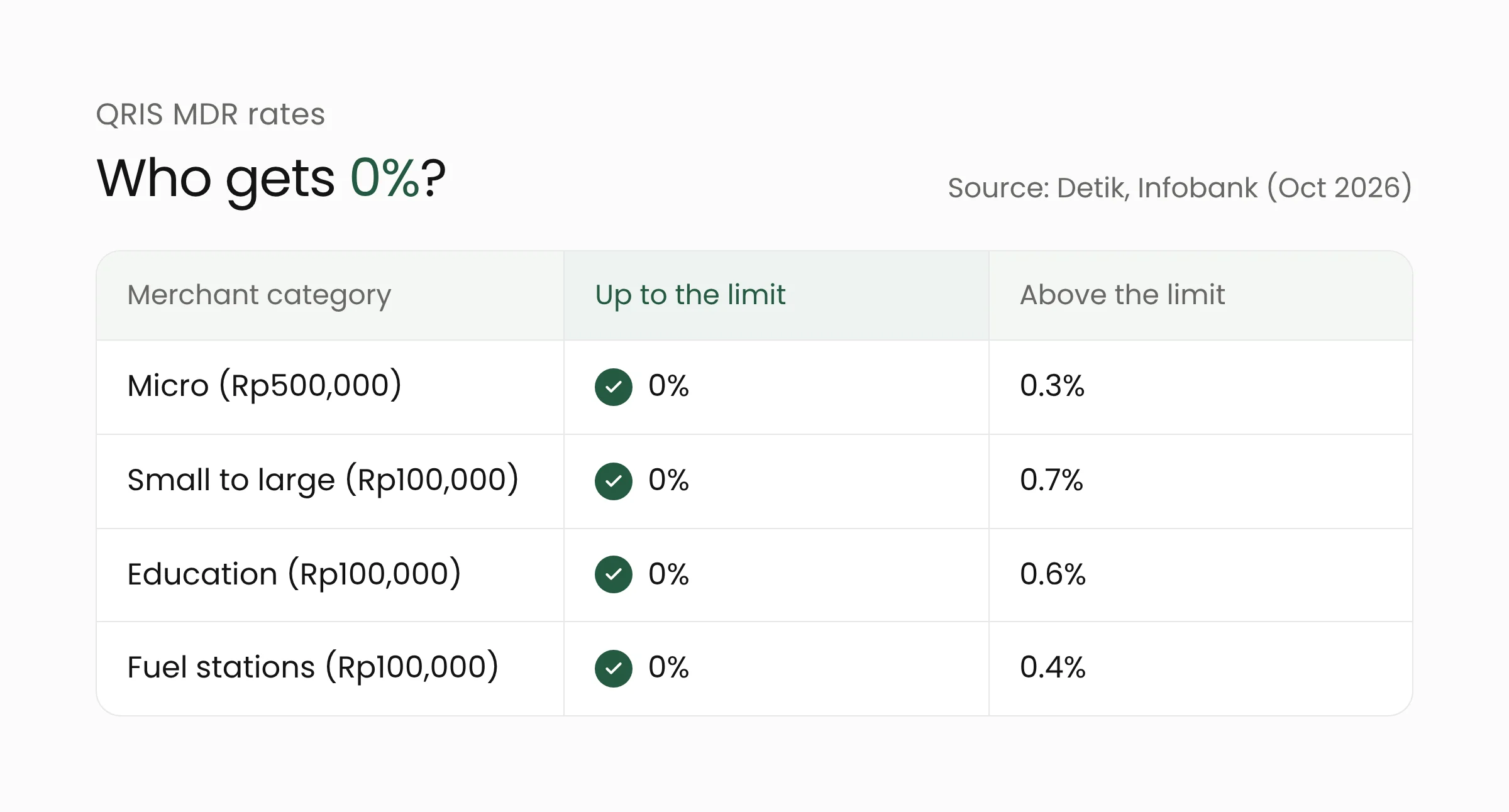
The numbers differ by group. Detik breaks them down: micro businesses stay at 0% up to Rp500,000 and pay 0.3% above that. Small, medium, and large merchants pay 0% up to Rp100,000, then return to the regular 0.7%. Education and fuel-station merchants, whose regular rates are 0.6% and 0.4%, follow the same Rp100,000 ceiling. Government payments such as social aid, taxes, and non-profit donations were already at 0%.
The gap between announcement and start date was about six and a half weeks. That gave banks, e-wallets, and point-of-sale providers time to adjust their fee systems, which makes the first couple of weeks after launch a sensible moment for sellers to check whether the change has reached their own statements.
How MDR works, and who pays it
MDR is a service fee that a payment provider deducts from the merchant each time it accepts a QRIS payment. The buyer does not pay it, and according to Detik, merchants may not pass it on to customers. Bank Indonesia does not take a share of the fee.
One point is easy to miss: 0% does not mean every QRIS payment is free. Detik stresses that the zero rate only applies up to the stated limit, and above it the regular rate applies. The sources we read do not detail how providers calculate the fee above the limit, so confirm that part directly with your provider.
For a rough idea, take a Rp80,000 purchase at a mid-sized grocery. At the previous 0.7% rate, the deduction would have been about Rp560. Now it is zero. For a micro business receiving Rp600,000, the 0.3% rate means about Rp1,800. These are our own illustrative sums, not figures from Bank Indonesia.
Why Bank Indonesia is doing this
According to Infobank, the aims are to lower transaction costs, raise efficiency and acceptance of QRIS, and support inclusive digitalization of the economy. Ryan Rizaldy, head of BI’s payment system policy department, tied it to the Indonesia Payment System Blueprint 2030.
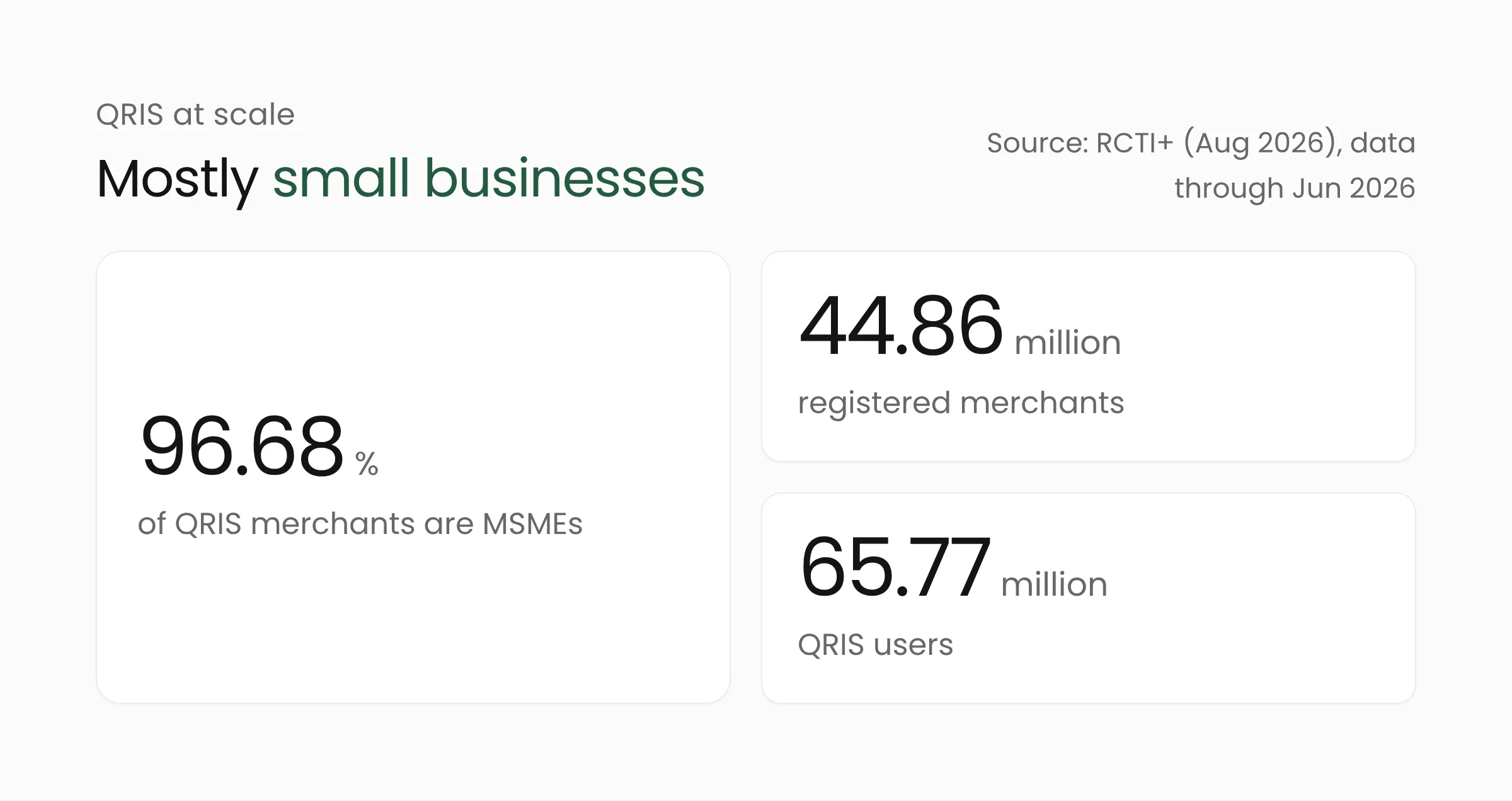
The scale is large. RCTI+ reports 65.77 million QRIS users as of June 2026, up 6.23 million since January. There are 44.86 million merchants, about 96.68% of them small businesses. In the first half of 2026 there were 12.55 billion transactions worth Rp1.12 quadrillion, up 93.92% year on year.
Growth has continued. Katadata reported BI’s July 2026 data: QRIS transactions grew 82.42% year on year, with Destry Damayanti linking the rise to more users and merchants. Total digital payments reached about 5.5 billion transactions, up 28.69%, while BI-FAST handled about 546 million transactions worth Rp1,355 trillion, up 31.62%.
Cash has not faded, though. In the same release, currency in circulation grew 15.10% to Rp1,314 trillion. Digital payments are speeding up, but in many small shops and markets cash still runs alongside QRIS. Cutting fees on small payments is one way to make the cashless option more attractive to sellers, who often count thin margins per sale.
There is a flip side. E-wallets and banks give up some commission income on small transactions. We did not find data on real effects for merchants or providers since October 1, so any impact on rates, promotions, or other services remains to be watched.
What this means for your shop
For a shop owner, the benefit shows up first in small payments, which are usually the most frequent. But the gain only becomes real if you verify it yourself.
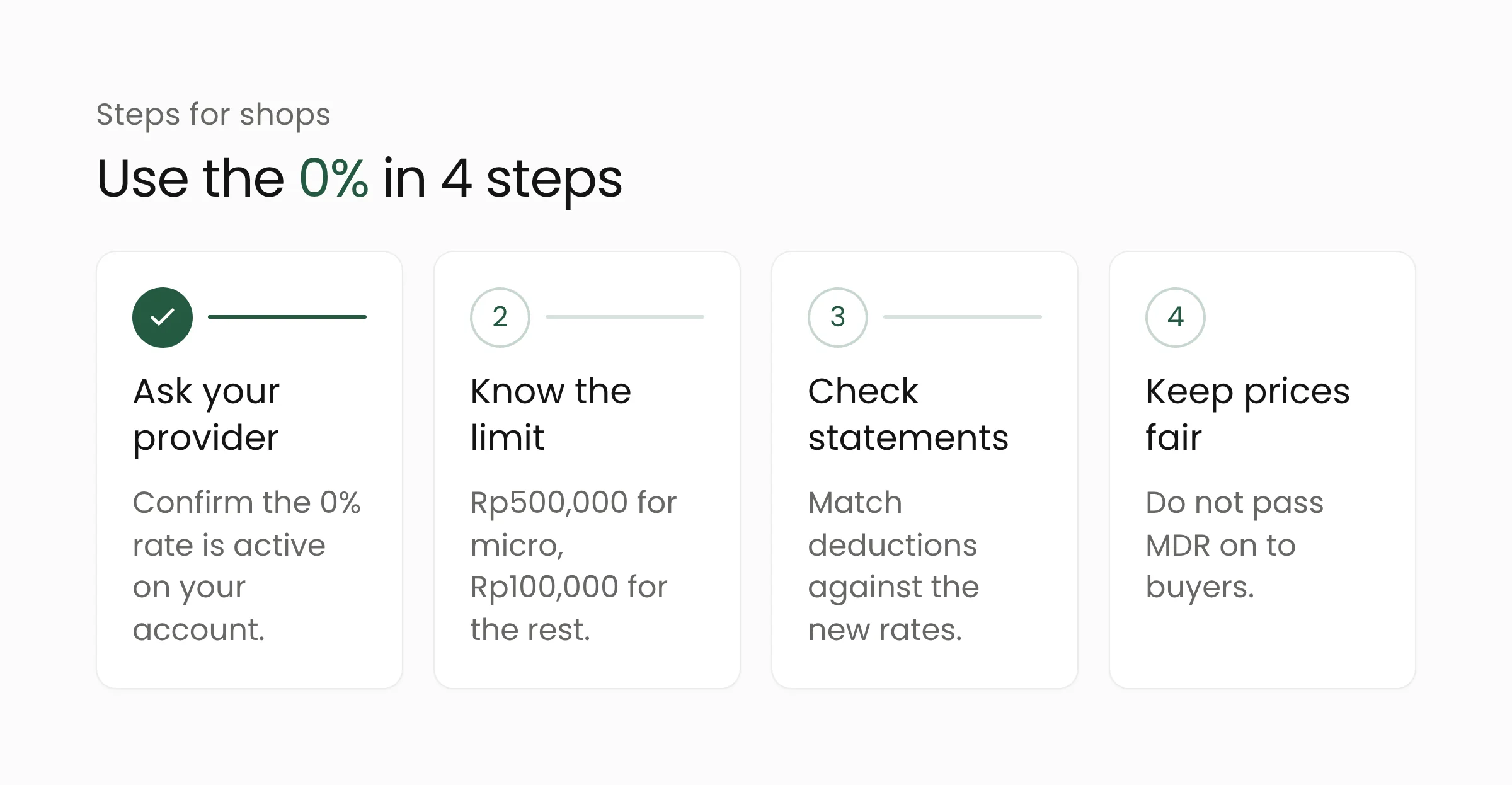
Confirm the new rate is active on your account. Ask the QRIS provider you use, whether a bank, an e-wallet, or a point-of-sale vendor. Ask which limit applies to your business category: Rp500,000 for micro or Rp100,000 for the rest.
Match your statements against the new rates. Pick a few payments under the limit and check whether the deduction is truly zero. If it is not, keep the evidence and raise it with your provider.
Watch payments that cross the limit. Wholesale orders and large purchases still carry the regular rate. If customers often pay Rp150,000 or more, consider whether another payment method suits that kind of sale better.
Do not pass MDR on to buyers. Keep the price at the till the same for every payment method. This is also the rule Detik cites.
Prepare your point-of-sale system for two thresholds. If you run your own till app or online store, make sure it can tell payments under and over the limit apart, as well as different business categories. A daily report that shows deductions by value range will tell you whether the policy actually lowers your monthly costs.
Think about the buyer’s side. Because buyers do not bear MDR, the extension does not change shelf prices. But sellers who now feel comfortable taking small QRIS payments may drop the minimum-spend rule they once set to cover fees. That is each business’s call, not something Bank Indonesia prescribes.
For larger operations, sales records and per-method reconciliation matter more. With different rates across value ranges, tills and financial reports need to split payments by those limits. That is the territory of retail management and financial services that depend on tidy transaction data, and data analytics can help with the number crunching.
Frequently asked questions
Are all QRIS payments now free for sellers?
No. The 0% rate applies up to Rp500,000 for micro businesses and Rp100,000 for other categories. Above those limits, the regular rate still applies.
Do buyers pay any extra fee?
MDR is charged to the merchant, not the buyer, and according to Detik merchants may not pass it on to customers. Other fees outside MDR, for example from a specific app, are not covered in the sources we read.
When did the rule start?
On October 1, 2026, as Bank Indonesia stated on August 17, 2026. It continues the 0% MDR that micro businesses already had.
Closing
The 0% MDR is a real nudge toward small cashless payments, but the result depends on habits at the till: who checks the statements and who knows the limits. Start with one week of matching your statements. If you want to tidy up how digital payments are recorded across a shop or a chain, we would be glad to talk through the options.
Sources
- Infobank: BI waives QRIS MDR for Rp100 thousand transactions from October 1, 2026 (August 17, 2026)
- RCTI+: BI makes QRIS free for all micro-business merchants from October 1, 2026 (August 17, 2026)
- Katadata: QRIS transactions in July 2026 grow 82.42% YoY, BI-FAST hits 546 million (August 19, 2026)
- Detik: What is QRIS MDR? Fee rules in force from October 2026 (October 2, 2026)