Blog Data Centers
Lamongan Regional Data Center and Indonesia's 540 MW
On this page· 6 sections
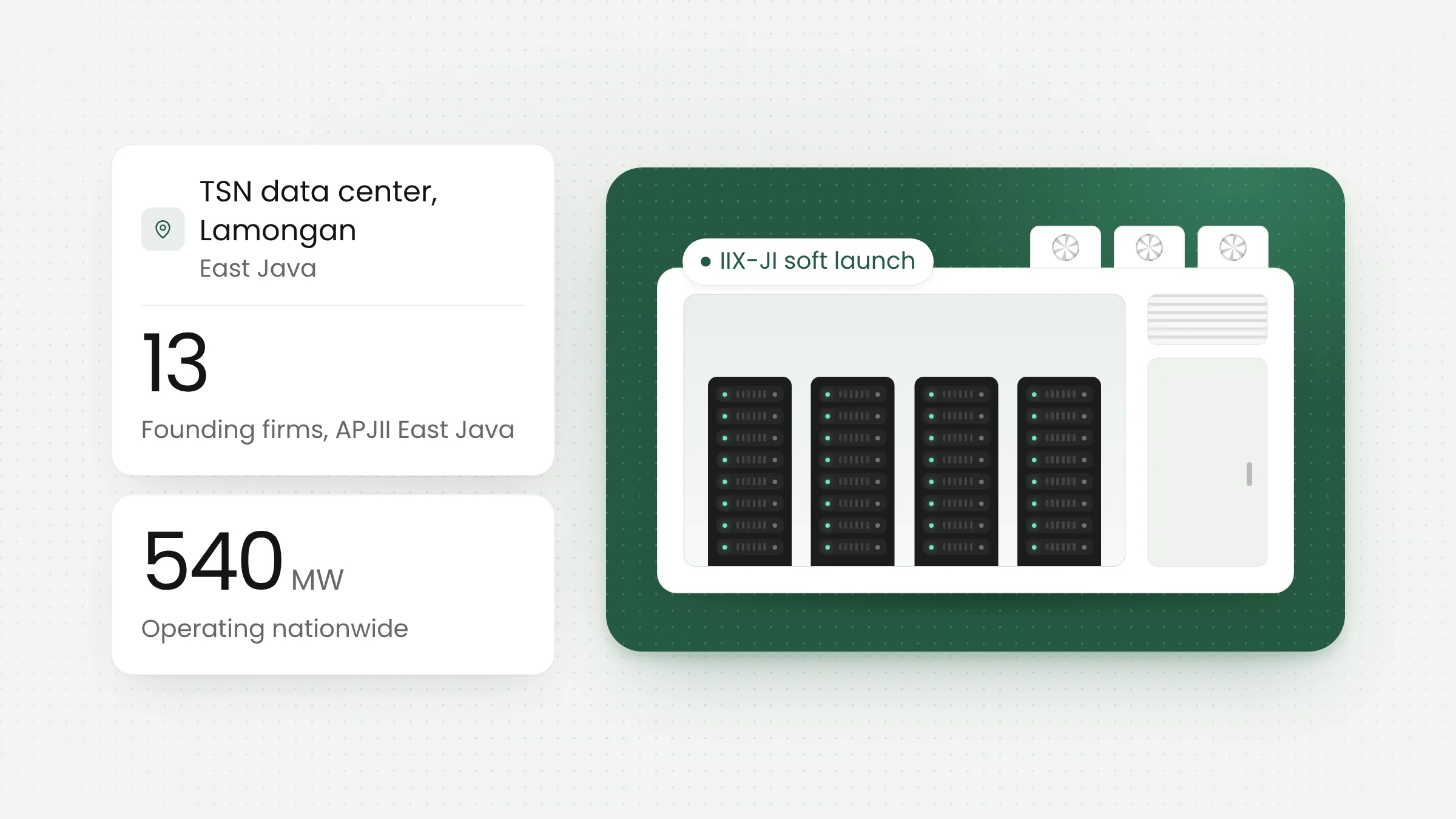
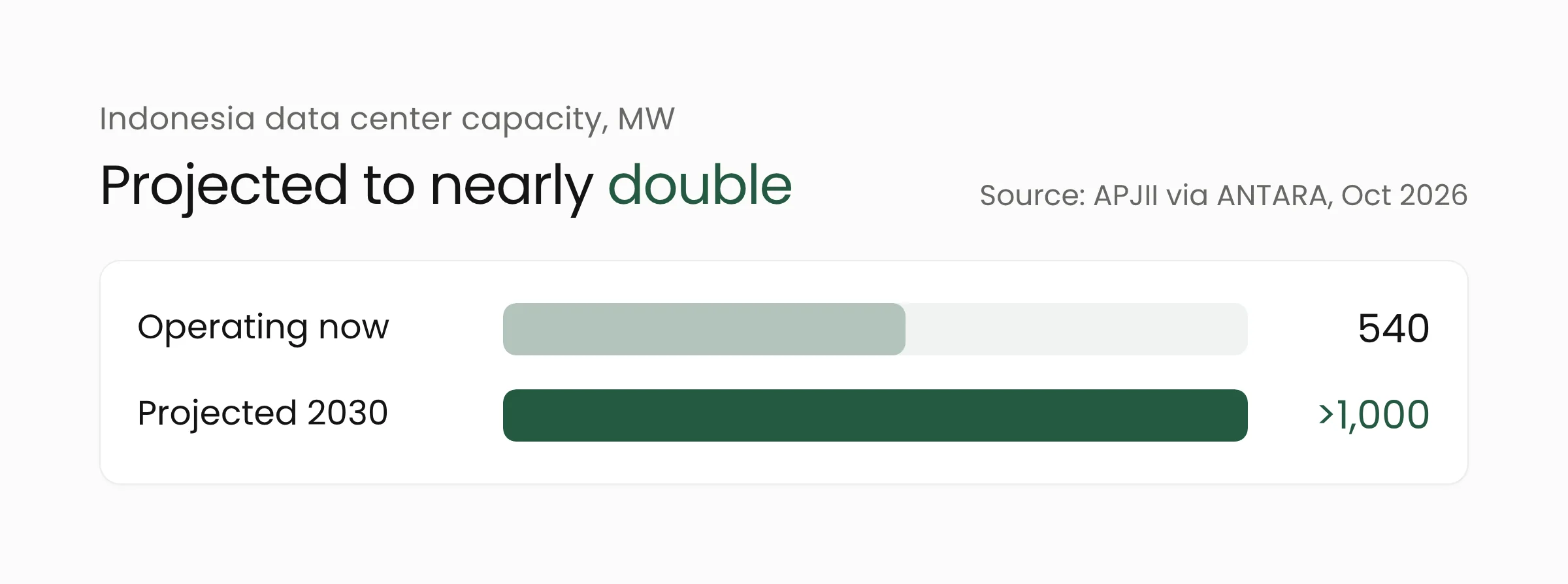
A new regional data center has opened in Lamongan, East Java, run by PT Tigabelas Solusi Nusantara (TSN), a company formed by 13 technology firms that belong to APJII’s East Java chapter. At the launch, APJII chairman Muhammad Arif said Indonesia’s operating data center capacity stands at about 540 MW and is projected to exceed 1,000 MW by 2030.
The TSN data center and the IIX-JI node
According to w.media, the TSN data center was inaugurated on Tuesday, October 13, 2026. Its founders are 13 technology companies from Lamongan, Tuban, Bojonegoro, Mojokerto, and Jombang, all members of APJII East Java. About 70 companies have already installed equipment there, occupying 14 server racks in total. TSN plans to win more customers and widen its services across the surrounding area.
Alongside the opening, TSN held a soft launch of IIX-JI, an internet exchange node. ANTARA reports that the node is meant to strengthen local network connectivity.
How an internet exchange works
Internet service providers (ISPs) interconnect their networks so that customer traffic reaches its destination. When two ISPs in the same city have no local meeting point, traffic between their customers often has to travel through a larger city first. An internet exchange supplies that meeting point. With IIX-JI in Lamongan, ISPs in the area can swap traffic locally instead of taking routes through big cities, as w.media describes it.
TSN’s president director said access does not always need to go through Jakarta or Surabaya first. Yosvensa Setiawan, who chairs APJII’s East Java board, linked building data centers outside major cities to efforts to address the uneven spread of digital infrastructure.
The sources we read do not state the TSN facility’s power capacity, investment value, or certification level. These figures have not been announced, so ask the operator directly if you are considering its services.
National capacity and who pays for it
At the launch, Arif said operating data center capacity nationwide has reached about 540 MW. APJII projects it will exceed 1,000 MW by 2030. Demand remains high, he said, and many providers expect their capacity to fill within a few years, so new facilities are needed. He also argued that construction should be spread across regions so that data storage and processing do not depend only on metropolitan areas.
Arif added that regional data centers could support ISP businesses, create IT jobs, and drive supporting sectors such as cable and telecom networks. He described the Lamongan site as part of East Java’s digital infrastructure buildout, which also includes mid-sized facilities and edge data centers in several areas.
Banks are lending to the sector
In the same week, Kontan reported that BNI extended a Rp10.75 trillion credit facility to PT NexAI Digital Infrastruktur Tbk (MGLV). The money is for taking over and expanding a data center in Jababeka and building one in Batang, with a tenor of up to six years. BNI calls data center financing a strategic productive-sector loan, given rising demand for digital infrastructure, computing power, and AI.
Kontan also lists the risks. Data centers need heavy capital and depend on electricity supply, technology, and tenant certainty. The highest risk comes during construction, before cash flow starts, and it falls once the facility runs with stable occupancy and contracts. Banks also point to power limits, environmental impact, and water needs. A senior figure at LPPI told Kontan that a high interest rate alone does not compensate for these risks. Bank of America, per Kontan, notes that demand often comes from outside the country hosting the facility.
Water and environmental questions are already a live issue in Indonesia. We covered one case in our article on the halted Jatiluhur AI data center. Smaller, dispersed sites such as Lamongan do not automatically carry a lighter footprint, so each facility’s power and water data is still worth requesting openly.
What this means for local agencies and businesses
For agencies, schools, hospitals, and companies outside the big cities, a regional data center adds a new option for hosting systems and data. That option should be judged with the same checklist you would apply to any provider.
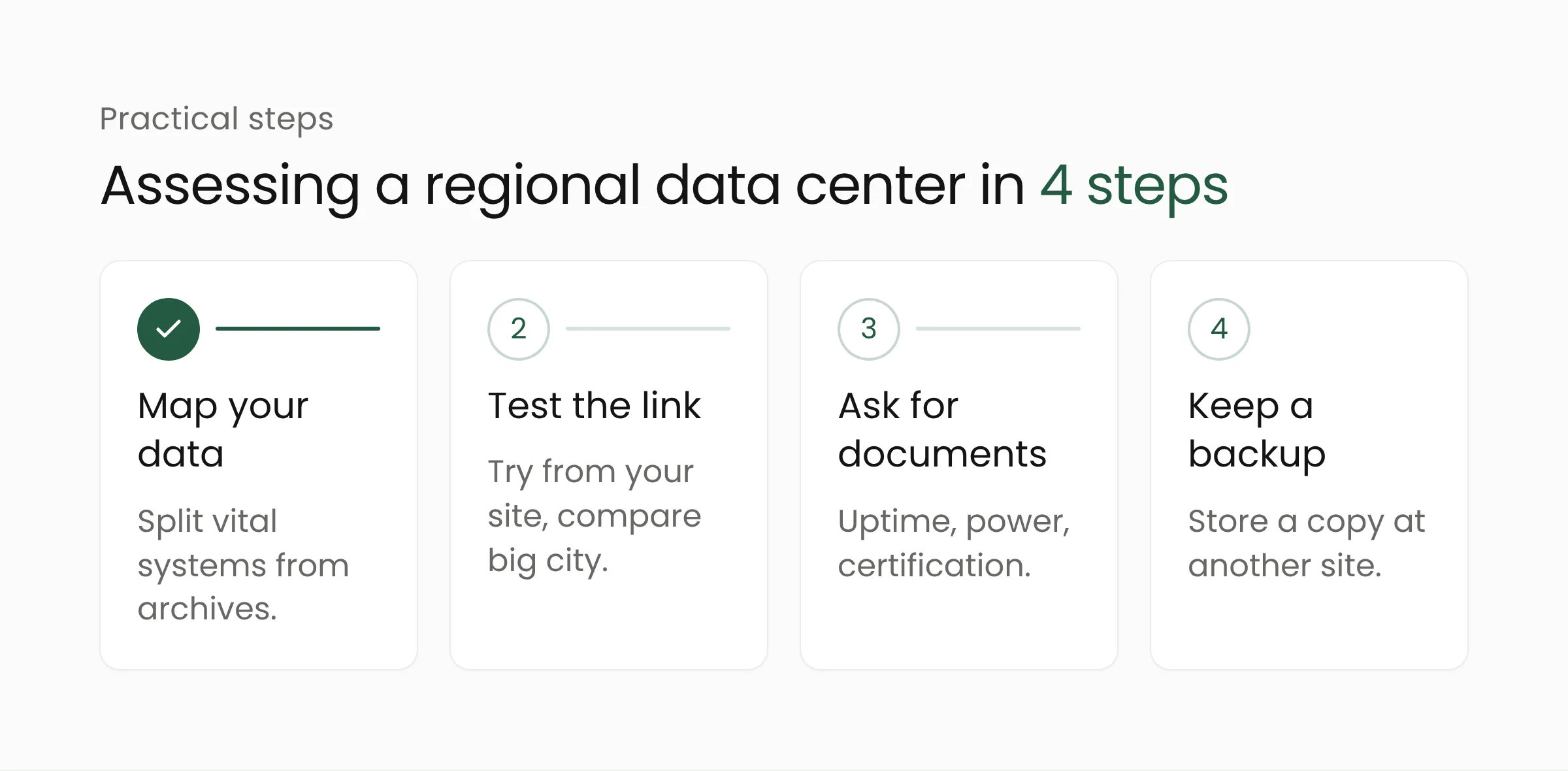
- Map your data. Separate systems that must be available at all times from archives that can wait. Personal data of citizens or patients must be handled under Indonesia’s Personal Data Protection Law (Undang-Undang Pelindungan Data Pribadi, UU PDP).
- Test the connection from your own site. Try the service from your office or school and compare it with a big-city location, because the benefit of a new site shows up in measurements.
- Ask for service documents. Request the uptime guarantee, power supply, cooling design, and facility certification. For TSN, this information has not been announced in the coverage we read.
- Keep a backup elsewhere. One data center, however large, is still a single point. A copy in another location limits the effect of a local power or network outage.
Examples for regional organizations
A school that runs online exams from a server in its own office could consider hosting at a nearby data center, provided the connection and service guarantees prove sound. Hospitals and clinics should be more careful, because patient records are sensitive personal data and services cannot afford to drop. Shops and small businesses that use a cloud-based cashier system are usually well served by general cloud services, so the physical location of the server rarely matters most.
For small ISPs, the main value lies in the exchange node. Customers who connect within the same area can be served through local paths, which reduces dependence on a single route to a big city. Each ISP will need to measure the benefit once IIX-JI is fully running, since the launch is still an initial one.
If your organization plans to move systems, Merakit’s cloud computing services can help design an architecture that combines regional and big-city sites. For local government bodies, data placement also connects to digital government solutions and the data storage rules that apply.
Frequently asked questions
What is an internet exchange node like IIX-JI?
An internet exchange node is a point where several ISPs connect their networks and swap traffic directly. IIX-JI had its initial launch at the TSN data center in Lamongan so that ISPs in the area can exchange traffic locally.
How much data center capacity does Indonesia have?
According to the APJII chairman, operating capacity nationwide is about 540 MW today and is projected to exceed 1,000 MW by 2030. The figure is the association’s projection.
Is the TSN data center open to general customers?
According to w.media, about 70 companies have installed equipment across 14 racks, and TSN plans to add customers. Service terms, pricing, and certification were not announced in the sources we read.
Conclusion
The opening in Lamongan shows local operators starting to build digital infrastructure beyond the largest metropolitan areas. A facility like this proves its worth only once its power and water data, service availability, and connection quality can be tested. If your organization is weighing where to place its systems, the Merakit team can help draft the evaluation criteria.
Sources
- PT Tigabelas Solusi Nusantara opens data center to improve regional internet connectivity, w.media, October 14, 2026
- APJII: Kapasitas data center RI diproyeksi tembus 1.000 megawatt, ANTARA, October 15, 2026
- Kapasitas Data Center RI Diproyeksikan Tembus 1.000 MW, JawaPos.com, October 16, 2026
- Menelisik Potensi Pembiayaan Data Center oleh Perbankan, Kontan, October 15, 2026