Blog Cloud Computing
SpaceX Starmind: What the FCC's 1 Million Satellite OK Means
On this page· 7 sections
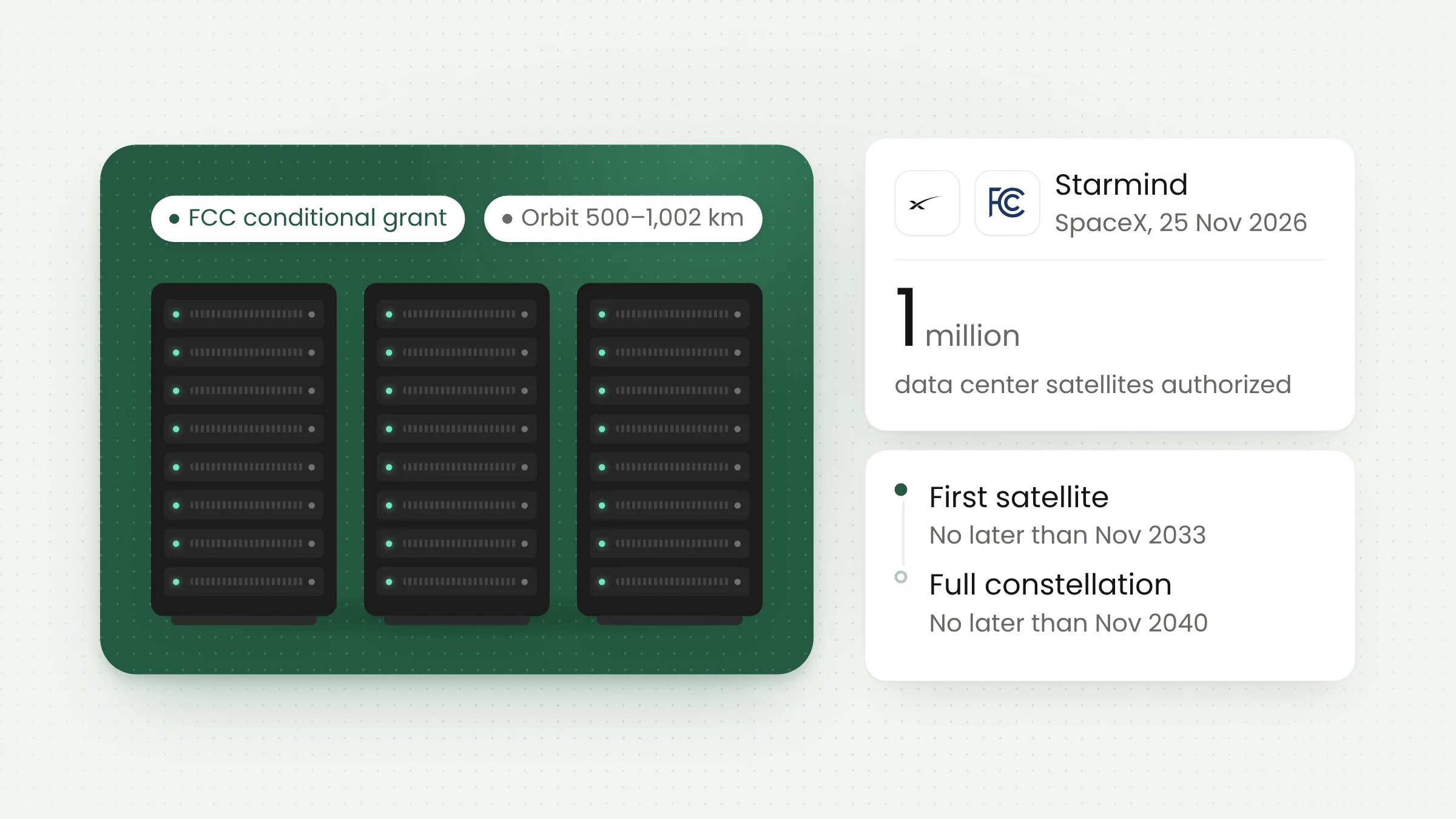
The US Federal Communications Commission on 25 November 2026 conditionally authorized SpaceX Starmind, a constellation of up to 1 million satellites designed to work as data centers in orbit. The grant sets staged deployment deadlines through 2040 and defers one significant request on satellite disposal.
The number drew most of the attention. The order itself is narrower than the headlines suggest: it governs backup radio frequencies and does not assess whether data centers in orbit are technically workable.
What the FCC order covers
The decision was released as DA 26-1273 by the FCC’s Space Bureau, granted in part and deferred in part. Chairman Brendan Carr announced it on X. According to CBS News, he wrote, “Today, in a historic first, the FCC approved SpaceX’s request for 1 million satellites”.
What the commission authorized is the use of radio spectrum. Starmind satellites will communicate mainly over optical links, meaning lasers between satellites that connect to first- and second-generation Starlink spacecraft. Radio is reserved for backup and emergency telemetry, tracking and command so that operators on the ground can still control a satellite if the primary link fails. The bands are 18.8 to 19.3 GHz for space-to-Earth and 28.6 to 29.1 GHz for Earth-to-space.
The constellation would sit in low Earth orbit at altitudes of 500 to 1,002 km. The order describes shells 50 km thick at 30-degree and sun-synchronous inclinations.
Conditions attached to the grant
The Ka-band use comes without interference protection. SpaceX may not cause harmful interference, must stop any transmission shown to be causing it, and has to coordinate with other satellite operators and federal users before operating.
SpaceX must also report twice a year, on 1 January and 1 July. The reports cover close approaches and the maneuvers taken, satellites removed from service or reentered, and the total number deployed.
The license runs for 15 years from the date SpaceX certifies that its first satellite is operating. The company has 30 days to decline the grant as conditioned.
What was deferred and what was denied
FCC rules require satellites that end their missions below 2,000 km to be disposed of through atmospheric reentry within five years. SpaceX asked for a waiver so that satellites operating above 600 km could instead be moved to other orbits around Earth or the Sun. The commission deferred that request, saying SpaceX had not supplied enough information.
The grant is therefore incomplete across the altitude range. Satellites below 600 km were found to comply with the orbital debris mitigation rules. Before deploying any satellite above 600 km, SpaceX must file a modification application with its final debris mitigation plan.
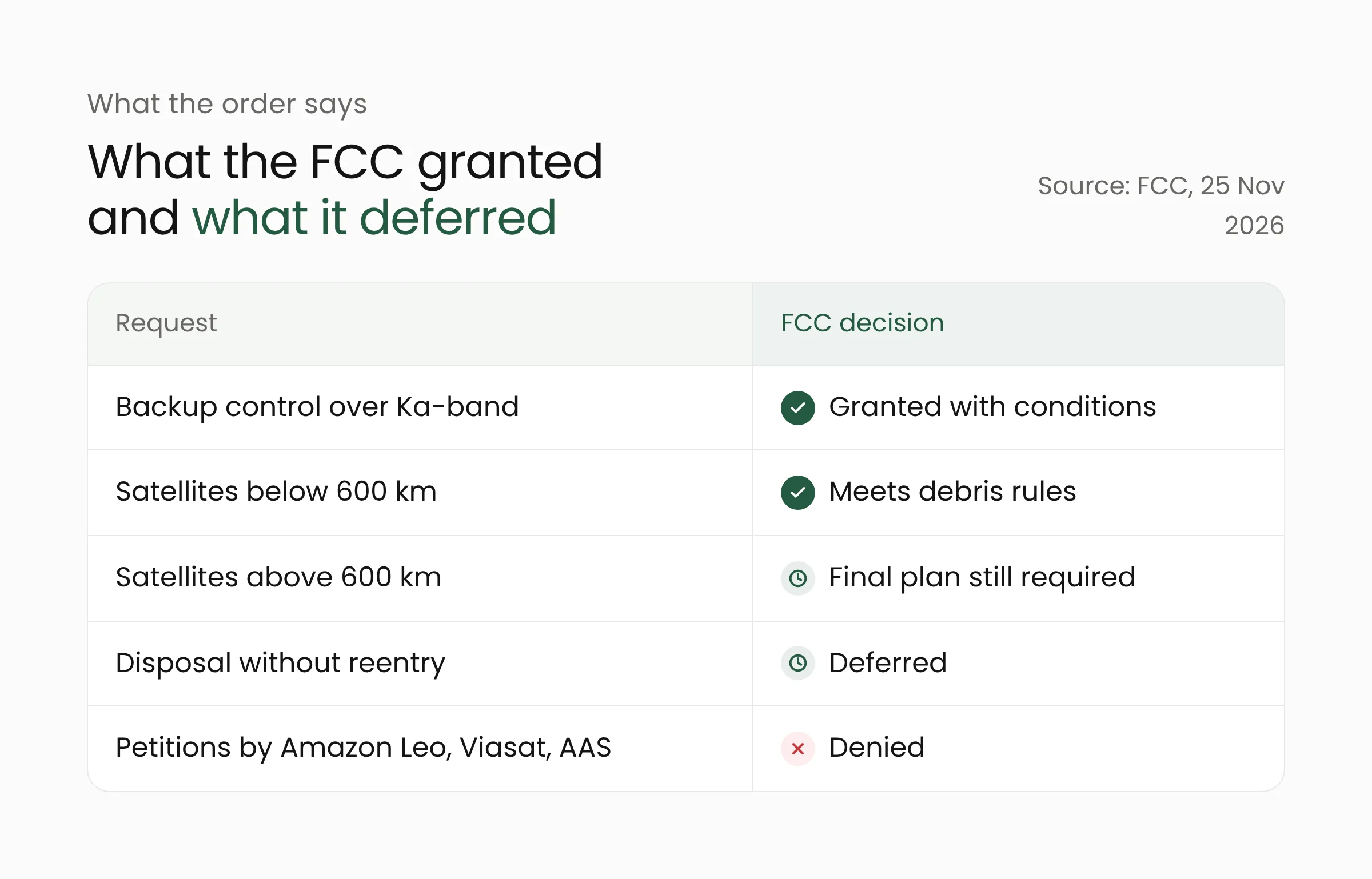
Three petitions to deny, from Viasat, Kuiper Systems (Amazon Leo) and the American Astronomical Society (AAS), were rejected. The commission also set aside environmental objections, citing its own October 2026 order that treats operations in space as outside US territory. Launch emissions were described as a matter for the Federal Aviation Administration.
Deployment deadlines through 2040
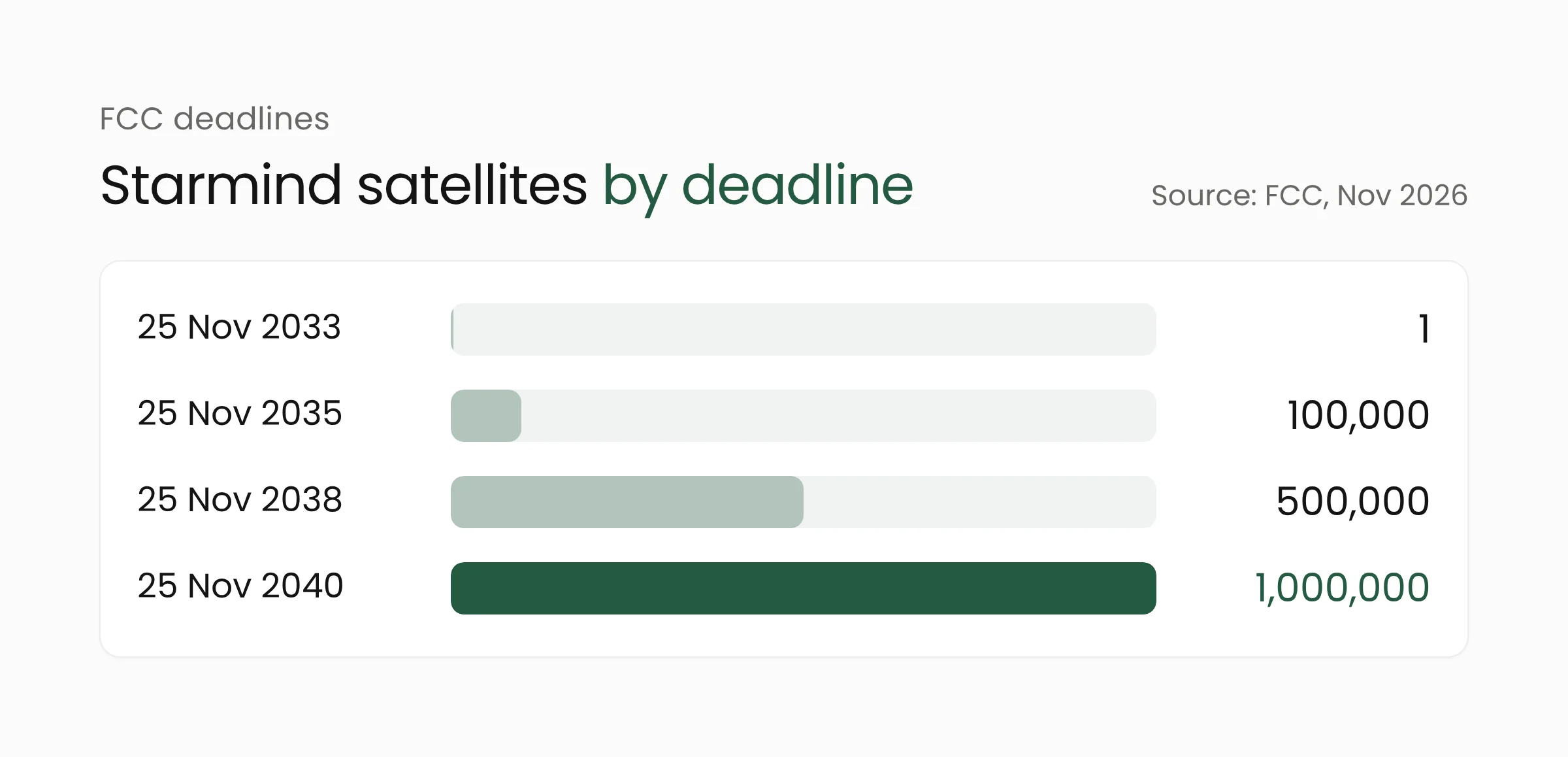
The authorization lapses if SpaceX misses its milestones. The first satellite must be in orbit and operating by 25 November 2033. Two years later, 10% of the maximum number must be deployed, followed by 50% by 25 November 2038 and the full constellation by 25 November 2040. CircleID puts that at 100,000 satellites by 2035 and 500,000 by 2038.
SpaceX’s own schedule is faster. CBS News reports that in the initial public offering filing it submitted in May, the company said it expects to begin deploying AI compute satellites as early as 2028. Engadget notes that Elon Musk previously mentioned 2027.
TechCrunch cautions that the approval does not mean orbital data centers are imminent. SpaceX still has to cut the cost of building and launching satellites, cool processors in space, and secure financing for the chips it sends to orbit.
SpaceX’s case and the objections
In its application, according to Engadget, SpaceX called orbital data centers the most efficient way to meet rising demand for AI computing power, running on solar energy with low operating and maintenance costs. That claim has not been tested at the scale proposed.
CBS News notes that thousands are under construction while nearby communities object to the noise and to higher electricity and water use. The same energy demand is driving other moves, such as Google’s superhot geothermal power contract for its data centers.
Heat, debris and the night sky
The most basic objection concerns heat. A vacuum has no air or water to carry heat away, so it can only be shed by radiation. Astrophysicist Adam Becker, cited by Engadget from the Associated Press, said there are basic physical limits to radiating heat from that many satellites and predicted the plan will not happen. Analysts at Forrester wrote in February that radiator size rises sharply with heat load, which could make thermal management a tighter constraint than launch capacity.
The second risk is collision. CNBC quotes Becker warning of a chain reaction of space debris collisions. SpaceX told the FCC that its satellites carry propulsion for avoidance maneuvers, are steered to reenter over the ocean, and burn up completely on the way.
Astronomers raised further concerns. According to Aviation Week, the AAS warned of harm to radio astronomy if emissions from a constellation this large go unchecked, along with waste heat, atmospheric pollution from launches and reentries, and collision risk.
Rivals and the feasibility question
CNBC reports that Amazon, in a petition filed in March, described Starmind as closer to an ambition than a real plan and estimated it would take centuries to build. Amazon declined to comment on the approval. The environmental law group Earthjustice criticized the commission for issuing the decision during a holiday week without an environmental review.
The FCC did not judge whether Starmind is technically or commercially viable. The order says feasibility concerns fall outside the commission’s mandate, which is limited to radio communications. Whether the system can be built remains an open question.
Other players in orbit
SpaceX has competition. CNBC notes that Blue Origin petitioned the FCC in March for up to 51,600 satellites under Project Sunrise, and Aviation Week reports that the commission is evaluating other orbital data center proposals. Google has already tried the idea at small scale, which we covered in our article on Project Suncatcher’s first AI response from orbit.
What this means for IT and cloud teams
For organizations in Indonesia and elsewhere, this news changes nothing in day-to-day operations yet.
Capacity planning still rests on data centers on the ground. The first binding FCC deadline is one satellite by 2033. Infrastructure plans for the next three to five years should still be built on existing cloud regions and data centers.
A spectrum license is not evidence of a service. The order contains no compute capacity, pricing or commercial launch date. One million satellites should not feed into budget assumptions.
Know which workloads are sensitive to latency and data location. Interactive applications such as public services, payments and hospital systems need servers close to their users. Organizations bound by data location requirements also need clarity on jurisdiction, which has not been addressed for computing in orbit.
Track milestones that can be verified. The items worth following are SpaceX’s modification application for satellites above 600 km, the twice-yearly reports to the FCC, the launch of the first operational satellite, and cooling data from hardware that is actually in orbit.
Work on the efficiency available now. AI compute costs come down faster through usage measurement, right-sized instances, workload scheduling and region selection. That work is part of the cloud computing services an organization can start without waiting for new technology.
Frequently asked questions
Is SpaceX now allowed to launch 1 million data center satellites?
The FCC’s conditional grant covers up to 1 million satellites, but its scope is the use of backup radio frequencies. For satellites above 600 km, SpaceX must still file a final orbital debris mitigation plan. Rocket launches fall under a separate authority.
When will Starmind orbital data centers start operating?
The FCC requires the first satellite to be operating by 25 November 2033. SpaceX said in its IPO filing that it expects deployment to begin as early as 2028. No date for a commercial service has been announced.
Will data centers in orbit replace data centers on the ground?
There is no basis yet for that conclusion. The FCC did not assess technical or commercial feasibility, and several scientists doubt that heat can be shed in a vacuum at this scale.
Closing
The FCC grant gives Starmind a legal footing for its backup frequencies, with clear deadlines and one unresolved question on satellite disposal. Proof on cooling and orbital safety will only come once the first satellite is operating. If your organization is planning cloud capacity or AI compute costs with the infrastructure available today, the Merakit team is ready to talk.
Sources
- Memorandum Opinion and Order and Authorization, DA 26-1273, FCC Space Bureau, 25 November 2026
- FCC approves SpaceX plan to put AI data centers in space, TechCrunch, 25 November 2026
- SpaceX wins FCC approval to deploy 1 million orbital data center satellites, CNBC, 25 November 2026
- SpaceX gets FCC approval for 1 million satellites to build data centers in space, Brendan Carr says, CBS News, 25 November 2026
- FCC Greenlights SpaceX Plan For Orbital Data Centers, Aviation Week, 25 November 2026
- FCC Authorizes SpaceX’s Million-Satellite Orbital Data Center Constellation, CircleID, 26 November 2026
- SpaceX gets FCC approval to deploy 1 million satellites for its AI orbital data center, Engadget, 26 November 2026
- SpaceX’s Million-Satellite Ambition: Visionary Leap Or AI-Orbit Hype?, Forrester, 3 February 2026