Blog Education Technology
Indonesia's Interactive Boards in Schools: 2026 Rollout
On this page· 7 sections
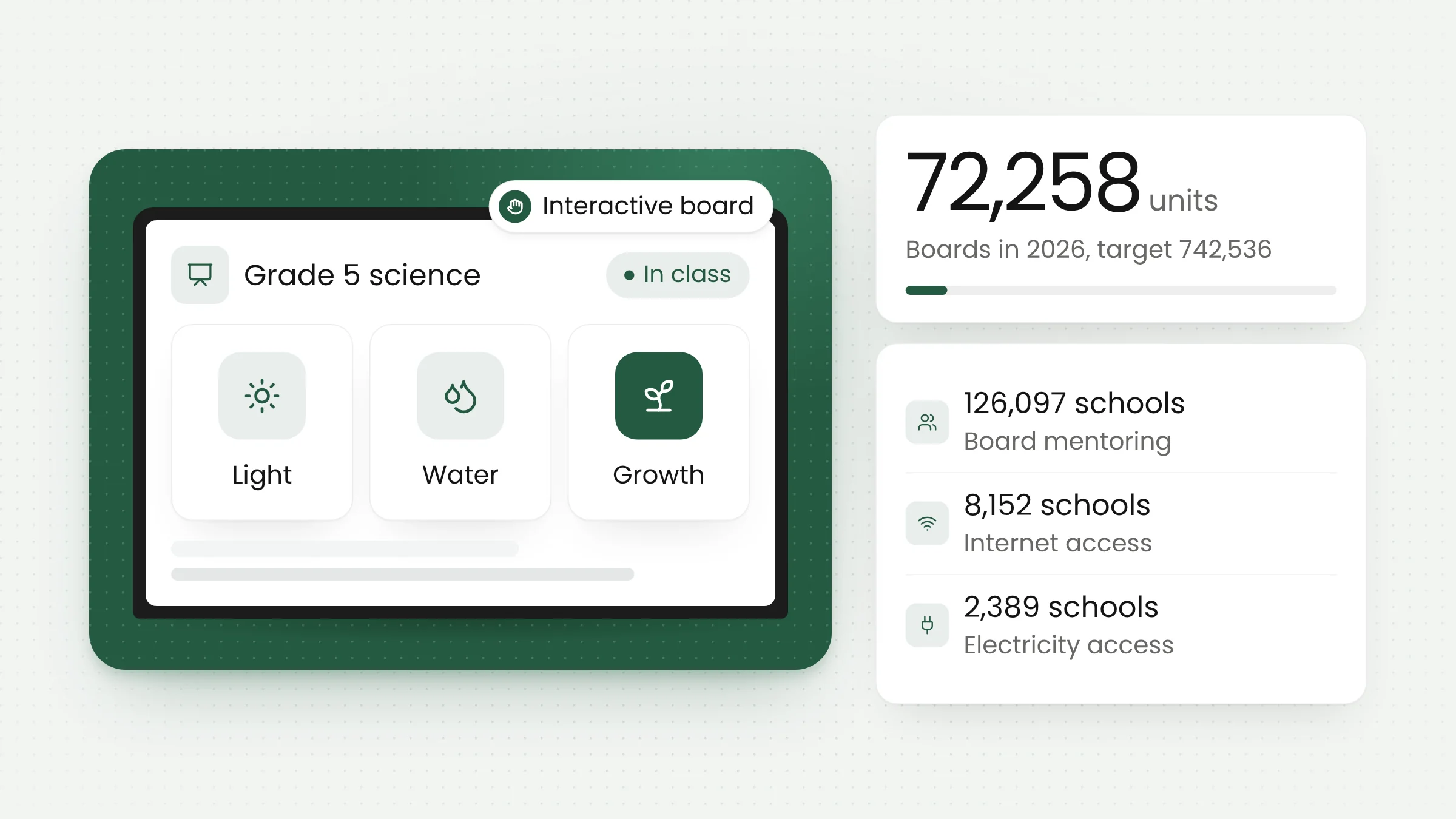
Indonesia has delivered 72,258 interactive boards to schools so far in 2026, against a target of 742,536 units for the year. The Ministry of Primary and Secondary Education (Kemendikdasmen) released the figure, based on data through October 20, 2026, at a briefing on its first two years. The harder question now sits in the classroom: whether teachers and schools are ready to use the devices.
Two years of the interactive board program
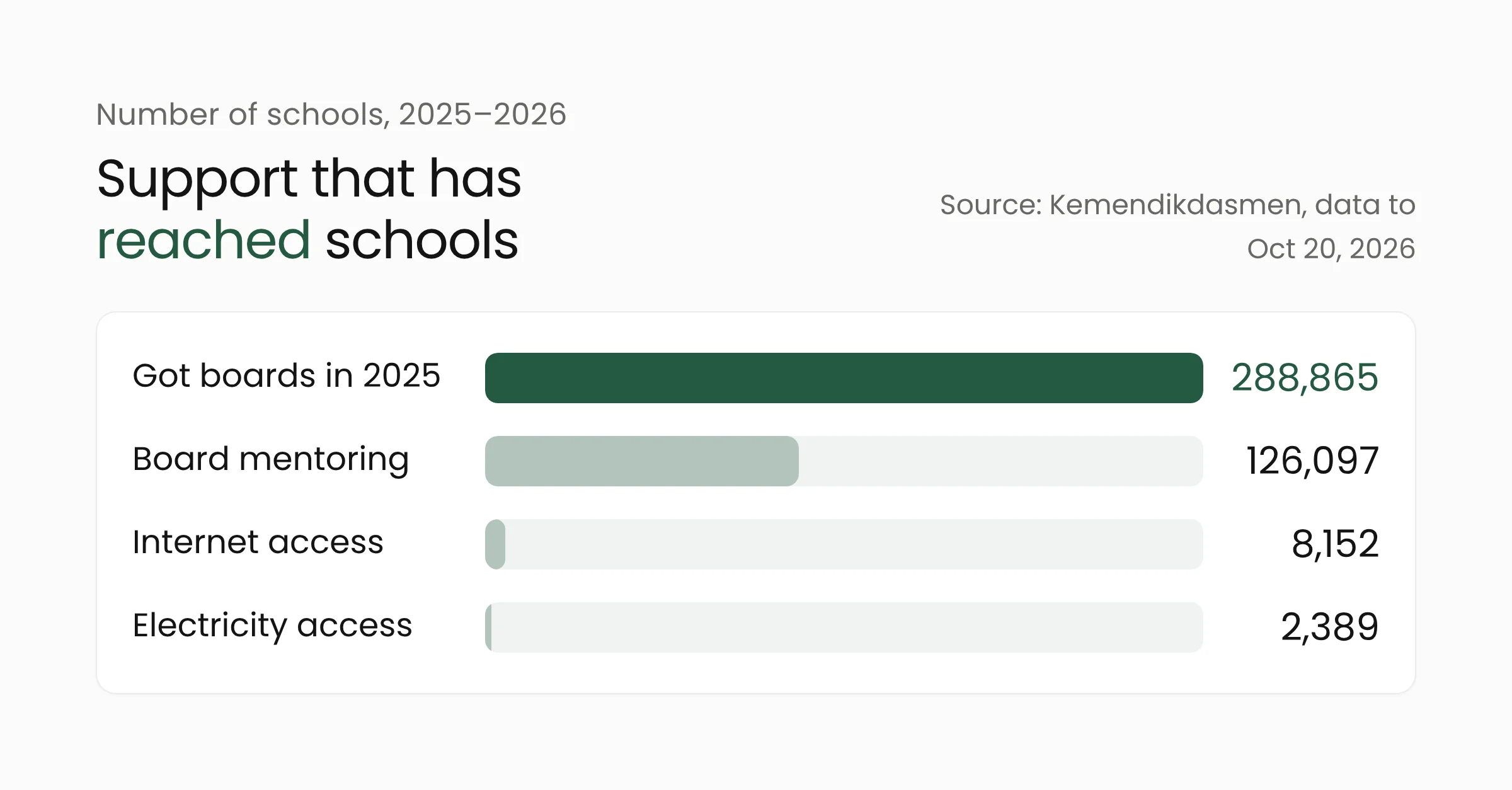
The ministry held the media briefing in Jakarta on Monday, October 26, 2026. According to the official summary published by BPMP Aceh, a regional office of the ministry, 288,865 schools received an interactive board, known locally as papan interaktif digital (PID), in 2025. This year’s deliveries stand at 72,258 units, or roughly 9.7 percent of the 2026 target.
The ministry also reported support around the devices. It provided electricity access to 2,389 schools and internet access to 8,152 schools, and offered mentoring on board use to 126,097 schools. Republika reported the same figures on October 27, 2026.
A summary on the BPMP Banten website adds that the 2025 package came with supporting equipment, including laptops and hard drives. On teacher skills, 53,023 teachers took training in coding and artificial intelligence, and coding and AI are now offered as an elective subject in 20,167 schools.
Another figure is also in circulation. At a two-year government review on October 27, 2026, Minister of Primary and Secondary Education Abdul Mu’ti said more than 300,000 Interactive Flat Panel devices had been distributed to schools, Radar TV reported. The ministry did not explain how that number was calculated, so readers should compare it with the year-by-year data above.
How an interactive board works
An interactive board, called an interactive flat panel (IFP) in most markets, is a large touchscreen mounted in the classroom. It combines the jobs of a whiteboard, a projector, and a computer. Teachers can write directly on the screen, play videos or simulations, and save lesson notes to open again later.
Panels of this type can generally be used in two ways. They can run learning apps on their own as standalone computers, or act as a large display for a teacher’s laptop connected by cable or wireless link. Both modes need a stable power supply, and most modern lesson content also needs an internet connection.
The ministry has planned for schools that are not yet connected. In a September 14, 2025 press release, it said interactive content can be used offline through specially prepared external storage, and that schools without internet receive additional equipment. Recipients are verified in three layers: the national school database (Dapodik), validation by the local education office, and a statement of willingness from the school.
Director General Gogot Suharwoto described devices, content, and mentoring as a single package at the time: “Ini satu paket. Tidak cukup hanya alat tanpa konten, atau konten tanpa pendampingan.” In English: it is one package, and a device without content, or content without mentoring, is not enough.
From delivery to teacher training
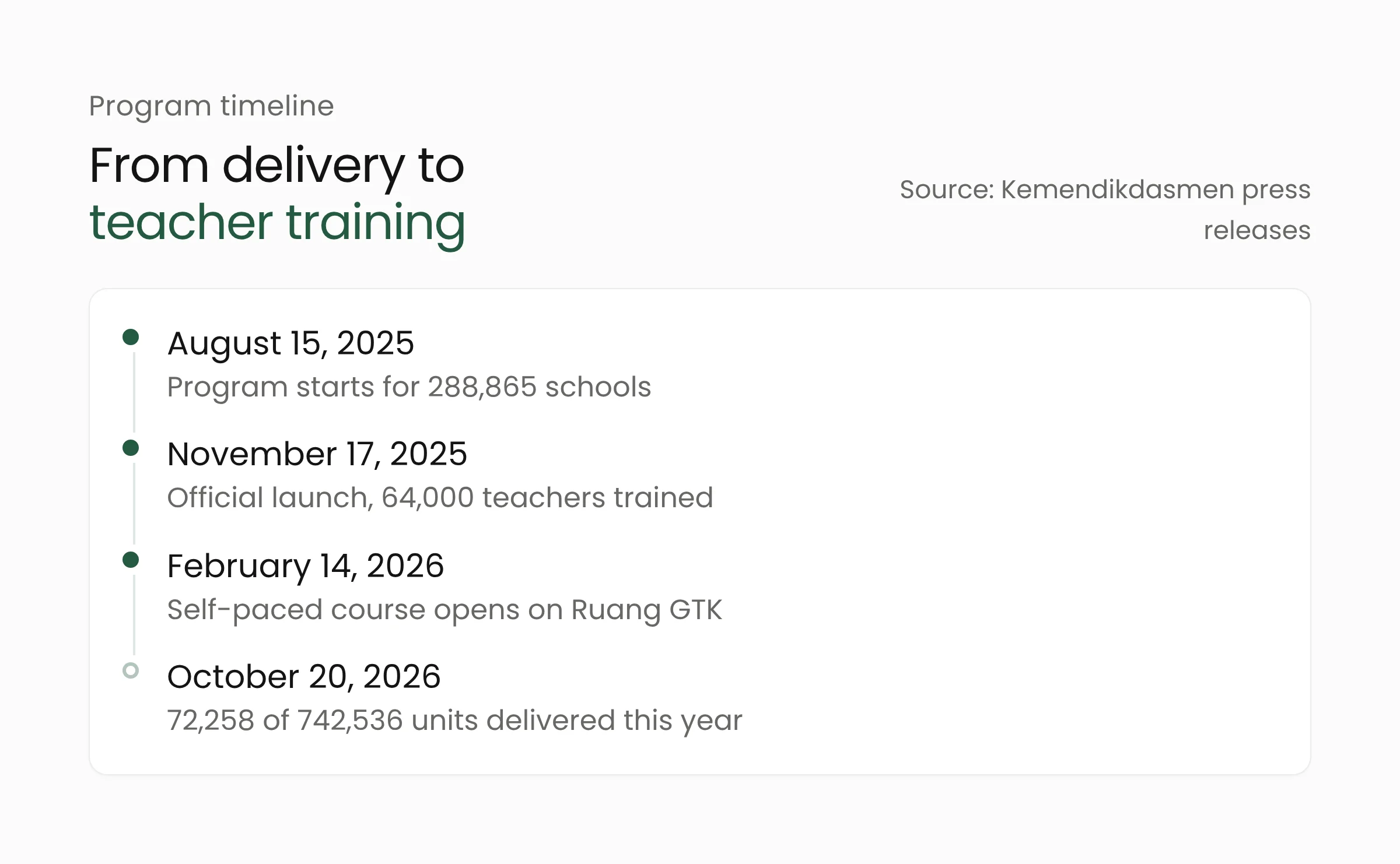
The learning digitization program started on August 15, 2025, covering 288,865 schools. When President Prabowo Subianto formally launched it at SMP Negeri 4 in Bekasi on November 17, 2025, a ministry press release said 215,572 units had been shipped and about 173,000 had arrived at schools. By then, 64,000 teachers had been trained and 1,450 “Pejuang Pendidikan Digital” (digital education champions) were working as mentors.
The next phase turned to teachers. On February 14, 2026, the ministry’s Center for Data and Information Technology opened a self-paced course on using interactive boards in teaching. It covers the board’s features, interactive teaching strategies, and classroom practice. Teachers can take it at any time through Ruang GTK on the Rumah Pendidikan platform, using a belajar.id account.
The scale of the teacher challenge
The numbers are large. Speaking at the Tech & Telco Forum 2026, covered by CNBC Indonesia in May 2026, Arif Jamali, the ministry’s director for secondary and special education teachers, said Indonesia has about three million teachers. The ministry has identified more than 50,000 teachers to speed up the rollout and is strengthening teacher communities as a way to learn.
Arif also warned that without better teacher skills, the boards would serve only as replacement whiteboards. In remote and underdeveloped regions, known as 3T areas, the government plans to provide electricity and internet before delivering boards, and every teacher in those areas will be trained.
Usage is harder to measure than unit counts
Delivered units are easy to count. Actual use is harder to measure. Official reports so far do not say how many teachers use the boards regularly in class, and the Radar TV report does not include that figure either.
For a school, a panel that is rarely switched on still has costs: space, electricity, maintenance, and software updates. A panel used every day also needs account management, storage for lesson files, and regular condition checks. Without good records, a small fault such as an unresponsive touchscreen can leave a device idle for months.
An interactive board is a connected device. It has an operating system, joins the school network, and stores lesson files. Managing a fleet of them looks a lot like managing laptops or IoT devices in any organization: each unit needs to be logged, updated, and monitored. We apply the same principle when designing education technology solutions for schools and education offices.
What this means for schools and education offices
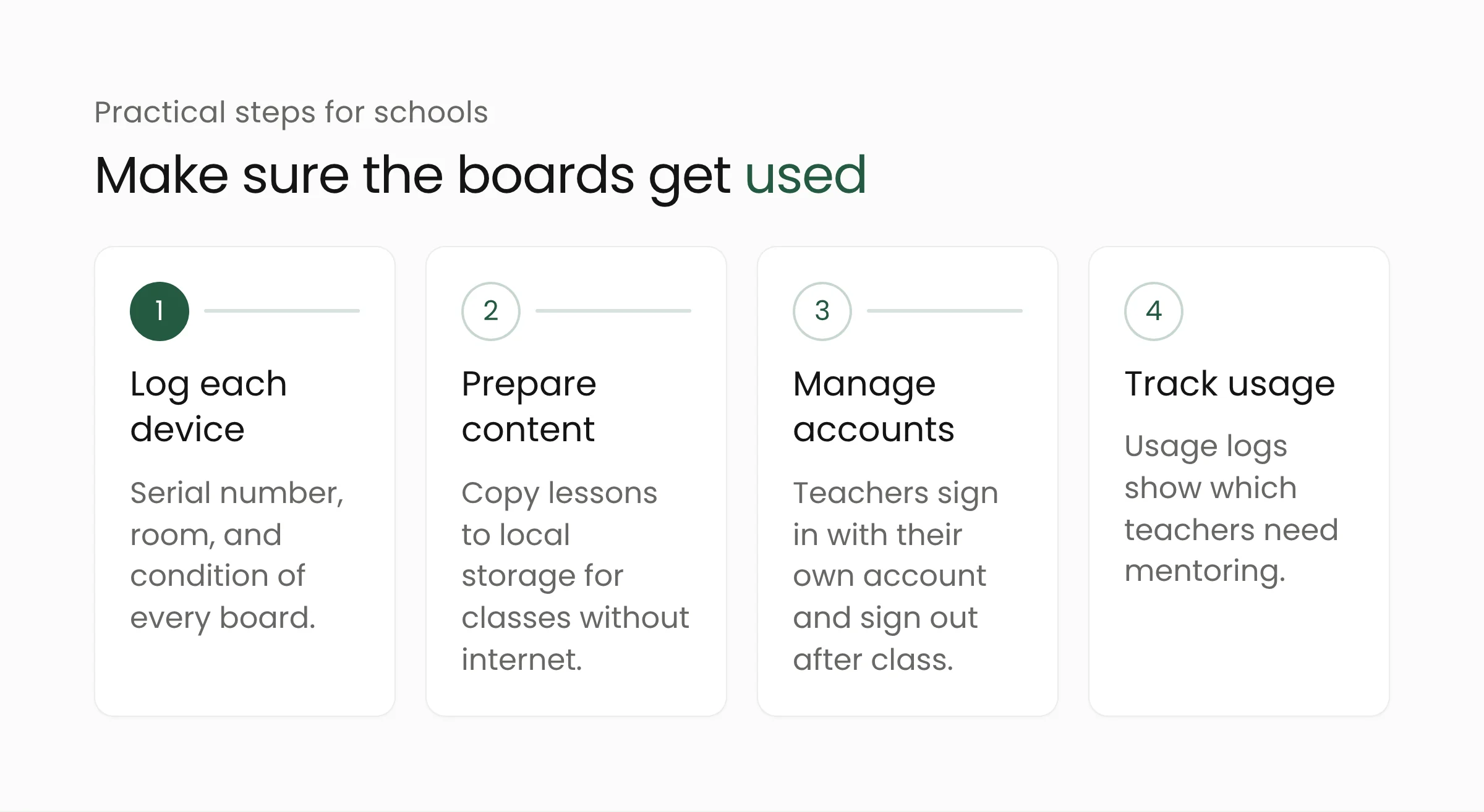
Schools that have received, or expect to receive, interactive boards can prepare four things.
- Log every device. Record each panel’s serial number, room, delivery date, and initial condition. This makes warranty claims and reporting to the education office easier.
- Prepare content that works offline. Copy lessons from the external storage or Rumah Pendidikan to local storage, especially for classrooms with weak signal. Set a schedule to refresh materials each semester.
- Manage accounts and security. Teachers should sign in with their own belajar.id account and sign out after class. Shared panels can easily retain personal accounts or student files. Install software updates released by the manufacturer.
- Track usage. Note how many hours each panel is used per week and by which teachers. This helps principals decide who needs mentoring and shows the value of the device during evaluations.
Education offices can collect the same data from many schools in a single dashboard. With it, they can spot schools where panels sit unused, send mentors where they are needed, and estimate power and internet needs more accurately. Remote device monitoring of this kind is part of our Internet of Things services, the same approach other sectors use to manage machines and sensors.
Schools can also draw on their experience with computer-based exams. Lessons from the TKA 2026 dress rehearsal, such as checking networks and devices well before the big day, apply to interactive boards as well.
Frequently asked questions
How is an interactive board different from a projector?
A projector only shows images from a computer on a wall or screen. An interactive board is a touchscreen that can run its own apps, so teachers and students can write, move objects, and save notes directly on the display.
Can interactive boards be used without internet?
Yes, for content that is already stored. The ministry says interactive content can be accessed offline through specially prepared external storage. The panels still need electricity, however, and updating content and software is easier with an internet connection.
How can teachers get trained on the boards?
Teachers can take the self-paced course “Pemanfaatan Papan Interaktif Digital dalam Pembelajaran” (Using Interactive Boards in Teaching) through Ruang GTK on Rumah Pendidikan with a belajar.id account. Schools can also request mentoring through the ministry’s program.
Closing thoughts
Interactive board deliveries for 2026 remain well short of target, but schools that already have the devices can start organizing how they are used now. Logging devices, preparing offline content, managing accounts, and tracking usage are simple tasks that decide whether a panel actually helps students learn. If your school or education office is setting up a system to manage classroom devices, the Merakit team is ready to talk.
Sources
- BPMP Aceh (Kemendikdasmen): Dua Tahun Pemerintahan Prabowo–Gibran, Kemendikdasmen Perluas Akses dan Perkuat Mutu Pendidikan (October 27, 2026)
- BPMP Banten (Kemendikdasmen): Capaian Pendidikan 2026 (October 27, 2026)
- Republika: Dua Tahun Prabowo-Gibran, Kemendikdasmen Perluas Akses dan Perkuat Mutu Pendidikan (October 27, 2026)
- Radar TV: 300 Ribu Perangkat Interaktif Masuk Sekolah, Kesiapan Guru Jadi Penentu Kualitas Pembelajaran (October 30, 2026)
- Kemendikdasmen: Kemendikdasmen Dorong Guru Optimalkan Pemanfaatan IFP dalam Pembelajaran melalui Pelatihan Mandiri (February 14, 2026)
- Kemendikdasmen: Percepat Transformasi Pendidikan, Presiden Luncurkan Digitalisasi Pembelajaran (November 17, 2025)
- Kemendikdasmen: Kemendikdasmen Dorong Digitalisasi Pembelajaran untuk Wujudkan Kelas Interaktif (September 14, 2025)
- CNBC Indonesia: Pemerintah Siapkan Papan Interaktif, Jangkau Daerah 3T Secara Digital (May 6, 2026)