Blog Smartphone Shipments
Smartphone Shipments Fall 22% as Memory Crisis Lifts Prices
On this page· 7 sections
Global smartphone shipments fell roughly 20 to 22% year on year in the third quarter of 2026, according to preliminary data from Counterpoint Research and IDC. The main cause is a surge in memory chip prices. Manufacturers have raised phone prices, and analysts do not expect relief before 2028.
Shipments fell 20 to 22%
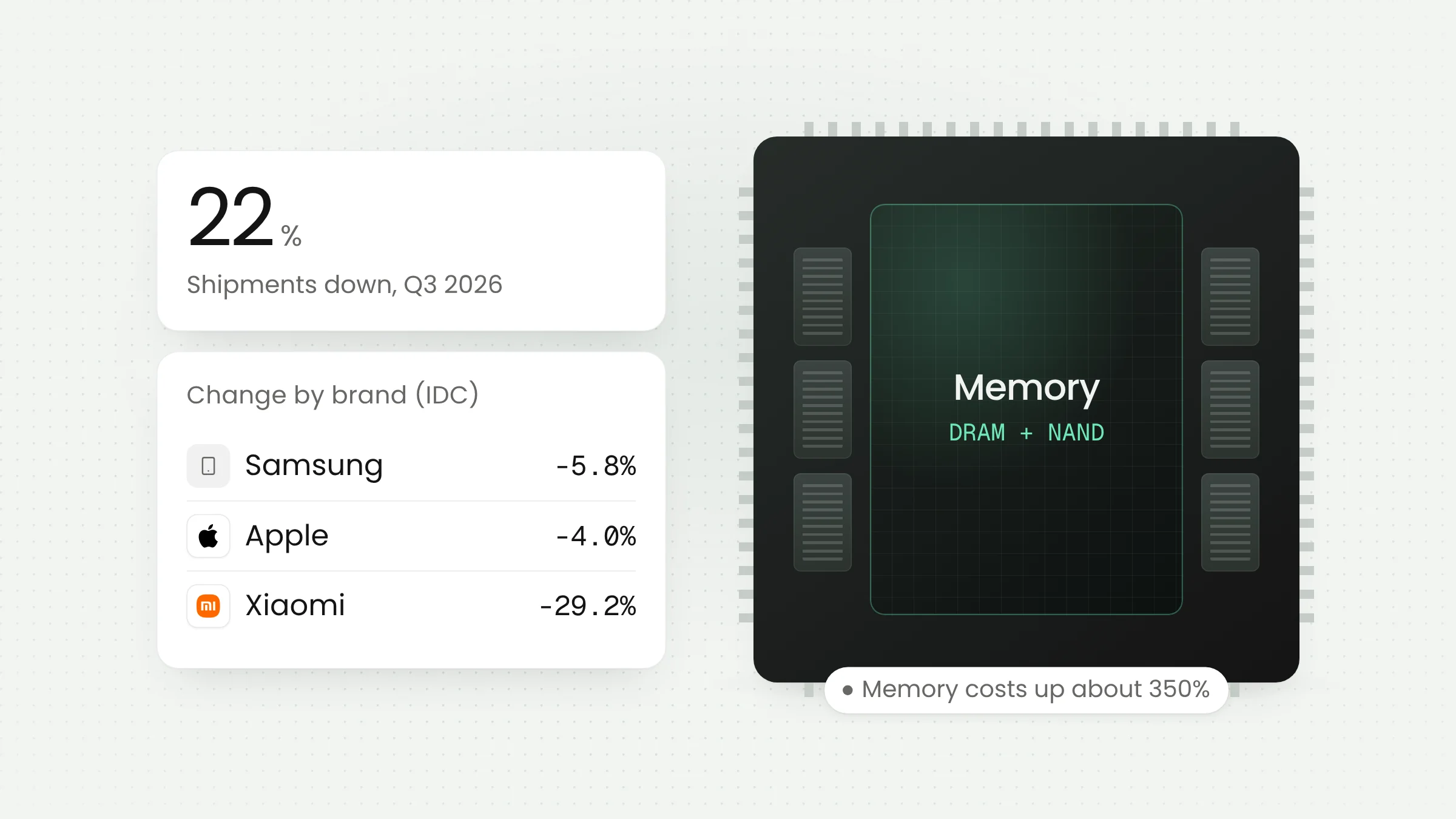
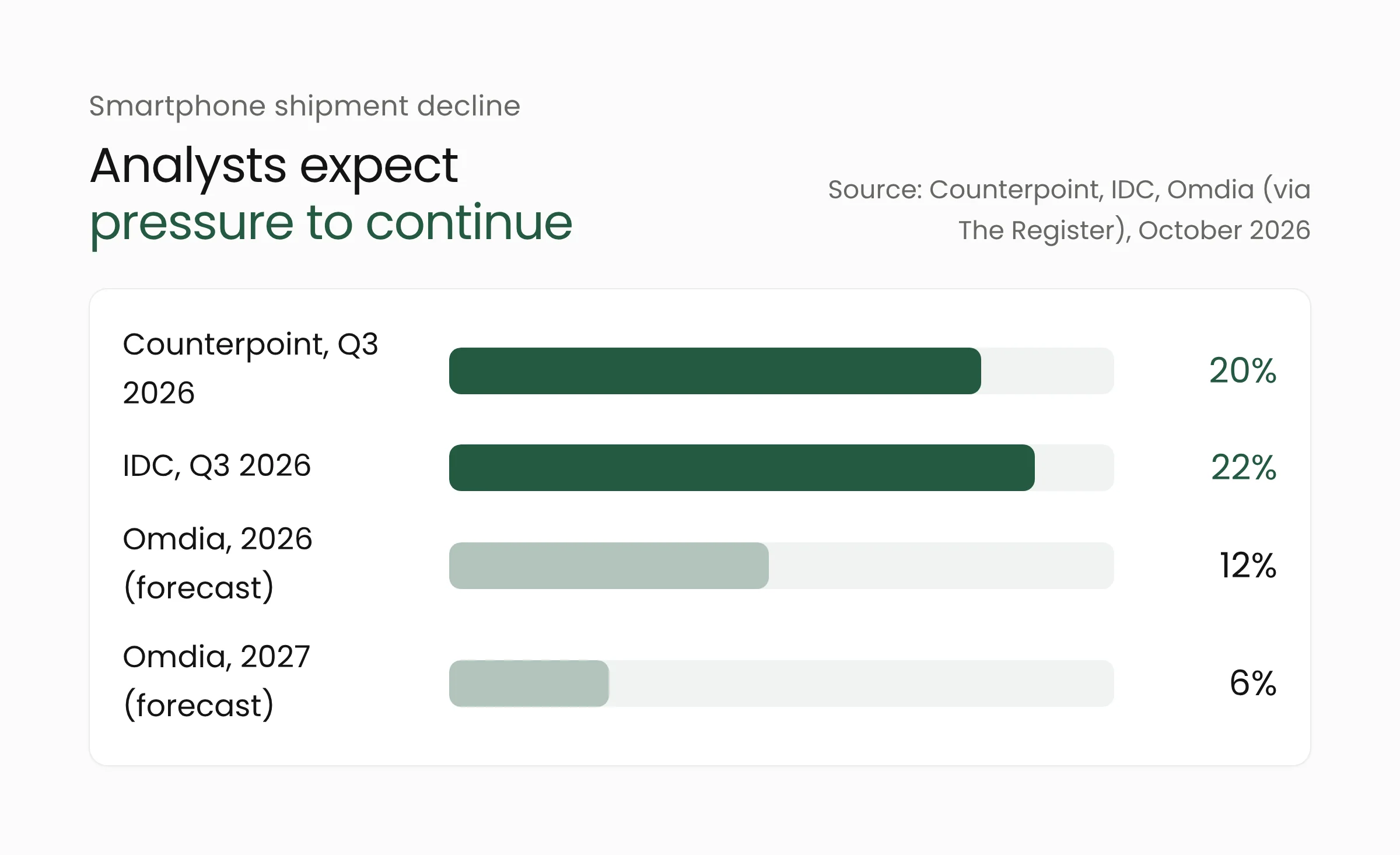
IDC recorded 255.3 million smartphones shipped between July and September 2026. That is 22.0% below the 327.3 million units shipped in the same quarter last year, and IDC calls it the largest year-on-year drop it has seen in any quarter. The figures are preliminary and cover branded new devices only, excluding OEM sales and refurbished units.
Counterpoint Research put the decline at 20% and described the quarter as the weakest third quarter since 2012. It says global retail smartphone prices have risen about 20% so far in 2026. Omdia, cited by The Register, also estimated a 20% decline for the quarter.
The gap between the numbers is normal, since each firm uses its own methodology. Counterpoint’s figures are sell-in, meaning phones shipped to channel partners rather than phones that have reached buyers. The data therefore shows the direction of the market without measuring sales to end customers.
We did not find third-quarter data specific to Indonesia in the sources we read. Readers there should still pay attention, because component prices are set by the same global market.
Chinese brands are under the most pressure
The decline is uneven. In IDC’s table, Samsung shipped 57.8 million units (down 5.8%) and Apple 57.3 million (down 4.0%). Xiaomi fell 29.2% to 30.7 million units, OPPO fell 34.5% to 25.6 million, and vivo fell 31.5% to 19.1 million.
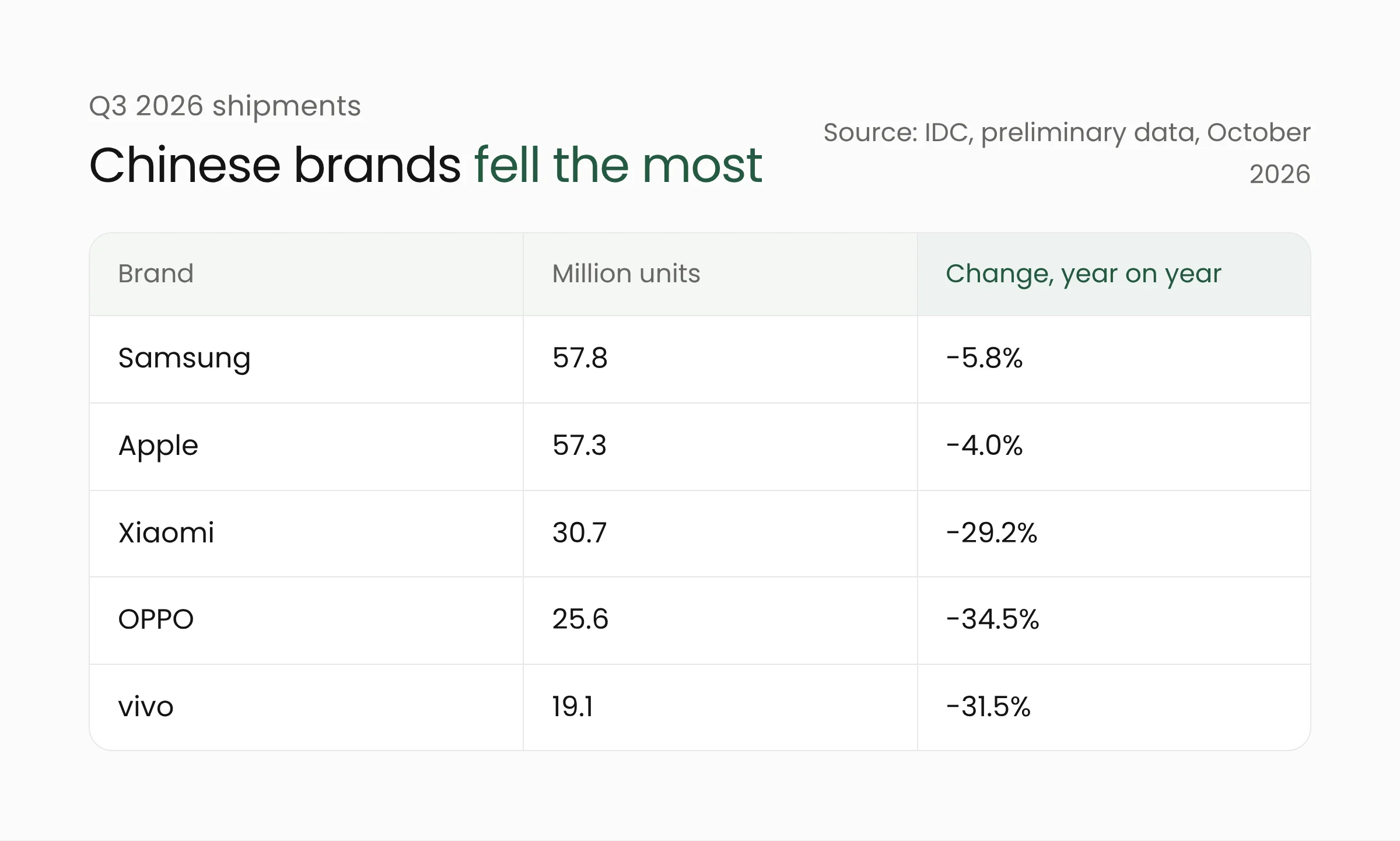
IDC vice president Francisco Jeronimo said Chinese brands face a particularly difficult moment because of their large share of low-end phones, which forces a choice between protecting margins and defending volume. Counterpoint reports that all three raised prices. Xiaomi also cut its exposure to non-core, low-price overseas markets, while OPPO merged the operations of OPPO, realme, and OnePlus. Vivo was constrained by stock shortages.
Samsung and Apple held up better. Counterpoint credits demand for the Galaxy Z Fold8 and steady supply of the Galaxy A series for Samsung. Apple had no base iPhone 18, which meant a smaller initial fill of sales channels, but the iPhone 18 Pro launched more strongly than its predecessors, especially in China and India. Counterpoint puts Samsung’s share at 23% and Apple’s at 22%, the first time Apple has topped 20% in a third quarter. Omdia calculates that the two together account for about 45% of global shipments, up roughly 8 percentage points in a year.
Memory chips shift toward AI data centers
The core problem is memory, meaning DRAM and NAND chips. IDC says memory costs are up about 350% since last year and still rising, although the pace is slowing. Third-quarter costs rose by a low double-digit percentage from the previous quarter, compared with 50 to 100% in earlier quarters.
A July report by IDXChannel, citing Counterpoint, said memory suppliers are prioritizing AI data center customers over consumer electronics makers. Component costs rise as a result, and manufacturers pass them on in prices, mainly on low- and mid-range phones. Omdia adds that some makers are using cheaper display panels, sensors, or radio modules to offset the higher memory bill.
The outlook has not improved. IDC senior research director Nabila Popal said, “Current indicators suggest that the market has not yet reached the bottom.” IDC expects growth to stay constrained through 2027, with recovery no earlier than 2028. Omdia analyst Runar Bjorhovde likewise does not expect the memory crisis to ease before 2028. Omdia forecasts shipments to fall 12% in 2026 and another 6% in 2027.
IDC also flags a downside risk. Some vendors raised production early because they expect component supply to tighten in 2027. If demand stays weak, inventory build-up could weigh on IDC’s 2027 forecast. Counterpoint expects manufacturers to cut production, streamline their portfolios, and focus on premium devices.
What this means for shops and device-buying organizations
Higher memory costs affect anyone who buys phones in volume, from phone shops to schools and local government offices. The changes show up in prices, in which models are available, and in how long devices stay in service. Several steps are worth considering.
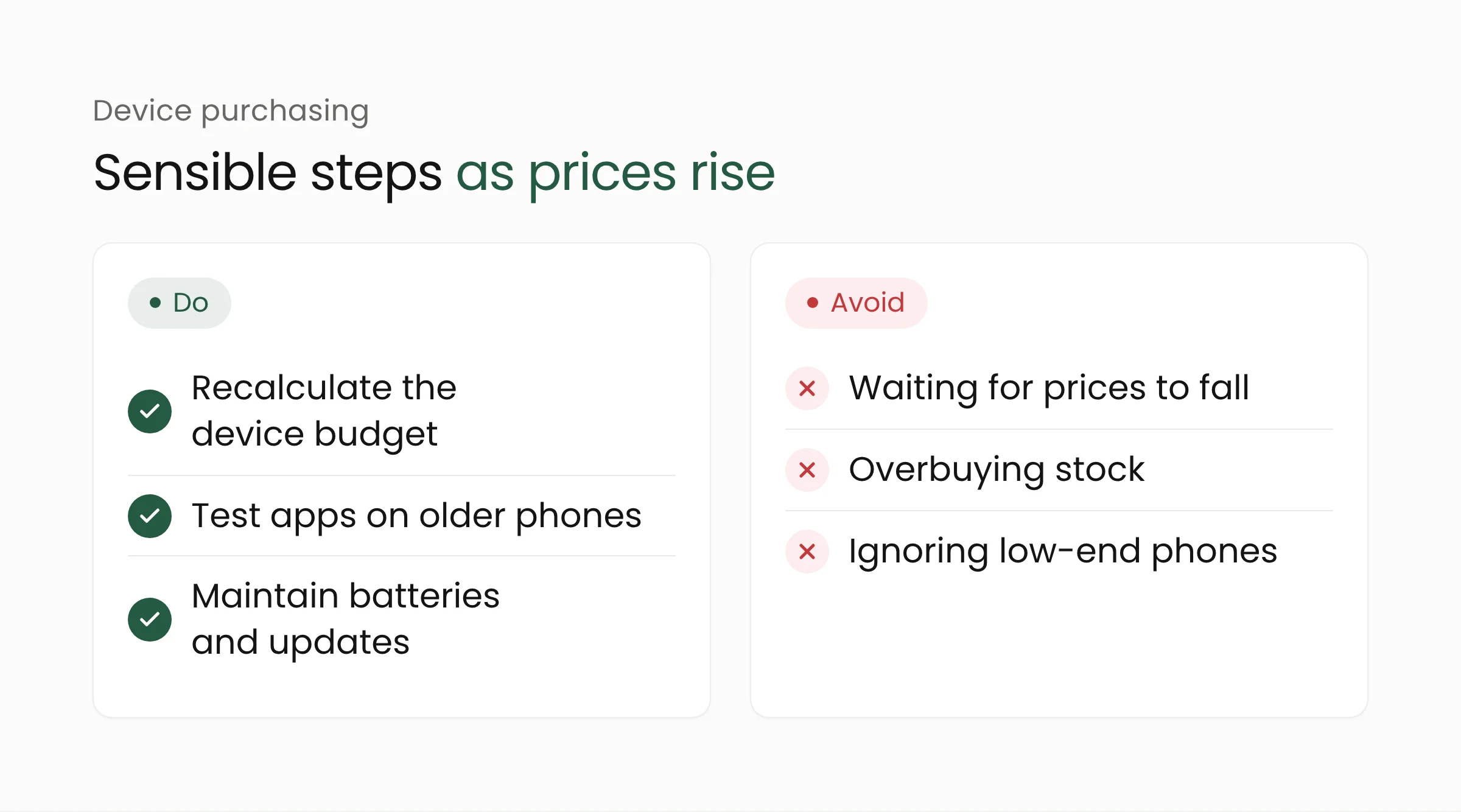
Recalculate budgets and purchase schedules
Counterpoint expects price-sensitive segments to face further pressure, so procurement budgets set last year need a fresh calculation. IDC advises consumers who cannot postpone a purchase to use holiday-quarter promotions, since no forecast supports waiting for prices to fall. Buying in stages is safer than placing one large order, especially if model availability can change.
Extend the life of existing devices
When new phones cost more, old ones stay in use longer. Batteries, storage space, and system updates need attention. App teams should also test on phones with small amounts of memory. Memory-efficient apps keep running well on older devices, and mobile development support can help build that testing. For a discussion of app readiness on a new device, see our article on the iPhone Duo.
Adjust shop stock and pricing
Owners of phone and accessory shops should watch distributor price changes more often. Low-cost models from the most pressured brands may thin out, so stock and selling prices need quick updates. A point-of-sale and inventory system that records purchase prices separately helps calculate real margins. More on this is on our retail management solutions page.
Test services on a mix of devices
Schools running digital exams often rely on student-owned phones or older school devices. Exam apps should be tested on the lowest specification in use, and spare devices should be ready. Our education technology solutions page covers the needs of this sector.
Frequently asked questions
Why are phone prices rising while shipments fall?
Component costs are rising faster than demand is weakening. IDC says memory costs are up about 350% since last year, and Counterpoint reports global retail prices up about 20% in 2026. Manufacturers pass those costs on to consumers, so prices keep rising even as volumes fall.
Will prices fall soon?
Research firms do not forecast that. IDC and Omdia both see relief in 2028 at the earliest. The pace of memory cost increases slowed in the third quarter, but costs have not come down.
Do the IDC and Counterpoint numbers contradict each other?
No. IDC recorded a 22% decline and Counterpoint 20%, using different methodologies and preliminary data. Both point the same way: the weakest third quarter on IDC’s record and the weakest since 2012 by Counterpoint’s count.
Closing
The memory crisis shows that phone prices are shaped partly by chip demand from AI data centers. Shops, schools, and agencies that buy devices in volume should plan budgets on the assumption that prices stay high through 2027. If your organization wants to make sure its apps keep running well on the devices it already has, the Merakit team is ready to talk through our service pages.