Blog AI Copyright
AI Copyright and Journalism: What Organizations Should Do
On this page· 9 sections
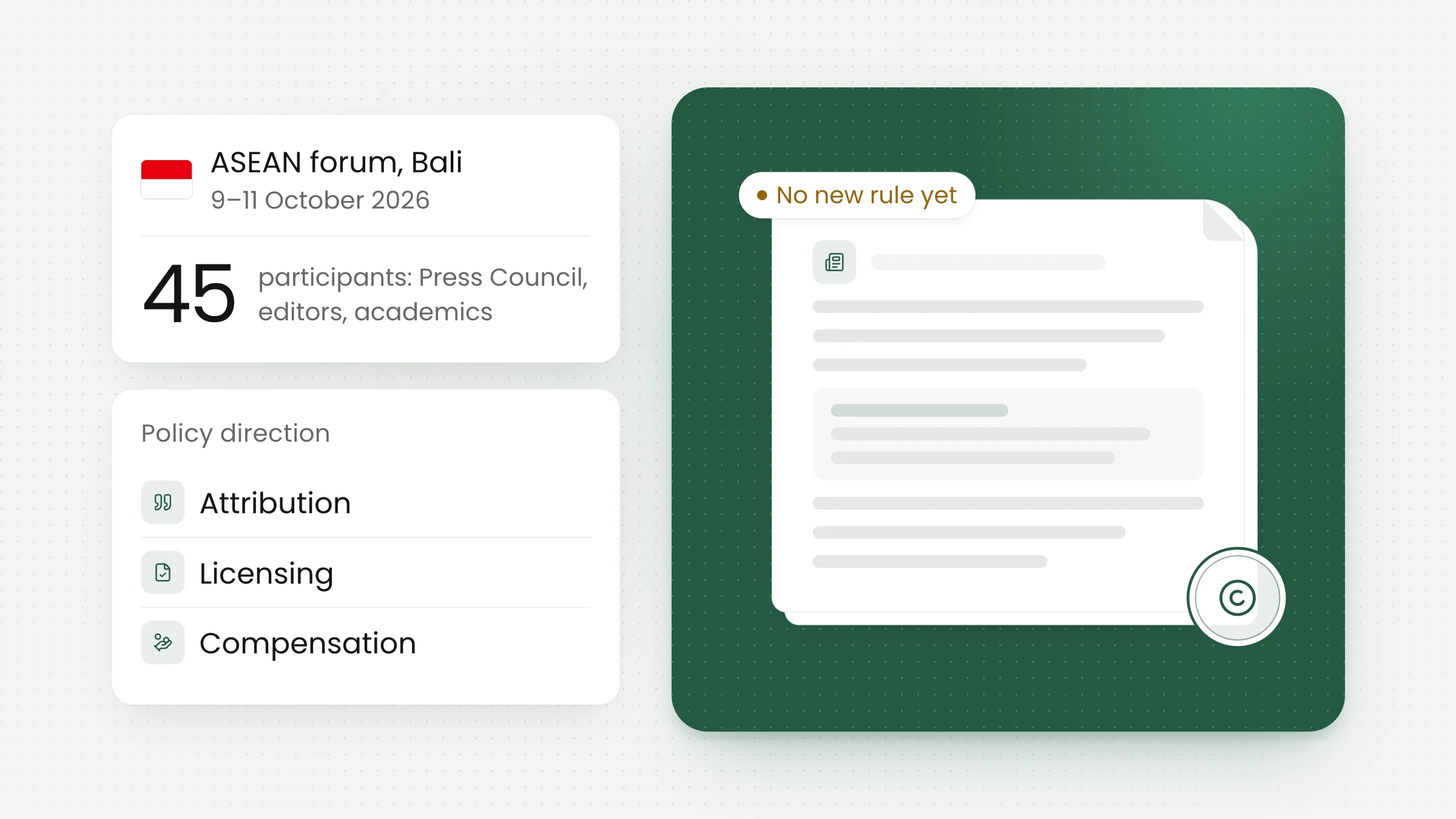
From 9 to 11 October 2026, Indonesian officials, the Press Council, and media leaders from across ASEAN met in Bali to discuss AI copyright for journalistic works. No new rule came out of it. The direction was clear, though: news content used by platforms and AI systems should come with attribution, licensing, and fair compensation.
What was discussed in Bali
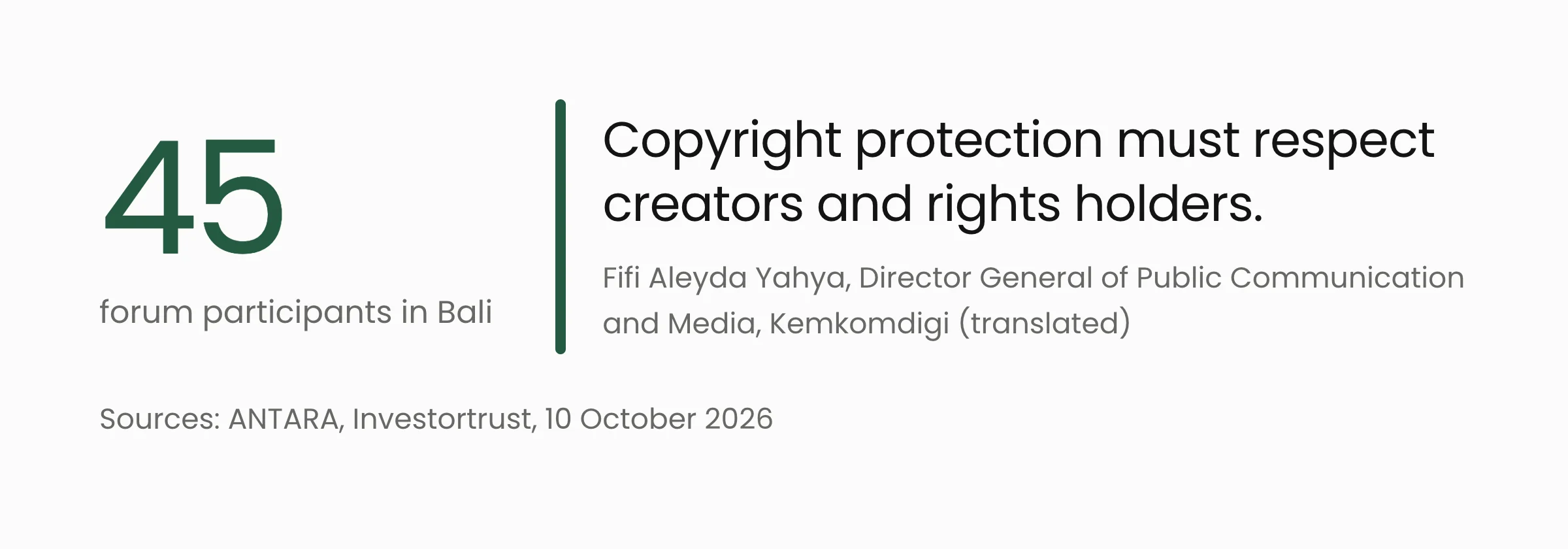
The event was called the ASEAN Forum on the Protection of Journalistic Works in the Copyright Regime in the Digital Era. According to Investortrust, it ran for three days in Bali with 45 participants, including Press Council representatives, editors-in-chief, journalists, academics, and related associations. Several outlets reported its opening on Saturday, 10 October.
Fifi Aleyda Yahya, Director General of Public Communication and Media at the Ministry of Communication and Digital (Kemkomdigi), said digital platforms and AI widen the reach of journalism while creating new copyright challenges. As ANTARA reported, she called for rules on attribution, licensing, and compensation, both for use on platforms and for AI development. Her message in one line: “Perlindungan hak cipta harus menghargai pencipta dan pemegang hak” (copyright protection must respect creators and rights holders).
From the Press Council, Chair Komaruddin Hidayat argued that AI systems learn from decades of journalistic work, so journalists and media companies should share in the value those systems create. He framed it as a question of ethics as much as economics.
The government’s position: legal certainty and fair return
Minister of Law Supratman Andi Agtas, as reported by RCTI+, said journalists and media organizations deserve legal certainty and a reasonable economic return for their work, while technology should keep moving forward.
The existing foundation in Indonesia is Peraturan Presiden Nomor 32 Tahun 2024 tentang Tanggung Jawab Perusahaan Platform Digital untuk Mendukung Jurnalisme Berkualitas (Presidential Regulation No. 32 of 2024 on digital platform companies’ responsibility to support quality journalism, often called the publisher rights rule). Kemkomdigi described it as complementary to copyright protection rather than a replacement. The two address related but separate problems.
One caveat: everything above comes from media coverage. We did not find an official forum outcome document or any binding agreement. Please read this as a signal of policy direction, not as a new legal obligation.
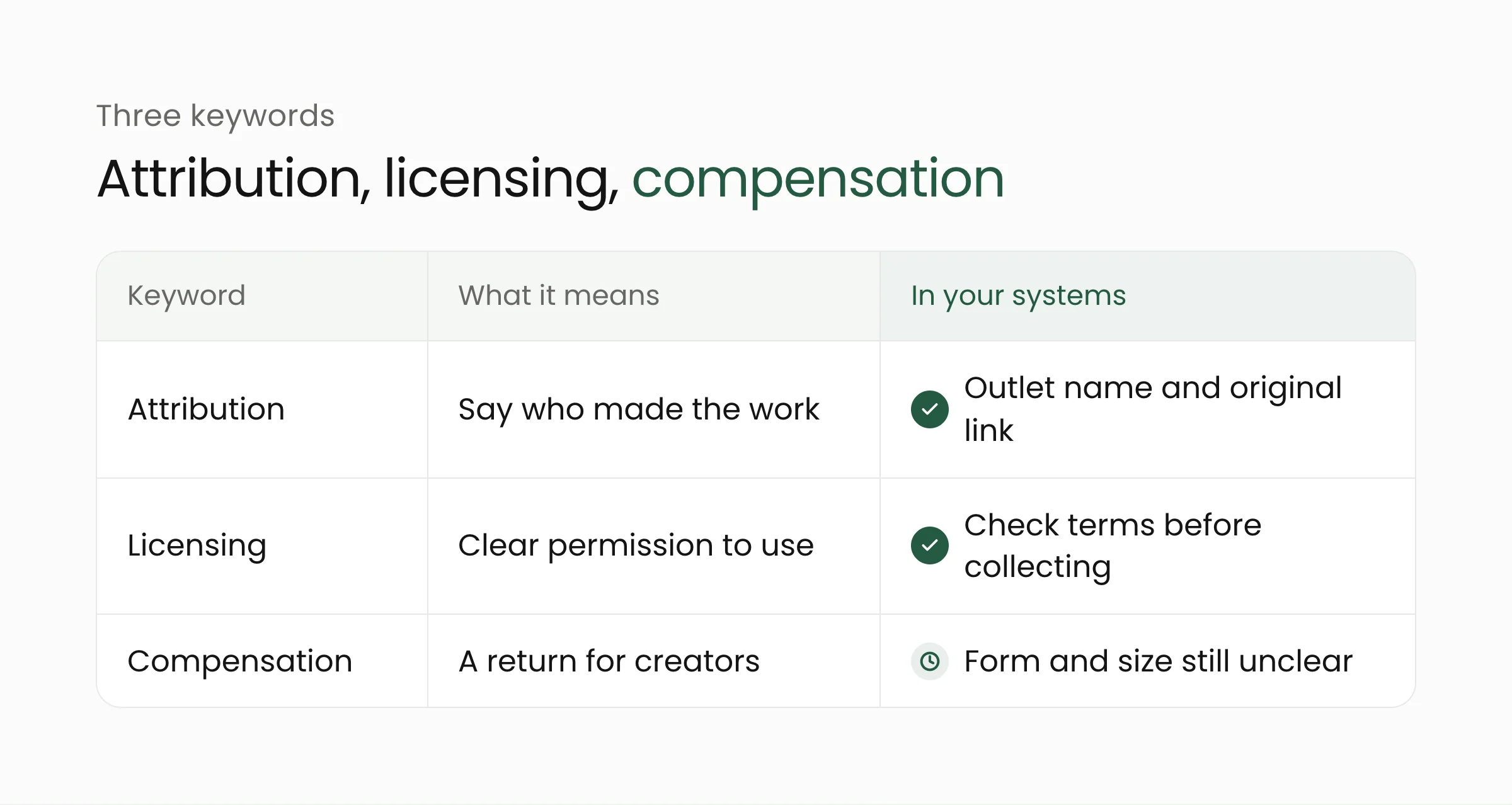
Three keywords: attribution, licensing, compensation
These terms sound technical, but the ideas are simple.
Attribution means saying who made the work. If your app shows a news summary, readers should be able to see which outlet it came from.
Licensing means clear permission. A work can be used for a defined purpose under defined terms, not just because it happens to be freely reachable online.
Compensation means a return for creators when their work is used commercially or to build new systems. The forum reports did not spell out its form or size, and that is exactly the part still waiting for a rule framework.
Fifi also stressed that protection has to be balanced with freedom of expression and the public interest. Fair quotation for information, education, or criticism is not automatically a problem. It is the exact boundary that still needs clarifying.
Why this matters to schools, agencies, and companies
At first glance, this looks like an issue for media houses and big tech. In practice, many ordinary organizations already touch it without noticing.
A local government office builds a service chatbot that answers by summarizing regional news. A university builds an issue monitor that collects articles from dozens of sites. A corporate communications team uses an AI tool to summarize press clippings for an internal newsletter. A teacher asks students to run reading articles through an AI assistant. All reasonable, and all of them use someone else’s journalism.
We recently covered how the government is preparing sector-specific AI guidelines and child protection for schools. The copyright question complements it: not only who uses AI, but what material goes into it.
What this means for your organization
Detailed rules may be a while away. Good habits can start now, and they are cheap.
Map where third-party content enters your systems. Check chatbots, internal search, summarizers, and any automated data collection.
Show attribution consistently. If your system displays summaries or excerpts, include the outlet name and a link to the original article. It builds reader trust and lowers the risk of disputes.
Read the terms of use before collecting content in bulk. News sites usually state conditions on reuse and automated access. Some prohibit it without written permission. Treat those terms as part of the process, not a formality.
Ask your AI vendors the same questions. Where does the training and reference data behind this product come from? Is it licensed? What happens if a rights holder objects? Serious vendors will have an answer, or at least be willing to find one.
Write a one-page policy. Define what may be quoted, how long an excerpt can be, how sources are credited, and who decides gray-area cases. A short policy people actually use beats a thick one nobody reads.
Consider licensed sources for core needs. If your product depends on news content, an official partnership or subscription with publishers is safer than relying on automated scraping. If you want to discuss designing AI systems with this in mind, see our artificial intelligence services.
A simple example
Imagine a high school that builds a literacy portal summarizing five education news stories every morning with AI. The risky version shows each summary without the outlet name or a link, so students assume the school wrote it. The tidy version includes the outlet, the publication date, and a “read the full story” button linking to the source, plus a note that the summary was AI-assisted.
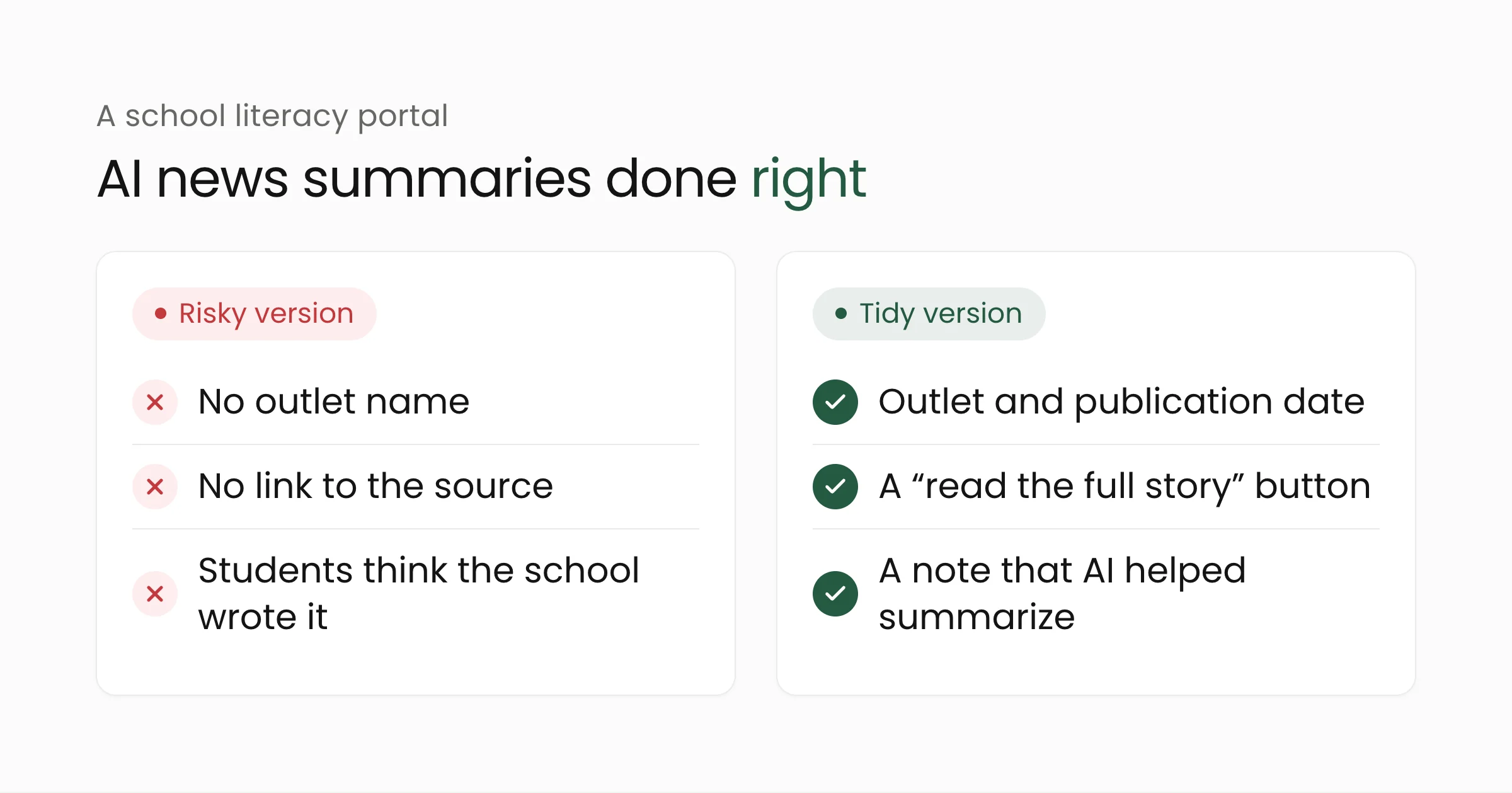
The difference is a few lines in a template. The effect is real: students learn to trace sources, publishers get visits, and the school keeps a record it can stand behind. For schools and campuses that want to organize AI use more broadly, see our education technology solutions.
Frequently asked questions
Does my organization already have to pay royalties for news content used by AI?
Based on coverage of the forum, no new obligation has been announced. What emerged is a push from the government and the Press Council to regulate attribution, licensing, and compensation. Keep following the copyright rules that already apply, including Undang-Undang Nomor 28 Tahun 2014 tentang Hak Cipta (Law No. 28 of 2014 on Copyright), and check each source’s terms of use.
Is quoting news for teaching material or an internal clipping service a problem?
Fair quotation with credit is generally different from copying or bulk-collecting content for reuse. The exact line depends on context, so for doubtful cases, ask the publisher for permission or consult your legal adviser.
What if our AI vendor will not explain its data sources?
That is information in itself. Record your questions and their answers, weigh the risk against your needs, and consider alternatives. For systems that handle sensitive data, that kind of opacity also deserves a look from a security and data protection angle.
Closing thoughts
The Bali forum did not produce new rules, but the message was consistent. Journalistic work has value, and that value deserves recognition when AI uses it. Organizations that tidy up attribution and licensing now will be better prepared when the technical rules arrive.
If you would like to talk through how AI systems at your school, agency, or company can be designed with clear sources, get in touch. We are happy to chat with no commitment. For related reading on checking AI-generated content, see our article on SynthID Detector.
Sources
- ANTARA, “Komdigi dorong perlindungan hak cipta karya jurnalistik di era AI” (10 October 2026)
- ANTARA, “Kemkomdigi tekankan pentingnya pelindungan hak cipta karya jurnalistik” (10 October 2026)
- Investortrust, “Ketua Dewan Pers: Platform dan AI harus berbagi nilai ekonomi dengan jurnalis” (10 October 2026)
- RCTI+ (Sindonews), “Di era AI, Menkum tekankan pentingnya pelindungan karya jurnalistik” (10 October 2026)