Blog Salesforce
Salesforce to Acquire Braze in a $5.66 Billion Deal
On this page· 7 sections
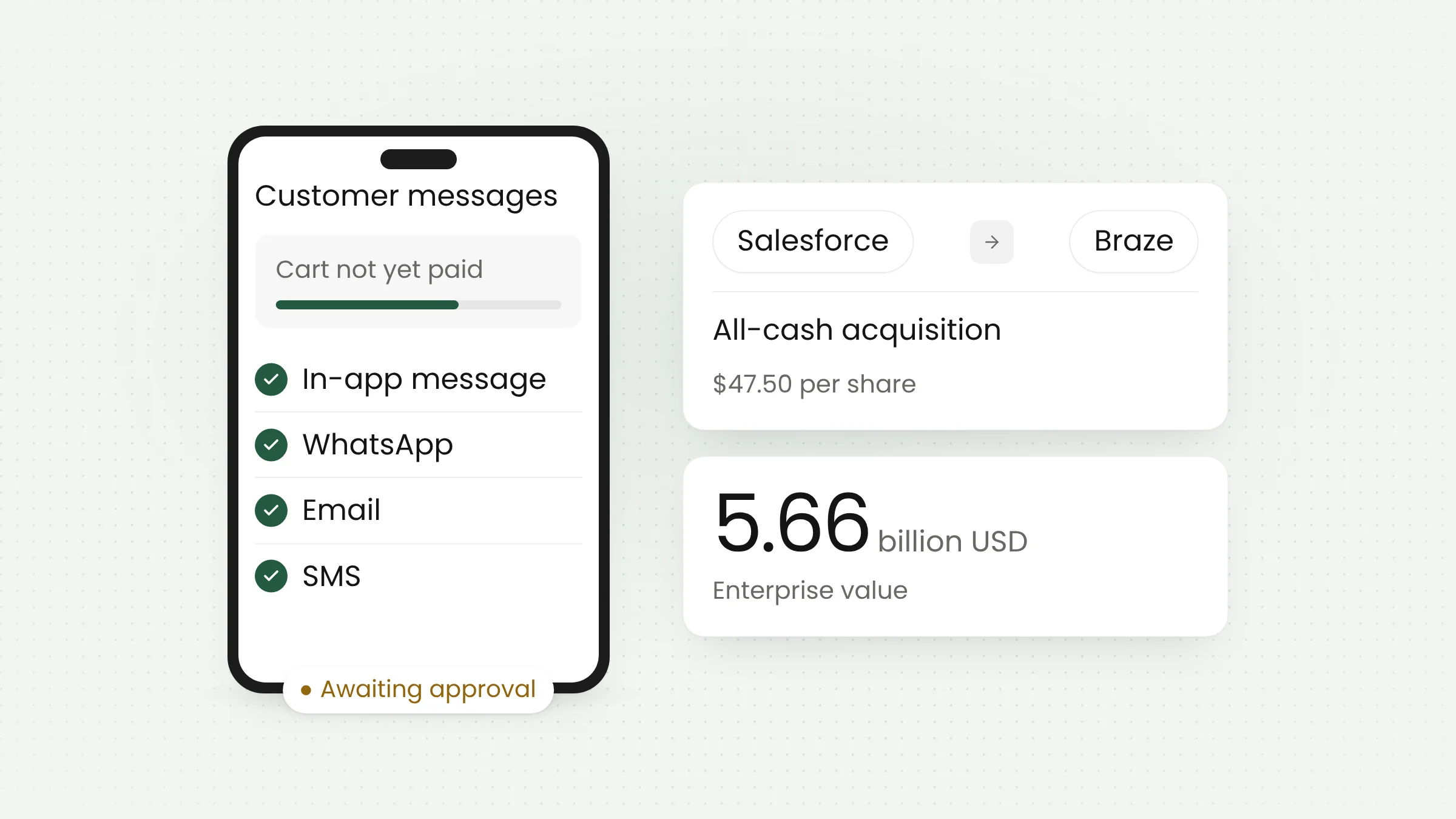
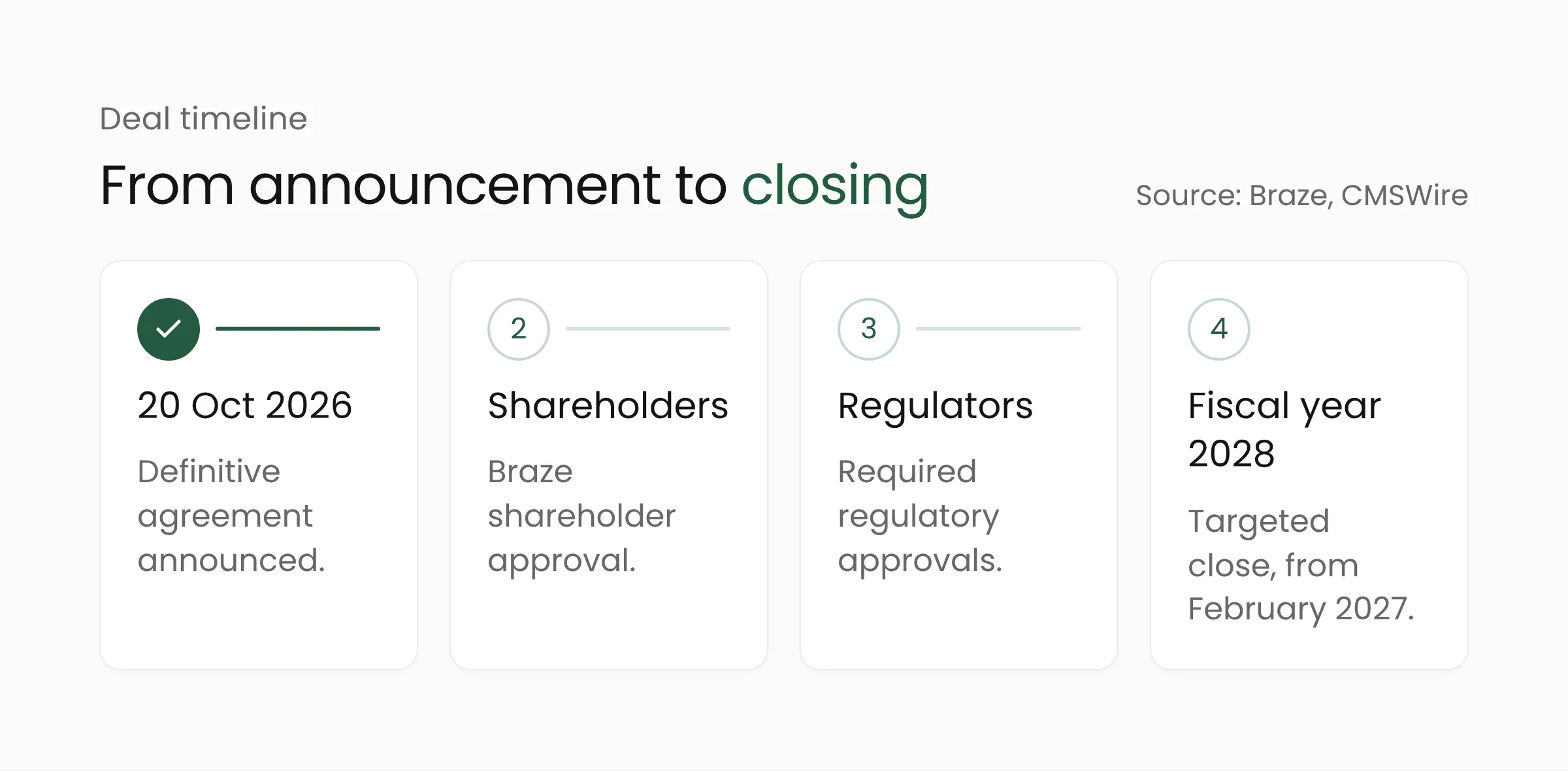
Salesforce has agreed to acquire Braze, the platform that sends personalized messages through mobile apps, email, SMS and WhatsApp. The deal, announced on 20 October 2026, values Braze at $47.50 per share in cash, or about $5.66 billion for the whole company. Closing is targeted for Salesforce’s fiscal year 2028.
What the Salesforce and Braze agreement says
Salesforce (NYSE: CRM) signed a definitive agreement to acquire Braze (NASDAQ: BRZE), according to Braze’s press release. Holders of Braze Class A common stock will receive $47.50 in cash per share. Enterprise value, a measure of the whole company’s worth, is about $5.66 billion.
Closing is targeted for Salesforce’s fiscal year 2028, which CMSWire says begins in February 2027. The deal still needs approval from Braze shareholders and from regulators. Until then the two companies operate separately, and Braze remains an independent public company.
Salesforce said the acquisition does not change its fiscal 2027 guidance. According to a MarketBeat report on Yahoo Finance, Salesforce’s Robin Washington said the purchase will be paid for with cash and needs no debt. She expects it to add to growth while weighing on profitability in the near term. Salesforce has not guided fiscal 2028 and has not updated its long-term targets.
How the Braze platform works
Braze describes itself as a cloud-based customer engagement platform for real-time interaction with consumers. Its system records events that happen in an app or on a website and triggers a matching message. For example, a shopper who opens a cart but has not paid can receive a reminder.
Those messages can take the form of in-app notifications, personalized content feeds, live updates on a phone screen, email, SMS or WhatsApp. An AI layer called BrazeAI optimizes the content, offers, channels and timing of messages, according to the press release.
Braze serves about 2,770 customers, including Canva, Dairy Queen, Equinox, Instacart, Urban Outfitters and Venmo. The press release does not give Braze’s revenue.
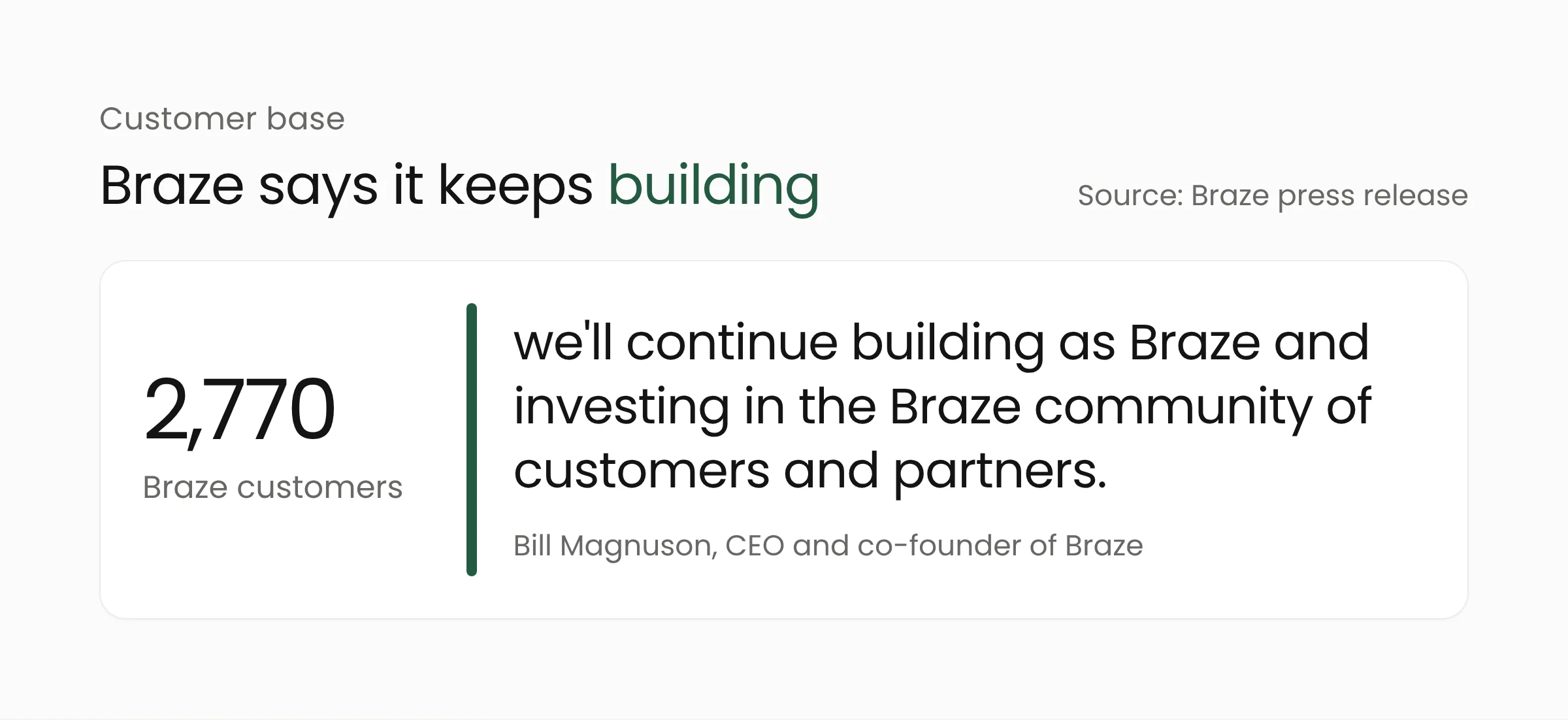
Braze CEO and co-founder Bill Magnuson said: “we’ll continue building as Braze and investing in the Braze community of customers and partners.” The press release does not say whether the brand and product names will survive after closing. Braze will be brought into Salesforce Marketing Cloud, led by Magnuson and co-founder Jon Hyman.
Why Salesforce wants Braze, and how the industry reads it
Salesforce says Braze’s real-time engagement engine and AI-driven decisioning will complement Agentforce, its AI agent platform. Braze is also expected to strengthen cross-channel personalization in Marketing Cloud. Patrick Stokes, Salesforce’s president of applications and marketing, described Braze as a platform that turns live customer behavior into personal messages.
CMSWire quotes three marketing technology executives rather than independent analysts. Holly Enneking of Markup AI said Salesforce is buying one of the strongest challengers to its own business, and that the outcome depends on whether it can preserve the focus that made Braze competitive. Jeremy Swift, CEO of Cordial, argued that activating messages works only as well as the data behind it. In his view, when data and decisioning are split across systems, AI agents work from a partial picture.
MarTech offers another angle. It warns that if Braze stays largely a separate product, the deal could widen Salesforce’s portfolio without simplifying the stack customers must manage. The open question is which system will own journey orchestration, messaging and the customer profile.
Governance of automated messaging is another concern. According to CMSWire, the products Braze launched at Forge 2026, namely Decisioning Studio Go, Agentic Standards, Operator Connect and Conversational Agents, are all still in beta. Braze expects Decisioning Studio Go and Agentic Standards to reach general availability in October. These self-service tools hand responsibility for frequency caps, permissions and sending rules to marketing teams. CMSWire notes that the governance question now extends to how Salesforce will manage Braze’s agents alongside its own. Any organization that lets AI agents message customers should set frequency limits and pre-send approval flows in writing.
What has not been announced
Salesforce has not published a combined roadmap. Changes to pricing, packaging and product names have not been announced either. CMSWire notes that Braze pulls signals from customers’ cloud data warehouses, so its approach matters most to brands that keep customer data outside Salesforce. It is unclear whether that approach will survive integration. Plans to connect Braze with Data 360, Customer 360 and Agentforce have also come without detail.
What this means for businesses that use apps and WhatsApp
The deal has not closed, so no step is mandatory yet. Still, any business that messages customers across several channels, such as an online store, a bank, a clinic or a school, can use the interval to tidy its foundations. The advice below is general and does not come from either company’s announcement.
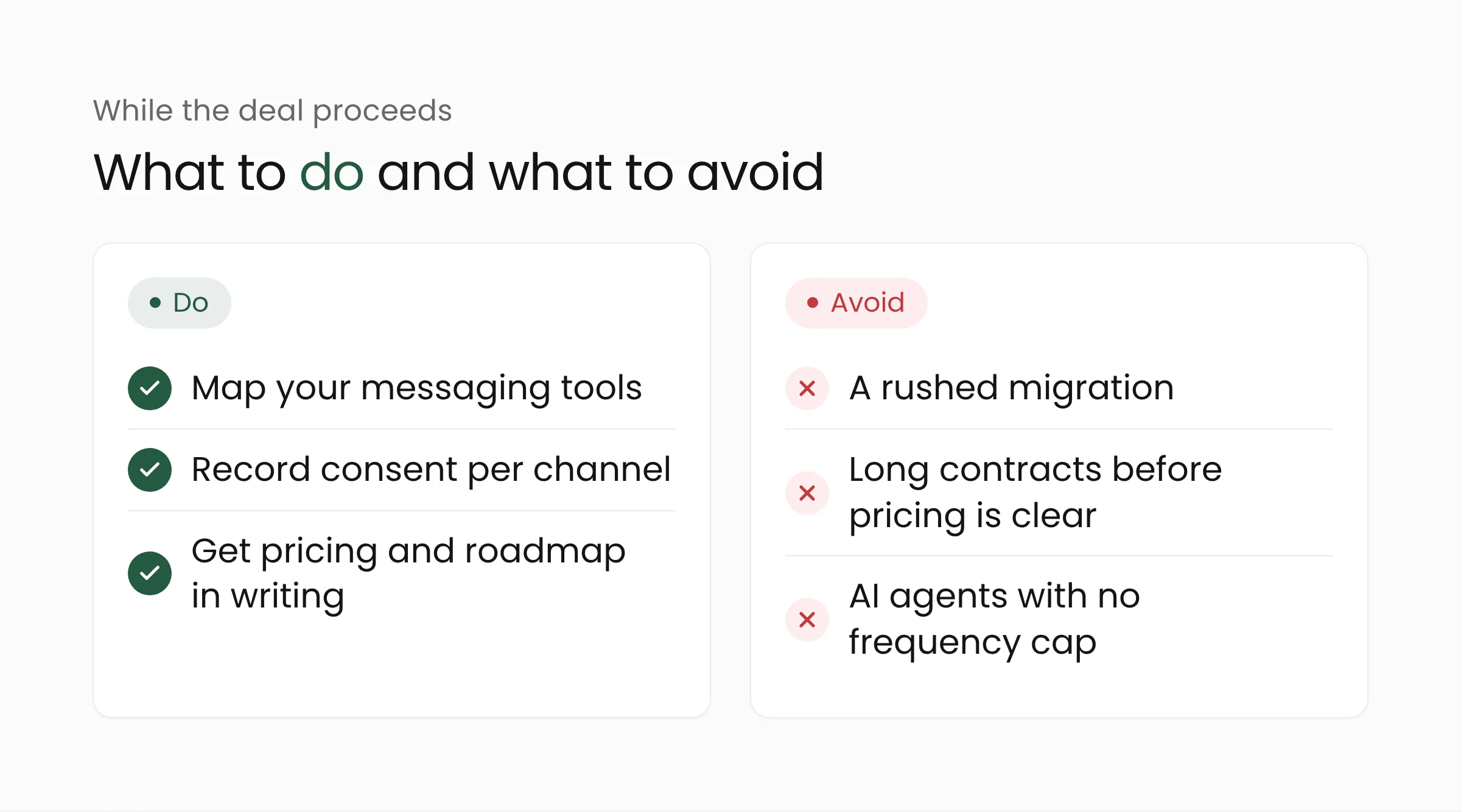
First, map the messaging tools already in use: who sends what, through which channel, and triggered by which event. The map shows overlaps before vendors publish a new roadmap. Second, check where customer data is stored and who holds the customer profile. Organizations that keep data in their own warehouse have a stronger bargaining position when a vendor changes.
Third, record user consent per channel. WhatsApp, SMS and push messages rely on personal data, so they must comply with Indonesia’s Undang-Undang Nomor 27 Tahun 2022 tentang Pelindungan Data Pribadi (Law No. 27 of 2022 on Personal Data Protection). A clinic’s appointment reminder, for instance, touches health data that calls for extra care.
Fourth, avoid a rushed migration. While pricing, packaging and integration timing remain unclear, a short contract extension leaves room to adjust. Fifth, ask the vendor to put its support plans and pricing in writing, especially if your contract is close to renewal.
For product teams, the lesson lies in how app events are recorded. A tidy event design, covering sign-ups, abandoned carts or completed payments, keeps data easy to move between platforms. The topic ties into data analytics and mobile app development. For shops and retail chains, see also retail management solutions, and our look at WhatsApp guest calling for customer service teams.
Frequently asked questions
How much is Salesforce paying for Braze?
Salesforce is paying $47.50 in cash per Braze Class A share. Enterprise value is about $5.66 billion. According to the MarketBeat report, the money comes from Salesforce’s cash.
When will the Braze acquisition close?
Closing is targeted for Salesforce’s fiscal year 2028, which starts in February 2027. Timing depends on approval from Braze shareholders and regulators. An exact date has not been announced.
Do Braze customers have to move to Marketing Cloud?
No such announcement has been made. Magnuson said Braze will keep building as Braze, and Salesforce has not announced changes to product names, packaging or pricing.
Conclusion
The Braze acquisition shows how much well-timed messages matter to customer relationships, and how much those messages depend on the quality of data. While the deal moves forward, businesses can prepare by mapping their tools, documenting user consent and recording events cleanly. If you want to design a customer data flow, or an app that can move between platforms, the Merakit team can help through its data analytics and app development services.
Sources
- Salesforce Signs Definitive Agreement to Acquire Braze, Braze, 20 October 2026
- Salesforce Form 8-K, Exhibit 99.1, SEC, 20 October 2026
- Why Is Salesforce Buying Braze and What Happens to Marketing Cloud?, CMSWire, 20 October 2026
- Will Salesforce’s Braze Deal Bring Clarity or Chaos?, MarTech, 20 October 2026
- Salesforce to Buy Braze for $5.66B, Expanding Real-Time AI Marketing, MarketBeat via Yahoo Finance, 20 October 2026